$60B trading giant BlockFills hits ‘pause’ as ‘extreme fear’ takes over market

ambcryptoPublicado em 2026-02-12Última atualização em 2026-02-12

Resumo

BlockFills, a major Chicago-based crypto trading firm that handled over $60 billion in trades last year, has paused all client deposits and withdrawals due to extreme market instability. The decision follows Bitcoin’s sharp decline of nearly 25% to around $60,000, though trading on the platform remains active. The move has heightened investor anxiety, evoking memories of the 2022 crypto collapses. Despite Bitcoin’s slight recovery to $67,490, institutional clients face significant risk. Analysts note parallels to past market crashes but suggest Bitcoin may be oversold and poised for a rebound if key support levels hold. The situation underscores ongoing regulatory uncertainty and fragile market sentiment.

In high-risk crypto trading, BlockFills is a major Chicago-based firm that handled over $60 billion in trades last year. After a difficult week in the market, when Bitcoin [BTC] dropped by nearly 25% to around $60,000, the company decided to take urgent action.

The company has paused all client deposits and withdrawals, saying this is needed because of unstable market and financial conditions.

Even though clients can still trade on the platform, they cannot move money in or out right now. This has made many investors nervous, especially since the industry still remembers the major failures of 2022.

In 2025, the company was doing extremely well. It handled $61.1 billion in trades and worked with more than 2,000 institutional clients around the world.

However, things changed after the “October Crash” of 2025, when Bitcoin fell sharply from its record high of $124,500. Even though Bitcoin has now recovered slightly to about $67,490, the damage to big investors and lenders remains serious.

Community reactions

Needless to say, the crypto community reacted strongly to this incident, as noted by Walter Bloomberg.

“The move echoes past crypto downturns, including the 2022 collapse of FTX and other lenders. Bitcoin’s recent drop below $65,000—down ~45% from October highs—has intensified pressures, while stalled U.S. crypto legislation continues to weigh on the market.”

Usually, small retail traders suffer the most when crypto exchanges go down. On the contrary, the BlockFills situation is different.

This time, it is not about regular users panicking. Instead, it may be a serious problem for large institutions with big money at stake, according to Milk Road’s analysis.

How is this incident acting in favor of Bitcoin?

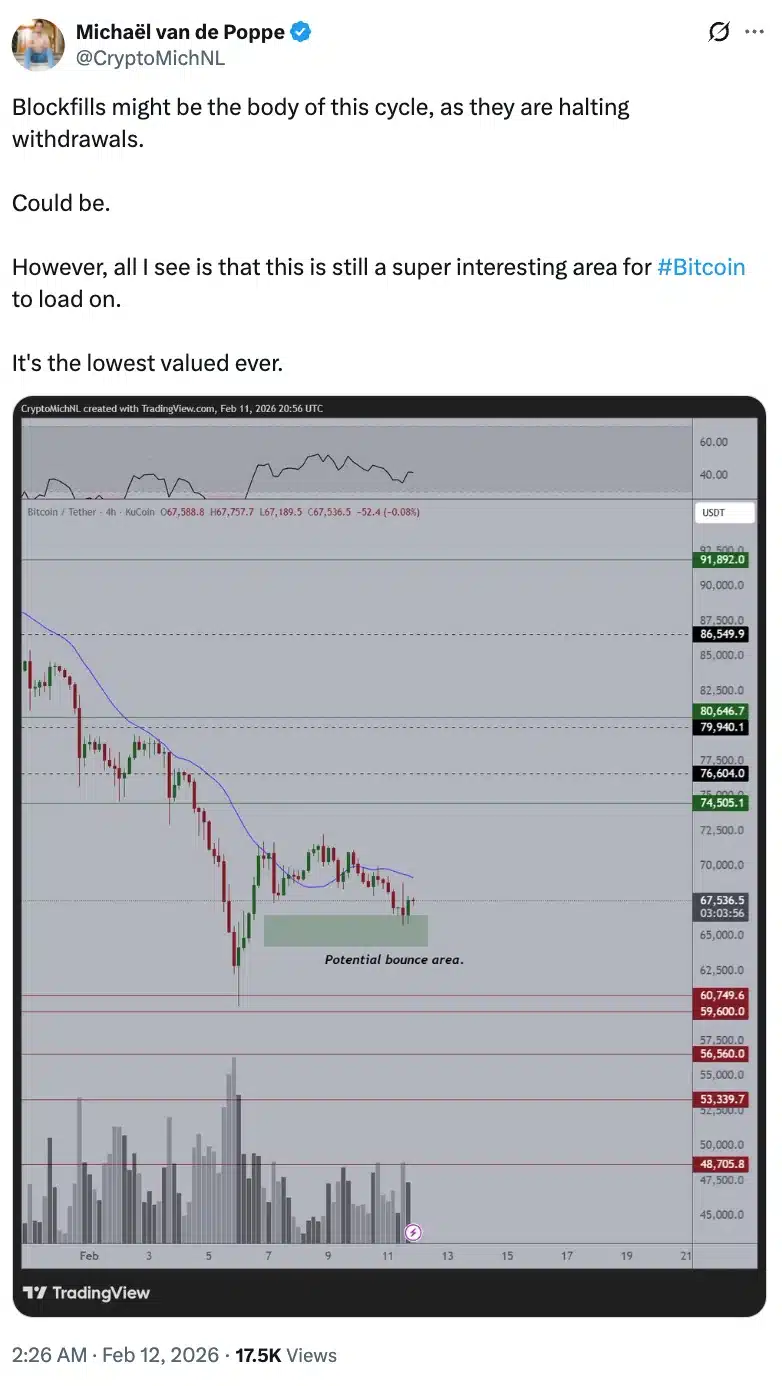
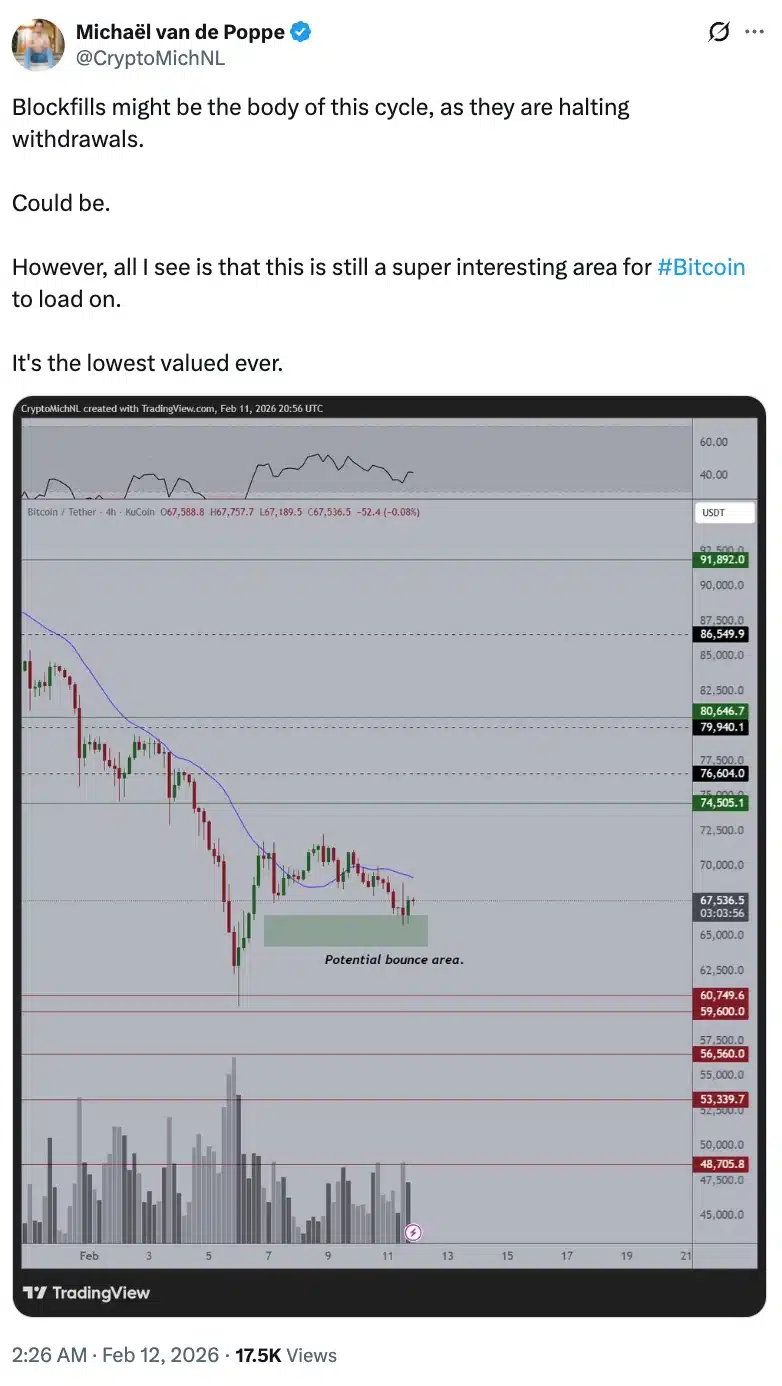
At the same time, there is some positive news due to this incident. Well-known analyst Michaël van de Poppe believes Bitcoin may be close to a strong turning point.

Even though Bitcoin is still around $67,490, he believes that market fear is extremely high right now. Recently, fear levels dropped to just 7 – A sign that many investors are worried.

Van de Poppe compared the current situation to the 2020 COVID crash, when prices fell sharply before recovering. He believes Bitcoin is now oversold and may be ready to bounce back.

If key support levels hold, BTC’s price could still move towards $100,000 in the coming months.

Source: Michaël van de Poppe/X
Former chairman of the National Vocational and Technical Training Commission, Javed Hassan, also weighed in. He noted,

“Thanks to Trump and his bandito family, this latest scam has full institutional respectability. Wall Street has adopted it. Yup, the same bunch of sharks who packaged subprime sh*t under exotic wrappers like: Mortgage-Backed Securities (MBS) , CDO, CDS, etc. Once again there’s the anything goes regulatory shrug.”

Past triggers

The pause in activity at BlockFills brings back memories of Celsius Network and Voyager Digital – Both of which collapsed after freezing user funds.

Binance [BNB] also experienced a similar situation in 2025, when it temporarily restricted withdrawals during market turmoil.

This coincided with recent data from Santiment as retail traders are full of doubt and fear right now. In fact, negative posts on social media are at a four-year high too.

Thus, for now, it is still unclear whether BlockFills is facing a small, temporary cash problem or something more serious. In the coming days, how open the company is with its 2,000+ institutional clients will matter the most.


Final Thoughts

  • Pausing withdrawals may protect the company in the short term, but it has clearly shaken investor confidence.
  • Memories of past failures like Celsius Network and Voyager Digital are making investors extra cautious.


Perguntas relacionadas

QWhy did BlockFills pause all deposits and withdrawals?

ABlockFills paused all client deposits and withdrawals due to unstable market and financial conditions following a sharp drop in Bitcoin's price.

QHow much trading volume did BlockFills handle in 2025, and how many clients did it serve?

AIn 2025, BlockFills handled $61.1 billion in trades and worked with over 2,000 institutional clients worldwide.

QAccording to analyst Michaël van de Poppe, what does the current market fear level indicate for Bitcoin's price?

AMichaël van de Poppe believes the extreme fear, with levels dropping to just 7, indicates that Bitcoin is oversold and may be close to a strong turning point, potentially bouncing back towards $100,000 if key support levels hold.

QHow does the BlockFills situation differ from typical crypto exchange failures in terms of affected users?

AUnlike typical crypto exchange failures that most severely impact small retail traders, the BlockFills situation is primarily a problem for large institutions with significant money at stake.

QWhich past crypto company failures does the article mention as similar to the current BlockFills incident?

AThe article mentions that the pause in activity at BlockFills brings back memories of the collapses of Celsius Network and Voyager Digital, which also froze user funds before failing.

Leituras Relacionadas

Has Hook Summer Really Arrived? sato, Lo0p, FLOOD Ignite the New Narrative of Uniswap v4

"Hook Summer" Arrives? Sato, Lo0p, FLOOD Ignite Uniswap v4 Narrative Amidst a slight market recovery, attention within the Ethereum ecosystem has shifted to Meme coins built on Uniswap v4's Hook protocol. Following ASTEROID, tokens like sato, sat1, Lo0p, and FLOOD have become market focal points, with market caps ranging from millions to tens of millions, bringing concentrated liquidity to a narrative-dry market. Uniswap v4 Hooks are "plugin smart contracts" that allow developers to inject custom logic at key points in a liquidity pool's lifecycle (initialization, adding/removing liquidity, swaps, etc.), making the AMM programmable. Recent representative projects include: * **sato**: Market cap peaked over $38M; uses a v4 curve mechanism for minting/burning, locking ETH as reserve. * **sat1**: Market cap briefly exceeded $10M, positioning as an "optimized sato," but later declined significantly. * **Lo0p**: Market cap neared $6.6M; a "lending AMM protocol" allowing users to borrow ETH against deposited LO0P tokens without immediate selling pressure. * **FLOOD**: Market cap approached $6M; channels trading reserves into Aave v3 to generate yield, which is retained in the pool. The emergence of these Hook-based tokens could drive long-term growth for the Uniswap ecosystem by attracting users and liquidity to v4 pools. Combined with Uniswap's activated fee switch (partially used to burn UNI), the long-term outlook for UNI appears positive. However, short-term UNI price appreciation is not directly guaranteed. Factors include the sustainability and lifecycle of these new tokens, their price volatility, overall market conditions, and regulatory pressures. Currently, Uniswap v4's TVL ($595M) lags behind v3 and v2, indicating Hook adoption still requires time to mature. In summary, the Hook ecosystem serves as "long-term nourishment" for UNI, but acts more as a "catalyst" than a direct "booster" in the short term. Note: These are early-stage experimental tokens and may carry unknown risks.

marsbitHá 25m

Has Hook Summer Really Arrived? sato, Lo0p, FLOOD Ignite the New Narrative of Uniswap v4

marsbitHá 25m

Has Hook Summer Truly Arrived? sato, Lo0p, FLOOD Ignite the New Uniswap v4 Narrative

With the broader market showing signs of recovery, a new wave of interest has emerged around Ethereum-based meme coins. Following ASTEROID, tokens like sato, sat1, Lo0p, and FLOOD, built upon the Uniswap v4 Hook protocol, are capturing market attention. Their market capitalizations range from millions to tens of millions of dollars, injecting much-needed focused liquidity into a market lacking narratives. This article explores whether this trend signifies an incoming "Hook Summer" and its potential impact on UNI's price. Hooks are essentially plug-in smart contracts for Uniswap v4 liquidity pools, allowing developers to inject custom logic at key points in a pool's lifecycle (like initialization, adding/removing liquidity, swaps). This transforms the AMM into programmable building blocks. Key highlighted projects include: * **sato**: Peaked over $38M market cap. It utilizes a v4 curve for minting/burning; buying locks ETH as reserve to mint new tokens, while selling redeems ETH from the reserve and burns tokens. * **sat1**: Market cap briefly exceeded $10M, promoted as an "optimized sato," but later declined significantly. * **Lo0p**: Reached nearly $6.6M. It's a lending AMM protocol where buying LO0P tokens locks them as collateral, allowing users to borrow ETH from the pool reserve at 40% LTV, aiming to improve capital efficiency for idle ETH in LPs. * **FLOOD**: Peaked near $6M. Its mechanism directs asset reserves from buys into Aave v3 to generate yield, with fees and interest retained in the pool to potentially influence the token's price long-term. In the long term, the development of the Hook ecosystem can attract users and liquidity to Uniswap v4, benefiting UNI's fundamentals—especially combined with the recent activation of the protocol fee switch, where a portion of fees is used to burn UNI. However, in the short term, these Hook-based tokens are unlikely to directly drive significant UNI price appreciation. Their impact is moderated by factors like token sustainability, price volatility, and broader market and regulatory conditions. Currently, Uniswap v4's TVL ($595M) still trails behind v2 and v3, indicating adoption and growth will take time. The article concludes that while the Hook ecosystem provides long-term "nourishment" for UNI, its short-term role is more of a "catalyst" than a "booster." Readers are cautioned that these are early-stage experimental tokens and may carry unknown risks.

Odaily星球日报Há 37m

Has Hook Summer Truly Arrived? sato, Lo0p, FLOOD Ignite the New Uniswap v4 Narrative

Odaily星球日报Há 37m

Interview with Michael Saylor: I Did Say I Would Sell Bitcoin, But Never a Net Sale

Interview with Michael Saylor: I Said We'd Sell Bitcoin, But Never Be a Net Seller In a recent podcast, MicroStrategy Executive Chairman Michael Saylor clarified the company's stance on potentially selling Bitcoin. Following MicroStrategy's earnings call statement about being prepared to sell BTC to fund dividends for its STRC (Strategic) credit product, Saylor emphasized the distinction between selling and being a "net seller." Saylor explained the core business model: MicroStrategy sells credit instruments like STRC and uses the proceeds to buy Bitcoin, which is viewed as "digital capital" expected to appreciate around 30-40% annually. A portion of these capital gains can then be used to pay the dividends on the credit products. He stressed that even if the company sells some Bitcoin for dividends, it simultaneously buys much more with new credit issuance. For example, after raising $3.2 billion from STRC sales in April, the dividend obligation was only $80-90 million, making the company a net buyer. The clarification aims to counter market narratives questioning the value of Bitcoin on MicroStrategy's balance sheet if it were never sold, and to dismiss claims of a "Ponzi scheme." Saylor reiterated his personal philosophy for investors: "Don't be a net seller of bitcoin" and ensure your Bitcoin holdings increase each year. Saylor also discussed Bitcoin's role as the foundation for "digital credit," noting that STRC has become the largest and most liquid preferred stock issue in the U.S., offering high risk-adjusted returns (Sharpe ratio). He highlighted Bitcoin's deep liquidity, stating that even large purchases by MicroStrategy do not move the market significantly, which is driven by macro factors, geopolitical tensions, and capital flows from ETFs and credit products. Finally, Saylor reflected on his early inspiration from sci-fi books, which motivated his path to MIT, and maintained his fundamental thesis on Bitcoin remains unchanged: it is superior digital capital enabling superior digital credit.

链捕手Há 41m

Interview with Michael Saylor: I Did Say I Would Sell Bitcoin, But Never a Net Sale

链捕手Há 41m

Trading

Spot
Futuros
活动图片