$55,000 Will Be Bitcoin's Make-or-Break Line

marsbitPublicado em 2026-02-10Última atualização em 2026-02-10

Resumo

Bitcoin is currently testing a critical threshold at $55,000, which may determine the structural integrity of its four-year market cycle. Historical data shows diminishing peak-to-peak growth multiples: 15.9× (2013–2017), 3.5× (2017–2021), and a projected 1.8× for the current cycle (2021–2025). This compressed upside—coupled with a recent drawdown exceeding 44% from the anticipated peak of ~$126,000 to ~$60,000—threatens the sustainability of Bitcoin’s long-term growth model. A drop below $55,000 would imply a 56% retracement and break key technical supports, including the 3000-day trendline and the previous cycle’s all-time high of $69,000. Such a breach could signal the failure of the classic cycle model, where high volatility no longer justifies reduced returns. The market now faces three potential paths: glory (reduced volatility, stabilized growth), destruction (cycle model breakdown), or reset (new demand drivers like sovereign adoption or structural capital inflows). The outcome hinges on whether Bitcoin can hold above $55,000. If it fails, the historical cycle framework may be irreparably broken.

Original Author: Dom

Original Compilation: Luffy, Foresight News

Bitcoin's price touched $60,000 last week. Under the model of diminishing returns, this is by no means simple noise. The market is touching the most fragile link in the entire four-year cycle and the logarithmic growth framework.

When the gains at the peak of Bitcoin's cycle have been severely compressed, if there is another historically deep correction, the appeal of its classic cycle will be completely lost.

This is not a prediction; it is mathematical law.

Cycle Peak Gains Are Compressing

Historical peaks of Bitcoin cycles:

  • 2013: ~$1,242
  • 2017: ~$19,700
  • 2021: ~$69,000
  • 2025: ~$126,000

Multiples of gains between cycle peaks:

  • 1,242 → 19,700 = 15.9x
  • 19,700 → 69,000 = 3.5x
  • 69,000 → 126,000 = 1.8x (weakest in history)
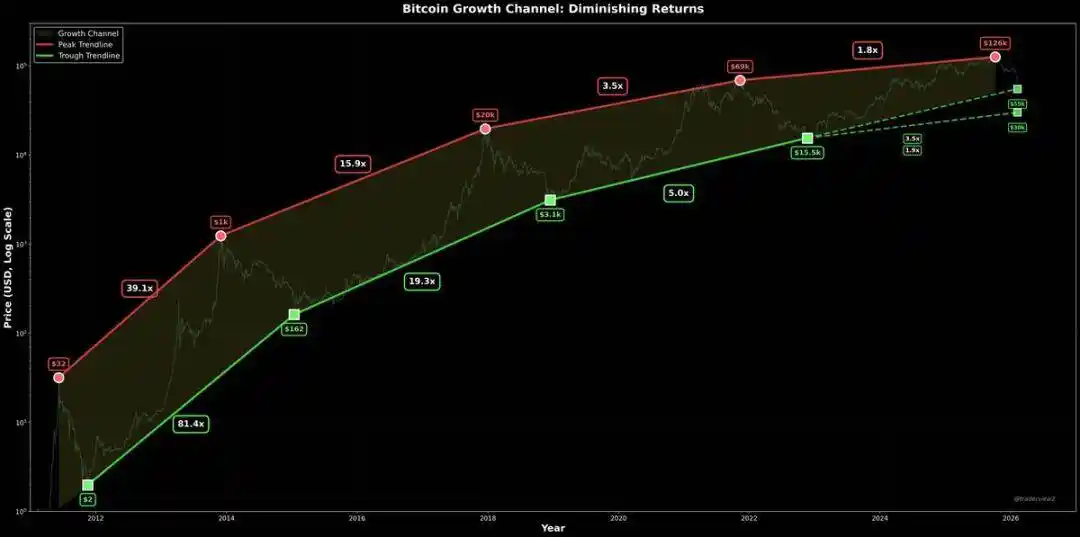
This 1.8x says it all. Compared to history, the upside potential in this cycle is minimal. This pattern cannot withstand a significant drop; otherwise, Bitcoin's growth will completely flatten.

This 1.8x gain is the core truth of the current market. Relative to historical levels, Bitcoin's upside space is now extremely narrow. This cycle pattern can no longer withstand a major pullback; otherwise, Bitcoin's long-term growth momentum will completely stall.

Pure Mathematical Constraint Formula

Definitions:

  • m = Cycle peak multiple = Current cycle peak ÷ Previous all-time high
  • d = Drawdown from peak (as a decimal)

Then, the bottom level of the next cycle relative to the previous high equals the current peak gain multiple multiplied by the remaining price proportion after the drawdown.

To ensure the bottom of the next cycle is not lower than the previous all-time high, the following condition must be met:
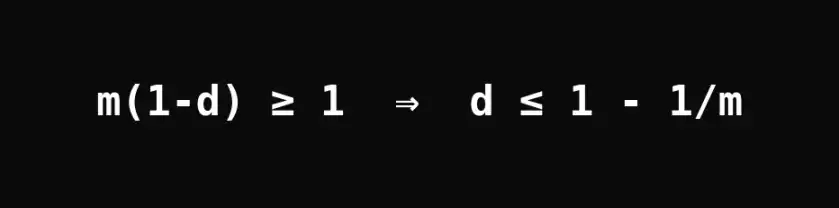
Substituting current cycle data: Previous ATH ≈ $69,000, Current cycle peak ≈ $126,000, we get:

Current peak multiple ≈ 1.8x. To maintain an intact bull market structure, the maximum allowed drawdown is approximately 44%. Currently, Bitcoin's drawdown has broken through this critical value.

Falling from about $126,000 to $60,000, Bitcoin's drawdown has exceeded the 44% "safety limit."
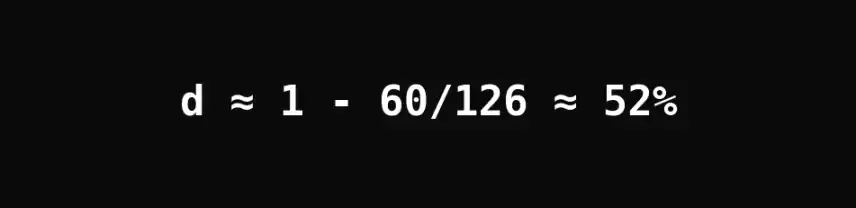
This means that if the previous all-time high was supposed to act as structural support, the current market is forcibly breaking through this support, forcing the market to a final conclusion.

$55,000 is the Key Make-or-Break Line

If Bitcoin falls to $55,000, two key signals will appear:

  • A drawdown of 56%, far exceeding the 44% allowed upper limit
  • The bottom price will be 20% lower than the previous all-time high ($69,000)

Once the price stays below $55,000, it means the market accepts that in this weak cycle with only a 1.8x gain, the cycle bottom can be significantly lower than the previous all-time high.

The subsequent impact will be: If the next cycle still maintains a 1.8x gain multiple, Bitcoin's price will rise from $55,000 to $99,000, and long-term growth momentum will stagnate. This is essentially a structural failure of the growth model; the market must change.

This is the core contradiction: Bitcoin's profit space has been severely compressed, but its volatility has not decreased proportionally. It's still a highly volatile market, but the peak gains have shrunk drastically. Such a cycle model is simply unsustainable.

Technical Support Near $55,000
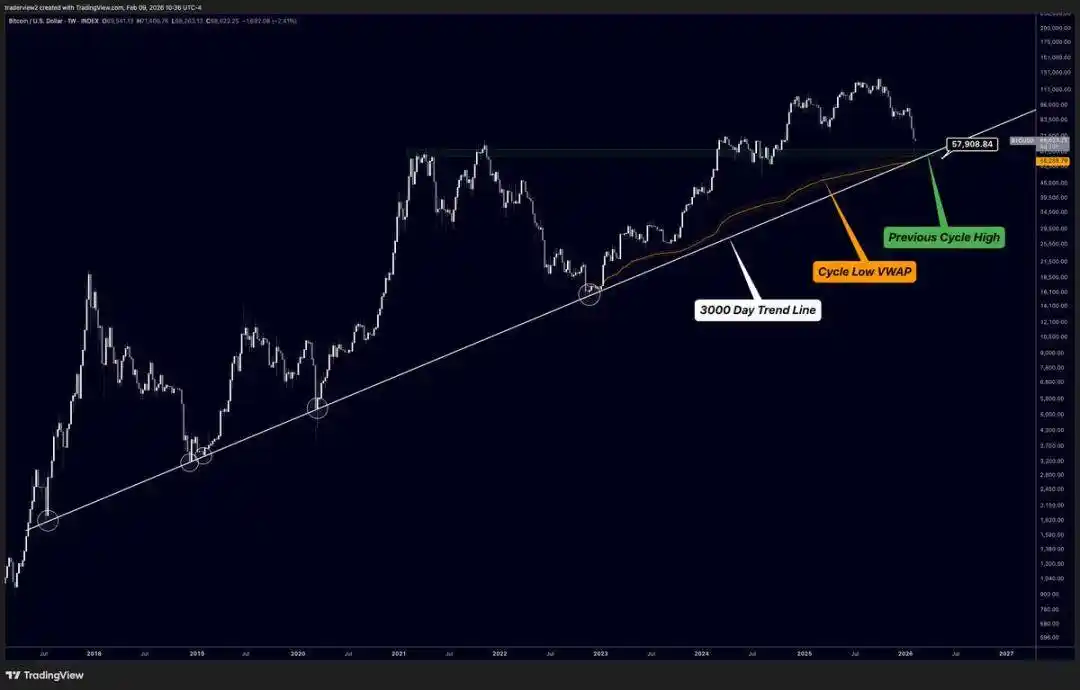
From a technical perspective, the mid-$55,000 range has extremely strong structural support, mainly including:

  • The 3000-day trendline (spanning over 8 years)
  • The Volume-Weighted Average Price (VWAP) of the 2022 cycle low
  • Support extension from the previous cycle's all-time high ($69,000)

Let's ponder: Why would an asset whose core belief is "long-term ultra-high returns" break below this triple structural support built up over years? Especially with the formal launch of convenient investment channels like ETFs, such a trend is completely contrary to the long-term growth trajectory.

The Cliff of Risk-Adjusted Returns

This contradiction makes Bitcoin's entire cycle logic black and white: If the cycle peak multiple continues to shrink, but the drawdown magnitude does not shrink proportionally, Bitcoin's risk-reward ratio will completely deteriorate:

  • The potential upside of the four-year cycle is only 20% to 50%
  • The downside risk could still reach 50%
  • Cycle trading would completely lose its meaning.
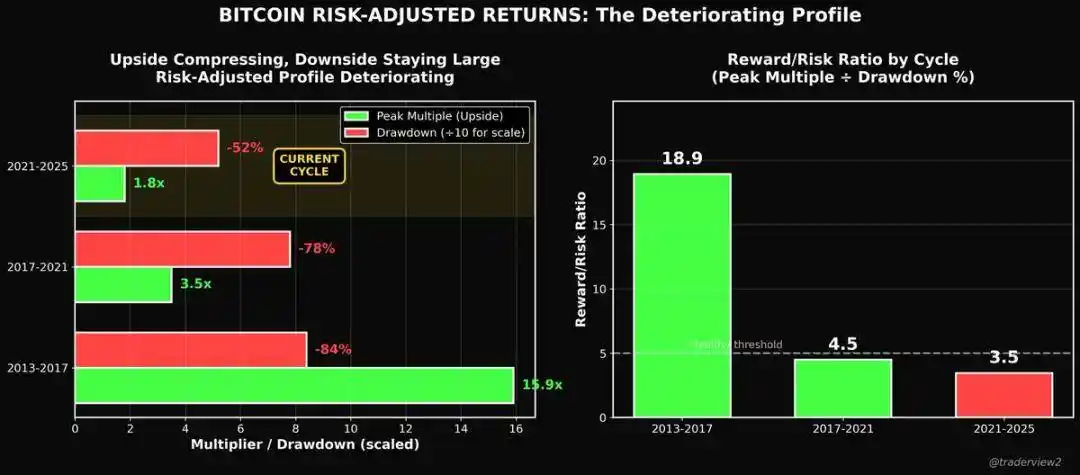
Faced with this dilemma, the market has only three ways out:

  • Volatility contracts significantly (Path to Glory)
  • The four-year cycle framework completely fails (Path to Ruin)
  • A new demand driver emerges, resetting the growth curve and ending the trend of decaying gain multiples

ETFs are the most commonly mentioned potential driver, but they have already been launched. To truly reset the growth curve, three types of power are needed more: large-scale structural capital allocation, adoption at the sovereign national level, or sustained, price-insensitive rigid demand.

The Harsh Reality: Why This Cycle is So Different

When I entered the crypto market in 2017, the entire industry was full of hope and innovative vitality. People firmly believed these blockchain networks could bring real solutions to the world.

Nearly nine years later, it's hard to say that any large crypto ecosystem has truly achieved sustainable mainstream utility value matching the initial promises.

This cycle has harvested countless participants; the vast majority of tokens have performed almost nothing. More and more people are realizing the truth of the market: For the vast majority of crypto assets, this is essentially a PvP game where participants rely on leverage, liquidations, and capital rotation to profit from other participants, not from the value growth of the assets themselves.

The market's selection rule has never failed: In the long run, the vast majority of cryptocurrencies will eventually go to zero. Bitcoin, along with a few quality assets in the crypto space, still has a chance to escape this fate and achieve true value breakthrough.

The Choice Between Glory and Ruin

Path to Glory

Bitcoin achieves "breaking the circle and upgrading": Volatility contracts significantly, drawdowns are far below historical levels, and the previous all-time high region re-establishes itself as solid structural support. Although the cycle peak multiple shrinks, the asset's stability improves significantly, the risk-reward ratio optimizes greatly, and it truly becomes a sustainable long-term investment.

Path to Ruin

The four-year cycle framework completely fails. It's not that Bitcoin itself perishes, but the cycle logic that has sustained it for years no longer holds. Volatility remains at historical highs, but the profit space continues to compress. The previous all-time high no longer acts as a bottom support. The past growth channel becomes a historical relic. Bitcoin may still experience阶段性上涨 (periodic rises) in the future, and may continue to gain adoption, but the former cycle规律 (laws) will no longer be the dominant rules of the market.

Path to Reset

A全新的 (brand new) demand driver强势出现 (forcefully emerges), completely breaking the model of decaying gain multiples and reshaping Bitcoin's growth curve. This could come from large-scale structural capital allocation, widespread adoption by sovereign nations, or passive buying by institutional funds forming long-term support.

Additional Hidden Danger: The Long-Term Test at the Protocol Layer

This is not a core factor affecting the current market, but it is worth long-term attention: In the long run, Bitcoin must prove that it can evolve at the protocol layer, especially possessing quantum resistance. The core of the quantum issue concerns the security of Bitcoin ownership and protocol upgrade coordination, not mining itself. The security of early Bitcoin (like Satoshi's holdings) is the real potential threat.

If Bitcoin hopes to become a long-lasting asset, it must ultimately pass the test of "completing protocol upgrades without破坏市场信任 (destroying market trust)". This is like a background timer, not yet triggered, but始终是 (always is) an important hidden danger for Bitcoin's long-term development.

Simple Judgment Criteria

If, after the washout, Bitcoin reclaims and holds firmly above $69,000: The cycle structure is preserved, and the path to glory remains highly possible.

If Bitcoin's price remains in the $55,000 to $69,000 range: The market is under maximum pressure, and the cycle model faces its final test.

If Bitcoin's price stays consistently below $55,000: Against the backdrop of a weak cycle with a 1.8x peak multiple, a structural breakdown occurs, and the market structure is highly likely to undergo a fundamental change.

Conclusion

Bitcoin cannot long-term possess two traits simultaneously: low-gain asset, high-drawdown asset. If risk-adjusted returns still have meaning, the two cannot coexist long-term.

Bitcoin's touch near $60,000 is the market testing this life-and-death boundary in real time. Once the price falls below the $50,000 range, all debates will end, and the market will deliver its final verdict, either走向荣耀 (heading towards glory) or坠入毁灭 (plunging into ruin).


Perguntas relacionadas

QWhat is the critical price level for Bitcoin according to the article, and why is it considered a 'life or death' line?

AThe critical price level is $55,000. It is considered a 'life or death' line because if Bitcoin falls and sustains below this level, it would signify a structural breakdown of its long-term logarithmic growth model. A drop to $55,000 represents a 56% drawdown from the projected cycle peak of ~$126,000, far exceeding the mathematically 'safe' maximum drawdown of 44% required to keep the bull market structure intact. This would mean the cycle low has fallen below the previous all-time high (~$69,000), potentially leading to a complete failure of the classic four-year cycle framework and a stagnation of Bitcoin's long-term growth trajectory.

QWhat are the three potential paths (outcomes) for Bitcoin's future that the article outlines?

AThe article outlines three potential paths for Bitcoin's future: 1. The Path to Glory: Bitcoin 'breaks through' with significantly reduced volatility and drawdowns. The previous all-time high becomes solid structural support, and it transforms into a sustainable long-term investment despite smaller cycle peaks. 2. The Path to Ruin: The four-year cycle framework completely fails. Volatility remains high while potential gains shrink further. The previous growth channel becomes a historical relic, and the old cyclical规律 are no longer the market's dominant rules. 3. The Path to Reset: A new, powerful demand driver emerges (e.g., massive structural capital allocation, sovereign adoption) that resets the growth curve and breaks the trend of diminishing peak multiples.

QAccording to the mathematical constraint formula, what is the maximum allowed drawdown from the projected cycle peak to maintain the bull market structure, and what is the current situation?

AAccording to the mathematical constraint formula, the maximum allowed drawdown from the projected cycle peak (~$126,000) to maintain the bull market structure (i.e., ensuring the next cycle's bottom doesn't fall below the previous all-time high of ~$69,000) is approximately 44%. The current situation is that Bitcoin's drawdown has already breached this critical 'safety limit,' having fallen from ~$126,000 to around $60,000, which is a drawdown of over 44%.

QWhat does the compression of cycle peak multiples (from 15.9x to 3.5x to 1.8x) indicate about Bitcoin's market?

AThe compression of cycle peak multiples from 15.9x (2013-2017) to 3.5x (2017-2021) to a projected 1.8x (2021-2025) indicates that Bitcoin's potential upside gains in each four-year cycle are diminishing dramatically. This 'weakest ever' 1.8x multiple suggests that the market's upward space is extremely narrow compared to its historical performance. This compressed growth model cannot withstand significant price retracements without risking the complete flattening of Bitcoin's long-term growth trend and the potential failure of its classic cyclical model.

QWhat underlying contradiction does the article highlight regarding Bitcoin's current market profile?

AThe article highlights a core contradiction: Bitcoin's potential reward space (upside gains per cycle) has been severely compressed, but its volatility (the magnitude of price swings and drawdowns) has not decreased proportionally. It remains a highly volatile asset while offering dramatically reduced peak gains. This combination of high risk (large potential losses) and low reward (small potential gains) creates an unsustainable and severely worsened risk-adjusted return profile, which fundamentally threatens the logic and appeal of trading based on its four-year cycles.

Leituras Relacionadas

On the Eve of X Money's Launch, Musk Dismantles the Referee First

"X Money Launches After Dismantling Regulator: Musk's 9-Day Power Play" In February 2025, a team from the "Department of Government Efficiency" (DOGE), led by Elon Musk, entered the Consumer Financial Protection Bureau (CFPB) headquarters. Shortly after, the CFPB was effectively dismantled—its funding frozen, activities suspended, and nearly 90% of staff laid off. This move came just nine days after X announced a partnership with Visa and as X Money prepared to launch. The article contrasts this with the decade-long regulatory battles faced by companies like Coinbase and PayPal. Coinbase spent over $75 million in political contributions and endured a major SEC lawsuit to operate legally. PayPal complied with strict state and federal rules for its stablecoin PYUSD, including 100% reserve requirements and monthly audits. However, Musk’s approach was different. After the CFPB introduced a rule placing large digital payment apps under federal oversight, Musk tweeted "Delete CFPB." Within months, the rule was revoked by Congress. Meanwhile, DOGE operatives gained "god-tier" access to CFPB databases, potentially obtaining sensitive competitive information from rivals like Apple, Google, and PayPal. The article also highlights a "suspicious exemption clause" in the GENIUS Act, which allows private companies like X to issue stablecoins with fewer restrictions. Senator Elizabeth Warren questioned whether Musk, who was a senior presidential advisor during the Act’s drafting, influenced this clause. X Money offers a 6% APY on deposits, despite FDIC warnings that stablecoin users are not insured. As X Money launches to 600 million monthly users, the article questions the fairness of a system where Musk can bypass regulations that others spent years and millions to comply with. The dismantling of the CFPB and the alleged regulatory advantages raise concerns about the future of equitable rule-making in the U.S. financial system.

marsbitHá 1m

On the Eve of X Money's Launch, Musk Dismantles the Referee First

marsbitHá 1m

Three Frameworks for Ordinary People to Achieve AI Capability Leap: Say Goodbye to the Dilemma of 'Repeating Inputs Every Day'

Summary: This article outlines three frameworks for maximizing AI efficiency, moving beyond basic prompt usage. 1. **Three-Layer Evolution**: Users progress from (1) **Prompt** (one-off instructions, reset each session), to (2) **Project** (context-aware within a specific project), to (3) **Skill** (permanent, auto-applied knowledge). Most users stagnate at the first layer, repeating the same instructions daily with no cumulative improvement. Skills transform the AI from a chat tool into a personalized work system. 2. **Transaction vs. Compound Interest Mindset**: Using prompts is a linear transaction—effort and output are 1:1, and stopping resets progress. Investing time in building Skills is compound interest; a small initial time investment pays continuous dividends, as each Skill permanently elevates the AI's baseline performance. 3. **Thin Harness, Fat Skills**: The system architecture should prioritize thick, well-defined Skills (90% of the value—containing processes, standards, and domain knowledge) and a thin "harness" (the minimal technical environment). Avoid over-engineering the toolchain while neglecting the AI's actual knowledge. Skills are permanent assets that automatically improve with model updates. The key takeaway: Identify tasks you repeat, encode them into Skills (using tools like Claude's Skill Creator), and shift focus from daily prompting to building a compounding, self-improving AI system.

marsbitHá 53m

Three Frameworks for Ordinary People to Achieve AI Capability Leap: Say Goodbye to the Dilemma of 'Repeating Inputs Every Day'

marsbitHá 53m

Trading

Spot
Futuros

Artigos em Destaque

O que é $S$

Compreender o SPERO: Uma Visão Abrangente Introdução ao SPERO À medida que o panorama da inovação continua a evoluir, o surgimento de tecnologias web3 e projetos de criptomoeda desempenha um papel fundamental na formação do futuro digital. Um projeto que tem atraído atenção neste campo dinâmico é o SPERO, denotado como SPERO,$$s$. Este artigo tem como objetivo reunir e apresentar informações detalhadas sobre o SPERO, para ajudar entusiastas e investidores a compreender as suas bases, objetivos e inovações nos domínios web3 e cripto. O que é o SPERO,$$s$? O SPERO,$$s$ é um projeto único dentro do espaço cripto que procura aproveitar os princípios da descentralização e da tecnologia blockchain para criar um ecossistema que promove o envolvimento, a utilidade e a inclusão financeira. O projeto é concebido para facilitar interações peer-to-peer de novas maneiras, proporcionando aos utilizadores soluções e serviços financeiros inovadores. No seu núcleo, o SPERO,$$s$ visa capacitar indivíduos ao fornecer ferramentas e plataformas que melhoram a experiência do utilizador no espaço das criptomoedas. Isso inclui a possibilidade de métodos de transação mais flexíveis, a promoção de iniciativas impulsionadas pela comunidade e a criação de caminhos para oportunidades financeiras através de aplicações descentralizadas (dApps). A visão subjacente do SPERO,$$s$ gira em torno da inclusão, visando fechar lacunas dentro das finanças tradicionais enquanto aproveita os benefícios da tecnologia blockchain. Quem é o Criador do SPERO,$$s$? A identidade do criador do SPERO,$$s$ permanece algo obscura, uma vez que existem recursos publicamente disponíveis limitados que fornecem informações detalhadas sobre o(s) seu(s) fundador(es). Esta falta de transparência pode resultar do compromisso do projeto com a descentralização—uma ética que muitos projetos web3 partilham, priorizando contribuições coletivas em vez de reconhecimento individual. Ao centrar as discussões em torno da comunidade e dos seus objetivos coletivos, o SPERO,$$s$ incorpora a essência do empoderamento sem destacar indivíduos específicos. Assim, compreender a ética e a missão do SPERO é mais importante do que identificar um criador singular. Quem são os Investidores do SPERO,$$s$? O SPERO,$$s$ é apoiado por uma diversidade de investidores que vão desde capitalistas de risco a investidores-anjo dedicados a promover a inovação no setor cripto. O foco desses investidores geralmente alinha-se com a missão do SPERO—priorizando projetos que prometem avanço tecnológico social, inclusão financeira e governança descentralizada. Essas fundações de investidores estão tipicamente interessadas em projetos que não apenas oferecem produtos inovadores, mas que também contribuem positivamente para a comunidade blockchain e os seus ecossistemas. O apoio desses investidores reforça o SPERO,$$s$ como um concorrente notável no domínio em rápida evolução dos projetos cripto. Como Funciona o SPERO,$$s$? O SPERO,$$s$ emprega uma estrutura multifacetada que o distingue de projetos de criptomoeda convencionais. Aqui estão algumas das características-chave que sublinham a sua singularidade e inovação: Governança Descentralizada: O SPERO,$$s$ integra modelos de governança descentralizada, capacitando os utilizadores a participar ativamente nos processos de tomada de decisão sobre o futuro do projeto. Esta abordagem promove um sentido de propriedade e responsabilidade entre os membros da comunidade. Utilidade do Token: O SPERO,$$s$ utiliza o seu próprio token de criptomoeda, concebido para servir várias funções dentro do ecossistema. Esses tokens permitem transações, recompensas e a facilitação de serviços oferecidos na plataforma, melhorando o envolvimento e a utilidade gerais. Arquitetura em Camadas: A arquitetura técnica do SPERO,$$s$ suporta modularidade e escalabilidade, permitindo a integração contínua de funcionalidades e aplicações adicionais à medida que o projeto evolui. Esta adaptabilidade é fundamental para manter a relevância no panorama cripto em constante mudança. Envolvimento da Comunidade: O projeto enfatiza iniciativas impulsionadas pela comunidade, empregando mecanismos que incentivam a colaboração e o feedback. Ao nutrir uma comunidade forte, o SPERO,$$s$ pode melhor atender às necessidades dos utilizadores e adaptar-se às tendências do mercado. Foco na Inclusão: Ao oferecer taxas de transação baixas e interfaces amigáveis, o SPERO,$$s$ visa atrair uma base de utilizadores diversificada, incluindo indivíduos que anteriormente podem não ter participado no espaço cripto. Este compromisso com a inclusão alinha-se com a sua missão abrangente de empoderamento através da acessibilidade. Cronologia do SPERO,$$s$ Compreender a história de um projeto fornece insights cruciais sobre a sua trajetória de desenvolvimento e marcos. Abaixo está uma cronologia sugerida que mapeia eventos significativos na evolução do SPERO,$$s$: Fase de Conceituação e Ideação: As ideias iniciais que formam a base do SPERO,$$s$ foram concebidas, alinhando-se de perto com os princípios de descentralização e foco na comunidade dentro da indústria blockchain. Lançamento do Whitepaper do Projeto: Após a fase conceitual, um whitepaper abrangente detalhando a visão, os objetivos e a infraestrutura tecnológica do SPERO,$$s$ foi lançado para atrair o interesse e o feedback da comunidade. Construção da Comunidade e Primeiros Envolvimentos: Esforços ativos de divulgação foram feitos para construir uma comunidade de primeiros adotantes e investidores potenciais, facilitando discussões em torno dos objetivos do projeto e angariando apoio. Evento de Geração de Tokens: O SPERO,$$s$ realizou um evento de geração de tokens (TGE) para distribuir os seus tokens nativos a apoiantes iniciais e estabelecer liquidez inicial dentro do ecossistema. Lançamento da dApp Inicial: A primeira aplicação descentralizada (dApp) associada ao SPERO,$$s$ foi lançada, permitindo que os utilizadores interagissem com as funcionalidades principais da plataforma. Desenvolvimento Contínuo e Parcerias: Atualizações e melhorias contínuas nas ofertas do projeto, incluindo parcerias estratégicas com outros players no espaço blockchain, moldaram o SPERO,$$s$ em um jogador competitivo e em evolução no mercado cripto. Conclusão O SPERO,$$s$ é um testemunho do potencial do web3 e das criptomoedas para revolucionar os sistemas financeiros e capacitar indivíduos. Com um compromisso com a governança descentralizada, o envolvimento da comunidade e funcionalidades inovadoras, abre caminho para um panorama financeiro mais inclusivo. Como em qualquer investimento no espaço cripto em rápida evolução, potenciais investidores e utilizadores são incentivados a pesquisar minuciosamente e a envolver-se de forma ponderada com os desenvolvimentos em curso dentro do SPERO,$$s$. O projeto demonstra o espírito inovador da indústria cripto, convidando a uma exploração mais aprofundada das suas inúmeras possibilidades. Embora a jornada do SPERO,$$s$ ainda esteja a desenrolar-se, os seus princípios fundamentais podem, de facto, influenciar o futuro de como interagimos com a tecnologia, as finanças e uns com os outros em ecossistemas digitais interconectados.

69 Visualizações TotaisPublicado em {updateTime}Atualizado em 2024.12.17

O que é $S$

O que é AGENT S

Agent S: O Futuro da Interação Autónoma no Web3 Introdução No panorama em constante evolução do Web3 e das criptomoedas, as inovações estão constantemente a redefinir a forma como os indivíduos interagem com plataformas digitais. Um projeto pioneiro, o Agent S, promete revolucionar a interação humano-computador através do seu framework aberto e agente. Ao abrir caminho para interações autónomas, o Agent S visa simplificar tarefas complexas, oferecendo aplicações transformadoras em inteligência artificial (IA). Esta exploração detalhada irá aprofundar-se nas complexidades do projeto, nas suas características únicas e nas implicações para o domínio das criptomoedas. O que é o Agent S? O Agent S é um framework aberto e agente, especificamente concebido para abordar três desafios fundamentais na automação de tarefas computacionais: Aquisição de Conhecimento Específico de Domínio: O framework aprende inteligentemente a partir de várias fontes de conhecimento externas e experiências internas. Esta abordagem dupla capacita-o a construir um rico repositório de conhecimento específico de domínio, melhorando o seu desempenho na execução de tarefas. Planeamento ao Longo de Longos Horizontes de Tarefas: O Agent S emprega planeamento hierárquico aumentado por experiência, uma abordagem estratégica que facilita a decomposição e execução eficientes de tarefas intrincadas. Esta característica melhora significativamente a sua capacidade de gerir múltiplas subtarefas de forma eficiente e eficaz. Gestão de Interfaces Dinâmicas e Não Uniformes: O projeto introduz a Interface Agente-Computador (ACI), uma solução inovadora que melhora a interação entre agentes e utilizadores. Utilizando Modelos de Linguagem Multimodais de Grande Escala (MLLMs), o Agent S pode navegar e manipular diversas interfaces gráficas de utilizador de forma fluida. Através destas características pioneiras, o Agent S fornece um framework robusto que aborda as complexidades envolvidas na automação da interação humana com máquinas, preparando o terreno para uma infinidade de aplicações em IA e além. Quem é o Criador do Agent S? Embora o conceito de Agent S seja fundamentalmente inovador, informações específicas sobre o seu criador permanecem elusivas. O criador é atualmente desconhecido, o que destaca ou o estágio nascente do projeto ou a escolha estratégica de manter os membros fundadores em anonimato. Independentemente da anonimidade, o foco permanece nas capacidades e no potencial do framework. Quem são os Investidores do Agent S? Como o Agent S é relativamente novo no ecossistema criptográfico, informações detalhadas sobre os seus investidores e financiadores não estão explicitamente documentadas. A falta de informações disponíveis publicamente sobre as fundações de investimento ou organizações que apoiam o projeto levanta questões sobre a sua estrutura de financiamento e roteiro de desenvolvimento. Compreender o apoio é crucial para avaliar a sustentabilidade do projeto e o seu impacto potencial no mercado. Como Funciona o Agent S? No núcleo do Agent S reside uma tecnologia de ponta que lhe permite funcionar eficazmente em diversos ambientes. O seu modelo operacional é construído em torno de várias características-chave: Interação Humano-Computador Semelhante: O framework oferece planeamento avançado em IA, esforçando-se para tornar as interações com computadores mais intuitivas. Ao imitar o comportamento humano na execução de tarefas, promete elevar as experiências dos utilizadores. Memória Narrativa: Utilizada para aproveitar experiências de alto nível, o Agent S utiliza memória narrativa para acompanhar os históricos de tarefas, melhorando assim os seus processos de tomada de decisão. Memória Episódica: Esta característica fornece aos utilizadores orientações passo a passo, permitindo que o framework ofereça suporte contextual à medida que as tarefas se desenrolam. Suporte para OpenACI: Com a capacidade de funcionar localmente, o Agent S permite que os utilizadores mantenham o controlo sobre as suas interações e fluxos de trabalho, alinhando-se com a ética descentralizada do Web3. Fácil Integração com APIs Externas: A sua versatilidade e compatibilidade com várias plataformas de IA garantem que o Agent S possa integrar-se perfeitamente em ecossistemas tecnológicos existentes, tornando-o uma escolha apelativa para desenvolvedores e organizações. Estas funcionalidades contribuem coletivamente para a posição única do Agent S no espaço cripto, à medida que automatiza tarefas complexas e em múltiplos passos com mínima intervenção humana. À medida que o projeto evolui, as suas potenciais aplicações no Web3 podem redefinir a forma como as interações digitais se desenrolam. Cronologia do Agent S O desenvolvimento e os marcos do Agent S podem ser encapsulados numa cronologia que destaca os seus eventos significativos: 27 de Setembro de 2024: O conceito de Agent S foi lançado num artigo de pesquisa abrangente intitulado “Um Framework Agente Aberto que Usa Computadores como um Humano”, mostrando a base para o projeto. 10 de Outubro de 2024: O artigo de pesquisa foi disponibilizado publicamente no arXiv, oferecendo uma exploração aprofundada do framework e da sua avaliação de desempenho com base no benchmark OSWorld. 12 de Outubro de 2024: Uma apresentação em vídeo foi lançada, proporcionando uma visão visual das capacidades e características do Agent S, envolvendo ainda mais potenciais utilizadores e investidores. Estes marcos na cronologia não apenas ilustram o progresso do Agent S, mas também indicam o seu compromisso com a transparência e o envolvimento da comunidade. Pontos-Chave Sobre o Agent S À medida que o framework Agent S continua a evoluir, várias características-chave destacam-se, sublinhando a sua natureza inovadora e potencial: Framework Inovador: Concebido para proporcionar um uso intuitivo de computadores semelhante à interação humana, o Agent S traz uma abordagem nova à automação de tarefas. Interação Autónoma: A capacidade de interagir autonomamente com computadores através de GUI significa um avanço em direção a soluções computacionais mais inteligentes e eficientes. Automação de Tarefas Complexas: Com a sua metodologia robusta, pode automatizar tarefas complexas e em múltiplos passos, tornando os processos mais rápidos e menos propensos a erros. Melhoria Contínua: Os mecanismos de aprendizagem permitem que o Agent S melhore a partir de experiências passadas, aprimorando continuamente o seu desempenho e eficácia. Versatilidade: A sua adaptabilidade em diferentes ambientes operacionais, como OSWorld e WindowsAgentArena, garante que pode servir uma ampla gama de aplicações. À medida que o Agent S se posiciona no panorama do Web3 e das criptomoedas, o seu potencial para melhorar as capacidades de interação e automatizar processos significa um avanço significativo nas tecnologias de IA. Através do seu framework inovador, o Agent S exemplifica o futuro das interações digitais, prometendo uma experiência mais fluida e eficiente para os utilizadores em diversas indústrias. Conclusão O Agent S representa um ousado avanço na união da IA e do Web3, com a capacidade de redefinir a forma como interagimos com a tecnologia. Embora ainda esteja nas suas fases iniciais, as possibilidades para a sua aplicação são vastas e cativantes. Através do seu framework abrangente que aborda desafios críticos, o Agent S visa trazer interações autónomas para o primeiro plano da experiência digital. À medida que avançamos mais profundamente nos domínios das criptomoedas e da descentralização, projetos como o Agent S desempenharão, sem dúvida, um papel crucial na formação do futuro da tecnologia e da colaboração humano-computador.

528 Visualizações TotaisPublicado em {updateTime}Atualizado em 2025.01.14

O que é AGENT S

Como comprar S

Bem-vindo à HTX.com!Tornámos a compra de Sonic (S) simples e conveniente.Segue o nosso guia passo a passo para iniciar a tua jornada no mundo das criptos.Passo 1: cria a tua conta HTXUtiliza o teu e-mail ou número de telefone para te inscreveres numa conta gratuita na HTX.Desfruta de um processo de inscrição sem complicações e desbloqueia todas as funcionalidades.Obter a minha contaPasso 2: vai para Comprar Cripto e escolhe o teu método de pagamentoCartão de crédito/débito: usa o teu visa ou mastercard para comprar Sonic (S) instantaneamente.Saldo: usa os fundos da tua conta HTX para transacionar sem problemas.Terceiros: adicionamos métodos de pagamento populares, como Google Pay e Apple Pay, para aumentar a conveniência.P2P: transaciona diretamente com outros utilizadores na HTX.Mercado de balcão (OTC): oferecemos serviços personalizados e taxas de câmbio competitivas para os traders.Passo 3: armazena teu Sonic (S)Depois de comprar o teu Sonic (S), armazena-o na tua conta HTX.Alternativamente, podes enviá-lo para outro lugar através de transferência blockchain ou usá-lo para transacionar outras criptomoedas.Passo 4: transaciona Sonic (S)Transaciona facilmente Sonic (S) no mercado à vista da HTX.Acede simplesmente à tua conta, seleciona o teu par de trading, executa as tuas transações e monitoriza em tempo real.Oferecemos uma experiência de fácil utilização tanto para principiantes como para traders experientes.

931 Visualizações TotaisPublicado em {updateTime}Atualizado em 2025.03.21

Como comprar S

Discussões

Bem-vindo à Comunidade HTX. Aqui, pode manter-se informado sobre os mais recentes desenvolvimentos da plataforma e obter acesso a análises profissionais de mercado. As opiniões dos utilizadores sobre o preço de S (S) são apresentadas abaixo.

活动图片