540 Million Token Airdrop About to Be Confiscated? OP Governance Vote Descends into Civil War

marsbitPublicado em 2026-08-18Última atualização em 2026-08-18

Resumo

Optimism Foundation has proposed reallocating the remaining 546.9 million OP tokens from the user airdrop pool into a new "Strategic Ecosystem Fund," a move requiring a governance vote from August 14 to 20. The fund would target institutional partnerships and on-chain growth. While support currently leads with ~9.1 million OP votes versus ~4.26 million opposed, participation falls short of the ~16.54 million quorum. The proposal follows a strategic shift away from broad user airdrops and Retro Funding, with no new airdrops since May and reduced annual token issuance. Critics argue it centralizes control and diminishes user incentives, as highlighted by a major voter's first-ever opposition vote. OP's price hovers around $0.08, with its TVL significantly down from peak levels. The outcome remains uncertain pending final voter turnout.

Original author: Ma He, Foresight News

In early August, the Optimism Foundation formally submitted a proposal on the governance forum, planning to reallocate the remaining 546.9 million OP tokens from the user airdrop allocation to a "Strategic Ecosystem Fund." As this may materially affect token holders' expectations regarding future airdrops, it requires a vote for approval. The voting commenced at 12:07 Beijing Time on August 14 and will close at 12:07 Beijing Time on August 20.
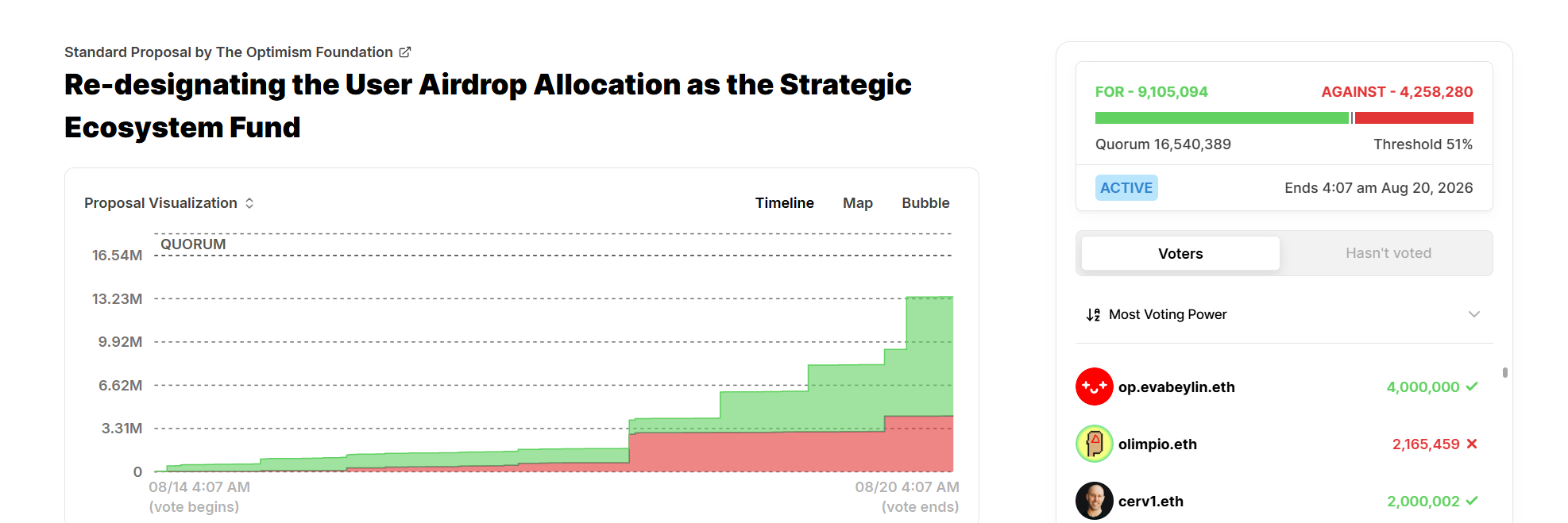
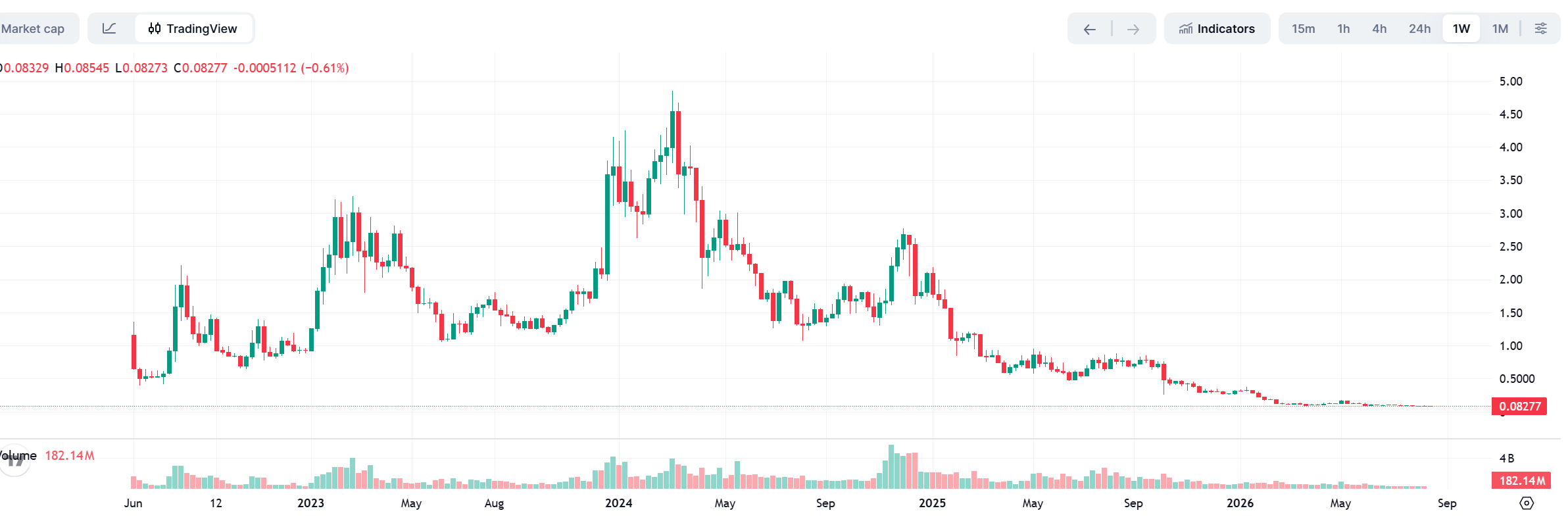
According to the latest on-chain data available, there are approximately 9.105 million OP tokens in support votes and about 4.258 million OP tokens in opposition votes. The quorum requirement is approximately 16.54 million OP tokens, and there remains a significant gap between the current participation level and reaching the required threshold. The final voting outcome has not yet been decided, and community contention continues.

OP Buybacks Halted After May This Year

The initial total supply of OP is approximately 4.295 billion tokens. Of this, 19% (about 816 million tokens) was explicitly reserved for user airdrops. While this arrangement is not a formal legal obligation, Optimism has repeatedly confirmed it in public communications over the years, including as recently as October 2024 when Airdrop 5 was distributed, still mentioning that approximately 550 million tokens could be used for future airdrops.

The actual execution shows: between 2022 and 2024, five rounds of airdrops were completed, distributing a cumulative total of about 269.1 million OP tokens, accounting for approximately 33% of the reserved total. The first round accounted for the highest proportion. Subsequent rounds continuously adjusted criteria, shifting from early usage and gas consumption towards delegated governance, OP Mainnet activity, NFT creators, and Superchain activities, among others.

The fourth year (May 2025 to April 2026) saw no new airdrops, with the official clearly pivoting towards "targeted growth projects with measurable retention and revenue outcomes."
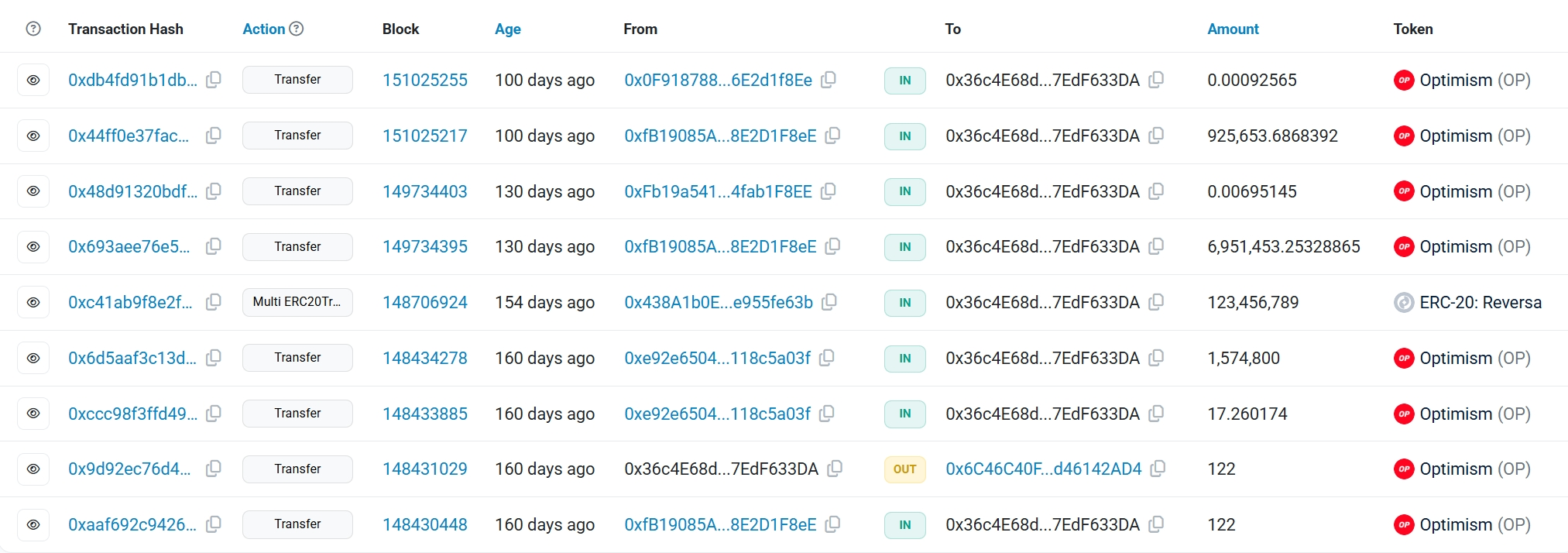
On-chain data also indicates that Optimism has not followed through with its original plan to buy back OP after May. After completing the second and third rounds (March and April) of monthly community buybacks, the official unilaterally halted the subsequent buyback plan. In March, the foundation spent 367.905 ETH to buy back 6,951,453 OP, and in April, 50.16 ETH to buy back 925,654 OP. To date, its cumulative buyback of OP tokens stands at 9,451,924 OP, valued at approximately $756,200 based on the latest price of $0.08.
The foundation stated it will reassess after the 12-month period ends and does not commit to a long-term continuation.

Simultaneously, the overall OP deployment volume for the fourth year decreased by approximately 35% compared to the third year. New circulating supply from the Governance Fund decreased by 53% year-on-year, Retro Funding (a public goods funding mechanism where OP rewards are distributed based on actual contributions) expenditures dropped by 30%, and airdrops were zeroed. The foundation also released a fourth-year budget update and fifth-year outlook, projecting approximately 273 million new OP tokens entering circulation in the fifth year (excluding the potential reallocation from this airdrop quota), with about 200 million OP expected to be deployed from the Ecosystem Fund.

According to DefiLlama data, its Total Value Locked (TVL) has significantly dropped from a peak of $5.5 billion to $526 million.

Strategic Shift Towards Enterprise Growth

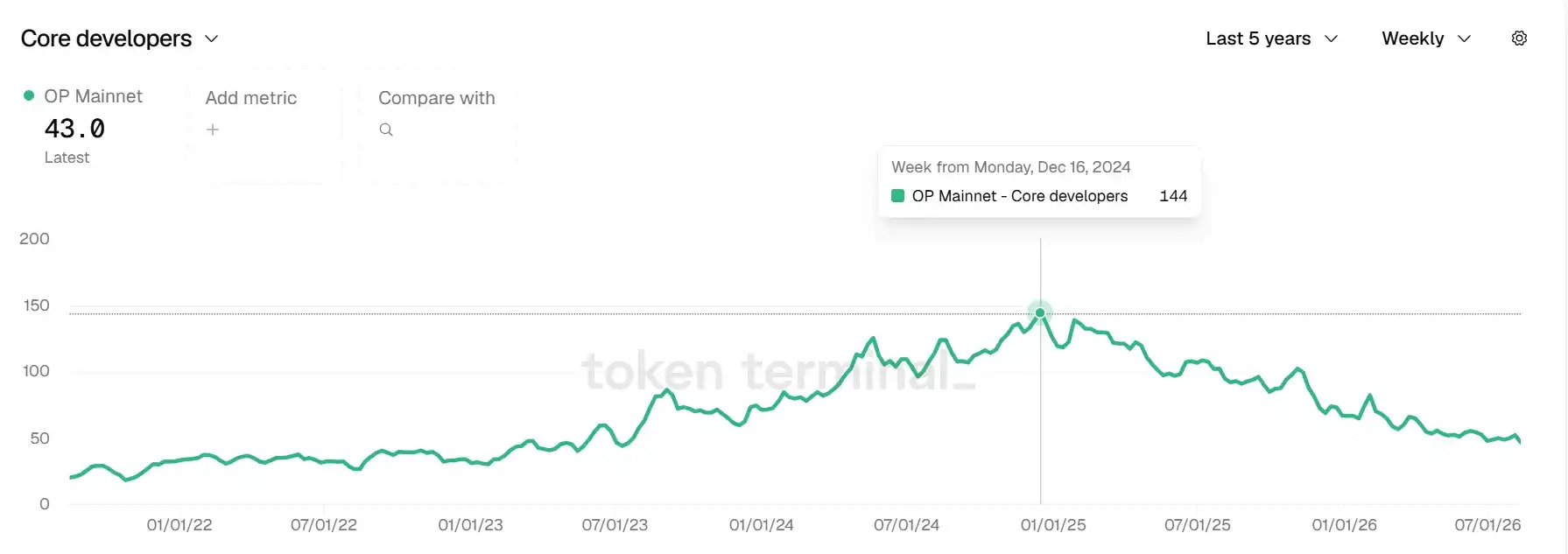
The Layer 2 network crypto market is currently facing issues like user attrition and a lack of innovation. According to the latest data from Token Terminal, its core developers have dwindled to 42, compared to 144 at its peak at the end of 2024.
Currently, Optimism is pivoting towards the enterprise market, including fintech, exchanges, payment institutions, and traditional financial institutions. Current partnerships include Bitpanda, Ink, and Dunamu, among others.

Specifically, the proposal requires:

  • Creating a new allocation category called "Strategic Ecosystem Fund";
  • Reallocating the remaining 546.9 million OP tokens from the user airdrop category into this fund;
  • The fund's use includes facilitating partnership deals to bring chains, protocols, institutions, and infrastructure to the OP Stack, deepening incentives for on-chain activity and liquidity on OP Mainnet, and expanding collaborations with top-tier brands and institutions.

The already distributed Rounds 1 to 5 airdrops will not be affected. If the proposal passes, the foundation will update the token allocation documentation and public accounting records and will continue using the existing grant oversight and annual budget reporting mechanisms. The fifth-year budget outlook itself already assumes zero airdrop deployment and notes that this outlook is independent of this reallocation proposal.

After being initiated by the official, early voting leaned in favor. However, as community discussions intensified, opposition voices quickly rose. Main criticisms focus on three points: the portion originally reserved for users is being reallocated to foundation-controlled enterprise growth funds, effectively allowing the official team to reclaim tokens under the guise of DAO governance; and with airdrops and Retro Funding successively phased out, incentive pathways for ordinary users are further narrowed.

The changing stance of the airdrop whale olimpio.eth, a long-time participant in Optimism governance, has drawn attention. This account previously maintained a high participation rate in over 120 governance votes. Its voting record shows it cast 2,165,459 votes in opposition, which the community views as its first-ever vote against a proposal in Optimism governance history. Some participating players criticized

Community discussions repeatedly feature calls to "preserve the right to future airdrops." Conversely, there are also views that even if the proposal fails, the official currently has no plans for new airdrops, making the practical impact limited.

If the proposal ultimately passes, Optimism's token allocation structure will formally shift further from the dual-track model of "user airdrops + ecosystem incentives" towards a greater tilt towards enterprise and institutional growth. This aligns with its OP Enterprise product line, Superchain expansion, and the overall trend of expenditure discipline. For token holders, this may strengthen the expectation of "growth prioritized over broad distribution" in the short term, potentially putting greater pressure on the token price.

There remains about a two-day window before the voting deadline, leaving room for a change in the final outcome. As of the time of writing, market data shows that the Optimism (OP) token's current market capitalization is approximately $185 million, with the token price fluctuating around $0.08, and a Fully Diluted Valuation (FDV) of $348 million.

Criptomoedas em alta

Perguntas relacionadas

QWhat is the main purpose of the new proposal submitted by the Optimism Foundation?

AThe proposal aims to reallocate the remaining 546.9 million OP tokens, originally reserved for future user airdrops, into a newly created 'Strategic Ecosystem Fund'.

QWhat are the main criticisms from the community regarding this proposal?

ACommunity criticisms primarily focus on three points: 1) The reallocation of user-reserved tokens to a fund for enterprise-focused growth, seen as the foundation reclaiming tokens under the guise of DAO governance. 2) The narrowing of incentive pathways for ordinary users after airdrops and Retro Funding have been reduced or halted. 3) Concerns that the move prioritizes corporate and institutional growth over broad user distribution.

QWhat significant change in Optimism's strategy does the article highlight?

AThe article highlights a strategic shift for Optimism from broad user incentive programs like airdrops towards focusing on the enterprise market, including financial technology firms, exchanges, payment institutions, and traditional financial institutions.

QAccording to the article, what was the change in Optimism's Total Value Locked (TVL)?

AAccording to DeFiLlama data cited in the article, Optimism's Total Value Locked (TVL) has significantly decreased from its peak of $5.5 billion to $526 million.

QWhat was notable about the voting behavior of the account 'olimpio.eth'?

AThe account 'olimpio.eth', a long-term participant and a whale in Optimism governance, cast over 2.16 million OP votes against the proposal. This was noted by the community as its first opposition vote in its history of participation in Optimism governance.

Leituras Relacionadas

One Vote Could Make SOL's Daily Burn Rate Soar 14 Times

Solana's first formal on-chain governance vote concluded on August 27th, coinciding with SOL hitting a yearly high. Three key proposals aimed at reshaping the network's tokenomics were decided. Solana's core challenge is a massive usage-to-value capture gap. Despite processing 120x more transactions than Ethereum and leading in DEX volume, its fee revenue is significantly lower due to its fee structure. Currently, most fees (priority fees) go to validators, with only a small base fee partially burned. This results in high net inflation (approx. 6k SOL issued vs. ~650 burned daily). The three proposals seek to address this: **SGP-0001** establishes the formal governance framework. **SGP-0002** (Double Deflation Acceleration) proposes doubling the annual reduction rate of new SOL issuance from 15% to 30%, aiming to reach the terminal inflation rate by 2029 instead of 2032, reducing issuance by an estimated 18.9 million SOL. **SGP-0003** (Resource & Entry Fee Restructuring) would split the base fee into a fixed "entry fee" for block producers and a variable, fully burned "resource fee." This could increase daily SOL burns by ~14x to 7,500-9,000. Major stakeholders like Helius, Jupiter, and Jito support the changes. However, opposition exists, notably from Solana Company (HSDT), whose revenue is 99.4% from staking. They argue rapid changes could disrupt institutional adoption. Critics also highlight a potential conflict where validators can vote against reduced staking yields using delegated SOL without explicit voter consent. The outcome of these votes provides a directional mandate. If passed, they represent a significant step towards aligning Solana's immense network activity with tangible economic value for SOL holders.

marsbitHá 13m

One Vote Could Make SOL's Daily Burn Rate Soar 14 Times

marsbitHá 13m

Chinese Venture Capital Is Shifting from 'Selecting People' to 'Selecting Cities'

Chinese Venture Capital: Shifting from "Picking Founders" to "Picking Cities" The article discusses a significant shift in China's venture capital (VC) landscape. Historically, VC investments heavily focused on the individual founder's vision, track record, and capability, as seen in early internet-era successes like Wang Xing (Meituan), Li Bin (Nio), and Li Xiang (Li Auto). The belief was that betting on exceptional people was the key to success. However, the rise of hard tech startups—in fields like semiconductors, robotics, AI, and biotech—has changed this calculus. These industries depend heavily on deep, localized ecosystems: specialized talent pools, established supply chains, manufacturing bases, and application scenarios. A city's industrial "resume" now significantly impacts a startup's chances. Examples include Shenzhen's dominance in robotics, Beijing's concentration of AI firms, Suzhou's biotech cluster, and Hefei's successful bet on semiconductor giant ChangXin. This shift is further driven by changes in funding sources. Government-guided funds and state-owned capital now dominate VC limited partners (LPs). These "patient capital" investors prioritize local economic development, job creation, and industrial chain growth alongside financial returns. Their early bets signal viability to other investors. Ultimately, the VC logic remains about managing risk and increasing the odds of success. In the hard tech era, a supportive city ecosystem provides crucial resources—talent, suppliers, R&D, and policy stability—that a single founder cannot easily assemble. The investment due diligence process has thus expanded from evaluating just the founder to also evaluating the founder's city. Consequently, capital is concentrating in a few regions with strong, focused industrial foundations, challenging other cities to build compelling, credible ecosystems to attract investment.

marsbitHá 1h

Chinese Venture Capital Is Shifting from 'Selecting People' to 'Selecting Cities'

marsbitHá 1h

Trading

Spot

Artigos em Destaque

Como comprar WAR

Bem-vindo à HTX.com!Tornámos a compra de WAR (WAR) simples e conveniente.Segue o nosso guia passo a passo para iniciar a tua jornada no mundo das criptos.Passo 1: cria a tua conta HTXUtiliza o teu e-mail ou número de telefone para te inscreveres numa conta gratuita na HTX.Desfruta de um processo de inscrição sem complicações e desbloqueia todas as funcionalidades.Obter a minha contaPasso 2: vai para Comprar Cripto e escolhe o teu método de pagamentoCartão de crédito/débito: usa o teu visa ou mastercard para comprar WAR (WAR) instantaneamente.Saldo: usa os fundos da tua conta HTX para transacionar sem problemas.Terceiros: adicionamos métodos de pagamento populares, como Google Pay e Apple Pay, para aumentar a conveniência.P2P: transaciona diretamente com outros utilizadores na HTX.Mercado de balcão (OTC): oferecemos serviços personalizados e taxas de câmbio competitivas para os traders.Passo 3: armazena teu WAR (WAR)Depois de comprar o teu WAR (WAR), armazena-o na tua conta HTX.Alternativamente, podes enviá-lo para outro lugar através de transferência blockchain ou usá-lo para transacionar outras criptomoedas.Passo 4: transaciona WAR (WAR)Transaciona facilmente WAR (WAR) no mercado à vista da HTX.Acede simplesmente à tua conta, seleciona o teu par de trading, executa as tuas transações e monitoriza em tempo real.Oferecemos uma experiência de fácil utilização tanto para principiantes como para traders experientes.

336 Visualizações TotaisPublicado em {updateTime}Atualizado em 2026.06.02

Como comprar WAR

Discussões

Bem-vindo à Comunidade HTX. Aqui, pode manter-se informado sobre os mais recentes desenvolvimentos da plataforma e obter acesso a análises profissionais de mercado. As opiniões dos utilizadores sobre o preço de WAR (WAR) são apresentadas abaixo.

活动图片