Weekly active crypto devs drops over 26% over the last 3 months

CointelegraphPublicado em 2022-09-09Última atualização em 2022-09-09

Resumo

The crypto industry has seen more than a 26% reduction in weekly active developers over the last three months amid a prolonged market slump, the latest data shows. 

The crypto industry has seen more than a 26% reduction in weekly active developers over the last three months amid a prolonged market slump, the latest data shows. 
According to Blockchain data aggregator Artemis, the four leading smart contract platforms — Ethereum, Polkadot, Solana, and Cosmos experienced even higher drop-off, clocking 30.5%, 43.6%, 48.4%, and 48.9% reductions in developer activity respectively over the last three months. 
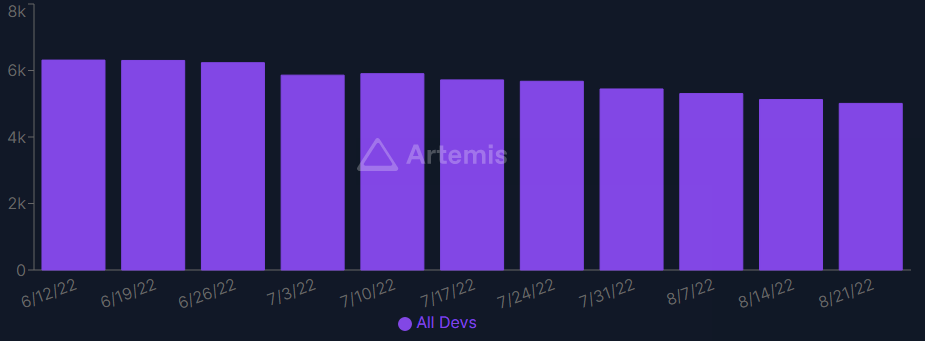
Source: ArtemisInterestingly, decentralized data storage protocol Interplanetary File System (IPFS) and blockchain network Internet Computer were among the few top smart contract platforms to have seen growth throughout this period, with increases of 206.6% and 21.7% respectively.
Blockchain developers are primarily responsible for designing blockchain architecture, maintaining and upgrading infrastructure, and building smart contracts that power decentralized applications.
Blockchain developer activity is considered one of the most important metrics for the success of a smart contract platform, as one that lacks developers will likely struggle to grow.
Crypto researcher and founder of Tascha Labs, Tascha Che told her 173,700 Twitter followers on Sept. 8 that she doesn’t believe the trend is of much concern, as the fall was attributed to the exit of “tourist builders” and “tourist investors,” which will now allow legitimate builders to “have peace and quiet to get real work done.”
Active developers across all crypto protocols have dropped 30% this yr.
Tourist builders are leaving along w/ tourist investors.
Finally the industry is having some peace & quiet to get real work done.
h/t @Artemis__xyz pic.twitter.com/PAGi6Yh7eo
— Tascha (@TaschaLabs) September 8, 2022
Another Twitter user, identifying themselves as a Binance research analyst didn’t comment on the downward trend but said developer activity will be an “important metric” to consider in the years to come because of the “flywheel effect” it has on the industry.
The fall in developer activity follows a crypto market downfall from April to mid-June, which saw the entire crypto market cap slashed from $2.1 trillion to $890 billion.


Leituras Relacionadas

The "Impossible Triad" Is Fundamentally a Pseudo-Problem

The article argues that blockchain's fundamental limitation is not the scalability trilemma (decentralization, scalability, security), which has been largely solved, but the lack of **privacy** and, until recently, clear **legitimacy**. Blockchain is described as a slow, expensive, globally shared computer whose core value is censorship resistance and verifiability. While ideal for native digital assets like money (e.g., stablecoins), its default transparency acts as a **tax**, exposing all transactions and enabling MEV extraction, which deters serious institutional capital. Simultaneously, its permissionless nature created regulatory ambiguity. The piece contends that **privacy** is the missing critical feature. It rejects the false choice between total transparency and complete anonymity. Modern cryptography (like zero-knowledge proofs) enables **compliant privacy**: users can prove facts (solvency, KYC status, compliance) without revealing the underlying sensitive data (specific holdings, identities). This preserves auditability for regulators and eliminates the leak of financial information. With recent regulatory progress (e.g., the GENIUS Act) addressing legitimacy, adding default, provably compliant privacy becomes a pure upgrade. It transforms blockchain from a costly, public ledger into a confidential settlement layer, finally bridging the gap to mainstream institutional and individual adoption of on-chain finance.

链捕手Há 11h

The "Impossible Triad" Is Fundamentally a Pseudo-Problem

链捕手Há 11h

Optical Chips: Collective Capacity Expansion

The global optical chip industry is experiencing a massive wave of expansion driven by surging AI data center demand. Major players across the US, Japan, Europe, and China are aggressively investing to ramp up production capacity. In the US, Coherent is expanding its 6-inch Indium Phosphide (InP) semiconductor fab in Texas, supported by CHIPS Act funding and a $2 billion strategic investment from NVIDIA. Lumentum is building a new factory for InP optical devices, and Nokia is scaling its advanced photonic chip packaging and testing capabilities. NVIDIA's investments aim to secure future supply of critical lasers and optical interconnect products for AI infrastructure. Japan's JX Advanced Metals, a leading InP substrate supplier, plans a multi-billion yen investment to increase its capacity 7-10 times, strengthening its grip on the crucial upstream materials market. In Europe, IQE and Tower Semiconductor settled a patent dispute and signed a multi-year InP epitaxial wafer supply agreement, highlighting that next-generation silicon photonics platforms will integrate high-performance InP components. STMicroelectronics and Sivers Semiconductors are also expanding silicon photonics production and partnerships. China is rapidly building out its domestic supply chain. Dongshan Precision's subsidiary, Source Photonics, announced a $12 billion project to expand optical chip and module production. Companies like Sanan Optoelectronics and Yunnan Germanium are scaling up InP chip manufacturing and substrate production, moving towards vertical integration from materials to modules. While debate continues around the exact future architecture—whether CPO (Co-Packaged Optics), NPO, or pluggables will dominate—analysts like Morgan Stanley argue the underlying driver is unchangeable: the explosive growth in bandwidth demand. This will inevitably increase the volume of optical engines, lasers, and related content per GPU, regardless of the final technical path. The competition for "more light" in the AI era has intensified into a global, full-chain capacity race.

marsbitHá 13h

Optical Chips: Collective Capacity Expansion

marsbitHá 13h

Trading

Spot
Futuros
活动图片