[Key interpretation] Soaring to 5.4 million BTC traded on the chain, ETH was excessively pulled by the short term

HuobiPublicado em 2022-09-08Última atualização em 2022-09-09

Resumo

BTC traded a large number of transactions at key points, and eth overbought drove up.

1. BTC transaction volume rebounded

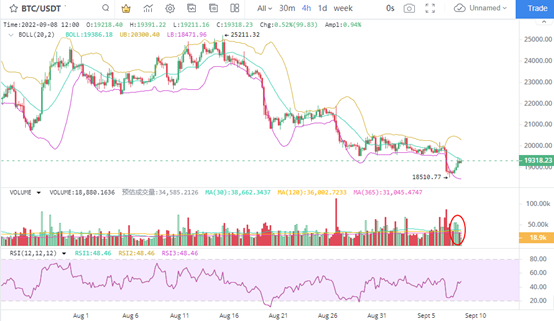
During the expansion of BTC's decline, the trading volume shown in the 4-hour K-line chart rebounded significantly, which was related to the growth of investors' enthusiasm for bottom reading. In fact, BTC has always maintained a high trading volume during the price decline. So far, BTC has gained more buying support at the low level below $19000. The increase of spot trading volume was synchronized with the increase of online transfer, and the price also rose slightly.
2. BTC chain turnover rebounded again

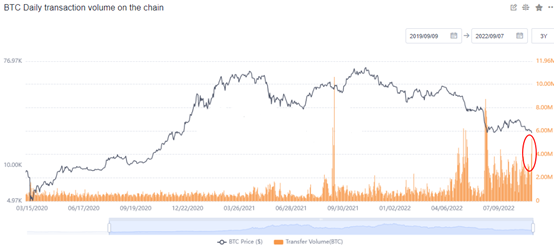
The online trading volume continued to rise. On September 7, the online trading volume reached a high of 5.355 million BTCs, which was significantly higher than the average trading volume in the past two months. It can be seen that investors' transfers at key points have increased, and they are obviously coping with possible price fluctuations. With the expectation that the Federal Reserve may still show signs of raising interest rates by 75 basis points in September, BTC prices will face greater pressure to adjust in the near future. The stronger the expectation of interest rate increase, the more investors look at selling BTC. Therefore, the next week may be a very critical time for BTC to change its market.
3. Usdt transaction growth

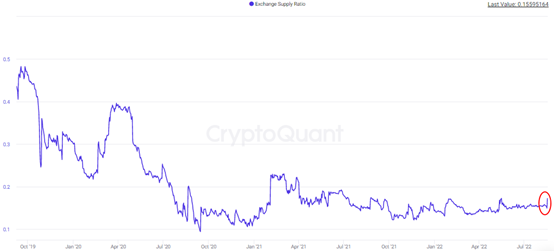
From the change in the number of exchange trading wallets, the proportion of usdt in trading wallets has risen rapidly from 0.149 to 0.172, with considerable room for recovery, but the absolute value is not high. The increase in the number of transactions of usdt also suggests that investors are increasing the signs of bargain hunting. Especially from the point of view, after the closing price of BTC reached the lowest $18790 in two years, investors did increase their enthusiasm for trading.

,
4. Eth rebound overbought

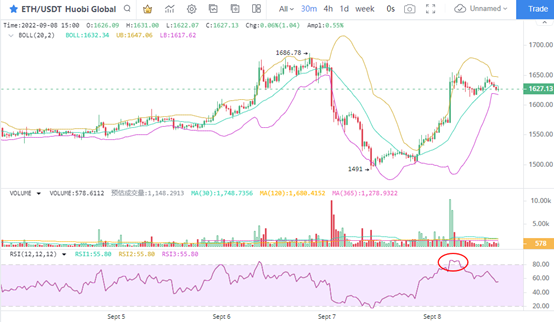
After the short-term rebound space of eth improved, the price did not return to the short-term high of $1660. In terms of trading volume, the 4-hour K-line chart is small, and the pulse trading volume in the ETH rebound stage is very large, which is similar to the pulse trading volume in the fall stage on September 7. However, the overall trading volume still shrank slightly, which means that there is greater resistance to rebound. At the same time, the shock indicator RSI retreated after rising above 80, reminding investors that eth has overbought in the short term. Therefore, the short-term market changes may still be adjusted, and the tracking risk is high.
5. Eth main selling increased

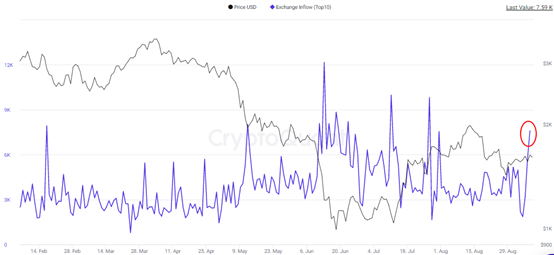
The number of eth flowing into the exchange rebounded significantly, and the number of eth flowing into the top 10 addresses of the exchange changed greatly. On September 7, the number of eth flowing into the trading day was 7590, with a value of US $12.14 million. From the peak performance, the difference between the peak on September 7 and the previous peak increased, but it was still the highest value since July 27. This shows that the selling pressure from the main force has indeed continued to grow, which means that the ETH price is in the key position of downward change.

Leituras Relacionadas

The "Impossible Triad" Is Fundamentally a Pseudo-Problem

The article argues that blockchain's fundamental limitation is not the scalability trilemma (decentralization, scalability, security), which has been largely solved, but the lack of **privacy** and, until recently, clear **legitimacy**. Blockchain is described as a slow, expensive, globally shared computer whose core value is censorship resistance and verifiability. While ideal for native digital assets like money (e.g., stablecoins), its default transparency acts as a **tax**, exposing all transactions and enabling MEV extraction, which deters serious institutional capital. Simultaneously, its permissionless nature created regulatory ambiguity. The piece contends that **privacy** is the missing critical feature. It rejects the false choice between total transparency and complete anonymity. Modern cryptography (like zero-knowledge proofs) enables **compliant privacy**: users can prove facts (solvency, KYC status, compliance) without revealing the underlying sensitive data (specific holdings, identities). This preserves auditability for regulators and eliminates the leak of financial information. With recent regulatory progress (e.g., the GENIUS Act) addressing legitimacy, adding default, provably compliant privacy becomes a pure upgrade. It transforms blockchain from a costly, public ledger into a confidential settlement layer, finally bridging the gap to mainstream institutional and individual adoption of on-chain finance.

链捕手Há 11h

The "Impossible Triad" Is Fundamentally a Pseudo-Problem

链捕手Há 11h

Optical Chips: Collective Capacity Expansion

The global optical chip industry is experiencing a massive wave of expansion driven by surging AI data center demand. Major players across the US, Japan, Europe, and China are aggressively investing to ramp up production capacity. In the US, Coherent is expanding its 6-inch Indium Phosphide (InP) semiconductor fab in Texas, supported by CHIPS Act funding and a $2 billion strategic investment from NVIDIA. Lumentum is building a new factory for InP optical devices, and Nokia is scaling its advanced photonic chip packaging and testing capabilities. NVIDIA's investments aim to secure future supply of critical lasers and optical interconnect products for AI infrastructure. Japan's JX Advanced Metals, a leading InP substrate supplier, plans a multi-billion yen investment to increase its capacity 7-10 times, strengthening its grip on the crucial upstream materials market. In Europe, IQE and Tower Semiconductor settled a patent dispute and signed a multi-year InP epitaxial wafer supply agreement, highlighting that next-generation silicon photonics platforms will integrate high-performance InP components. STMicroelectronics and Sivers Semiconductors are also expanding silicon photonics production and partnerships. China is rapidly building out its domestic supply chain. Dongshan Precision's subsidiary, Source Photonics, announced a $12 billion project to expand optical chip and module production. Companies like Sanan Optoelectronics and Yunnan Germanium are scaling up InP chip manufacturing and substrate production, moving towards vertical integration from materials to modules. While debate continues around the exact future architecture—whether CPO (Co-Packaged Optics), NPO, or pluggables will dominate—analysts like Morgan Stanley argue the underlying driver is unchangeable: the explosive growth in bandwidth demand. This will inevitably increase the volume of optical engines, lasers, and related content per GPU, regardless of the final technical path. The competition for "more light" in the AI era has intensified into a global, full-chain capacity race.

marsbitHá 13h

Optical Chips: Collective Capacity Expansion

marsbitHá 13h

Trading

Spot
Futuros
活动图片