Viewpoint: A $4 Billion Buyback Can Fix Liquidity, But Not U.S. Fiscal Health

marsbitPublicado em 2026-08-20Última atualização em 2026-08-20

Resumo

On August 19, the U.S. Treasury announced it would increase its maximum single-operation buyback size for long-term bonds from $2 billion to at least $4 billion, aiming to improve market liquidity. This move initially led to a pullback in long-term yields, such as the 30-year Treasury yield which had recently hit a 2007 high near 5.34%, sparking talk of potential "Treasury support." However, an opposing perspective argues this is merely a temporary fix. While buybacks can enhance trading conditions for older, less-liquid bonds, they do not address the underlying fiscal pressures. The Treasury's actions are a form of debt management, not monetary stimulus like QE; the funds used for buybacks ultimately come from cash balances or new borrowing. They do not reduce the government's overall financing needs. The core issue is growing fiscal supply. With the federal deficit reaching a record $432 billion in July 2026 and cumulative deficits already surpassing the prior fiscal year's total, the market faces a massive wave of new debt issuance. The recent surge in long-term yields may reflect a repricing of this persistent fiscal risk and the associated term premium, rather than just a liquidity shortage. Furthermore, demand-side challenges loom. Foreign holdings of U.S. Treasuries have recently declined, and if official demand weakens, the market will rely more on price-sensitive private investors, potentially requiring higher yields to clear future auctions. In essence, the Trea...

Editor's Note: On August 19, the U.S. Treasury Department announced an expansion of its long-term Treasury buyback program, increasing the maximum single-operation size for 10–20 year and 20–30 year Treasury bonds from $2 billion to at least $4 billion. Previously, the yield on the 30-year Treasury note had briefly risen to around 5.34%, the highest level since 2007. Following the announcement, long-end yields fell rapidly.

This gave the market a straightforward bullish narrative: the Treasury is taking more proactive steps to improve the liquidity of long-term bonds, potentially even creating a kind of "Treasury floor" expectation.

However, Marcus Nunes, in his article "The Treasury's $4 Billion Band-Aid," offers a counterpoint: while buybacks can indeed alleviate liquidity issues, if the pressure on long-term bonds stems from larger fiscal deficits, increased bond supply, and weaker marginal buying interest, then a $4 billion buyback does not address the real underlying conflict.

In other words, the market needs to distinguish between two things: the Treasury can make bonds easier to trade, but it cannot use buybacks to reduce the total amount the U.S. government ultimately needs to finance.

The following is a translated compilation of the original article:

On August 19, U.S. Treasury Secretary Scott Bessent announced an increase in the maximum single-operation size for liquidity support buybacks of 10–20 year and 20–30 year Treasury bonds, from $2 billion to at least $4 billion. The market reaction was swift. The yield on the 30-year Treasury note, which had earlier climbed to about 5.34%, subsequently retreated noticeably, while assets like stocks and gold strengthened in tandem.

But the author, Nunes, believes this reaction risks causing the market to overlook a more fundamental issue: Treasury buybacks address liquidity, not the fiscal deficit.

Buybacks Can Improve Trading, But Don't Reduce Government Financing Needs

Treasury buybacks are not quantitative easing.

When the Federal Reserve conducts QE, it can create base money to purchase Treasuries by expanding its balance sheet; the Treasury lacks this ability. The funds it uses to buy back old debt ultimately still come from its cash balance or from new debt issuance.

Therefore, Treasury buybacks are fundamentally more akin to debt structure management.

They can repurchase illiquid older securities, improving market liquidity, and can to some extent increase demand for bonds of specific maturities. However, they do not change one fact: the U.S. government still needs to issue bonds to finance its fiscal deficit.

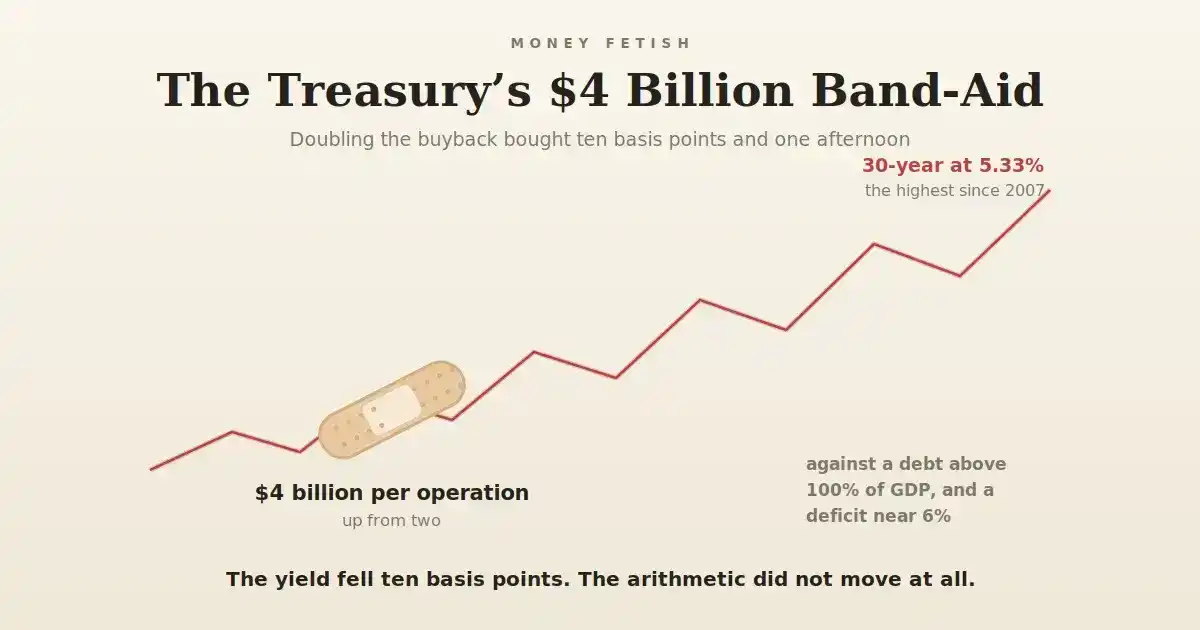
The scale difference is particularly stark. The U.S. Treasury previously estimated needing to borrow a net $739 billion in the third quarter of 2026, while this single-operation buyback increase for long-term Treasuries is merely from $2 billion to at least $4 billion.

This is why Nunes refers to it as a "Band-Aid." Four billion dollars is enough to improve trading conditions for some long-term bonds, but it is unlikely to alter the overall supply and demand dynamics of the entire U.S. Treasury market.
What's Really Weighing on Long Bonds is the Growing Fiscal Supply

In Nunes's framework, the recent rise of the 30-year Treasury yield above 5% cannot be interpreted solely as a liquidity issue. More importantly, the amount the U.S. government needs to finance remains substantial.

In July 2026, the U.S. federal budget deficit reached $432 billion, a 48% year-over-year increase, setting a record high for any July. The cumulative deficit for the first 10 months of the fiscal year stands at approximately $1.8 trillion, already surpassing the total for the entire 2025 fiscal year.
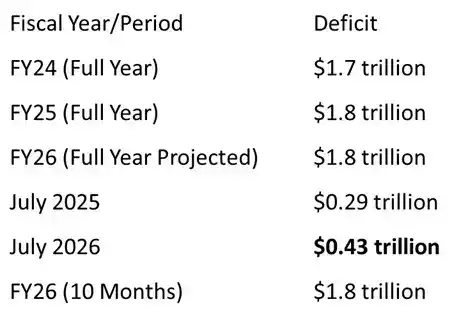
U.S. Federal Deficit – Year-on-Year Comparison

Meanwhile, total U.S. federal debt surpassed $40 trillion on August 19. As the debt stock grows and borrowing costs have risen in recent years, interest expenses are also climbing higher.

This means the core problem facing the U.S. Treasury is not that "old bonds are hard to trade," but rather: who will absorb the massive future supply of new bonds? If investors believe fiscal deficits will remain elevated in the future, they will demand higher yields to absorb the supply of long-term bonds.

From this perspective, the 30-year yield breaking through 5% may not be a temporary market malfunction, but rather a repricing of U.S. fiscal risk and duration risk.

The Buyer Problem Can't Be Solved by $4 Billion Either

Nunes also highlights the shift in foreign demand.

According to the U.S. Treasury's TIC data, foreign holdings of U.S. Treasuries decreased by approximately $72.1 billion month-over-month in June, with Japan, China, and the UK all seeing declines of varying degrees. This is not enough to prove foreign investors are "fleeing U.S. Treasuries en masse," as single-month holdings can be affected by exchange rates, custodian location changes, and asset allocation shifts. Furthermore, TIC data itself cannot fully identify the ultimate owners of securities. However, it at least indicates that previously stable foreign demand can no longer be taken for granted.
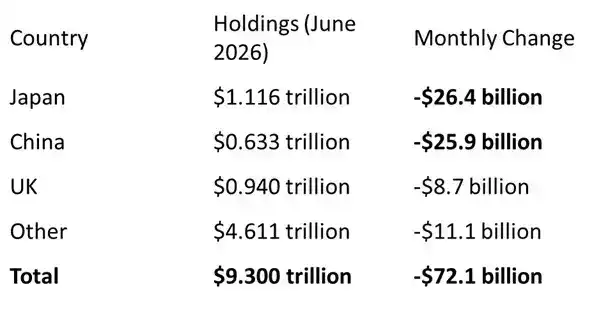
Foreign Holdings of U.S. Treasury Securities (June 2026)

More important is the buyer structure. If the willingness of foreign official institutions to absorb U.S. Treasuries declines, the U.S. will need to rely more on private investors. Private capital typically places greater emphasis on price and yield, meaning the market may require higher long-term interest rates to attract sufficient funds to take on the growing bond supply.

This is also why simply increasing buybacks doesn't solve the problem. The Treasury can buy back a portion of old debt, but it cannot dictate at what price other investors are willing to hold the large volumes of long-term bonds the U.S. will issue in the future.

The Real Divide: Is This a Liquidity Problem or a Fiscal Problem?

Supporters of expanding buybacks could argue that the Treasury is not attempting to solve the fiscal deficit. Buybacks are inherently a market liquidity tool. If they can improve the trading of old securities and reduce market friction, they have already achieved their policy objective. In this sense, criticizing buybacks with "$4 billion can't fix the deficit" might itself confuse the purpose of the policy tool.

But the real question Nunes poses is this: if the primary force driving long-end yields higher has shifted from liquidity to fiscal supply, then continuing to use liquidity tools will naturally have limited effectiveness.

These two explanations correspond to two completely different market judgments. If the recent selloff in long bonds was mainly due to insufficient market depth, deteriorating liquidity in old securities, and short-term positioning shocks, then the Treasury's expanded buyback might be enough to stabilize the market. However, if the rise in long-end yields primarily reflects persistent fiscal deficits, larger long-term bond supply, and higher term premia, then buybacks can only make the adjustment process smoother; they are unlikely to change the ultimate level of yields.

This is the article's core judgment: The Treasury can improve the "trading problem" in the Treasury market, but it cannot buy away America's "fiscal problem" through buybacks.

What truly needs to be watched next is not how much the Treasury increases its next buyback size, but whether long-term Treasury auctions continue to attract sufficient demand, whether the fiscal deficit narrows, and whether higher yields can re-attract foreign and private buyers.

If these variables do not improve, then the yield decline brought about by the $4 billion initiative is more likely to be a short-term buffer, rather than a true reversal of the pressure on U.S. long bonds.


Criptomoedas em alta

Perguntas relacionadas

QWhat is the main action taken by the U.S. Treasury according to the article, and what was its immediate market impact?

AThe U.S. Treasury announced an expansion of its long-term bond repurchase program, increasing the maximum single-operation size for 10–20 year and 20–30 year Treasuries from $2 billion to at least $4 billion. The immediate market impact was a rapid decline in long-term bond yields, particularly the 30-year yield which had previously reached a high, and a simultaneous strengthening of assets like stocks and gold.

QAccording to Marcus Nunes's perspective in the article, what fundamental problem does the Treasury's bond repurchase fail to address?

AAccording to Marcus Nunes, the Treasury's bond repurchase program addresses market liquidity issues but fails to address the fundamental problem of the U.S. government's large fiscal deficits and the associated high financing needs. The repurchase does not reduce the total amount the government ultimately needs to borrow.

QWhy does the author refer to the $4 billion repurchase increase as a 'Band-Aid' solution?

AThe author refers to it as a 'Band-Aid' because while the $4 billion increase can improve trading conditions for some long-term bonds, its scale is negligible compared to the broader financing needs (e.g., an estimated $739 billion in net borrowing needed for a single quarter). Therefore, it cannot meaningfully alter the overall supply and demand dynamics of the U.S. Treasury market driven by large fiscal deficits.

QWhat are the two main factors, beyond liquidity, that the article suggests are putting upward pressure on long-term bond yields?

ABeyond liquidity issues, the two main factors are: 1) The increasingly large supply of new bonds required to finance persistent and growing U.S. federal budget deficits. 2) Potential weakening in demand from traditional major buyers, such as foreign official institutions, which may require higher yields to attract sufficient private investor capital to absorb the supply.

QWhat does the article conclude about the true test for the U.S. long-term bond market, beyond the Treasury's repurchase actions?

AThe article concludes that the true test for the U.S. long-term bond market is not the size of Treasury repurchases, but whether upcoming long-term bond auctions continue to attract sufficient demand, whether the fiscal deficit narrows, and whether higher yields can successfully re-attract foreign and private investor buying. Without improvement in these underlying variables, the yield decline from the repurchase program is likely just a short-term buffer, not a fundamental reversal of pressure.

Leituras Relacionadas

Gold Diggers in Prediction Markets: From Competing for Trading Entrances to Competing for Outcome Definition Rights

The report identifies a shift in prediction market competition from front-end user acquisition to back-end infrastructure, specifically the "outcome layer." This layer encompasses the standardized services for rule comparison, evidence verification, outcome confirmation, and payment triggering. Analysis shows that while a tiny fraction (0.487%) of markets face disputes, they account for a significant share (8.64%) of traded volume. This highlights the financial impact of rule uncertainty, which creates trading alpha but limits strategy capacity due to shallow order books. The larger opportunity lies in productizing these backend functions. Services like automated settlement (e.g., HIP-4), AI-assisted evidence processing, and external data oracles (e.g., Pyth, Chainlink) are becoming reusable, cross-platform infrastructure. This is creating a "second profit pool" separate from trading fees. Current observable revenue for this outcome layer is estimated at $15-37 million annually. If applied to the entire existing market, this could expand to $64-161 million. In a mature state, modeled after existing commercial models like Azuro's, annual revenue potential could reach approximately $456 million. While the industry logic is forming, pure-play investment assets are still early. Platform equities (e.g., Kalshi, Polymarket) price in broad growth, not just the outcome layer. Tokens like HYPE have minimal fee contribution from related products, and ICE's exposure is too small relative to its total business. The key is to track early projects that achieve cross-platform adoption and convert usage into attributable, recurring revenue. The most significant alpha may emerge before the ideal investment target is fully established.

marsbitHá 29m

Gold Diggers in Prediction Markets: From Competing for Trading Entrances to Competing for Outcome Definition Rights

marsbitHá 29m

Bitcoin Surpasses $72k. What Happens Next?

Bitcoin exceeded $72,000, reaching its highest level since early summer after a $8,000 surge. The broader crypto market followed, with total market capitalization rising 10%. Analysts attribute the rally to a combination of factors: the U.S. Treasury's decision to increase purchases of long-term government bonds, which lowers yields and makes riskier assets like crypto more attractive, and positive remarks about cryptocurrency from former President Donald Trump. Experts note that while Trump's comments provided an emotional boost, the Treasury's action was a more fundamental driver. However, they caution that significant sustained growth is not assured. High U.S. inflation limits the Federal Reserve's ability to ease policy, and network activity within crypto ecosystems remains low. Competition for capital from sectors like semiconductors and AI also persists. Analysts present mixed short-term forecasts. Some see resistance around $72,000; a breakout could target $76,000-$80,000, but a moderate, localized rise within a longer-term downward trend is deemed more likely. Others identify $69,000-$70,000 as a key support zone. A sustained move above $72,000 could open a path toward $75,000-$78,000, or even $80,000-$82,000 under a strong bullish scenario, with support expected around $66,000-$67,000 on any pullback. The overall outlook is cautiously optimistic, with the recent surge signaling improved sentiment, but a confirmed upward trend requires prices to solidify above current levels.

cryptonews.ruHá 33m

Bitcoin Surpasses $72k. What Happens Next?

cryptonews.ruHá 33m

Optimism Developers' Vote Deprives Users of $49 Million Airdrop

On August 19th, the Optimism community approved a proposal to reallocate 546.9 million OP tokens (worth ~$49.7 million) from a reserve for future user airdrops into a new Strategic Ecosystem Fund for development. The vote passed with 17.97 million OP for and 10.93 million against, with a decisive last-minute vote from developer group Test in Prod securing the majority. The funds will now be managed by the Optimism Foundation to foster ecosystem growth, targeting partnerships with blockchains, protocols, and financial firms, and attracting major brands. This marks a strategic shift from broad user acquisition via airdrops to focusing on corporate clients and enterprise solutions (OP Enterprise). The decision does not affect past airdrops, which distributed 269.1 million OP over five rounds. The proposal faced criticism. L2BEAT and delegate cp0x argued the Foundation gains overly broad discretion without sufficient detail on fund use, results measurement, or benefit to OP holders. Critics also noted these tokens were publicly reserved for future user distributions, and their reallocation removes the need for separate community votes on individual Foundation deals. Test in Prod defended its support, stating the reserve is needed for competitive corporate deals where premature disclosure could be detrimental, while urging the Foundation to later disclose aggregate spending and outcomes.

cryptonews.ruHá 33m

Optimism Developers' Vote Deprives Users of $49 Million Airdrop

cryptonews.ruHá 33m

Trading

Spot

Artigos em Destaque

Como comprar 4

Bem-vindo à HTX.com!Tornámos a compra de 4 (4) simples e conveniente.Segue o nosso guia passo a passo para iniciar a tua jornada no mundo das criptos.Passo 1: cria a tua conta HTXUtiliza o teu e-mail ou número de telefone para te inscreveres numa conta gratuita na HTX.Desfruta de um processo de inscrição sem complicações e desbloqueia todas as funcionalidades.Obter a minha contaPasso 2: vai para Comprar Cripto e escolhe o teu método de pagamentoCartão de crédito/débito: usa o teu visa ou mastercard para comprar 4 (4) instantaneamente.Saldo: usa os fundos da tua conta HTX para transacionar sem problemas.Terceiros: adicionamos métodos de pagamento populares, como Google Pay e Apple Pay, para aumentar a conveniência.P2P: transaciona diretamente com outros utilizadores na HTX.Mercado de balcão (OTC): oferecemos serviços personalizados e taxas de câmbio competitivas para os traders.Passo 3: armazena teu 4 (4)Depois de comprar o teu 4 (4), armazena-o na tua conta HTX.Alternativamente, podes enviá-lo para outro lugar através de transferência blockchain ou usá-lo para transacionar outras criptomoedas.Passo 4: transaciona 4 (4)Transaciona facilmente 4 (4) no mercado à vista da HTX.Acede simplesmente à tua conta, seleciona o teu par de trading, executa as tuas transações e monitoriza em tempo real.Oferecemos uma experiência de fácil utilização tanto para principiantes como para traders experientes.

810 Visualizações TotaisPublicado em {updateTime}Atualizado em 2026.06.02

Como comprar 4

Discussões

Bem-vindo à Comunidade HTX. Aqui, pode manter-se informado sobre os mais recentes desenvolvimentos da plataforma e obter acesso a análises profissionais de mercado. As opiniões dos utilizadores sobre o preço de 4 (4) são apresentadas abaixo.

活动图片