Is OpenAI Losing? Anthropic Presses the Fast-Forward Button on Its Trillion-Dollar IPO, Dario's 2% Stake Seizes Control

marsbitPublicado em 2026-08-19Última atualização em 2026-08-19

Resumo

Anthropic is accelerating towards a potential IPO this fall, fueled by a massive surge in quarterly revenue. In Q2, its revenue of $11.6 billion surpassed OpenAI's $6.7 billion for the first time, signaling a major shift in the competitive landscape. With an estimated valuation nearing $1 trillion, Anthropic aims to become the first major AI model company to go public. Ahead of the listing, the company plans to issue special shares with enhanced voting rights to CEO Dario Amodei (who holds only a 2% stake) and other co-founders. This dual-class stock structure is designed to secure management control post-IPO, addressing the tension between raising substantial capital and retaining founder-led direction. While Anthropic's performance appears stronger on metrics like adjusted operating profit, OpenAI retains significant advantages, most notably its vast global user base through ChatGPT, which serves as a crucial platform for future expansion. The current dynamic suggests Anthropic has secured a notable lead, but the long-term competition remains open. Key questions moving forward include whether Anthropic can sustain its commercial momentum, how founder control will impact a trillion-dollar public company, and how OpenAI will respond to reclaim its position.

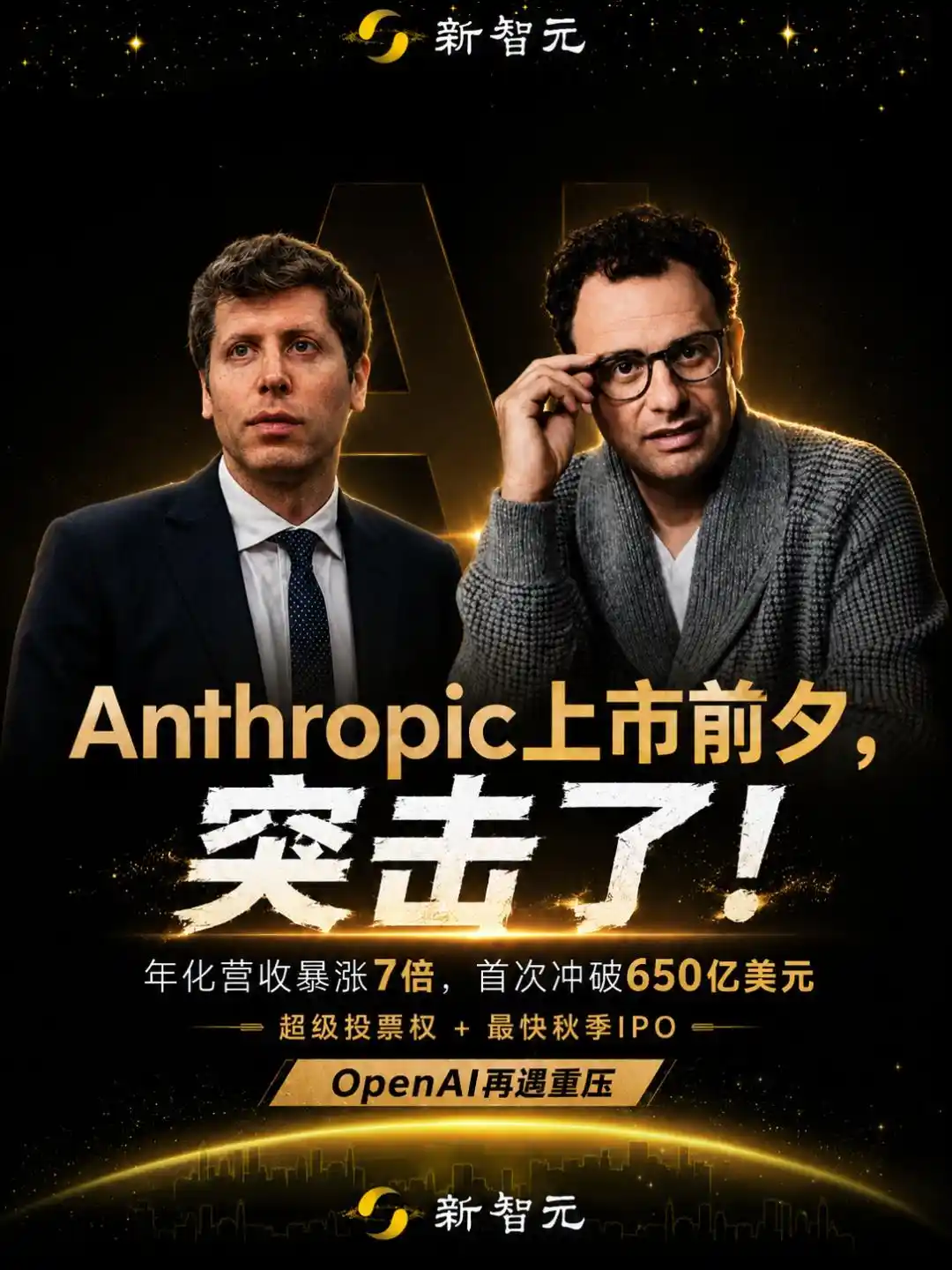
Anthropic is making a last-minute push before its IPO!

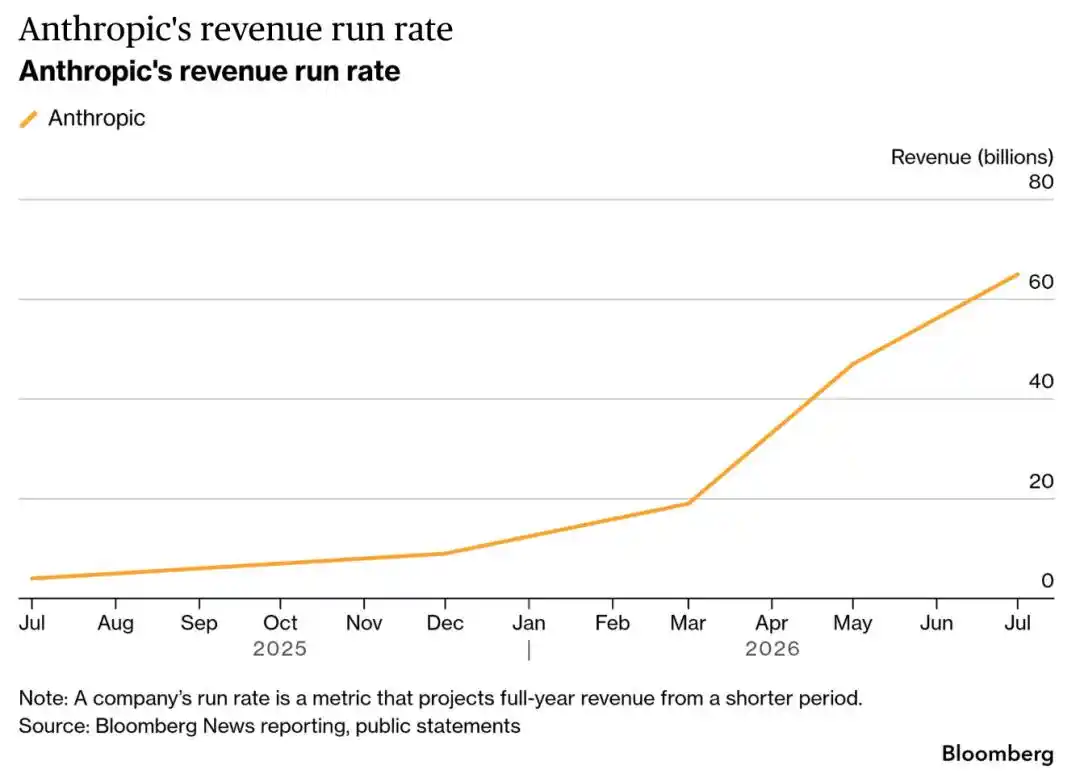
Its annualized revenue has skyrocketed sevenfold, breaking the $65 billion mark for the first time, with an IPO this fall almost a certainty.

Almost simultaneously, The Information reports—

Anthropic plans to issue a class of stock with "extra voting rights" to CEO Dario and six co-founders before going public.
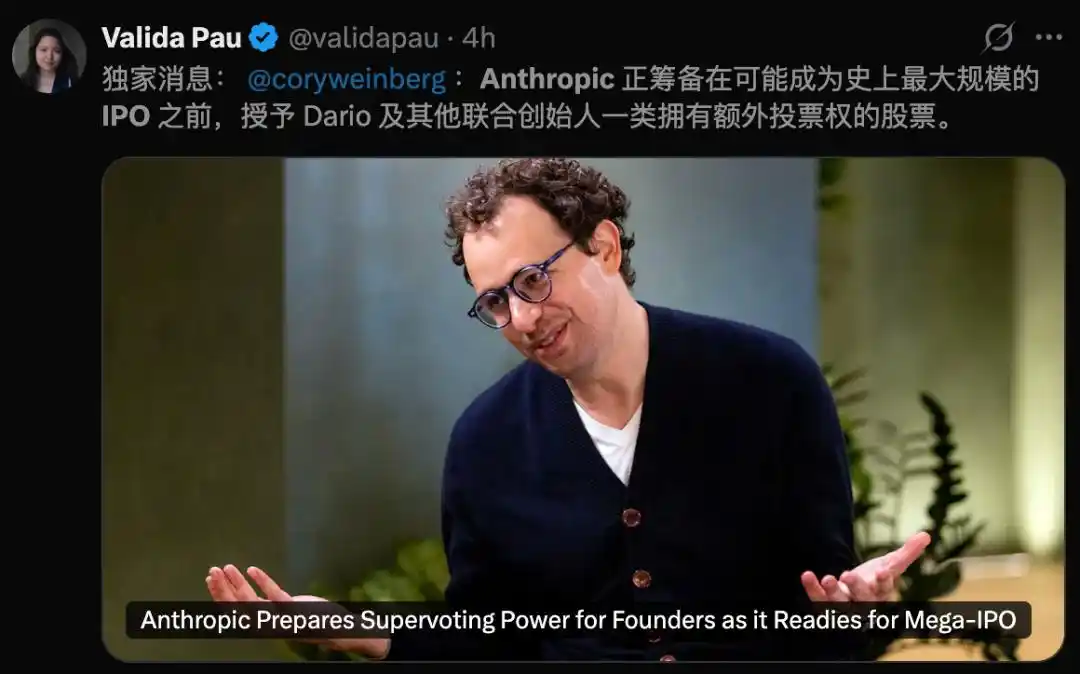
This marks the first time in the company's five-year history that management will have "super-voting rights."

Surprisingly, as the helm of an AI company valued at nearly a trillion dollars, Dario holds only a 2% stake. But compared to Sam Altman's 0% stake, that's still something.

While Anthropic is surging ahead, OpenAI has encountered another setback.

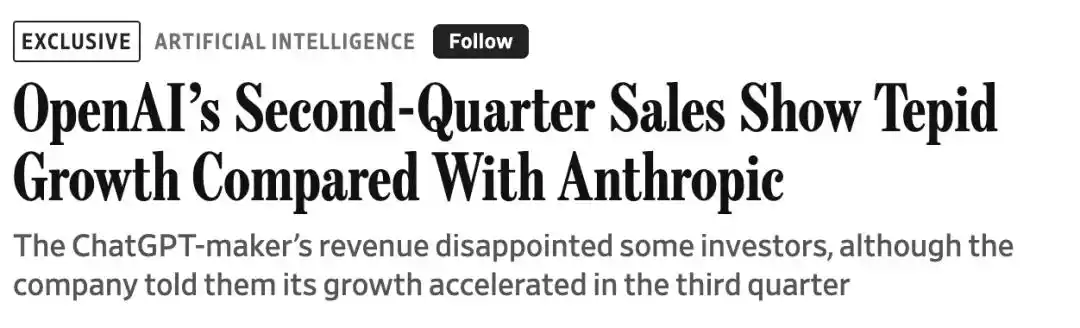
The WSJ exclusively reported that OpenAI's Q2 revenue reached $6.7 billion, a result that greatly disappointed shareholders.
Riding this wave of victory, Anthropic is sprinting towards Wall Street, aiming to claim the title of "AI's first public stock" with a staggering $1 trillion valuation.

The top seat in AI seems poised to change hands.

For the First Time, Anthropic Outpaces OpenAI

Two report cards for the same quarter.

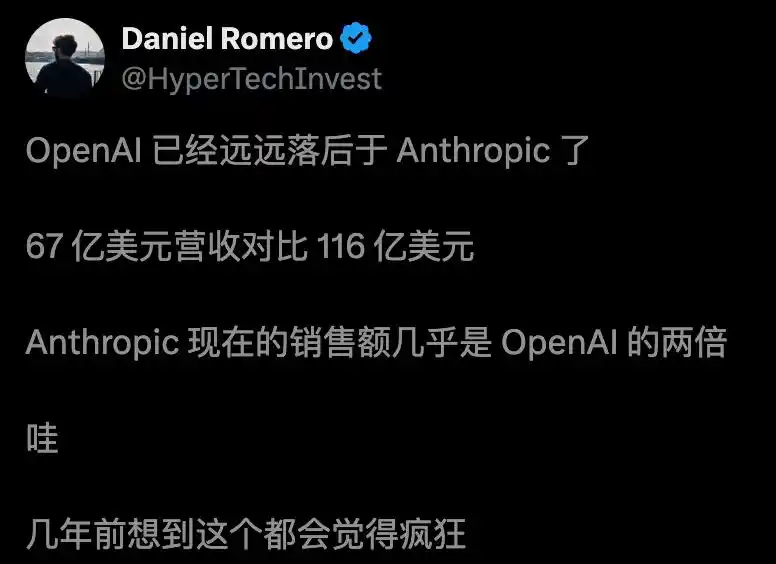
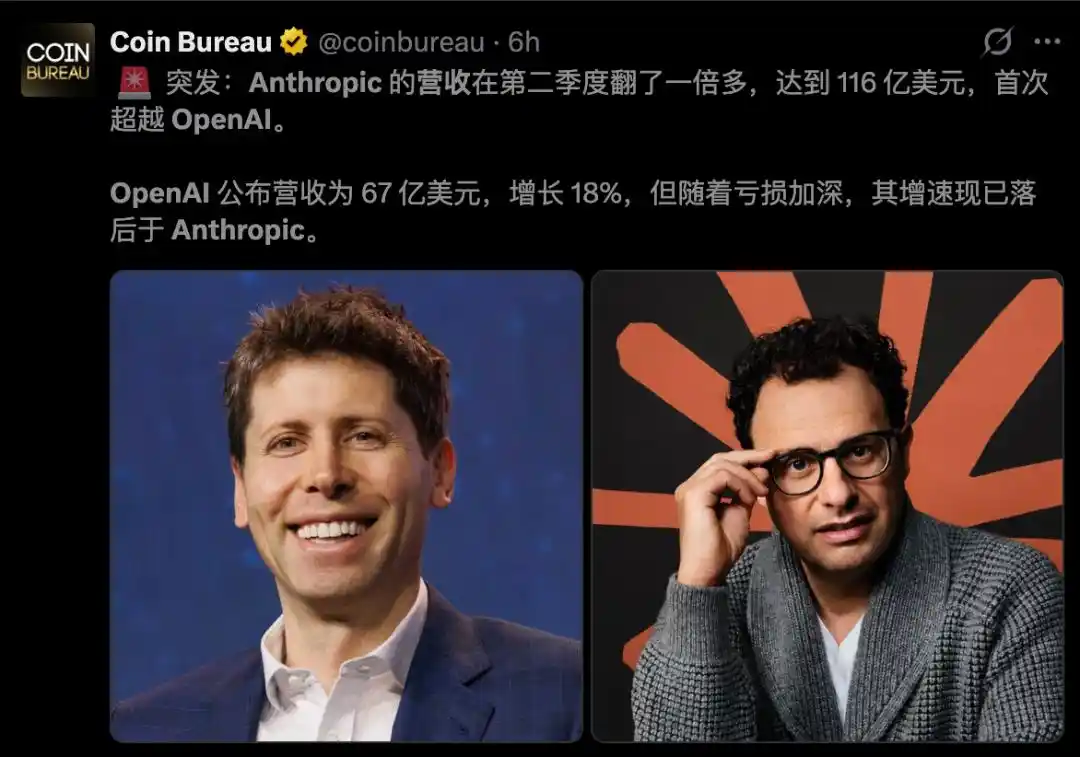
Breaking it down, OpenAI's Q2 revenue was $6.7 billion, up from $5.7 billion in Q1, an 18% sequential increase.

Anthropic, on the other side, reported $11.6 billion in Q2, more than doubling from last year's $787 million.
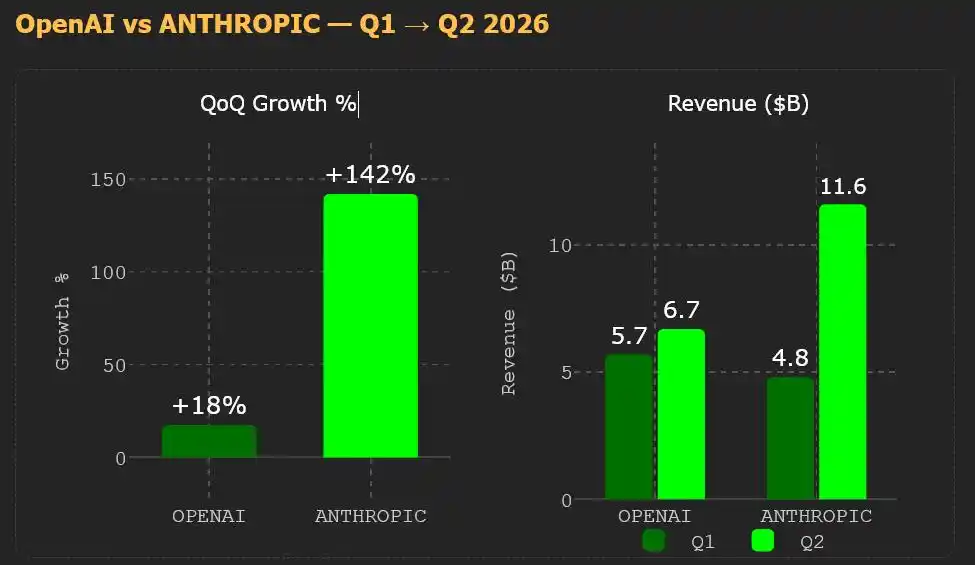
One company's quarterly losses are nearly double what the other earned in a single quarter.

This is the first time in Anthropic's five-year history that its quarterly revenue has surpassed that of its former parent company, OpenAI.

OpenAI's operating loss widened from $9.3 billion to $12.3 billion over the same period. Meanwhile, Anthropic disclosed that its "adjusted operating profit" has turned slightly positive.

Of course, these profit metrics cannot be directly compared.

Exactly which items Anthropic excludes in its "adjusted profit" is not entirely clear to the outside world; in the past, it has also excluded stock-based compensation from its adjusted figures.

But one point is hard to ignore:

At least at this stage, Anthropic's revenue growth speed and compute efficiency are forcing the capital markets to reassess the positions of the two companies.
This shift is actually much more significant than "Claude's recent popularity."

Because for the past few years, one of OpenAI's strongest moats has been scale.

ChatGPT has a massive user base, with brand recognition almost synonymous with AI itself.

Anthropic, while consistently strong in model capabilities, has been more like the capable but less visible challenger.

Now, for the first time, the situation has reversed.

Targeting October, Sprinting Towards a Trillion-Dollar IPO

After completing its financing round in May, Anthropic's valuation has reached $965 billion.

It's just one step away from $1 trillion.

Armed with these results, the Anthropic team has pressed the "fast-forward" button on its IPO.

It secretly filed its S-1 in June, with Morgan Stanley, Goldman Sachs, and JPMorgan as underwriters. Opinions vary on the final bell-ringing moment:

The most conservative estimates point to a listing this fall, with some even suggesting it could happen as early as late September.
If it truly goes public this fall, it might even beat OpenAI to become the first major model company to IPO in this wave of AI.

At the very moment Anthropic seems closest to "victory," Dario is starting to worry about something else:

If the company goes public, who gets the final say?

Holding 2% of Shares, Aiming to Lock Down Control

On the eve of its IPO, Anthropic is preparing to issue shares with extra voting rights to Dario and the other co-founders.

The specific voting multiplier and issuance scale have not been made public. But the intent is not hard to understand:

To ensure Dario retains stronger influence even after the company goes public.

This is not new in Silicon Valley. Tech giants like Meta and Snap have employed similar "dual-class share" structures.

But Anthropic has a unique aspect: Dario holds only a 2% equity stake.
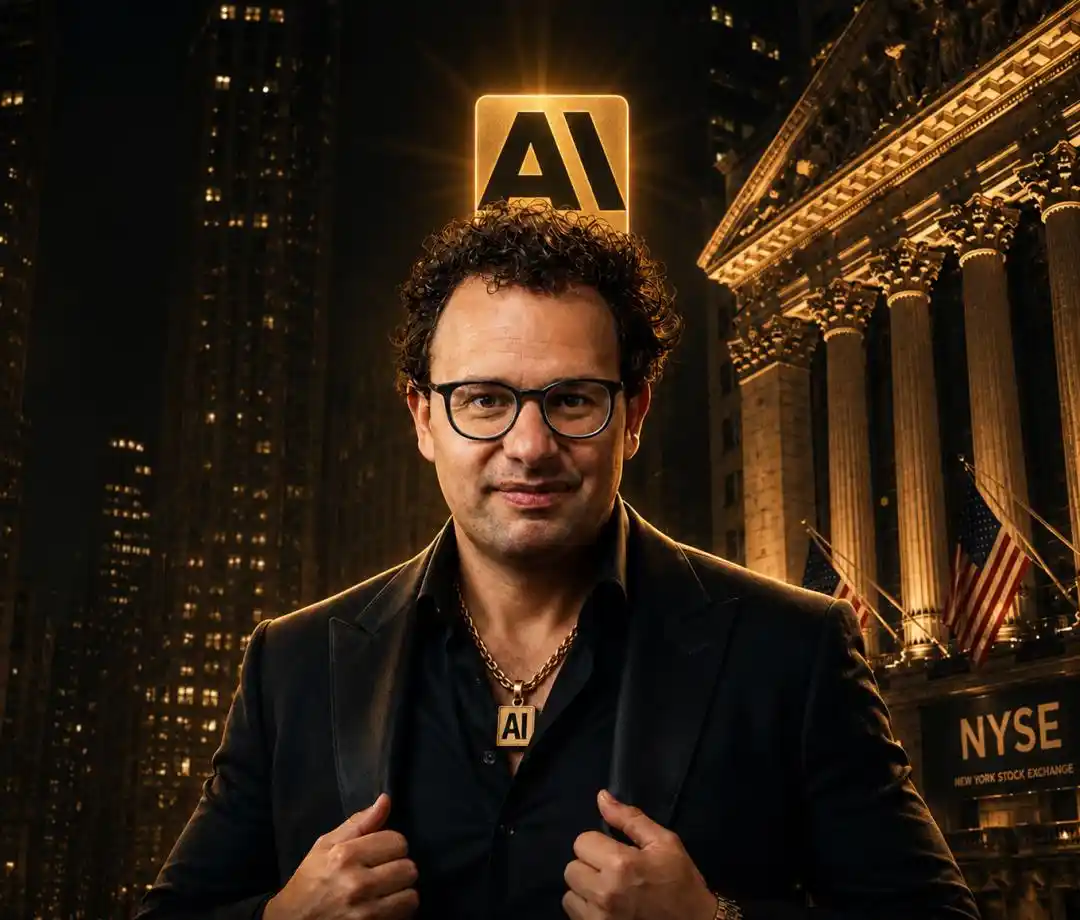
In other words, under the traditional "one share, one vote" corporate governance logic, the more a company raises, the higher its valuation, and the more dispersed its post-IPO shareholders, the more diluted the founder's control tends to become.

And Anthropic happens to be one of the world's most capital-hungry companies.

Frontier model training, data centers, chips, power, inference infrastructure—each of these can swallow vast amounts of capital.

To continue competing with OpenAI, it must keep raising money. The more it raises, the thinner the founders' own shares theoretically become.

So Anthropic now seeks to resolve a contradiction: it wants to take a lot of Wall Street's money, but it doesn't want to hand the steering wheel over to Wall Street.

This is the truly noteworthy aspect of this dual-class share arrangement.

Has OpenAI Really Lost?

If we look only at Q2 revenue, Anthropic is undoubtedly the winner.

Higher revenue, faster growth, and more favorable profitability metrics. But declaring an "AI throne change" is still premature.

Because OpenAI still holds a "trump card" that is difficult for Anthropic to replicate: a massive consumer entry point.

Today, ChatGPT boasts over a billion global users.
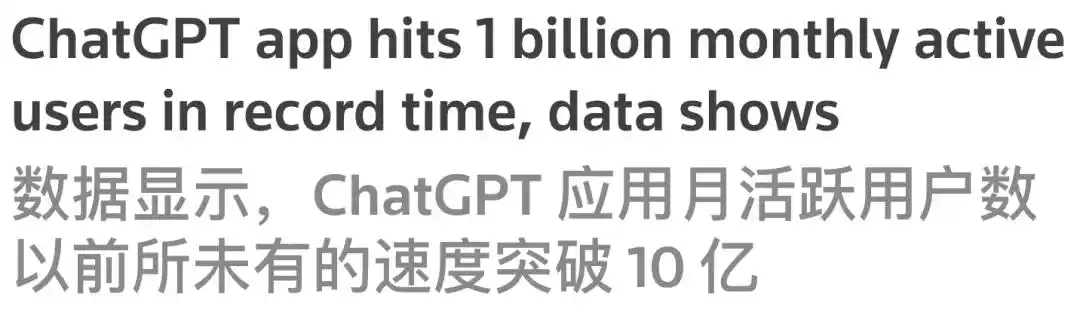
These free users might look like a cost now, but they are also the entry point for OpenAI's future ventures into search, browsers, office tools, shopping, advertising, agents, and even a "super app."

OpenAI has recently started integrating Codex, ChatGPT, and browser capabilities.

Insiders reveal that after the release of new models, growth has re-accelerated in Q3.

The Real Outcome Will Be Seen After the IPO

It's undeniable that Anthropic has scored a beautiful, albeit preliminary, victory.

But the truly brutal battle is just beginning. $65 billion in annualized revenue means the market will scrutinize it with harsher standards.

A valuation nearing $1 trillion means investors are betting on the Anthropic that might control the AI infrastructure entry point years from now.

Meanwhile, Dario's "super-voting rights" themselves are a double-edged sword.

In favorable times, the market will interpret it as the founding team possessing a long-term vision, not bound by quarterly performance.

But in a downturn, the same structure could pose a different problem: if the founder's judgment is wrong, who can hit the brakes?
This is precisely the most interesting contradiction to observe after Anthropic goes public.

Dario is telling Wall Street: you can buy Anthropic, you can share in the gains from growth, but at least for a considerable period, you cannot buy the final decision-making power of this company.

OpenAI stands on the other side.

It has just been surpassed in revenue by Anthropic for the first time, its losses are widening, and it has undergone internal management adjustments.

Yet it still possesses one of the industry's most powerful user entry points and has enough capital, compute, and product ammunition to mount a counteroffensive.

Therefore, the current situation may be more interesting than "Anthropic killing OpenAI."

Anthropic has achieved a clear lead for the first time, but it has also truly stepped into a position where it must defend its title for the first time.

What comes next depends on three questions:

Can Anthropic turn Claude Code's explosive breakout into a sustained commercial advantage lasting several years?

After securing stronger control, can Dario prove that founder-led governance is truly more suitable for a trillion-dollar AI company than Wall Street constraints?

When OpenAI truly begins to counterattack, will Anthropic's current lead mark the beginning of an era's handover or just a brief shift in positions?

$65 billion in annualized revenue, a trillion-dollar IPO, 2% ownership, and super-voting rights.

These three seemingly unrelated sets of numbers collectively point to one undeniable fact:

Anthropic has reached the position closest to the throne.

References:

https://www.bloomberg.com/news/articles/2026-08-18/anthropic-plans-to-give-ceo-extra-voting-power-information-says

This article is from the WeChat public account "新智元" (New Zhiyuan), author: ASI启示录

Criptomoedas em alta

Perguntas relacionadas

QWhich company reportedly surpassed the other in quarterly revenue for the first time, according to the article?

AAccording to the article, Anthropic surpassed OpenAI in quarterly revenue for the first time. Anthropic's Q2 revenue was $11.6 billion, while OpenAI's was $6.7 billion.

QWhat significant corporate action is Anthropic planning ahead of its potential IPO?

AAhead of its potential IPO, Anthropic is reportedly planning to issue a class of shares with "extra voting rights" to CEO Dario Amodei and six co-founders, granting them super-voting power for greater control.

QWhat is Dario Amodei's reported stake in Anthropic, and why is the issuance of super-voting shares particularly notable given this?

ADario Amodei's reported stake in Anthropic is only 2%. The issuance of super-voting shares is notable because it aims to secure founder control despite this small ownership stake, allowing them to retain significant decision-making power after the company goes public and raises more capital.

QWhat is one key advantage that the article suggests OpenAI still holds over Anthropic?

AThe article suggests that OpenAI still holds a key advantage in its massive consumer reach, with ChatGPT having over a billion global users. This provides a significant platform and potential entry point for future products and services.

QWhat potential challenge or risk does the article associate with Anthropic's plan for founder super-voting rights?

AThe article suggests that founder super-voting rights can be a double-edged sword. While it may allow for long-term vision, it also poses a risk if the founder's judgment is wrong, as there may be limited mechanisms for other stakeholders to "hit the brakes" or challenge poor decisions.

Leituras Relacionadas

Gold Diggers in Prediction Markets: From Competing for Trading Entrances to Competing for Outcome Definition Rights

The report identifies a shift in prediction market competition from front-end user acquisition to back-end infrastructure, specifically the "outcome layer." This layer encompasses the standardized services for rule comparison, evidence verification, outcome confirmation, and payment triggering. Analysis shows that while a tiny fraction (0.487%) of markets face disputes, they account for a significant share (8.64%) of traded volume. This highlights the financial impact of rule uncertainty, which creates trading alpha but limits strategy capacity due to shallow order books. The larger opportunity lies in productizing these backend functions. Services like automated settlement (e.g., HIP-4), AI-assisted evidence processing, and external data oracles (e.g., Pyth, Chainlink) are becoming reusable, cross-platform infrastructure. This is creating a "second profit pool" separate from trading fees. Current observable revenue for this outcome layer is estimated at $15-37 million annually. If applied to the entire existing market, this could expand to $64-161 million. In a mature state, modeled after existing commercial models like Azuro's, annual revenue potential could reach approximately $456 million. While the industry logic is forming, pure-play investment assets are still early. Platform equities (e.g., Kalshi, Polymarket) price in broad growth, not just the outcome layer. Tokens like HYPE have minimal fee contribution from related products, and ICE's exposure is too small relative to its total business. The key is to track early projects that achieve cross-platform adoption and convert usage into attributable, recurring revenue. The most significant alpha may emerge before the ideal investment target is fully established.

marsbitHá 29m

Gold Diggers in Prediction Markets: From Competing for Trading Entrances to Competing for Outcome Definition Rights

marsbitHá 29m

Bitcoin Surpasses $72k. What Happens Next?

Bitcoin exceeded $72,000, reaching its highest level since early summer after a $8,000 surge. The broader crypto market followed, with total market capitalization rising 10%. Analysts attribute the rally to a combination of factors: the U.S. Treasury's decision to increase purchases of long-term government bonds, which lowers yields and makes riskier assets like crypto more attractive, and positive remarks about cryptocurrency from former President Donald Trump. Experts note that while Trump's comments provided an emotional boost, the Treasury's action was a more fundamental driver. However, they caution that significant sustained growth is not assured. High U.S. inflation limits the Federal Reserve's ability to ease policy, and network activity within crypto ecosystems remains low. Competition for capital from sectors like semiconductors and AI also persists. Analysts present mixed short-term forecasts. Some see resistance around $72,000; a breakout could target $76,000-$80,000, but a moderate, localized rise within a longer-term downward trend is deemed more likely. Others identify $69,000-$70,000 as a key support zone. A sustained move above $72,000 could open a path toward $75,000-$78,000, or even $80,000-$82,000 under a strong bullish scenario, with support expected around $66,000-$67,000 on any pullback. The overall outlook is cautiously optimistic, with the recent surge signaling improved sentiment, but a confirmed upward trend requires prices to solidify above current levels.

cryptonews.ruHá 33m

Bitcoin Surpasses $72k. What Happens Next?

cryptonews.ruHá 33m

Optimism Developers' Vote Deprives Users of $49 Million Airdrop

On August 19th, the Optimism community approved a proposal to reallocate 546.9 million OP tokens (worth ~$49.7 million) from a reserve for future user airdrops into a new Strategic Ecosystem Fund for development. The vote passed with 17.97 million OP for and 10.93 million against, with a decisive last-minute vote from developer group Test in Prod securing the majority. The funds will now be managed by the Optimism Foundation to foster ecosystem growth, targeting partnerships with blockchains, protocols, and financial firms, and attracting major brands. This marks a strategic shift from broad user acquisition via airdrops to focusing on corporate clients and enterprise solutions (OP Enterprise). The decision does not affect past airdrops, which distributed 269.1 million OP over five rounds. The proposal faced criticism. L2BEAT and delegate cp0x argued the Foundation gains overly broad discretion without sufficient detail on fund use, results measurement, or benefit to OP holders. Critics also noted these tokens were publicly reserved for future user distributions, and their reallocation removes the need for separate community votes on individual Foundation deals. Test in Prod defended its support, stating the reserve is needed for competitive corporate deals where premature disclosure could be detrimental, while urging the Foundation to later disclose aggregate spending and outcomes.

cryptonews.ruHá 33m

Optimism Developers' Vote Deprives Users of $49 Million Airdrop

cryptonews.ruHá 33m

Trading

Spot

Artigos em Destaque

Como comprar PUSH

Bem-vindo à HTX.com!Tornámos a compra de Push Protocol (PUSH) simples e conveniente.Segue o nosso guia passo a passo para iniciar a tua jornada no mundo das criptos.Passo 1: cria a tua conta HTXUtiliza o teu e-mail ou número de telefone para te inscreveres numa conta gratuita na HTX.Desfruta de um processo de inscrição sem complicações e desbloqueia todas as funcionalidades.Obter a minha contaPasso 2: vai para Comprar Cripto e escolhe o teu método de pagamentoCartão de crédito/débito: usa o teu visa ou mastercard para comprar Push Protocol (PUSH) instantaneamente.Saldo: usa os fundos da tua conta HTX para transacionar sem problemas.Terceiros: adicionamos métodos de pagamento populares, como Google Pay e Apple Pay, para aumentar a conveniência.P2P: transaciona diretamente com outros utilizadores na HTX.Mercado de balcão (OTC): oferecemos serviços personalizados e taxas de câmbio competitivas para os traders.Passo 3: armazena teu Push Protocol (PUSH)Depois de comprar o teu Push Protocol (PUSH), armazena-o na tua conta HTX.Alternativamente, podes enviá-lo para outro lugar através de transferência blockchain ou usá-lo para transacionar outras criptomoedas.Passo 4: transaciona Push Protocol (PUSH)Transaciona facilmente Push Protocol (PUSH) no mercado à vista da HTX.Acede simplesmente à tua conta, seleciona o teu par de trading, executa as tuas transações e monitoriza em tempo real.Oferecemos uma experiência de fácil utilização tanto para principiantes como para traders experientes.

757 Visualizações TotaisPublicado em {updateTime}Atualizado em 2026.06.02

Como comprar PUSH

Discussões

Bem-vindo à Comunidade HTX. Aqui, pode manter-se informado sobre os mais recentes desenvolvimentos da plataforma e obter acesso a análises profissionais de mercado. As opiniões dos utilizadores sobre o preço de PUSH (PUSH) são apresentadas abaixo.

活动图片