Dark Pools Prevail, Whales Vanish: How Credible Are Public Market Signals?

marsbitPublicado em 2026-08-07Última atualização em 2026-08-07

Resumo

Institutional cryptocurrency trading is increasingly shifting towards dark pools and over-the-counter (OTC) desks, with data from sFOX showing such venues accounted for 15% of total monthly volume by June, up from negligible levels in April. In July, 77.7% of institutional capital on sFOX's platform was routed through OTC desks, while only 18.4% went to public exchanges. A key driver is institutions' need to conceal large orders to avoid revealing trading patterns, preventing front-running and minimizing price impact. Firms like Jane Street and Citadel use dark pools and order-splitting across multiple venues to execute trades discreetly. This structural shift mirrors earlier developments in equities and forex markets. As a result, public order books now reflect only a fraction of actual market activity, eroding the once-significant advantage retail traders had in tracking large wallets and exchange flows. The proliferation of prime brokers and aggregation platforms is also rapidly closing simple arbitrage opportunities. The market may evolve toward a brokerage model for retail, similar to traditional stocks. Two scenarios emerge: an optimistic one where retail gains from narrower spreads and better order routing, and a pessimistic one where transparency declines faster than benefits trickle down, leaving smaller investors in the dark. Regardless, traders must adapt by not relying solely on exchange volume, comparing total execution costs, and using limit orders in thin marke...

Original Author: Gino Matos

Original Compilation: Saoirse, Foresight News

Data from sFOX shows that cryptocurrency dark pool trading volume continues to climb, growing from negligible levels in April to account for 15% of total monthly volume by June. The firm's July 30th report also noted that 77.7% of institutional capital on its platform was matched through OTC desks, with only 18.4% flowing to public exchanges. In May alone, dark pool transaction volume reached $147 million.

In an interview with CryptoSlate, sFOX's Diana Pires described this as a structural shift, similar to the industry transformation experienced by stock and foreign exchange markets years ago.

Why Institutions Choose Crypto Dark Pools

Large orders placed on public order books leave clear footprints. Other traders can identify these trading patterns, execute trades ahead of the order, or push prices in the opposite direction before the order is filled, thereby increasing trading slippage.

Pires gave an example: institutions like Jane Street and Citadel have strong incentives to hide their trading trails. Once trading patterns are identified by the market, other participants will conduct targeted reverse trades.

This is also the fundamental reason why more and more crypto orders are choosing dark pools, OTC desks, and platforms that can route single orders to over a dozen trading venues simultaneously.

sFOX alone is connected to over 40 exchanges and OTC desks, and its institutional clients typically use 14 to 19 of these channels to complete trades each month on average.

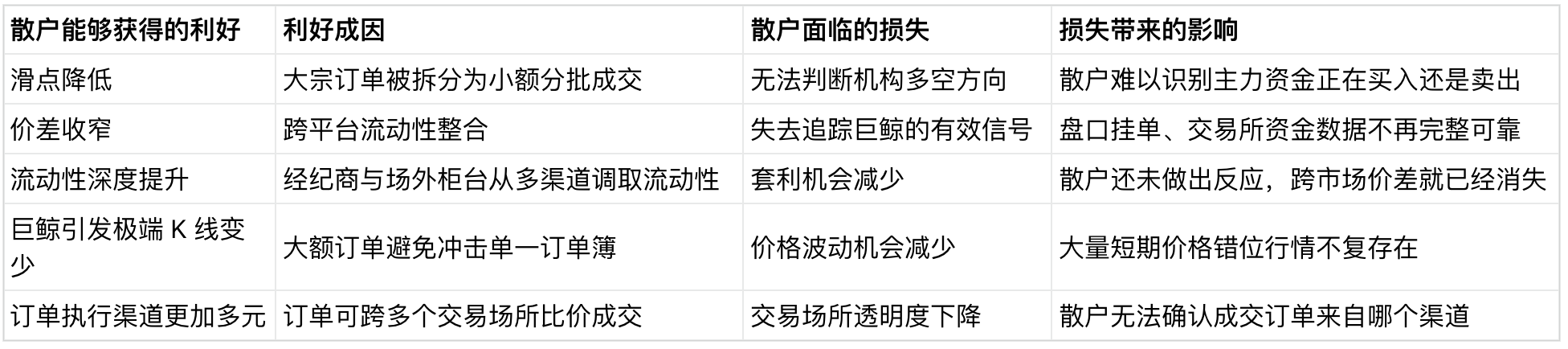
OTC desks that receive large orders typically break them down into smaller orders before distributing them to avoid single transactions from causing severe market fluctuations.

Pires summarized the core logic of crypto dark pools as follows: trading platforms privately take on large positions, then split them into small orders to be sent to exchanges; these small orders hardly disturb the order book. She believes that this type of capital inflow into the public market helps deepen the order book and further narrow the bid-ask spread.

In the past, public order books could reflect the vast majority of real market trading activity, but now they only represent a small fraction of it. Quiet exchange order books do not mean institutions are not trading. Large buyers can accumulate positions over weeks without posting any visible buy orders; large sellers can complete significant reductions in holdings without massive sell pressure appearing on the order book.
The Information Advantage of Tracking Whales Is Being Actively Diminished

Bitcoin and crypto traders once had a natural advantage over participants in other markets: everyone could continuously monitor exchange fund balances, large orders on the order book, and large on-chain holdings.

Pires pointed out that dark pools, by design, eliminate this advantage. Trading platforms, OTC desks, and brokers can see the underlying fund flows. This information is protected by regulatory rules and client agreements, preventing retail traders from knowing whether institutions are buying or selling.

Simple cross-market arbitrage opportunities are also disappearing. Information once spread slower than capital flows, allowing investors to buy low on one exchange and sell high on another for profit. Pires stated that as prime brokers and aggregation platforms simultaneously scan dozens of trading venues, completing arbitrage and closing price gaps before retail traders can capture them, such opportunities are shrinking year by year.

She predicts the crypto trading market will eventually evolve towards a structure similar to the stock market: individual investors will no longer connect directly to exchanges but will instead go through brokers, who will seek the best prices across major trading venues on their behalf.

Retail account trading volumes typically struggle to meet the minimum fee tier thresholds set by exchanges, while brokers aggregating massive institutional orders can easily meet them. Pires believes this disparity will continue to drive ordinary traders towards brokers, although this shift won't be mandated by regulation as it was in the stock market.

Two Market Outlook Scenarios

Optimistic Scenario

Order aggregation platforms and mainstream trading venues handle retail orders in the same way they handle institutional orders. Market spreads continue to narrow, slippage decreases further, and instances of large orders piercing thin order books diminish.

Trading opportunities lost from public exchanges shift to other arenas. On-chain and DeFi markets still maintain public data on large holdings, providing channels for traders wanting to speculate on price volatility; regulated, compliant trading markets will exhibit more stable trends.

Pessimistic Scenario

For traders with ordinary capital sizes, the loss of trading transparency outpaces the realization of expected trading optimization benefits. Retail and medium-sized investors completely lose the ability to discern institutional capital movements.

Spread optimization and premium order routing services remain exclusively for large clients with sufficient capital to access prime brokers and aggregation platforms. Public exchange price signals continue to weaken, with participants relying on monitoring exchange order books being the first to feel the change.

Regardless of the market's direction, traders need to adjust their habits: do not treat the trading volume of a single exchange as a reflection of the entire market; compare total trading costs across different channels before referencing exchange-listed fee rates; when order book depth is insufficient, use limit orders as much as possible to guard against market orders impacting prices.

Beneath seemingly calm order books may lurk large-scale institutional trading.

As the crypto market matures and trading experiences continuously optimize, the difficulty of interpreting the market increases. Retail traders encounter fewer sudden price shocks from whales, but they also find it harder to observe the movements of the most influential capital.


Criptomoedas em alta

Perguntas relacionadas

QWhat is the main trend highlighted in the sFOX report regarding cryptocurrency trading?

AThe sFOX report highlights a significant structural shift, showing that dark pool and OTC trading volumes are rising sharply. In April, dark pool volume was negligible, but by June it accounted for 15% of the total monthly volume. In May alone, dark pool transaction volume reached $147 million.

QWhy are institutional players increasingly using crypto dark pools according to the article?

AInstitutions use dark pools to hide their trading patterns. Large orders on public order books leave clear traces, allowing other traders to front-run them or push prices against them before execution, increasing slippage. Dark pools and OTC desks allow them to break large orders into smaller ones executed across multiple venues, minimizing market impact.

QHow does the rise of dark pools affect the information advantage previously held by crypto traders?

AIt actively dismantles that advantage. Dark pools are designed to obscure large trade flows. Information on institutional buying or selling is protected by regulations and client agreements, making it inaccessible to retail traders. Furthermore, opportunities for simple cross-exchange arbitrage are disappearing as prime brokers and aggregators execute trades faster than retail can.

QWhat are the two potential future scenarios for the crypto market outlined in the article?

AThe article outlines one optimistic and one pessimistic scenario. The optimistic scenario envisions benefits like tighter spreads and lower slippage trickling down to retail traders via aggregators. The pessimistic scenario predicts that transparency will erode faster than benefits materialize for retail, leaving them unable to gauge institutional moves, with premium services remaining exclusive to large clients.

QWhat practical adjustments does the article suggest for traders in light of the rising use of dark pools?

ATraders should adjust by: 1) Not treating a single exchange's volume as representative of the whole market. 2) Comparing comprehensive transaction costs across different channels before referencing exchange-listed fees. 3) Using limit orders over market orders when order book depth is insufficient to prevent price impact.

Leituras Relacionadas

Elon Musk Building Terafab: The Largest Chip Factory for AI, Robots, and Space Data Centers

Elon Musk's SpaceX and Tesla have launched the Terafab project to build a massive semiconductor facility in Grimes County, Texas. The plant, exceeding 9.3 million square meters, aims to integrate logic chip manufacturing, memory production, advanced packaging, and testing. The initial phase requires $16.8 billion in capital investment, with a long-term goal of producing over 1 terawatt of computing power annually. This capacity will support Tesla's Optimus robots and Cybercab autonomous vehicles, as well as SpaceX's orbital data centers. Texas Governor Greg Abbott confirmed the project's start in August 2026, highlighting 3,000 new jobs and a $30 million state grant. Elon Musk emphasized the strategic advantage of combining logic, memory, and packaging under one roof. Musk called the future complex the "largest and most valuable building on Earth," with an area roughly 50 times that of the Pentagon. Intel is the key technology partner, with plans to use its 14A process node for chip production. This partnership aims to diversify supply chains currently dominated by TSMC. The project aligns with the U.S. Pax Silica initiative to secure semiconductor supply chains. An AI analysis notes the project's scale and potential challenges, comparing it to delays seen in other U.S. megafab projects like Intel's Ohio facility. It questions whether Terafab can avoid similar pitfalls related to timelines, budgets, workforce, and supply chain stability. The facility's success could significantly shift the global semiconductor balance and strengthen the U.S. position in the tech race.

cryptonews.ruHá 14m

Elon Musk Building Terafab: The Largest Chip Factory for AI, Robots, and Space Data Centers

cryptonews.ruHá 14m

Elon Musk is Building Terafab: The Largest Chip Plant for AI, Robots, and Space Data Centers

Elon Musk's SpaceX and Tesla have launched the massive Terafab project to build a semiconductor plant in Grimes County, Texas. Spanning over 9.3 million square meters, the facility will integrate logic chip and memory production, advanced packaging, and testing. The initial phase requires $16.8 billion in capital investment, with a long-term goal of producing over 1 terawatt of computing power annually. This output is intended to supply Tesla's Optimus robots and Cybercab autonomous vehicles, as well as SpaceX's orbital data centers. Texas Governor Greg Abbott confirmed the project's start on August 6, 2026, highlighting the creation of 3,000 jobs and a $30 million grant from the Texas Enterprise Fund. Musk emphasized the strategic advantage of combining chip design, memory production, and packaging under one roof to accelerate hardware development. He stated the fully built complex would be "the largest and most valuable building on Earth," about 50 times larger than the Pentagon. An estimated 25% of production is earmarked for Tesla's robotics, with 75% for SpaceX's space-based AI systems. Earlier tax documents suggested a total project cost of up to $119 billion, but this has not been officially confirmed. Intel is the key technology partner, with plans to use its 14A process node for chip manufacturing. This partnership aims to diversify supply chains and reduce dependence on dominant foundries like TSMC. The initiative aligns with the broader U.S. Pax Silica program, which seeks to build secure international semiconductor supply chains with allied nations. An AI-driven analysis notes that megafab projects, such as Intel's delayed Ohio facility, often face schedule and budget overruns. While Terafab represents a significant step toward U.S. semiconductor self-sufficiency and could shift the global tech balance, its success will depend on factors like skilled labor availability, energy supply, and supply chain stability. The final outcome may not be clear until the late 2030s.

cryptonews.ruHá 29m

Elon Musk is Building Terafab: The Largest Chip Plant for AI, Robots, and Space Data Centers

cryptonews.ruHá 29m

"AI God of Stocks" Blowup Dragged Down, Jane Street Suffered Massive 15 Billion Loss in July, First Monthly Loss in a Decade

Jane Street, a major proprietary trading firm, suffered an estimated $15 billion loss in July, marking its first monthly loss in about a decade. The loss was primarily triggered by the blow-up of the AI-focused hedge fund Situational Awareness, which faced massive margin calls amid a sharp sell-off in AI and semiconductor stocks in July. Jane Street, an investor in the fund, was significantly impacted. Compounding the loss were substantial declines in Jane Street's own Asian non-AI equity long positions, which had performed well earlier in the year. The firm described the losses as a concentrated reversal of previously successful trading strategies in AI and tech sectors. Despite the historic monthly loss, Jane Street's net trading income for the year to date remains strong at over $40 billion. In response, the firm stated it has become more selective in risk-taking, closing specific losing exposures and reducing risk in other strategies. Coinciding with the loss, Jane Street is undergoing a major debt refinancing of approximately $14.6 billion, led by JPMorgan. The move aims to shift more debt from public markets to private investors like Pimco and Fidelity, accepting higher costs for greater flexibility and less public disclosure. The Situational Awareness incident highlights systemic risks in the prime brokerage ecosystem, where leveraged bets on crowded AI trades can lead to forced liquidations and market volatility. Jane Street's subsequent risk reduction and debt restructuring are seen as key responses to this costly lesson.

marsbitHá 34m

"AI God of Stocks" Blowup Dragged Down, Jane Street Suffered Massive 15 Billion Loss in July, First Monthly Loss in a Decade

marsbitHá 34m

QCP Capital Analysts Explained Why Bitcoin Stalled at $63,000

QCP Capital's latest report explains that Bitcoin has stalled around $63,000, testing the lower boundary of its recent trading range ($62,500–$64,000). The retreat wasn't due to a single catalyst but stems from several cross-market pressures: heightened geopolitical risks, rising oil prices, uncertainty around global liquidity, and a muted reaction to positive U.S. macroeconomic data. While U.S. inflation and jobs data softened, reducing expectations of imminent Fed tightening, Bitcoin's price response has been subdued. This highlights the importance of other factors like trader positioning, liquidity conditions, and overall risk appetite. The regulatory landscape is progressing on two tracks: congressional legislation (like the CLARITY Act) is delayed, but SEC rulemaking continues. Corporate treasury activity, exemplified by Strategy's new Bitcoin monetization program, now creates a potential two-way flow, adding complexity to supply dynamics. Geopolitical tensions around the Strait of Hormuz keep oil prices elevated, impacting crypto indirectly through inflation expectations and financial conditions. Historical seasonality shows August and September are typically weak for Bitcoin, but this is descriptive, not predictive, in today's ETF-driven market. In conclusion, Bitcoin has shown resilience by absorbing multiple negative forces without a decisive breakdown. However, it has failed to convert improving macro fundamentals into sustained upward momentum. The market awaits key events like the U.S. PCE data, the Jackson Hole symposium, and the September FOMC meeting for a potential catalyst to break the current range.

cryptonews.ruHá 1h

QCP Capital Analysts Explained Why Bitcoin Stalled at $63,000

cryptonews.ruHá 1h

Trading

Spot

Artigos em Destaque

Como comprar DATA

Bem-vindo à HTX.com!Tornámos a compra de DATA Network (DATA) simples e conveniente.Segue o nosso guia passo a passo para iniciar a tua jornada no mundo das criptos.Passo 1: cria a tua conta HTXUtiliza o teu e-mail ou número de telefone para te inscreveres numa conta gratuita na HTX.Desfruta de um processo de inscrição sem complicações e desbloqueia todas as funcionalidades.Obter a minha contaPasso 2: vai para Comprar Cripto e escolhe o teu método de pagamentoCartão de crédito/débito: usa o teu visa ou mastercard para comprar DATA Network (DATA) instantaneamente.Saldo: usa os fundos da tua conta HTX para transacionar sem problemas.Terceiros: adicionamos métodos de pagamento populares, como Google Pay e Apple Pay, para aumentar a conveniência.P2P: transaciona diretamente com outros utilizadores na HTX.Mercado de balcão (OTC): oferecemos serviços personalizados e taxas de câmbio competitivas para os traders.Passo 3: armazena teu DATA Network (DATA)Depois de comprar o teu DATA Network (DATA), armazena-o na tua conta HTX.Alternativamente, podes enviá-lo para outro lugar através de transferência blockchain ou usá-lo para transacionar outras criptomoedas.Passo 4: transaciona DATA Network (DATA)Transaciona facilmente DATA Network (DATA) no mercado à vista da HTX.Acede simplesmente à tua conta, seleciona o teu par de trading, executa as tuas transações e monitoriza em tempo real.Oferecemos uma experiência de fácil utilização tanto para principiantes como para traders experientes.

473 Visualizações TotaisPublicado em {updateTime}Atualizado em 2026.07.01

Como comprar DATA

Discussões

Bem-vindo à Comunidade HTX. Aqui, pode manter-se informado sobre os mais recentes desenvolvimentos da plataforma e obter acesso a análises profissionais de mercado. As opiniões dos utilizadores sobre o preço de DATA (DATA) são apresentadas abaixo.

活动图片