QCP Capital Analysts Explained Why Bitcoin Stalled at $63,000

cryptonews.ruPublicado em 2026-08-15Última atualização em 2026-08-15

Resumo

QCP Capital's latest report explains that Bitcoin has stalled around $63,000, testing the lower boundary of its recent trading range ($62,500–$64,000). The retreat wasn't due to a single catalyst but stems from several cross-market pressures: heightened geopolitical risks, rising oil prices, uncertainty around global liquidity, and a muted reaction to positive U.S. macroeconomic data. While U.S. inflation and jobs data softened, reducing expectations of imminent Fed tightening, Bitcoin's price response has been subdued. This highlights the importance of other factors like trader positioning, liquidity conditions, and overall risk appetite. The regulatory landscape is progressing on two tracks: congressional legislation (like the CLARITY Act) is delayed, but SEC rulemaking continues. Corporate treasury activity, exemplified by Strategy's new Bitcoin monetization program, now creates a potential two-way flow, adding complexity to supply dynamics. Geopolitical tensions around the Strait of Hormuz keep oil prices elevated, impacting crypto indirectly through inflation expectations and financial conditions. Historical seasonality shows August and September are typically weak for Bitcoin, but this is descriptive, not predictive, in today's ETF-driven market. In conclusion, Bitcoin has shown resilience by absorbing multiple negative forces without a decisive breakdown. However, it has failed to convert improving macro fundamentals into sustained upward momentum. The market await...

QCP Capital published a fresh report for traders, noting that Bitcoin's range has been tested for resilience but not broken. The asset retreated to the $63,000 mark, abandoning its earlier move towards $64,000, and returned to the lower boundary of its recent trading range. The company's analysts note that this pullback was not triggered by any single dominant industry catalyst—instead, digital assets are simultaneously facing several cross-market pressures: heightened geopolitical risks, rising oil prices, uncertainty surrounding global liquidity, and a weak response to generally favorable U.S. macroeconomic data.
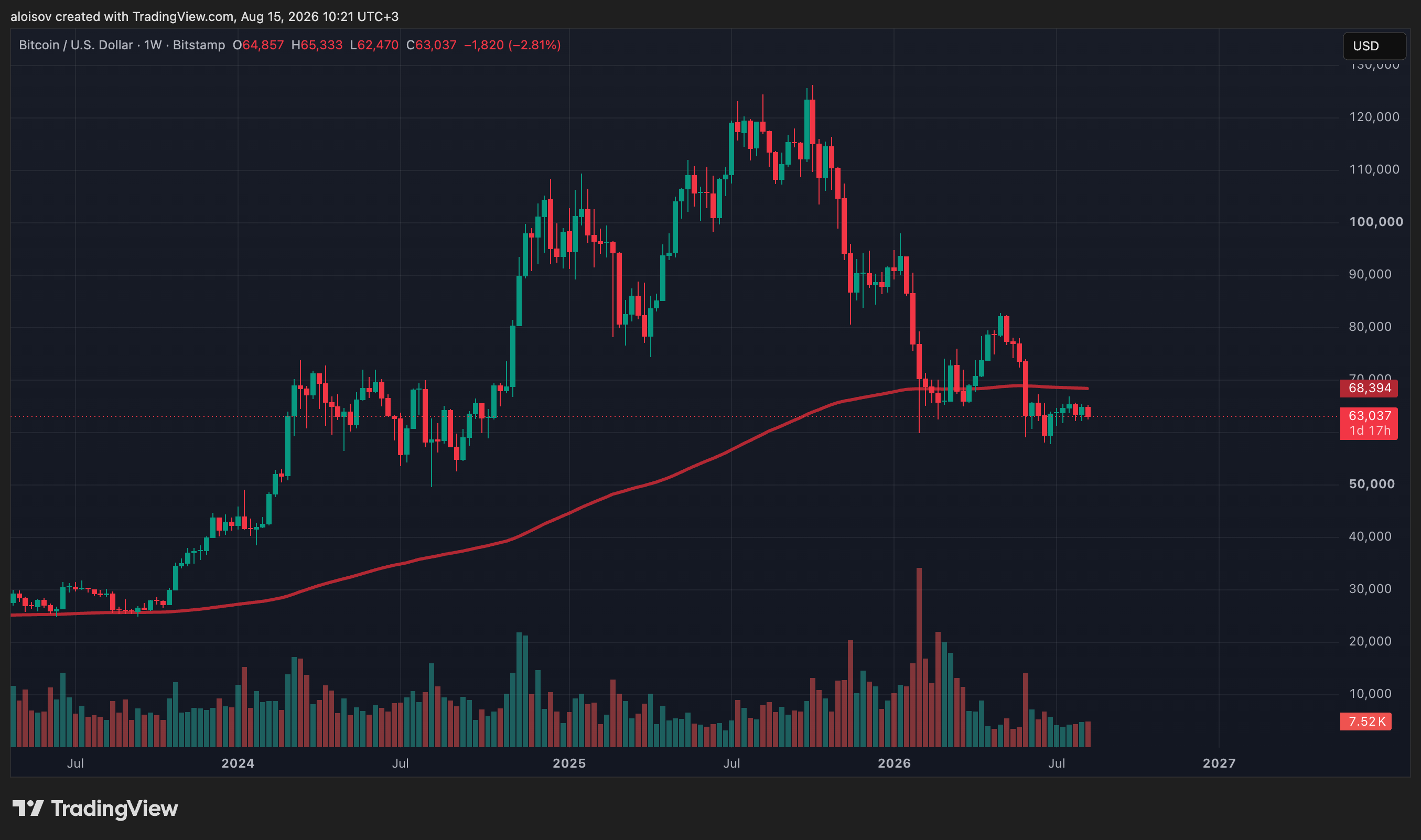
1-week chart of $BTC/USD and 200EMA. Source: Bitstamp

Range Held but Lacked Momentum

According to QCP Capital's observation, last week Bitcoin demonstrated resilience, absorbing several negative headlines without a sharp breakdown. This week, as noted in the report, reinforced the distinction between resilience and momentum: the range remains unchanged, but softer inflation data has so far elicited only a muted response from the market.

The $62,500–63,000 area continues to act as the lower boundary of the recent trading range. Whether this range holds will increasingly depend on the interplay of macroeconomic data, liquidity conditions, and asset-specific fund flows, rather than any single trigger.

Inflation Slows, Bitcoin Remains in Sideways Trend

U.S. inflation data this week provided further confirmation that price pressures are easing. According to the report, the annual Consumer Price Index (CPI) for July fell to 3.4% from 3.5% in June, while core CPI slowed to 2.5% from 2.6%. The Producer Price Index (PPI) also came in softer than expected: the figure remained unchanged in July against a forecast of 0.2% growth, following a 0.3% decline in June.

This data came after a notably weaker July employment report, which showed a decline of 23k in non-farm payrolls and downward revisions to figures for the two previous months. Together, these releases have reduced market expectations for imminent monetary policy tightening, although inflation still exceeds the Fed's long-term target.

Bitcoin's response, however, remained subdued. QCP Capital emphasizes that this should not be interpreted as a directional signal—the divergence between softening macro data and a sluggish price reaction points to the importance of other variables: trader positioning, the state of liquidity, and overall risk appetite, which determine how macro data is translated into crypto asset prices.

Market attention is now shifting to the U.S. Personal Consumption Expenditures (PCE) index, due on August 26, and the September meeting of the Federal Open Market Committee (FOMC). Investors appear likely to focus on whether the slowdown in inflation is accompanied by sufficient economic resilience to keep financial conditions stable.

Regulation Progresses Along Two Trajectories

The report notes that U.S. digital asset policy is increasingly developing along two parallel paths. In Congress, Senate consideration of the CLARITY Act has moved beyond the August recess. Senate Majority Leader John Thune stated that the bill will return for House consideration in September, though disagreements over ethics provisions and banking issues remain unresolved.

Simultaneously, regulatory work continues independently of the legislative schedule. The Securities and Exchange Commission's (SEC) 2026 agenda includes further work on capital raising through crypto assets and tokenized securities, with the agency already taking steps this year regarding trading of tokenized stocks.

QCP Capital emphasizes that this is an important distinction: delays in passing comprehensive legislation do not mean regulatory development has stopped—individual elements of the regulatory framework continue to take shape through agency rulemaking, guidance, and existing legislative procedures.

Strategy Now Both Buys and Sells

Corporate treasury activity also remains significant for Bitcoin's supply dynamics. According to the report, Strategy disclosed another sale of 1,690 $BTC for $109 million last week, using the proceeds for preferred stock buybacks. Additionally, the company raised approximately $653 million through an issuance of common stock to replenish dollar reserves.

These transactions follow the launch of a formal Bitcoin Monetization Program, which Strategy introduced this summer. Under this program, the company can sell Bitcoin to support dollar reserves and other balance sheet needs. JPMorgan notes that this creates a risk of "two-way" fund flows, as Strategy can now act as both a major buyer and seller of Bitcoin—depending on its financing needs.

QCP Capital clarifies: this does not mean corporate treasuries should be viewed as a constant source of supply in the market. However, it makes the flow picture more conditional than in earlier stages of the cycle. For the market, it's now not only the volumes that corporate treasuries acquire that matter, but also their liquid position, financing conditions, and disclosed asset sale policies.

Negotiations Around the Strait of Hormuz Continue, Oil Remains High

Geopolitical uncertainty remains another source of pressure across several asset classes. According to the report, Oman-mediated negotiations on the framework conditions for commercial shipping through the Strait of Hormuz are ongoing, with Qatar and Pakistan still participating in the broader mediation process between the U.S. and Iran. Negotiators have made progress on possible shipping agreements, but full and sustainable resumption of passage is not yet secured.

This uncertainty is reflected in energy markets. Brent crude traded around $88 on the morning of August 14 and is heading for a significant weekly gain—limited shipping through the Strait of Hormuz and the absence of a sustainable agreement maintain a geopolitical risk premium.

For cryptocurrencies, QCP Capital notes, the macroeconomic transmission channel remains relevant. Sustained increases in energy prices can impact overall inflation, inflation expectations, and long-term bond yields—all of which, in turn, affect financial conditions for liquidity-sensitive assets.

As long as physical shipping does not normalize on a sustainable basis, the situation around the Strait of Hormuz remains significant for cryptocurrencies primarily through oil, interest rates, and global liquidity, rather than through a direct channel of influence on digital assets.

Seasonality as Context, Not as a Guide

The calendar also provides historical context for the current price dynamics. According to data from Bespoke Investment Group cited in the QCP Capital report, Bitcoin's median return for August historically stands around -7.5%, with positive returns occurring in roughly 30% of observations. September has also traditionally been weaker—with a median decline of about 5.3%. Bitcoin posted negative returns in August each year from 2022 through 2025.

QCP Capital emphasizes: historical seasonality is descriptive, not predictive, especially considering how the structure of the crypto market has changed due to exchange-traded funds (ETFs) and increased institutional participation. Nevertheless, seasonality provides useful context for periods when thinner late-summer liquidity may coincide with reduced trading activity and heightened sensitivity to trader positioning.

More relevant, according to the company's analysts, is not the question of whether history will repeat itself, but whether the current range will hold as the market moves through the seasonally calmer part of the calendar.

Resilience Exists, Momentum Not Yet Present

In the concluding part of the report, QCP Capital notes that Bitcoin is not reacting to any single dominant negative catalyst. Instead, it continues to absorb several competing forces simultaneously: easing U.S. inflation, a weakening labor market, elevated oil prices, evolving regulation, and the more conditional nature of flows from corporate treasuries.

The analysts' conclusion largely reiterates their conclusion from a week ago. Bitcoin has demonstrated the ability to absorb negative news without a sustained breakdown, but the market has so far failed to convert improving elements of the macroeconomic backdrop into sustained upward momentum.

An exit from the current range in either direction, according to QCP Capital, would give the market much more information than intraday fluctuations within it. Until then, resilience remains the market's main characteristic—but not momentum.

Key Events in the Coming Weeks

  • August 19 — Publication of FOMC meeting minutes

  • August 26 — U.S. PCE index for July, second estimate of Q2 GDP

  • August 27–29 — Economic Symposium in Jackson Hole

  • September 15–16 — FOMC meeting

Bitcoin's current range resembles a tightly coiled spring: pressure is building from all sides, but the form holds for now. The market is testing the strength of this structure from both sides, finding no immediate reason for a sharp move.

The coming weeks—with the release of PCE data, the Jackson Hole symposium, and the September Fed meeting—will test whether this structure can withstand the seasonally weaker period or whether the accumulated pressure finally finds an outlet.

AI Opinion

From the perspective of machine data analysis, the current linkage of "oil—liquidity—Bitcoin" is not new to the crypto market. Earlier this year, the asset already faced similar pressure: when Brent exceeded $119 per barrel, Bitcoin unexpectedly held firm and moved upward, breaking the usual correlation with risky assets. This shows that the transmission channel "oil → inflation expectations → yields → crypto market," described in the QCP Capital report, does not work mechanically—in practice, Bitcoin's behavior depends on whether the asset is perceived in the moment as a risky instrument or a defensive one.

A technical aspect not covered in the report: the narrow range of $62,500–64,000 amid declining realized volatility statistically increases the probability of a sharp, directional move—regardless of macro news. Will the current compression maintain directional uncertainty until the September FOMC meeting, or will the market find a reason to exit earlier?


Criptomoedas em alta

Perguntas relacionadas

QAccording to the QCP Capital report, what are the main cross-market factors currently pressuring Bitcoin and digital assets?

AAccording to the QCP Capital report, Bitcoin and digital assets are facing simultaneous pressure from several cross-market factors: heightened geopolitical risks, rising oil prices, uncertainty around global liquidity, and a weak reaction to generally favorable U.S. macro data.

QHow did Bitcoin react to the latest U.S. inflation and employment data, according to the analysis?

AAccording to the analysis, Bitcoin's reaction to the softening U.S. inflation data (CPI, PPI) and weaker employment report has been restrained or muted. The report states this divergence highlights the importance of other variables like trader positioning, liquidity conditions, and overall risk appetite in translating macro data into crypto asset prices.

QWhat risk does the company Strategy's new Bitcoin Monetization Program introduce to the market, as mentioned by JPMorgan?

AJPMorgan points out that Strategy's formal Bitcoin Monetization Program creates a risk of 'two-way' fund flows. This means Strategy can now act as both a major buyer and a major seller of Bitcoin, depending on its funding and balance sheet needs, making the supply flow picture more conditional.

QBeyond legislation, how is U.S. crypto regulation continuing to evolve, as noted in the report?

AThe report notes that U.S. crypto regulation is progressing independently of the legislative calendar. The SEC's 2026 agenda includes further work on capital raising via crypto assets and tokenized securities, and the agency has already taken steps this year regarding trading of tokenized securities. This shows regulatory development continues through agency rulemaking, guidance, and existing legislative procedures.

QWhat is the historical seasonal performance context for Bitcoin in August and September, and how should it be viewed according to QCP?

AHistorically, Bitcoin's median return in August is around -7.5% and in September around -5.3%, with positive August returns occurring only about 30% of the time. QCP Capital emphasizes that this seasonality is descriptive, not predictive, especially given structural market changes like ETFs. It provides context for periods of thinner late-summer liquidity and reduced trading activity, but the key question is whether the current trading range will hold during this seasonally quieter period.

Leituras Relacionadas

Elon Musk Building Terafab: The Largest Chip Factory for AI, Robots, and Space Data Centers

Elon Musk's SpaceX and Tesla have launched the Terafab project to build a massive semiconductor facility in Grimes County, Texas. The plant, exceeding 9.3 million square meters, aims to integrate logic chip manufacturing, memory production, advanced packaging, and testing. The initial phase requires $16.8 billion in capital investment, with a long-term goal of producing over 1 terawatt of computing power annually. This capacity will support Tesla's Optimus robots and Cybercab autonomous vehicles, as well as SpaceX's orbital data centers. Texas Governor Greg Abbott confirmed the project's start in August 2026, highlighting 3,000 new jobs and a $30 million state grant. Elon Musk emphasized the strategic advantage of combining logic, memory, and packaging under one roof. Musk called the future complex the "largest and most valuable building on Earth," with an area roughly 50 times that of the Pentagon. Intel is the key technology partner, with plans to use its 14A process node for chip production. This partnership aims to diversify supply chains currently dominated by TSMC. The project aligns with the U.S. Pax Silica initiative to secure semiconductor supply chains. An AI analysis notes the project's scale and potential challenges, comparing it to delays seen in other U.S. megafab projects like Intel's Ohio facility. It questions whether Terafab can avoid similar pitfalls related to timelines, budgets, workforce, and supply chain stability. The facility's success could significantly shift the global semiconductor balance and strengthen the U.S. position in the tech race.

cryptonews.ruHá 15m

Elon Musk Building Terafab: The Largest Chip Factory for AI, Robots, and Space Data Centers

cryptonews.ruHá 15m

Elon Musk is Building Terafab: The Largest Chip Plant for AI, Robots, and Space Data Centers

Elon Musk's SpaceX and Tesla have launched the massive Terafab project to build a semiconductor plant in Grimes County, Texas. Spanning over 9.3 million square meters, the facility will integrate logic chip and memory production, advanced packaging, and testing. The initial phase requires $16.8 billion in capital investment, with a long-term goal of producing over 1 terawatt of computing power annually. This output is intended to supply Tesla's Optimus robots and Cybercab autonomous vehicles, as well as SpaceX's orbital data centers. Texas Governor Greg Abbott confirmed the project's start on August 6, 2026, highlighting the creation of 3,000 jobs and a $30 million grant from the Texas Enterprise Fund. Musk emphasized the strategic advantage of combining chip design, memory production, and packaging under one roof to accelerate hardware development. He stated the fully built complex would be "the largest and most valuable building on Earth," about 50 times larger than the Pentagon. An estimated 25% of production is earmarked for Tesla's robotics, with 75% for SpaceX's space-based AI systems. Earlier tax documents suggested a total project cost of up to $119 billion, but this has not been officially confirmed. Intel is the key technology partner, with plans to use its 14A process node for chip manufacturing. This partnership aims to diversify supply chains and reduce dependence on dominant foundries like TSMC. The initiative aligns with the broader U.S. Pax Silica program, which seeks to build secure international semiconductor supply chains with allied nations. An AI-driven analysis notes that megafab projects, such as Intel's delayed Ohio facility, often face schedule and budget overruns. While Terafab represents a significant step toward U.S. semiconductor self-sufficiency and could shift the global tech balance, its success will depend on factors like skilled labor availability, energy supply, and supply chain stability. The final outcome may not be clear until the late 2030s.

cryptonews.ruHá 30m

Elon Musk is Building Terafab: The Largest Chip Plant for AI, Robots, and Space Data Centers

cryptonews.ruHá 30m

"AI God of Stocks" Blowup Dragged Down, Jane Street Suffered Massive 15 Billion Loss in July, First Monthly Loss in a Decade

Jane Street, a major proprietary trading firm, suffered an estimated $15 billion loss in July, marking its first monthly loss in about a decade. The loss was primarily triggered by the blow-up of the AI-focused hedge fund Situational Awareness, which faced massive margin calls amid a sharp sell-off in AI and semiconductor stocks in July. Jane Street, an investor in the fund, was significantly impacted. Compounding the loss were substantial declines in Jane Street's own Asian non-AI equity long positions, which had performed well earlier in the year. The firm described the losses as a concentrated reversal of previously successful trading strategies in AI and tech sectors. Despite the historic monthly loss, Jane Street's net trading income for the year to date remains strong at over $40 billion. In response, the firm stated it has become more selective in risk-taking, closing specific losing exposures and reducing risk in other strategies. Coinciding with the loss, Jane Street is undergoing a major debt refinancing of approximately $14.6 billion, led by JPMorgan. The move aims to shift more debt from public markets to private investors like Pimco and Fidelity, accepting higher costs for greater flexibility and less public disclosure. The Situational Awareness incident highlights systemic risks in the prime brokerage ecosystem, where leveraged bets on crowded AI trades can lead to forced liquidations and market volatility. Jane Street's subsequent risk reduction and debt restructuring are seen as key responses to this costly lesson.

marsbitHá 35m

"AI God of Stocks" Blowup Dragged Down, Jane Street Suffered Massive 15 Billion Loss in July, First Monthly Loss in a Decade

marsbitHá 35m

Trading

Spot

Artigos em Destaque

O que é BITCOIN

Compreender o HarryPotterObamaSonic10Inu (ERC-20) e a Sua Posição no Espaço Cripto Nos últimos anos, o mercado de criptomoedas assistiu a um aumento na popularidade das moedas meme, cativando não apenas os traders, mas também aqueles que procuram envolvimento comunitário e valor de entretenimento. Entre estes tokens únicos está o HarryPotterObamaSonic10Inu (ERC-20), um projeto intrigante que mistura referências culturais no tecido das criptomoedas. Este artigo explora os principais aspetos do HarryPotterObamaSonic10Inu, examinando os seus mecanismos, a sua ética orientada pela comunidade e o seu envolvimento com o vasto panorama cripto. O que é o HarryPotterObamaSonic10Inu (ERC-20)? Como o nome sugere, o HarryPotterObamaSonic10Inu é uma moeda meme construída na blockchain Ethereum, classificada sob o padrão ERC-20. Ao contrário das criptomoedas tradicionais, que podem enfatizar a utilidade prática ou o potencial de investimento, este token prospera no valor de entretenimento e na força da sua comunidade. O projeto visa promover um ambiente onde utilizadores envolvidos possam reunir-se, partilhar ideias e participar em atividades inspiradas por diversos fenómenos culturais. Uma característica notável do HarryPotterObamaSonic10Inu é a zero taxa sobre transações. Este elemento atraente visa encorajar a negociação e o envolvimento da comunidade, isento de encargos adicionais que podem desencorajar os traders de pequena escala. A oferta total da moeda está fixada em mil milhões de tokens, uma cifra que marca a sua intenção de manter uma circulação substancial dentro da comunidade. Criador do HarryPotterObamaSonic10Inu (ERC-20) As origens do HarryPotterObamaSonic10Inu estão um pouco envoltas em mistério; os detalhes sobre o criador permanecem desconhecidos. O desenvolvimento deste token carece de uma equipa identificável ou de um plano explícito, o que não é raro no setor das moedas meme. Em vez disso, o projeto surgiu de forma orgânica, com o seu progresso a depender fortemente do entusiasmo e da participação da sua comunidade. Investidores do HarryPotterObamaSonic10Inu (ERC-20) No que diz respeito a investimentos externos e apoios, o HarryPotterObamaSonic10Inu também permanece ambíguo. O token não lista quaisquer fundações de investimento conhecidas ou apoio organizacional significativo. Em vez disso, o “sangue vital” do projeto é a sua comunidade de base, que informa o seu crescimento e sustentabilidade através da ação coletiva e do envolvimento no espaço cripto. Como Funciona o HarryPotterObamaSonic10Inu (ERC-20)? Como uma moeda meme, o HarryPotterObamaSonic10Inu opera principalmente fora dos quadros tradicionais que muitas vezes governam o valor dos ativos. Existem vários aspetos distintivos que definem como o projeto funciona: Transações Sem Taxas: Sem taxas sobre transações, os utilizadores podem comprar e vender o token livremente, sem a preocupação de custos ocultos. Envolvimento da Comunidade: O projeto prospera na interação da comunidade, aproveitando plataformas de redes sociais para criar entusiasmo e facilitar a participação. Discussões, partilha de conteúdo e envolvimento são elementos cruciais que ajudam a expandir o seu alcance e a fomentar a lealdade entre os apoiantes. Sem Utilidade Prática: Deve ser notado que o HarryPotterObamaSonic10Inu não oferece utilidade concreta dentro do ecossistema financeiro. Em vez disso, é classificado como um token principalmente para entretenimento e atividades comunitárias. Referência Cultural: O token incorpora de forma inteligente elementos da cultura popular para atrair interesse, conectando-se tanto com entusiastas de memes como com seguidores de criptomoedas. HarryPotterObamaSonic10Inu exemplifica como as moedas meme operam de forma diferente de projetos de criptomoedas mais tradicionais, entrando no mercado como construções sociais inovadoras em vez de ativos utilitários. Linha do Tempo do HarryPotterObamaSonic10Inu (ERC-20) A história do HarryPotterObamaSonic10Inu é marcada por vários marcos notáveis: Criação: O token surgiu de um meme viral, capturando a imaginação de muitos entusiastas de criptomoedas. Datas específicas de criação não estão disponíveis, sublinhando a sua ascensão orgânica. Listagem em Exchanges: O HarryPotterObamaSonic10Inu conseguiu entrar em várias exchanges, permitindo um acesso e negociação mais fáceis pela comunidade. Iniciativas de Envolvimento da Comunidade: Atividades contínuas direcionadas a melhorar a interação comunitária, incluindo concursos, campanhas em redes sociais e geração de conteúdo por fãs e defensores. Planos de Expansão Futura: O roteiro do projeto inclui o lançamento de uma coleção de NFTs, mercadorias e um site de eCommerce relacionado aos seus temas culturais, envolvendo ainda mais a comunidade e tentando adicionar mais dimensões ao seu ecossistema. Pontos-Chave sobre o HarryPotterObamaSonic10Inu (ERC-20) Natureza Orientada pela Comunidade: O projeto prioriza a contribuição coletiva e a criatividade, assegurando que o envolvimento dos utilizadores está na vanguarda do seu desenvolvimento. Classificação como Moeda Meme: Representa o epítome da criptomoeda baseada em entretenimento, destacando-se dos veículos de investimento tradicionais. Sem Afiliação Direta com o Bitcoin: Apesar da semelhança no nome do ticker, o HarryPotterObamaSonic10Inu é distinto e não tem qualquer relação com o Bitcoin ou outras criptomoedas estabelecidas. Foco na Colaboração: O HarryPotterObamaSonic10Inu é projetado para criar um espaço de colaboração e partilha de histórias entre os seus detentores, proporcionando uma via para a criatividade e o fortalecimento da comunidade. Perspectivas Futuras: A ambição de expandir além da sua premissa inicial para NFTs e mercadorias delineia um caminho para o projeto potencialmente entrar em avenidas mais mainstream dentro da cultura digital. À medida que as moedas meme continuam a capturar a imaginação da comunidade cripto, HarryPotterObamaSonic10Inu (ERC-20) destaca-se devido aos seus laços culturais e abordagem centrada na comunidade. Embora possa não se encaixar no molde típico de um token orientado para utilidade, a sua essência reside na alegria e camaradagem fomentadas entre os seus apoiantes, destacando a natureza em evolução das criptomoedas em uma era cada vez mais digital. À medida que o projeto continua a desenvolver-se, será importante observar como as dinâmicas comunitárias influenciam a sua trajetória no panorama em constante mudança da tecnologia blockchain.

2.4k Visualizações TotaisPublicado em {updateTime}Atualizado em 2024.12.03

O que é BITCOIN

Como comprar BTC

Bem-vindo à HTX.com!Tornámos a compra de Bitcoin (BTC) simples e conveniente.Segue o nosso guia passo a passo para iniciar a tua jornada no mundo das criptos.Passo 1: cria a tua conta HTXUtiliza o teu e-mail ou número de telefone para te inscreveres numa conta gratuita na HTX.Desfruta de um processo de inscrição sem complicações e desbloqueia todas as funcionalidades.Obter a minha contaPasso 2: vai para Comprar Cripto e escolhe o teu método de pagamentoCartão de crédito/débito: usa o teu visa ou mastercard para comprar Bitcoin (BTC) instantaneamente.Saldo: usa os fundos da tua conta HTX para transacionar sem problemas.Terceiros: adicionamos métodos de pagamento populares, como Google Pay e Apple Pay, para aumentar a conveniência.P2P: transaciona diretamente com outros utilizadores na HTX.Mercado de balcão (OTC): oferecemos serviços personalizados e taxas de câmbio competitivas para os traders.Passo 3: armazena teu Bitcoin (BTC)Depois de comprar o teu Bitcoin (BTC), armazena-o na tua conta HTX.Alternativamente, podes enviá-lo para outro lugar através de transferência blockchain ou usá-lo para transacionar outras criptomoedas.Passo 4: transaciona Bitcoin (BTC)Transaciona facilmente Bitcoin (BTC) no mercado à vista da HTX.Acede simplesmente à tua conta, seleciona o teu par de trading, executa as tuas transações e monitoriza em tempo real.Oferecemos uma experiência de fácil utilização tanto para principiantes como para traders experientes.

4.9k Visualizações TotaisPublicado em {updateTime}Atualizado em 2026.06.02

Como comprar BTC

O que é $BITCOIN

OURO DIGITAL ($BITCOIN): Uma Análise Abrangente Introdução ao OURO DIGITAL ($BITCOIN) OURO DIGITAL ($BITCOIN) é um projeto baseado em blockchain que opera na rede Solana, com o objetivo de combinar as características dos metais preciosos tradicionais com a inovação das tecnologias descentralizadas. Embora partilhe um nome com o Bitcoin, frequentemente referido como “ouro digital” devido à sua percepção como uma reserva de valor, o OURO DIGITAL é um token separado projetado para criar um ecossistema único dentro da paisagem Web3. O seu objetivo é posicionar-se como um ativo digital alternativo viável, embora os detalhes sobre as suas aplicações e funcionalidades ainda estejam em desenvolvimento. O que é o OURO DIGITAL ($BITCOIN)? OURO DIGITAL ($BITCOIN) é um token de criptomoeda explicitamente projetado para uso na blockchain Solana. Em contraste com o Bitcoin, que fornece um papel amplamente reconhecido como armazenamento de valor, este token parece focar em aplicações e características mais amplas. Aspectos notáveis incluem: Infraestrutura Blockchain: O token é construído na blockchain Solana, conhecida pela sua capacidade de lidar com transações de alta velocidade e baixo custo. Dinâmicas de Oferta: O OURO DIGITAL tem um fornecimento máximo limitado a 100 quatrilhões de tokens (100P $BITCOIN), embora os detalhes sobre o seu fornecimento circulante ainda não tenham sido divulgados. Utilidade: Embora as funcionalidades precisas não estejam explicitamente delineadas, existem indicações de que o token poderia ser utilizado para várias aplicações, potencialmente envolvendo aplicações descentralizadas (dApps) ou estratégias de tokenização de ativos. Quem é o Criador do OURO DIGITAL ($BITCOIN)? Neste momento, a identidade dos criadores e da equipa de desenvolvimento por trás do OURO DIGITAL ($BITCOIN) permanece desconhecida. Esta situação é típica entre muitos projetos inovadores no espaço da blockchain, particularmente aqueles alinhados com finanças descentralizadas e fenómenos de moedas meme. Embora tal anonimato possa fomentar uma cultura orientada pela comunidade, intensifica as preocupações sobre governança e responsabilidade. Quem são os Investidores do OURO DIGITAL ($BITCOIN)? As informações disponíveis indicam que o OURO DIGITAL ($BITCOIN) não tem apoiantes institucionais conhecidos ou investimentos proeminentes de capital de risco. O projeto parece operar num modelo peer-to-peer focado no apoio e adoção da comunidade, em vez de rotas de financiamento tradicionais. A sua atividade e liquidez estão principalmente situadas em exchanges descentralizadas (DEXs), como a PumpSwap, em vez de plataformas de negociação centralizadas estabelecidas, destacando ainda mais a sua abordagem de base. Como Funciona o OURO DIGITAL ($BITCOIN) A mecânica operacional do OURO DIGITAL ($BITCOIN) pode ser elaborada com base no seu design de blockchain e nas características da rede: Mecanismo de Consenso: Ao aproveitar o exclusivo proof-of-history (PoH) da Solana combinado com um modelo de proof-of-stake (PoS), o projeto assegura uma validação eficiente das transações, contribuindo para o alto desempenho da rede. Tokenomics: Embora mecanismos deflacionários específicos não tenham sido extensivamente detalhados, o vasto fornecimento máximo de tokens implica que pode atender a microtransações ou casos de uso de nicho que ainda estão por definir. Interoperabilidade: Existe o potencial para integração com o ecossistema mais amplo da Solana, incluindo várias plataformas de finanças descentralizadas (DeFi). No entanto, os detalhes sobre integrações específicas permanecem não especificados. Cronologia de Eventos Chave Aqui está uma cronologia que destaca marcos significativos relacionados ao OURO DIGITAL ($BITCOIN): 2023: O lançamento inicial do token ocorre na blockchain Solana, marcado pelo seu endereço de contrato. 2024: O OURO DIGITAL ganha visibilidade ao tornar-se disponível para negociação em exchanges descentralizadas como a PumpSwap, permitindo que os utilizadores o negociem contra SOL. 2025: O projeto testemunha atividade de negociação esporádica e potencial interesse em envolvimentos liderados pela comunidade, embora não tenham sido documentadas parcerias ou avanços técnicos notáveis até ao momento. Análise Crítica Forças Escalabilidade: A infraestrutura subjacente da Solana suporta altos volumes de transações, o que pode aumentar a utilidade do $BITCOIN em vários cenários de transação. Acessibilidade: O potencial preço de negociação baixo por token pode atrair investidores de retalho, facilitando uma participação mais ampla devido a oportunidades de propriedade fracionada. Riscos Falta de Transparência: A ausência de apoiantes, desenvolvedores ou um processo de auditoria publicamente conhecidos pode gerar ceticismo em relação à sustentabilidade e confiabilidade do projeto. Volatilidade do Mercado: A atividade de negociação depende fortemente do comportamento especulativo, o que pode resultar em volatilidade significativa dos preços e incerteza para os investidores. Conclusão O OURO DIGITAL ($BITCOIN) surge como um projeto intrigante, mas ambíguo, dentro do ecossistema em rápida evolução da Solana. Embora tente aproveitar a narrativa do “ouro digital”, a sua divergência do papel estabelecido do Bitcoin como reserva de valor sublinha a necessidade de uma diferenciação mais clara da sua utilidade pretendida e estrutura de governança. A aceitação e adoção futuras dependerão provavelmente da abordagem da atual opacidade e da definição mais explícita das suas estratégias operacionais e económicas. Nota: Este relatório abrange informações sintetizadas disponíveis até outubro de 2023, e desenvolvimentos podem ter ocorrido além do período de pesquisa.

483 Visualizações TotaisPublicado em {updateTime}Atualizado em 2025.05.13

O que é $BITCOIN

Discussões

Bem-vindo à Comunidade HTX. Aqui, pode manter-se informado sobre os mais recentes desenvolvimentos da plataforma e obter acesso a análises profissionais de mercado. As opiniões dos utilizadores sobre o preço de BTC (BTC) são apresentadas abaixo.

活动图片