A New Era: The Fundamental Transformation of China's Entrepreneurs

marsbitPublicado em 2026-08-03Última atualização em 2026-08-03

Resumo

A profound generational shift is underway among Chinese entrepreneurs. The wealth and influence once dominated by real estate and internet giants is now being claimed by a new wave of founders driving breakthroughs in AI, semiconductors, and robotics. This change is vividly reflected in 2026's wealth rankings. Figures like Zhang Yiming (ByteDance), Liang Wenfeng (DeepSeek), Chen Tianshi (Cambricon), and Wang Xingxing (Unitree Robotics) are ascending. Their wealth stems not from traditional business models but from market expectations for future technological competitiveness, with AI, chips, and smart hardware becoming the primary engines of wealth creation. Their common trait is a foundational focus on technology, often starting from the laboratory rather than a business plan. Examples include Chen Tianshi's decade-long push in AI chips, Liang Wenfeng's core algorithmic innovations at DeepSeek with a compact team, and Zhu Yiming's "no salary until profitable" 9-year journey to build Changxin Memory into a global DRAM player. This transition marks a fundamental shift in China's economic imperative: from commercial expansion and learning to indigenous innovation and deep industrial capability. While the previous generation built the foundational market and infrastructure, this new cohort is tasked with achieving global leadership in core technologies, moving China from "keeping pace" to pioneering original, breakthrough innovations that are industrialized at scale. The baton...

The summer of 2026 is destined to be recorded in the annals of Chinese business history.

On July 27th, ChangXin Memory Technologies (CXMT) made its debut on the STAR Market (China's Nasdaq-style board), with its market capitalization soaring past 3.28 trillion yuan, instantly becoming the most valuable stock on the A-share market. On the morning of July 31st, it further surged past 4 trillion yuan. Zhu Yiming, the company's founder—a Tsinghua University physics graduate who pledged "no salary until the company turns profitable" and went without a single yuan in salary for seven full years—saw his personal shareholding value exceed 90 billion yuan.

In the same month, Wang Xingxing, founder of robotics company Unitree Robotics, graced the cover of TIME magazine under the headline, "The Robot Age Has Arrived." The full-page cover featured a photo of him standing beside the company's 2.7-meter-tall mass-produced manned mech, the GD01. TIME described him as "an atypical prophet of the AI era." It had been a full eight years since the last Chinese entrepreneur, Baidu founder Robin Li, appeared on the magazine's cover.

Just a month prior, AI chipmaker Cambricon became the first company on the STAR Market to surpass a market cap of 1 trillion yuan, with shares held by its 'post-85s' founder Chen Tianshi valued at nearly 300 billion yuan. Meanwhile, Liang Wenfeng, founder of DeepSeek which had just completed its first funding round, topped the global AI wealth list with a fortune of $36 billion, while ByteDance founder Zhang Yiming retained the top spot on the New Fortune 'Creation & Wealth' list with 543.9 billion yuan.

This cluster of events points unmistakably to the same profound shift: China's entrepreneur community is undergoing a deep-seated generational transition.

01. From "Internet" to "Artificial Intelligence"

The changing composition of China's wealth lists offers the most direct window into the evolution of the Chinese economy.

Over the past two decades, the protagonists of China's rich lists have changed several times. Real estate, retail, internet, FMCG, e-commerce, social media, and mobile internet entrepreneurs have successively entered the core positions of the wealth rankings.

Behind this lies the constant shifting of China's leading industries.

Today, the wealth landscape is undergoing another major reshuffle.

Zhang Yiming's defense of his top spot is first and foremost a testament to ByteDance's commercial success. However, to view it merely as the victory of an internet company would be to underestimate the deeper significance of this wealth shift: ByteDance is itself in the midst of migrating from the internet era to the AI era.

Zhang Yiming's ascension, in a sense, reflects the shifting primary drivers of wealth creation in China—from demographic dividends to technological dividends. The development prospects of AI business are also a key factor driving the continuous revaluation of ByteDance's market capitalization.

Zhang Yiming first appeared on a major wealth list in 2018, with his estimated holdings valued at around 12 billion yuan. The rocket-like speed of his wealth accumulation in the following few years is backed by the super-cycle of mobile internet and AI convergence, as well as the market's continuous revaluation of ByteDance's global business and AI potential.

A significant change here is: Entrepreneurial wealth increasingly reflects market expectations for future technological competitiveness.

This is even more evident in the 2026 New Fortune list. The list shows that 114 individuals from the TMT (Technology, Media, Telecommunications) sector made the cut, with a combined shareholding value of 4.6 trillion yuan, accounting for 26.9% of the total wealth on the list—a record high. AI large language models, chips, optical modules, embodied AI, and AI hardware emerged as the most concentrated wealth creation directions.
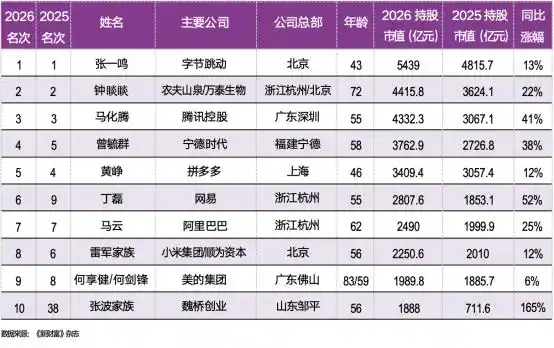
▲ Top 10 of the 2026 New Fortune 500 Creation & Wealth List. Source: Shenzhen News Network

Independent innovation and breakthroughs in core technologies, with AI leading the charge, are creating and concentrating wealth at an unprecedented speed and scale. In the 2025 New Fortune 500 list, DeepSeek founder Liang Wenfeng debuted on the list, entering the top ten with a fortune of 184.62 billion yuan. According to relevant institution statistics, the large model sector has already created at least 36 billionaires, with cumulative wealth reaching several hundred billion yuan.

The reshaping of the wealth map is not merely an industrial replacement, but a generational handover of entrepreneurs. Names like 43-year-old Zhang Yiming, 41-year-old Liang Wenfeng, 36-year-old Wang Xingxing, and 41-year-old Chen Tianshi are replacing those born in the 1960s and 1950s as the leading figures on China's wealth lists.

This is not a transfer of wealth between different individuals, but the passing of the baton from one era to the next.

02. From "Doing Business" to "Developing Technology"

If the most important keywords of the previous wave of Chinese business were "market" and "business model," then today's most important keyword is "technology."

This generation of entrepreneurs shares a distinct common trait: the starting point for many of their ventures is not a business plan, but a laboratory.

Chen Tianshi is a typical case.

Born in 1985, he entered the Special Class for the Gifted Young (SCGY) at the University of Science and Technology of China at age 16, completed his undergraduate and doctoral studies there, and then conducted research at the Institute of Computing Technology, Chinese Academy of Sciences, focusing on deep learning and artificial intelligence, becoming a world-class scientist in the AI field. In 2016, he co-founded Cambricon with his brother Chen Yunji, choosing a direction that was at the time extremely cutting-edge and challenging—AI chips.

Cambricon did not rapidly monetize through a proven business model. Instead, it underwent a long period of technological investment. At its 2020 IPO, its revenue was only 4.59 billion yuan, with a net loss attributable to shareholders of 4.35 billion yuan. In subsequent years, revenue fluctuated around 7 billion yuan, while net losses attributable to shareholders expanded annually, reaching a peak loss of 12.57 billion yuan in 2022.

Finally, the turning point arrived in 2025. The company achieved revenue of 64.97 billion yuan, with a net profit attributable to shareholders of 20.59 billion yuan, marking its first annual profit. In Q1 2026, revenue reached 28.85 billion yuan, a year-on-year increase of 159.56%; net profit attributable to shareholders was 10.13 billion yuan, up 185.04% year-on-year. On June 30th, Cambricon's market capitalization broke through 1 trillion yuan for the first time, becoming the first company on the STAR Market to achieve a trillion-yuan valuation.

Regarding this journey from losses to profitability, from a valuation of tens of billions at IPO to a trillion yuan, what deserves the most attention is not the stock price increase, but one fact: China's AI chips have progressed from laboratory technology to the stage of industrial-scale production.
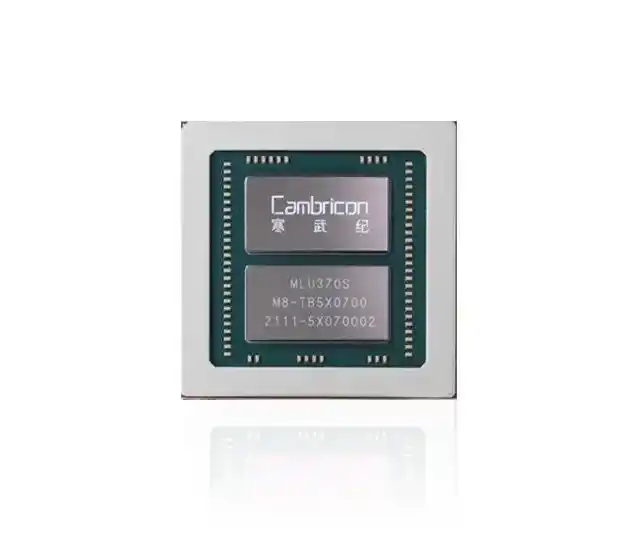
▲ Image Source: Cambricon

Liang Wenfeng presents another type of archetype.

He studied at Zhejiang University for his bachelor's and master's degrees. In 2015, he co-founded quantitative hedge fund High-Flyer Capital (幻方量化), before later entering the large model field. The emergence of DeepSeek made the world reassess Chinese AI entrepreneurs.

Its unique aspect is that Liang Wenfeng did not start with "building an AI application." Instead, he began from more fundamental problems like model architecture, training algorithms, and computational efficiency optimization, leading to disruptive innovation. At the time DeepSeek shone on the world stage, its core R&D team, including Liang Wenfeng, numbered fewer than 150 people—a stark contrast to the scale of international AI giants like OpenAI.

This mode of entrepreneurship is indeed different from traditional internet startups. Internet entrepreneurship often starts by finding users, then searching for a product; technological entrepreneurship frequently reverses this: first solving a technical problem, then discovering the industrial potential it can unlock.

Zhu Yiming's story illustrates this change even more profoundly.

In 2005, he returned to China to found GigaDevice. In 2016, he dedicated himself to building China's domestic DRAM industry; after 2018, he focused his primary efforts on ChangXin Memory Technologies, pledging not to take a salary until the project became profitable. For a full seven years, he did not receive a single yuan in salary.

ChangXin also experienced a long period of losses, with a net loss attributable to shareholders of 16.34 billion yuan in 2023, and 7.145 billion yuan in 2024. In 2025, the company achieved revenue of 61.799 billion yuan, a year-on-year increase of 155.60%; net profit was 7.144 billion yuan, marking its first annual profit.

In Q1 2026, driven by rising DRAM prices, growing computing power demand, and production capacity ramp-up, revenue further reached 50.8 billion yuan, up 719.13% year-on-year; net profit attributable to shareholders was 24.762 billion yuan. On its first trading day, July 27th, ChangXin's market cap soared to 3.28 trillion yuan.

But more noteworthy than the market capitalization is the position this company has reached—a position where few Chinese enterprises have been able to firmly stand before.

DRAM is a highly concentrated market with extremely high technical barriers, long dominated by Samsung, SK Hynix, and Micron. According to Omdia data, based on Q4 2025 sales statistics, ChangXin's global market share has increased to 7.67%, making it the world's fourth-largest DRAM manufacturer.

It has not yet changed the established global memory market landscape, but it has entered the list of major global players. This is a historic leap.

The length of this journey far exceeded most people's imaginations. From the project launch in 2016 to its first profit in 2025, ChangXin walked a full nine years. This is not a story about wealth; it is a story about faith in technology.

A UBS report shows that in 2025, 70 new billionaires emerged in mainland China, with the technology sector becoming the primary engine of wealth creation. The emergence of these "engineer billionaires" signifies a fundamental change in the composition of China's business elite:

The starting point of entrepreneurship is shifting from "doing business" to "developing technology."

03. From "Expanding the Market" to "Deepening the Industry"

Rather than saying Chinese entrepreneurs are simply undergoing a change of guard, it's more accurate to say: the Chinese economy is presenting entrepreneurs with a new set of questions.

The previous generation of entrepreneurs laid the foundation; today's tech entrepreneurs are building the skyscraper upon it.

Without the foundation, the building cannot rise high.

If not for the groundwork laid by Wang Shi and Wang Jianlin in urbanization and real estate, the internet popularization driven by Jack Ma and Pony Ma, the supply chain accumulation from decades of Chinese manufacturing, the influx of a large number of engineering talents into the industry, and the massive digital consumer market, there wouldn't be the fertile industrial soil for today's AI, chip, and robotics entrepreneurs.

The pioneer-level entrepreneurs solved the most critical questions of one or even several eras. Today, the questions have changed.

The 2025 Government Work Report proposed developing New Quality Productive Forces according to local conditions, promoting the integrated development of technological innovation and industrial innovation, cultivating future industries like biomanufacturing, quantum technology, embodied AI, and 6G, and continuously advancing the "AI Plus" initiative.

By the 2026 Government Work Report, it was further noted that China had taken a lead in the R&D and application of AI, biopharmaceuticals, robotics, and quantum technologies, achieving new breakthroughs in chip self-reliance, and seeing domestic large models leading the global open-source ecosystem.

Consequently, the entire Chinese economy has bid farewell to the stage of "crossing the river by feeling the stones," entering a new era of true innovation-driven, and moreover, independent innovation-driven growth: achieving the possible where others deem it impossible, and reaching global leadership in areas others thought China could not.

For Zhu Yiming's ChangXin, the turning point from massive losses to huge profits was singular: product competitiveness brought by technological breakthroughs.

For Chen Tianshi's Cambricon, the leap from losses to profit crossed not just financial thresholds, but critical points in technological capability.

For Liang Wenfeng's DeepSeek, challenging OpenAI's massive compute route with a low-cost training strategy is not about following, but about originality.

These names represent a new type of entrepreneur: original, groundbreaking, global in impact. The stage they are ascending is no longer just China's business arena, but the table of global industrial competition.

This so-called "generational handover" never concerns just wealth or titles. What is being handed over is a nation's structural capacity to participate in global competition.

The previous generation of entrepreneurs accomplished the commercial expansion through learning and catching up; the task for the new generation is to push Chinese technology from "keeping up" to "capable of original innovation, breakthroughs, and industrialization."

The shift from business innovation to technological innovation, from traffic-driven growth to technology-driven growth, from "expanding the market" to "deepening the industry"—it's all just beginning.

The names highlighted today—Zhu Yiming, Chen Tianshi, Liang Wenfeng, Wang Xingxing... are merely the first batch of individuals stepping into the center stage of this era.

This article is from the WeChat public account "HuaShang Strategy" by HuaShang Strategy.

Criptomoedas em alta

Perguntas relacionadas

QAccording to the article, what is the most significant change happening to the Chinese entrepreneur group?

AThe most significant change is a profound generational transition, characterized by a shift from 'doing business' based on market models and population dividends to 'doing technology' focused on original innovation, core technological breakthroughs, and global industrial competition in fields like AI, semiconductors, and robotics.

QWhat key event symbolized the rise of this new generation of technology-driven entrepreneurs in 2026, as described in the article?

AThe symbolic event was Changxin Technology's listing on the STAR Market in July 2026, where its market capitalization soared to over 3.28 trillion yuan, making it the 'share king' of the A-share market, representing the success of a long-term, R&D-intensive venture in the core DRAM semiconductor field.

QHow does the article characterize the difference in the starting point for business between the older generation of entrepreneurs and the new generation?

AThe older generation often started with business plans seeking markets and models, while the new generation frequently starts from laboratories, tackling fundamental technical problems first—like AI chip architecture or foundational AI models—before seeking their industrial applications and market space.

QWhat economic shift does the success of entrepreneurs like Zhang Yiming (ByteDance) and Liang Wenfeng (DeepSeek) reflect, according to the article?

ATheir success reflects a shift in China's wealth creation engine from relying on population and market scale dividends to relying more on technology dividends. Their wealth increasingly represents the market's valuation of future technological competitiveness and potential for original innovation.

QWhat is the new core proposition or mission for China's economy and its new generation of entrepreneurs, as outlined in the article's conclusion?

AThe new mission is to move from commercial expansion and learning/catching-up to achieving original, breakthrough, and industrializing technological capabilities. The goal is to lead in global industrial competition, particularly in domains like AI, chips, and robotics, transforming China's participation in the global economy from following to pioneering.

Leituras Relacionadas

XRP Ledger Active Users Approach 200,000

The number of daily active users on the XRP Ledger is approaching 200,000, one of the highest levels in recent months. Despite XRP continuing to trade below key technical resistance, on-chain data shows accelerated network activity, suggesting growing ecosystem usage even as price momentum remains subdued. The increase to roughly 190,800 daily active users has been sustained through late July, marking a significant recovery from levels around 100,000 during the broader market correction. This rise indicates user return driven by sustained engagement rather than just speculative trading. Higher address activity typically reflects broader blockchain adoption and can boost transaction counts, payment volumes, and dApp liquidity—considered healthier indicators than price fluctuations. However, XRP's price has not mirrored this network improvement, currently trading near $1.07 and struggling to break resistance at $1.10. It remains below its 50-day and 100-day moving averages, with a recent attempt to break out of a symmetrical triangle losing momentum. The technical outlook remains mixed; while blockchain activity shows improving fundamentals, price action lacks confirmation of a broader recovery. A decisive break above the 200-day moving average near $1.21 is needed to strengthen the long-term technical outlook. Momentum indicators like the RSI, around 47, show a balanced forecast with reduced selling pressure. In conclusion, XRP Ledger user activity nears a yearly high despite the asset's price being below major technical barriers. Sustained user growth, coupled with a price recovery above key moving averages, could begin to align the technical structure with the strengthening on-chain fundamentals.

cryptonews.ruHá 27m

XRP Ledger Active Users Approach 200,000

cryptonews.ruHá 27m

ZEC Price Just Surpassed $490 — Here's What Fueled the Rally

ZEC Surges Past $490, Key Drivers Behind the Rally On August 3, the privacy-focused cryptocurrency Zcash (ZEC) surged nearly 5%, climbing over $20 in a six-hour rally to a session high near $494. This move helped ZEC's market cap reclaim $8 billion, solidifying its position as the most valuable privacy coin and marking an almost 8% gain for the month. While benefiting from a broader market uptrend, ZEC's outperformance was driven by significant fundamental catalysts. The primary driver was the integration by privacy infrastructure project Nym of Zcash's new shielded pool, Ironwood. This enables direct, end-to-end private payments in ZEC for network services, a landmark development for privacy-first decentralized finance. The rally coincides with renewed industry focus on privacy as digital assets mature. Industry observers note privacy is becoming the "next frontier," evolving from Bitcoin's proof-of-concept to Ethereum's programmability and Solana's scalability. Commentary highlighted that true privacy, via zero-knowledge (ZK) technology which is now production-ready, was a foundational goal for early crypto pioneers. Further momentum came from Zcash's progress in decentralized governance, launching a retroactive grant funding (RetroPGF-like) program. This shifts treasury fund distribution from closed committees to direct coin holder voting, pioneering a privacy-native funding mechanism. ZEC's surge helped push the total market capitalization of privacy-focused coins above $30 billion. Other notable gainers included NEAR, ZK, and NOCK. However, losses in coins like ZANO, ZBT, and a significant drop in last week's leader COTI partially offset the sector's overall gains.

cryptonews.ruHá 42m

ZEC Price Just Surpassed $490 — Here's What Fueled the Rally

cryptonews.ruHá 42m

Trading

Spot

Artigos em Destaque

O que é $S$

Compreender o SPERO: Uma Visão Abrangente Introdução ao SPERO À medida que o panorama da inovação continua a evoluir, o surgimento de tecnologias web3 e projetos de criptomoeda desempenha um papel fundamental na formação do futuro digital. Um projeto que tem atraído atenção neste campo dinâmico é o SPERO, denotado como SPERO,$$s$. Este artigo tem como objetivo reunir e apresentar informações detalhadas sobre o SPERO, para ajudar entusiastas e investidores a compreender as suas bases, objetivos e inovações nos domínios web3 e cripto. O que é o SPERO,$$s$? O SPERO,$$s$ é um projeto único dentro do espaço cripto que procura aproveitar os princípios da descentralização e da tecnologia blockchain para criar um ecossistema que promove o envolvimento, a utilidade e a inclusão financeira. O projeto é concebido para facilitar interações peer-to-peer de novas maneiras, proporcionando aos utilizadores soluções e serviços financeiros inovadores. No seu núcleo, o SPERO,$$s$ visa capacitar indivíduos ao fornecer ferramentas e plataformas que melhoram a experiência do utilizador no espaço das criptomoedas. Isso inclui a possibilidade de métodos de transação mais flexíveis, a promoção de iniciativas impulsionadas pela comunidade e a criação de caminhos para oportunidades financeiras através de aplicações descentralizadas (dApps). A visão subjacente do SPERO,$$s$ gira em torno da inclusão, visando fechar lacunas dentro das finanças tradicionais enquanto aproveita os benefícios da tecnologia blockchain. Quem é o Criador do SPERO,$$s$? A identidade do criador do SPERO,$$s$ permanece algo obscura, uma vez que existem recursos publicamente disponíveis limitados que fornecem informações detalhadas sobre o(s) seu(s) fundador(es). Esta falta de transparência pode resultar do compromisso do projeto com a descentralização—uma ética que muitos projetos web3 partilham, priorizando contribuições coletivas em vez de reconhecimento individual. Ao centrar as discussões em torno da comunidade e dos seus objetivos coletivos, o SPERO,$$s$ incorpora a essência do empoderamento sem destacar indivíduos específicos. Assim, compreender a ética e a missão do SPERO é mais importante do que identificar um criador singular. Quem são os Investidores do SPERO,$$s$? O SPERO,$$s$ é apoiado por uma diversidade de investidores que vão desde capitalistas de risco a investidores-anjo dedicados a promover a inovação no setor cripto. O foco desses investidores geralmente alinha-se com a missão do SPERO—priorizando projetos que prometem avanço tecnológico social, inclusão financeira e governança descentralizada. Essas fundações de investidores estão tipicamente interessadas em projetos que não apenas oferecem produtos inovadores, mas que também contribuem positivamente para a comunidade blockchain e os seus ecossistemas. O apoio desses investidores reforça o SPERO,$$s$ como um concorrente notável no domínio em rápida evolução dos projetos cripto. Como Funciona o SPERO,$$s$? O SPERO,$$s$ emprega uma estrutura multifacetada que o distingue de projetos de criptomoeda convencionais. Aqui estão algumas das características-chave que sublinham a sua singularidade e inovação: Governança Descentralizada: O SPERO,$$s$ integra modelos de governança descentralizada, capacitando os utilizadores a participar ativamente nos processos de tomada de decisão sobre o futuro do projeto. Esta abordagem promove um sentido de propriedade e responsabilidade entre os membros da comunidade. Utilidade do Token: O SPERO,$$s$ utiliza o seu próprio token de criptomoeda, concebido para servir várias funções dentro do ecossistema. Esses tokens permitem transações, recompensas e a facilitação de serviços oferecidos na plataforma, melhorando o envolvimento e a utilidade gerais. Arquitetura em Camadas: A arquitetura técnica do SPERO,$$s$ suporta modularidade e escalabilidade, permitindo a integração contínua de funcionalidades e aplicações adicionais à medida que o projeto evolui. Esta adaptabilidade é fundamental para manter a relevância no panorama cripto em constante mudança. Envolvimento da Comunidade: O projeto enfatiza iniciativas impulsionadas pela comunidade, empregando mecanismos que incentivam a colaboração e o feedback. Ao nutrir uma comunidade forte, o SPERO,$$s$ pode melhor atender às necessidades dos utilizadores e adaptar-se às tendências do mercado. Foco na Inclusão: Ao oferecer taxas de transação baixas e interfaces amigáveis, o SPERO,$$s$ visa atrair uma base de utilizadores diversificada, incluindo indivíduos que anteriormente podem não ter participado no espaço cripto. Este compromisso com a inclusão alinha-se com a sua missão abrangente de empoderamento através da acessibilidade. Cronologia do SPERO,$$s$ Compreender a história de um projeto fornece insights cruciais sobre a sua trajetória de desenvolvimento e marcos. Abaixo está uma cronologia sugerida que mapeia eventos significativos na evolução do SPERO,$$s$: Fase de Conceituação e Ideação: As ideias iniciais que formam a base do SPERO,$$s$ foram concebidas, alinhando-se de perto com os princípios de descentralização e foco na comunidade dentro da indústria blockchain. Lançamento do Whitepaper do Projeto: Após a fase conceitual, um whitepaper abrangente detalhando a visão, os objetivos e a infraestrutura tecnológica do SPERO,$$s$ foi lançado para atrair o interesse e o feedback da comunidade. Construção da Comunidade e Primeiros Envolvimentos: Esforços ativos de divulgação foram feitos para construir uma comunidade de primeiros adotantes e investidores potenciais, facilitando discussões em torno dos objetivos do projeto e angariando apoio. Evento de Geração de Tokens: O SPERO,$$s$ realizou um evento de geração de tokens (TGE) para distribuir os seus tokens nativos a apoiantes iniciais e estabelecer liquidez inicial dentro do ecossistema. Lançamento da dApp Inicial: A primeira aplicação descentralizada (dApp) associada ao SPERO,$$s$ foi lançada, permitindo que os utilizadores interagissem com as funcionalidades principais da plataforma. Desenvolvimento Contínuo e Parcerias: Atualizações e melhorias contínuas nas ofertas do projeto, incluindo parcerias estratégicas com outros players no espaço blockchain, moldaram o SPERO,$$s$ em um jogador competitivo e em evolução no mercado cripto. Conclusão O SPERO,$$s$ é um testemunho do potencial do web3 e das criptomoedas para revolucionar os sistemas financeiros e capacitar indivíduos. Com um compromisso com a governança descentralizada, o envolvimento da comunidade e funcionalidades inovadoras, abre caminho para um panorama financeiro mais inclusivo. Como em qualquer investimento no espaço cripto em rápida evolução, potenciais investidores e utilizadores são incentivados a pesquisar minuciosamente e a envolver-se de forma ponderada com os desenvolvimentos em curso dentro do SPERO,$$s$. O projeto demonstra o espírito inovador da indústria cripto, convidando a uma exploração mais aprofundada das suas inúmeras possibilidades. Embora a jornada do SPERO,$$s$ ainda esteja a desenrolar-se, os seus princípios fundamentais podem, de facto, influenciar o futuro de como interagimos com a tecnologia, as finanças e uns com os outros em ecossistemas digitais interconectados.

267 Visualizações TotaisPublicado em {updateTime}Atualizado em 2024.12.17

O que é $S$

O que é AGENT S

Agent S: O Futuro da Interação Autónoma no Web3 Introdução No panorama em constante evolução do Web3 e das criptomoedas, as inovações estão constantemente a redefinir a forma como os indivíduos interagem com plataformas digitais. Um projeto pioneiro, o Agent S, promete revolucionar a interação humano-computador através do seu framework aberto e agente. Ao abrir caminho para interações autónomas, o Agent S visa simplificar tarefas complexas, oferecendo aplicações transformadoras em inteligência artificial (IA). Esta exploração detalhada irá aprofundar-se nas complexidades do projeto, nas suas características únicas e nas implicações para o domínio das criptomoedas. O que é o Agent S? O Agent S é um framework aberto e agente, especificamente concebido para abordar três desafios fundamentais na automação de tarefas computacionais: Aquisição de Conhecimento Específico de Domínio: O framework aprende inteligentemente a partir de várias fontes de conhecimento externas e experiências internas. Esta abordagem dupla capacita-o a construir um rico repositório de conhecimento específico de domínio, melhorando o seu desempenho na execução de tarefas. Planeamento ao Longo de Longos Horizontes de Tarefas: O Agent S emprega planeamento hierárquico aumentado por experiência, uma abordagem estratégica que facilita a decomposição e execução eficientes de tarefas intrincadas. Esta característica melhora significativamente a sua capacidade de gerir múltiplas subtarefas de forma eficiente e eficaz. Gestão de Interfaces Dinâmicas e Não Uniformes: O projeto introduz a Interface Agente-Computador (ACI), uma solução inovadora que melhora a interação entre agentes e utilizadores. Utilizando Modelos de Linguagem Multimodais de Grande Escala (MLLMs), o Agent S pode navegar e manipular diversas interfaces gráficas de utilizador de forma fluida. Através destas características pioneiras, o Agent S fornece um framework robusto que aborda as complexidades envolvidas na automação da interação humana com máquinas, preparando o terreno para uma infinidade de aplicações em IA e além. Quem é o Criador do Agent S? Embora o conceito de Agent S seja fundamentalmente inovador, informações específicas sobre o seu criador permanecem elusivas. O criador é atualmente desconhecido, o que destaca ou o estágio nascente do projeto ou a escolha estratégica de manter os membros fundadores em anonimato. Independentemente da anonimidade, o foco permanece nas capacidades e no potencial do framework. Quem são os Investidores do Agent S? Como o Agent S é relativamente novo no ecossistema criptográfico, informações detalhadas sobre os seus investidores e financiadores não estão explicitamente documentadas. A falta de informações disponíveis publicamente sobre as fundações de investimento ou organizações que apoiam o projeto levanta questões sobre a sua estrutura de financiamento e roteiro de desenvolvimento. Compreender o apoio é crucial para avaliar a sustentabilidade do projeto e o seu impacto potencial no mercado. Como Funciona o Agent S? No núcleo do Agent S reside uma tecnologia de ponta que lhe permite funcionar eficazmente em diversos ambientes. O seu modelo operacional é construído em torno de várias características-chave: Interação Humano-Computador Semelhante: O framework oferece planeamento avançado em IA, esforçando-se para tornar as interações com computadores mais intuitivas. Ao imitar o comportamento humano na execução de tarefas, promete elevar as experiências dos utilizadores. Memória Narrativa: Utilizada para aproveitar experiências de alto nível, o Agent S utiliza memória narrativa para acompanhar os históricos de tarefas, melhorando assim os seus processos de tomada de decisão. Memória Episódica: Esta característica fornece aos utilizadores orientações passo a passo, permitindo que o framework ofereça suporte contextual à medida que as tarefas se desenrolam. Suporte para OpenACI: Com a capacidade de funcionar localmente, o Agent S permite que os utilizadores mantenham o controlo sobre as suas interações e fluxos de trabalho, alinhando-se com a ética descentralizada do Web3. Fácil Integração com APIs Externas: A sua versatilidade e compatibilidade com várias plataformas de IA garantem que o Agent S possa integrar-se perfeitamente em ecossistemas tecnológicos existentes, tornando-o uma escolha apelativa para desenvolvedores e organizações. Estas funcionalidades contribuem coletivamente para a posição única do Agent S no espaço cripto, à medida que automatiza tarefas complexas e em múltiplos passos com mínima intervenção humana. À medida que o projeto evolui, as suas potenciais aplicações no Web3 podem redefinir a forma como as interações digitais se desenrolam. Cronologia do Agent S O desenvolvimento e os marcos do Agent S podem ser encapsulados numa cronologia que destaca os seus eventos significativos: 27 de Setembro de 2024: O conceito de Agent S foi lançado num artigo de pesquisa abrangente intitulado “Um Framework Agente Aberto que Usa Computadores como um Humano”, mostrando a base para o projeto. 10 de Outubro de 2024: O artigo de pesquisa foi disponibilizado publicamente no arXiv, oferecendo uma exploração aprofundada do framework e da sua avaliação de desempenho com base no benchmark OSWorld. 12 de Outubro de 2024: Uma apresentação em vídeo foi lançada, proporcionando uma visão visual das capacidades e características do Agent S, envolvendo ainda mais potenciais utilizadores e investidores. Estes marcos na cronologia não apenas ilustram o progresso do Agent S, mas também indicam o seu compromisso com a transparência e o envolvimento da comunidade. Pontos-Chave Sobre o Agent S À medida que o framework Agent S continua a evoluir, várias características-chave destacam-se, sublinhando a sua natureza inovadora e potencial: Framework Inovador: Concebido para proporcionar um uso intuitivo de computadores semelhante à interação humana, o Agent S traz uma abordagem nova à automação de tarefas. Interação Autónoma: A capacidade de interagir autonomamente com computadores através de GUI significa um avanço em direção a soluções computacionais mais inteligentes e eficientes. Automação de Tarefas Complexas: Com a sua metodologia robusta, pode automatizar tarefas complexas e em múltiplos passos, tornando os processos mais rápidos e menos propensos a erros. Melhoria Contínua: Os mecanismos de aprendizagem permitem que o Agent S melhore a partir de experiências passadas, aprimorando continuamente o seu desempenho e eficácia. Versatilidade: A sua adaptabilidade em diferentes ambientes operacionais, como OSWorld e WindowsAgentArena, garante que pode servir uma ampla gama de aplicações. À medida que o Agent S se posiciona no panorama do Web3 e das criptomoedas, o seu potencial para melhorar as capacidades de interação e automatizar processos significa um avanço significativo nas tecnologias de IA. Através do seu framework inovador, o Agent S exemplifica o futuro das interações digitais, prometendo uma experiência mais fluida e eficiente para os utilizadores em diversas indústrias. Conclusão O Agent S representa um ousado avanço na união da IA e do Web3, com a capacidade de redefinir a forma como interagimos com a tecnologia. Embora ainda esteja nas suas fases iniciais, as possibilidades para a sua aplicação são vastas e cativantes. Através do seu framework abrangente que aborda desafios críticos, o Agent S visa trazer interações autónomas para o primeiro plano da experiência digital. À medida que avançamos mais profundamente nos domínios das criptomoedas e da descentralização, projetos como o Agent S desempenharão, sem dúvida, um papel crucial na formação do futuro da tecnologia e da colaboração humano-computador.

883 Visualizações TotaisPublicado em {updateTime}Atualizado em 2025.01.14

O que é AGENT S

Como comprar S

Bem-vindo à HTX.com!Tornámos a compra de Sonic (S) simples e conveniente.Segue o nosso guia passo a passo para iniciar a tua jornada no mundo das criptos.Passo 1: cria a tua conta HTXUtiliza o teu e-mail ou número de telefone para te inscreveres numa conta gratuita na HTX.Desfruta de um processo de inscrição sem complicações e desbloqueia todas as funcionalidades.Obter a minha contaPasso 2: vai para Comprar Cripto e escolhe o teu método de pagamentoCartão de crédito/débito: usa o teu visa ou mastercard para comprar Sonic (S) instantaneamente.Saldo: usa os fundos da tua conta HTX para transacionar sem problemas.Terceiros: adicionamos métodos de pagamento populares, como Google Pay e Apple Pay, para aumentar a conveniência.P2P: transaciona diretamente com outros utilizadores na HTX.Mercado de balcão (OTC): oferecemos serviços personalizados e taxas de câmbio competitivas para os traders.Passo 3: armazena teu Sonic (S)Depois de comprar o teu Sonic (S), armazena-o na tua conta HTX.Alternativamente, podes enviá-lo para outro lugar através de transferência blockchain ou usá-lo para transacionar outras criptomoedas.Passo 4: transaciona Sonic (S)Transaciona facilmente Sonic (S) no mercado à vista da HTX.Acede simplesmente à tua conta, seleciona o teu par de trading, executa as tuas transações e monitoriza em tempo real.Oferecemos uma experiência de fácil utilização tanto para principiantes como para traders experientes.

1.5k Visualizações TotaisPublicado em {updateTime}Atualizado em 2026.06.02

Como comprar S

Discussões

Bem-vindo à Comunidade HTX. Aqui, pode manter-se informado sobre os mais recentes desenvolvimentos da plataforma e obter acesso a análises profissionais de mercado. As opiniões dos utilizadores sobre o preço de S (S) são apresentadas abaixo.

活动图片