Dash Launches ZK-Privacy Based on Zcash

cryptonews.ruPublicado em 2026-07-30Última atualização em 2026-07-30

Resumo

Dash has launched ZK-based privacy features built on Zcash's Orchard protocol. This is now integrated directly into the Dash Platform's consensus (v4.0.0), providing a native, non-custodial privacy model alongside the existing CoinJoin system. It offers optional confidentiality, hiding sender, receiver, amount, and balance within a shielded pool. The implementation adapts Zcash's Orchard protocol (using Halo 2 without a trusted setup) to Dash Platform, handling state transitions, GroveDB storage, fees, and wallet sync. A critical double-spend vulnerability discovered in Orchard prior to release was patched using updated libraries, with Dash adding a SumTree structure for extra security. Users can privately transfer Platform Credits (pegged 1:100 billion to DASH) and move funds to/from the main Dash Core chain. Wallet synchronization, which is required to detect incoming private transactions, took about 21 seconds in testing, noted as significantly faster than a comparable Zcash wallet. Future plans include extending shielded pools to native Platform tokens and NFTs, aiming to combine ZK-privacy with token issuance and direct exchangeability with Dash. Mobile wallet support for the new feature is expected soon.

In February, we wrote about Dash's plans to integrate Orchard. At that time, it was about a future release and the prospect of private user tokens.

Now the first part of the plan has been implemented: in Dash Platform v4.0.0, shielded operations have become part of the consensus. This is not an external mixer, not a custodial service, and not an experimental smart contract — privacy is built directly into the protocol.

For Dash, historically associated with CoinJoin, this is not a replacement for the old mechanism, but a second model of privacy. CoinJoin continues to work on the main network, while Platform uses ZK-proofs instead of mixing rounds with multiple participants. This approach is better suited for fast mobile wallets. At the same time, regular Dash transactions remain transparent: confidentiality is optional.

The shielded pool hides the balance, sender, recipient, and transfer amount within the pool. The network verifies that funds exist, belong to the sender, and are not double-spent, but does so without revealing the operation's contents.

A user can deposit credits into the pool from a transparent Platform address, conduct a private transfer, and return the funds back. For DASH holders, two other routes are more important: ShieldFromAssetLock sends funds to the shielded pool directly from Core, and ShieldedWithdrawal withdraws them to a specified Core address. To avoid linking the withdrawal to previous activity, the wallet must use a new address.
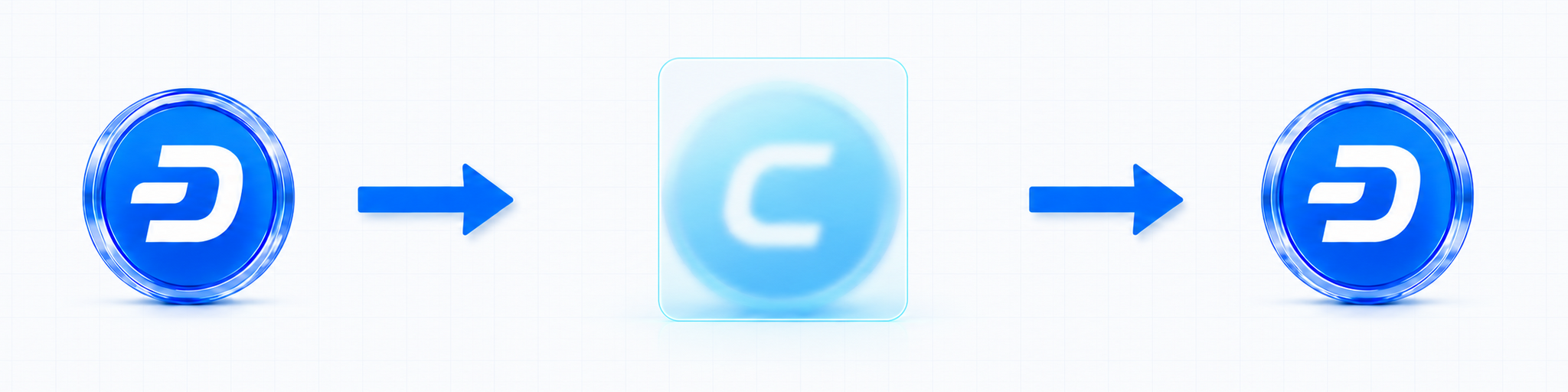
Platform Credits are the internal accounting unit of Dash Platform, linked to Dash by a fixed ratio: one Dash corresponds to 100 billion credits.

How the Privacy Works — Without Unnecessary Math

Dash did not create a new ZK-scheme from scratch. The implementation is based on Orchard, Zcash's shielded protocol built on Halo 2 without a trusted setup. Dash's engineering work involved adapting it to Platform: custom state transitions, storage in GroveDB, fees, wallet synchronization, and the route back to Core.

Shortly before the release, a critical vulnerability was discovered in Orchard, potentially allowing double spending within the pool. The Zcash team fixed the proof scheme, and the Dash Core Group updated its implementation to the revised libraries even before the release of Platform 4.0. An additional layer of control in Dash is provided by SumTree: this structure stores and verifies the pool's state, preventing hidden inflation from going unnoticed.

One of the main problems with shielded systems is wallet synchronization. To detect incoming funds, the application receives encrypted notes and locally checks which ones its key can decrypt. The server does not learn which transfers belong to the user.

In the test version of the application, we created a new wallet and started synchronization: it took about 21 seconds, which is significantly faster than synchronizing the Zodl wallet for ZCash.

The release of mobile wallets supporting the new technology is expected soon.

Currently, the pool only works with Platform Credits. However, Dash has already announced plans to add separate shielded pools for native Platform tokens.

Private user assets are not a new concept. Dash's strength lies in the specific combination of capabilities: ZK-privacy, token and NFT issuance, and the ability to exchange created assets for Dash and back. Thanks to this, each asset gains a direct link to the already established coin, and through it — to the external market.

end-content

Criptomoedas em alta

Perguntas relacionadas

QWhat is the main news about Dash mentioned in the article?

ADash has launched ZK-privacy (shielded operations) built directly into its protocol, specifically in Dash Platform v4.0.0, based on Zcash's Orchard protocol.

QHow does the new shielded privacy model in Dash Platform differ from its previous CoinJoin method?

AThe new model uses Zero-Knowledge (ZK) proofs for privacy, making it better suited for fast mobile wallets. It is built directly into the protocol, unlike CoinJoin which is a mixing service in the main network. Both models coexist, with the new shielded pool offering optional privacy for Platform Credits.

QWhat are the two new transaction routes mentioned for DASH holders to interact with the shielded pool?

AThe two new routes are 'ShieldFromAssetLock', which sends funds into the shielded pool directly from Dash Core, and 'ShieldedWithdrawal', which withdraws funds from the shielded pool to a specified Dash Core address.

QWhat was a key security issue addressed before the launch of Dash Platform v4.0.0?

AA critical vulnerability was discovered in the Orchard protocol that could potentially allow double-spending within the shielded pool. The Zcash team fixed the proof scheme, and the Dash Core Group updated its implementation to the patched libraries before release.

QWhat future development for Dash Platform's shielded pools is announced in the article?

ADash announced plans to add separate shielded pools for native tokens on the Dash Platform, enabling private user-created assets like tokens and NFTs with a direct link to the DASH cryptocurrency and the external market.

Leituras Relacionadas

Ethereum's 11th Year: Why Is This Year Particularly Crucial?

Ethereum's 11th year proved pivotal, marked by a dual evolution in its technical roadmap and organizational structure. The year saw the completion of the Fusaka upgrade, introducing PeerDAS to make data availability sampling more efficient and laying groundwork for future L2 scaling. This was followed by a significant reorganization of the Ethereum Foundation (EF). The EF downsized, redefining its core mandate around user sovereignty and CROPS principles, while spinning off key functions. Independent entities like Ethlabs (non-profit R&D), Ethereum Institutional (institutional onboarding), and EthSystems (institutional privacy solutions) now operate separately. Technologically, the community debated a bold, long-term vision outlined in Justin Drake's "Lean Ethereum" proposal and the collaborative "Strawmap." These point toward a "third major iteration" for Ethereum, targeting goals like faster finality (~1 second), gigagas-scale L1 throughput, teragas-scale L2 capacity, post-quantum cryptography, and protocol-level privacy. Data underscores Ethereum's dominant position: its L1 still holds roughly half of all stablecoin value, leads in tokenized Real-World Assets (RWA), and commands over 55% of total DeFi TVL. While L2s now handle over 10x more transactions than the mainnet, high-value assets remain concentrated on L1. The launch of Robinhood Chain, an EVM-compatible L2 for stock tokens, signals growing institutional adoption. The immediate roadmap includes the Glamsterdam upgrade (featuring ePBS for in-protocol proposer-builder separation and Block Access Lists for parallelism), potentially followed by Hegotá focusing on anti-censorship via FOCIL. In summary, Ethereum's 11th year was defined by setting ambitious technical foundations for its next decade and restructuring its core development ecosystem to be more modular and sustainable, all while maintaining its role as the leading settlement layer for decentralized finance and assets.

marsbitHá 11m

Ethereum's 11th Year: Why Is This Year Particularly Crucial?

marsbitHá 11m

Notable Forecast from an Analytical Company Regarding Bitcoin (BTC): After This Date, a New Bull Season Could Begin!

Bitcoin continues to trade sideways around $64,000 amid ongoing uncertainty regarding U.S. monetary policy and geopolitical risks in the Middle East. As BTC struggles for direction, an analyst predicts the next major uptrend could commence after the U.S. midterm elections. João Wedson, founder and CEO of crypto analytics firm Alphractal, revisited the connection between Bitcoin's price movements and the U.S. election calendar in his latest analysis. Wedson claims that analyzing past market cycles reveals similar patterns in Bitcoin's price behavior, particularly around U.S. midterm and presidential elections. Historically, Bitcoin has faced headwinds leading up to midterms but tends to recover once election-related uncertainty subsides. Based on historical data, Bitcoin entered bear markets roughly a year before past midterm elections, only to initiate prolonged bull markets after the elections concluded. In some cycles, price bottoms formed just days before the vote, while in others, the low occurred immediately after. The analyst also noted presidential elections have a distinct impact: Bitcoin experiences strong rallies each time a president wins re-election and approaches the peak of its main cycle shortly after the presidential inauguration. As an example, Wedson pointed to XRP, which began a sharp rise on the day Donald Trump won the 2024 election and reached a local peak on January 20, 2025, his inauguration day.

cryptonews.ruHá 27m

Notable Forecast from an Analytical Company Regarding Bitcoin (BTC): After This Date, a New Bull Season Could Begin!

cryptonews.ruHá 27m

Lummis: The CLARITY Act mechanism "is not working" as the Senate drags its feet

U.S. Senator Cynthia Lummis has argued that the current regulatory framework for digital assets is inadequate, harming industry, investors, and regulators alike. She is urgently pushing for the Senate to pass the Digital Asset Market Clarity Act (H.R. 3633/CLARITY Act) before the August recess, warning the current momentum for the bill is a unique opportunity this decade. The legislation aims to divide oversight between the SEC and CFTC. Time is running out, as the Senate must act before its August 8th recess. Delays would push the debate to September, further squeezing the legislative calendar before the midterm elections. Forecasting platforms now estimate only a 30% chance of the bill becoming law in 2026, a sharp drop from over 80% in February. Passage requires 60 votes, meaning at least seven Democrats must join Republicans, a task complicated by Democratic opposition. Key objections from figures like Senator Elizabeth Warren center on concerns the bill could weaken oversight of decentralized finance (DeFi) and consumer protection, potentially endangering the financial system. Over 200 crypto industry organizations, including Coinbase and Ripple, are lobbying for a vote, arguing continued uncertainty drives innovation and jobs overseas. Lummis contends the bill's custody and disclosure rules are precisely the consumer protections needed to close existing loopholes. The bill's fate now hinges on whether Senate Majority Leader John Thune schedules a vote this week or delays it until the fall session, where it would face an even more constrained political environment.

cryptonews.ruHá 27m

Lummis: The CLARITY Act mechanism "is not working" as the Senate drags its feet

cryptonews.ruHá 27m

Trading

Spot

Artigos em Destaque

Como comprar DASH

Bem-vindo à HTX.com!Tornámos a compra de DASH (DASH) simples e conveniente.Segue o nosso guia passo a passo para iniciar a tua jornada no mundo das criptos.Passo 1: cria a tua conta HTXUtiliza o teu e-mail ou número de telefone para te inscreveres numa conta gratuita na HTX.Desfruta de um processo de inscrição sem complicações e desbloqueia todas as funcionalidades.Obter a minha contaPasso 2: vai para Comprar Cripto e escolhe o teu método de pagamentoCartão de crédito/débito: usa o teu visa ou mastercard para comprar DASH (DASH) instantaneamente.Saldo: usa os fundos da tua conta HTX para transacionar sem problemas.Terceiros: adicionamos métodos de pagamento populares, como Google Pay e Apple Pay, para aumentar a conveniência.P2P: transaciona diretamente com outros utilizadores na HTX.Mercado de balcão (OTC): oferecemos serviços personalizados e taxas de câmbio competitivas para os traders.Passo 3: armazena teu DASH (DASH)Depois de comprar o teu DASH (DASH), armazena-o na tua conta HTX.Alternativamente, podes enviá-lo para outro lugar através de transferência blockchain ou usá-lo para transacionar outras criptomoedas.Passo 4: transaciona DASH (DASH)Transaciona facilmente DASH (DASH) no mercado à vista da HTX.Acede simplesmente à tua conta, seleciona o teu par de trading, executa as tuas transações e monitoriza em tempo real.Oferecemos uma experiência de fácil utilização tanto para principiantes como para traders experientes.

289 Visualizações TotaisPublicado em {updateTime}Atualizado em 2026.06.02

Como comprar DASH

Discussões

Bem-vindo à Comunidade HTX. Aqui, pode manter-se informado sobre os mais recentes desenvolvimentos da plataforma e obter acesso a análises profissionais de mercado. As opiniões dos utilizadores sobre o preço de DASH (DASH) são apresentadas abaixo.

活动图片