In June, crypto activity showed signs of recovery, although liquidity inflows remained weak. DeFi lending shows signs of returning, as the internal liquidity of stablecoins remains high.
July remained a month of stagnation for cryptocurrencies, where $BTC dominated over altcoins and tokens. Despite this, DeFi and other on-chain transactions showed signs of recovery.
DeFi demonstrated its first month of growth. After five months of decline, the volume of active DeFi loans increased from $20.7 billion to $22.2 billion, rising by 7.2% for the month, according to data. The total value locked in DeFi grew from $68 billion at the beginning of the month to over $74.9 billion as of July 31.
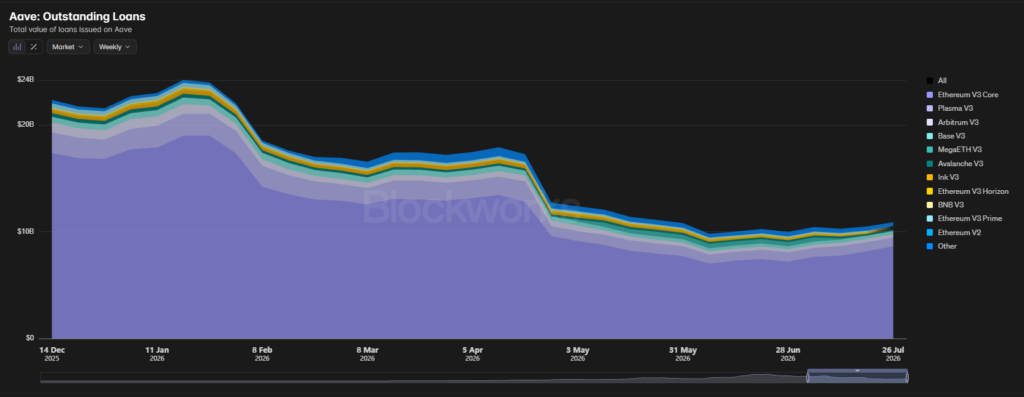
According to Cryptorank, Aave still dominates the lending market, with active loans worth $11 billion and a market share of 46.2%. About two-thirds of the loans are placed on Aave and Morpho platforms.
Partially, the recovery in July was driven by positive momentum in $ETH. The token ended the month with a net gain of 20.32%, while $BTC rose by 9.03% over the same period. $BTC still outperformed most altcoins and tokens.
Despite Active Cryptocurrency Activity, There is Caution in Liquidity Allocation
Although activity is recovering, the cryptocurrency market is moving without new sources of liquidity. This also applies to stablecoin issuance, which has been limited over the past month. The total stablecoin supply decreased by 0.6% in July, to approximately $312 billion.
Inflows from ETF trading also remained weak, indicating a lack of external capital entering cryptocurrency. Unlike 2025, inflows from treasury companies have completely ceased, even for $BTC. Treasury companies for SOL and $ETH have also abandoned aggressive expansion.
As Cryptopolitan reported, 2026 has been a year of liquidating non-viable projects and redistributing liquidity to the few remaining winners.
At the same time, DEX trading volume exceeded $169 billion, increasing by over 10% in the past week. Perpetual futures trading volumes continued to rise, adding more than 12% in the final week of July. The total open interest in 2026 also grew, reaching over $15 billion, according to DeFi Llama data.
Robinhood also sought to become part of the overall recovery of the cryptocurrency market, becoming one of the most active blockchain networks in the past month.
Cryptocurrency Activity is Becoming More Aggressive
In July, cryptocurrency activity did not receive a boost from easily accessible liquidity but continued to grow.
Over the past month, stablecoin velocity remained high as some liquidity redistribution occurred. Stablecoins flowed out of Arbitrum and Optimism but remained active on Solana, Base, and Ethereum.
Last month, Solana maintained the highest stablecoin velocity metric, supported by mixed trading of meme tokens and tokenized securities.
Large players are also taking aggressive positions using leverage on perpetual futures markets, recently shifting to stock trading. Even former major players in the crypto market have moved to making directional bets on the S&P 500 index and stocks like SK Hynix (SKHX).
The recent surge in activity is not a signal of increasing risk appetite, as liquidity levels remain cautious. Rather, it is a short-term risky investment of funds aimed at generating short-term profits through highly leveraged positions.
end-content