Ansem:为什么我认为代币回购不解决任何问题?

marsbitPublicado em 2026-07-17Última atualização em 2026-07-17

Resumo

知名交易员Ansem发文指出,代币回购机制本身并不创造价值,真正决定代币估值的是团队与社区间建立的“信任溢价”。他以Hyperliquid和pump.fun为例,两者年化收入分别约为8亿和4.4亿美元,且都大规模回购代币,但前者的完全稀释估值(FDV)约650亿美元,后者仅约14亿美元,估值倍数相差近50倍。 Ansem分析认为,Hyperliquid获得高估值源于其团队长期专注产品、透明分配奖励、兑现空投承诺等行为积累的信任。而pump.fun虽收入可观,但团队未兑现承诺一年多的社区空投,其大规模销毁代币的举动反而加深了社区不信任。他强调,若pump.fun能履行承诺并回应社区关切,其代币价值和平台生态有望大幅提升。

作者:克洛德,深潮 TechFlow

深潮导读:知名 Solana 交易员 Ansem 发文称,回购机制本身不创造价值,决定代币估值倍数的是团队与社区之间的「信任溢价」。他以 Hyperliquid(年化收入约 8 亿美元,FDV 约 650 亿美元)和 pump.fun(年化收入约 4.4 亿美元,FDV 仅约 14 亿美元)为对照,指出两者都在大规模回购,但估值倍数相差近 50 倍。
加密市场最持久的叙事之一正在遭受挑战:把协议收入砸进回购,代币价格就会涨。

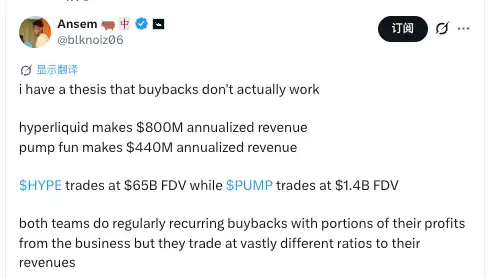
7 月 16 日,知名 Solana 交易员 Ansem(@blknoiz06)在 X 平台发布长帖,提出一个反直觉的论断:回购机制本身并不创造价值,真正决定代币交易倍数的是团队与社区之间的「信任溢价」。这条帖子发布后迅速获得超 46.9 万次浏览、3240 个点赞和 509 次转发。

Ansem 选了加密行业两个收入最强的协议作对照。Hyperliquid 年化收入约 8 亿美元,HYPE 的 FDV 约为 650 亿美元;pump.fun 年化收入约 4.4 亿美元,HYPE 的 FDV 约为 650 亿美元;pump.fun 年化收入约 4.4 亿美元, HYPE 的 FDV 约为 650 亿美元;pump.fun 年化收入约 4.4 亿美元,PUMP 的 FDV 仅约 14 亿美元。两个团队都在用收入的绝大部分做回购,但估值倍数相差近 50 倍。

Ansem 的结论是:差距不在收入规模,而在团队行为积累出的信任。

同样砸钱回购,Hyperliquid 和 pump.fun 为什么估值天差地别

Ansem 在帖子中拆解了两个平台的回购策略。

Hyperliquid 将协议费用的 97%至 99%直接导入 HYPE 回购和销毁。据 CryptoNews 数据,截至 6 月 30 日,Hyperliquid 累计协议收入已突破 10 亿美元,年化运行率接近 8.4 亿美元。平台已销毁超过 4100 万枚 HYPE 代币,价值超过 10 亿美元,流通供应量减少约 4.2%。截至发稿,HYPE 报价约 60 至 67 美元区间,FDV 约 570 亿至 620 亿美元。

pump.fun 同样激进。2025 年该平台总收入约 9.7 亿美元,将接近 100%的收入投入 PUMP 回购,累计回购约 2.13 亿美元。2026 年 4 月,团队一次性销毁了价值 3.7 亿美元的 PUMP 代币(约占流通供应量的 36%),并将后续收入的 50%锁定为持续销毁。但 PUMP 目前报价约 0.0016 美元,FDV 约 14 至 17 亿美元。

pump.fun 的年化收入约为 Hyperliquid 的一半多,但 FDV 不到 Hyperliquid 的 3%。如果回购机制是估值的核心驱动力,这个倍数差距无法解释。

Ansem 的解释:信任溢价才是定价核心

Ansem 认为,市场给 Hyperliquid 的高估值,根源在于 Jeff(Hyperliquid 创始人)和团队建立起的信任。

他在帖子中列举了几点:Hyperliquid 从未过度承诺,团队只专注于出产品;用户奖励严格按照事先确定的链上指标分配,没有暗箱操作;核心用户群对 Jeff 和团队有极高的信任评级。Ansem 原话称,这种信任溢价「是代币交易得这么好的一个主要原因」。

Hyperliquid 的历史行为确实支撑了这一判断。该项目没有接受 VC 投资,总供应量的 70%分配给社区;2024 年 11 月启动时的大规模空投兑现了早期承诺;平台在 2026 年 2 月市场抛售中展现出韧性,表明用户群包含大量依赖平台进行日常交易的严肃交易者。

pump.fun 的问题:10 亿美元收入,承诺的空投一年没兑现

Ansem 对 pump.fun 的批评更为直接。

他指出,pump.fun 累计收入超过 10 亿美元,在 ICO 中又募集了 10 亿美元,但承诺给用户的空投从未兑现。据 Protos 报道,pump.fun 在 2025 年 7 月 9 日宣布 PUMP 代币 ICO 时明确表示「airdrop coming soon」,承诺将 24%的供应量分配给社区。截至 2026 年 7 月中旬,这一承诺已经过去整整一年,空投仍未落地。

Ansem 此前在 6 月 25 日就曾公开批评过这一点:「pump.fun 是加密行业唯一一个持续维持注意力好几年的应用,OpenSea 都没做到。但人们愤怒是因为他们承诺了 24%的空投却从未兑现,现在就坐在现金上。」

2026 年 4 月的 3.7 亿美元代币销毁本意是修复信任,但社区反应适得其反。部分用户认为,这些被销毁的代币原本应该用于空投分配,销毁等于直接消灭了社区应得的份额。据 Cryptopolitan 报道,社区对此举的普遍解读是「加深了不信任」。

Ansem 在最新帖子中做了一个假设:如果 pump.fun 认真兑现空投承诺,回应核心用户的关切,代币价格可能会上涨 10 到 15 倍,同时交易量、关注度和平台收入也会实质性提升。

Criptomoedas em alta

Perguntas relacionadas

Q文章中,Ansem认为决定代币交易倍数的核心因素是什么?

AAnsem认为决定代币交易倍数的核心因素是团队与社区之间建立的“信任溢价”,而非回购机制本身。他强调团队的行为和承诺兑现是获得高估值的关键。

Q文章中以哪两个协议作为案例对比,来说明回购与估值关系不大?

A文章中以Hyperliquid(HYPE)和pump.fun(PUMP)作为案例进行对比。两者都进行大规模回购,但估值倍数相差近50倍,以此说明回购并非决定估值的核心。

Q根据文章,pump.fun在社区信任方面存在的主要问题是什么?

Apump.fun在社区信任方面存在的主要问题是:它曾在2025年7月承诺将24%的代币供应量空投给社区,但截至2026年7月中旬(文章发布时间)已过去整整一年,这一承诺仍未兑现。此外,其2026年4月的大规模销毁行动被部分社区成员解读为侵占了本应空投的份额,加深了不信任。

QHyperliquid的团队是如何建立起社区信任的?

AHyperliquid的团队通过以下行为建立起社区信任:1. 专注于产品开发,没有过度承诺;2. 用户奖励严格按照事先确定的链上指标分配,公开透明;3. 总供应量的70%分配给社区,并兑现了早期空投承诺;4. 核心用户群对团队有极高的信任评级,平台在2026年2月的市场抛售中表现出韧性,显示出其用户基础是严肃交易者。

QAnsem对pump.fun提出的假设性建议是什么?

AAnsem假设,如果pump.fun能够认真兑现其空投承诺,并积极回应核心用户的关切,那么其代币价格可能会上涨10到15倍。同时,平台的交易量、关注度和收入也会获得实质性的提升。

Leituras Relacionadas

Upbit is Anxious: A Hasty Counterattack Aimed at Regaining Stablecoin Market Share

Title: Upbit's Rushed Counterattack to Reclaim Stablecoin Market Share Facing a dramatic shift in South Korea's stablecoin market, leading exchange Upbit launched a promotional campaign from July 26 to August 9, waiving the 0.05% trading fee for stablecoins paired with the Korean Won (KRW) and rapidly listing new stablecoins like RLUSD and USDG. This move is a direct response to its plummeting market share in this sector. Historically a duopoly with Bithumb, the market has been reshaped since October 2025 when Coinone permanently removed fees for USDC trading. By June 2026, Coinone led with 34.8% of stablecoin volume, followed by Bithumb (31.1%) and Upbit (30.1%). This contrasts sharply with the overall crypto market, where Upbit commands 60%. The data shows stablecoin demand is highly sensitive to fees, as users primarily buy them to transfer capital overseas for derivatives trading or forex arbitrage. South Korean exchanges have seen a net outflow of stablecoins for 18 consecutive months, totaling approximately 14.9 trillion KRW, underscoring their role as a cross-border capital conduit. Upbit's limited-time promotion initially boosted its daily stablecoin volume by 162%, but the surge was almost entirely in USDT (98.1% of volume). The newly listed stablecoins saw negligible, fleeting interest. Furthermore, the promotional effect quickly waned in the second week, with volume dropping 33% on weekdays. A concurrent weakening of the KRW also contributed to the trading spike, independent of the fee waiver. The analysis suggests that once the promotion ends, Upbit is unlikely to retain its temporary gains unless it matches Coinone's permanent zero-fee policy, forcing a choice between market share and fee revenue. Upbit's strategic push may be less about immediate profit and more about preparing for future regulatory shifts. With South Korea's *Digital Asset Basic Act* on the horizon, which will regulate KRW-backed stablecoins, and following Dunamu's (Upbit's parent) integration into Naver Financial to build a payment ecosystem, securing a dominant position in the dollar stablecoin distribution channel holds long-term strategic value. However, potential regulatory conflicts could prevent Upbit from listing a future Naver-issued KRW stablecoin, making the current fight for dollar stablecoin flow even more critical.

marsbitHá 2h

Upbit is Anxious: A Hasty Counterattack Aimed at Regaining Stablecoin Market Share

marsbitHá 2h

Michael Saylor Compares Bitcoin and Gold!

Michael Saylor, founder of MicroStrategy, argues that Bitcoin fundamentally changes how wealth is stored and transferred by transforming digital scarcity into economic value. He describes Bitcoin as the first digital monetary network, combining computers, digital networks, and cryptography. It digitizes monetary assets, allowing their supply to be controlled by public protocols rather than institutions, thus converting economic value into information transmissible over global networks. Comparing Bitcoin to gold, Saylor states that while increasing Bitcoin's supply is harder, its integration with software and transfer is easier. He highlights Bitcoin's proof-of-work mechanism, which ties it to the physical world by consuming real energy to secure the ledger, making past transactions immutable. This creates a shared security system involving miners, energy companies, and investors. Saylor suggests "digital monetary energy" is a more accurate term than "digital gold." He emphasizes that the Bitcoin network is an adaptive ecosystem of miners, nodes, developers, and users. Its core design is intentionally simple, focused on maintaining a secure ledger for scarce digital assets, with complex functionalities built in higher-layer applications. This architecture allows Bitcoin to serve as a foundation for transmitting value and fostering innovation in payments and financial services. Saylor notes Bitcoin's deeper impact lies in creating digital sovereignty, where private keys give individuals permissionless control over their economic power, with ownership verified mathematically, not by institutions. He concludes that while gold's physical scarcity makes it money, Bitcoin's digital scarcity does the same, characterizing Bitcoin as the monetary energy of the digital age.

cryptonews.ruHá 3h

Michael Saylor Compares Bitcoin and Gold!

cryptonews.ruHá 3h

Trading

Spot

Artigos em Destaque

Como comprar ANSEM

Bem-vindo à HTX.com!Tornámos a compra de The Black Bull (ANSEM) simples e conveniente.Segue o nosso guia passo a passo para iniciar a tua jornada no mundo das criptos.Passo 1: cria a tua conta HTXUtiliza o teu e-mail ou número de telefone para te inscreveres numa conta gratuita na HTX.Desfruta de um processo de inscrição sem complicações e desbloqueia todas as funcionalidades.Obter a minha contaPasso 2: vai para Comprar Cripto e escolhe o teu método de pagamentoCartão de crédito/débito: usa o teu visa ou mastercard para comprar The Black Bull (ANSEM) instantaneamente.Saldo: usa os fundos da tua conta HTX para transacionar sem problemas.Terceiros: adicionamos métodos de pagamento populares, como Google Pay e Apple Pay, para aumentar a conveniência.P2P: transaciona diretamente com outros utilizadores na HTX.Mercado de balcão (OTC): oferecemos serviços personalizados e taxas de câmbio competitivas para os traders.Passo 3: armazena teu The Black Bull (ANSEM)Depois de comprar o teu The Black Bull (ANSEM), armazena-o na tua conta HTX.Alternativamente, podes enviá-lo para outro lugar através de transferência blockchain ou usá-lo para transacionar outras criptomoedas.Passo 4: transaciona The Black Bull (ANSEM)Transaciona facilmente The Black Bull (ANSEM) no mercado à vista da HTX.Acede simplesmente à tua conta, seleciona o teu par de trading, executa as tuas transações e monitoriza em tempo real.Oferecemos uma experiência de fácil utilização tanto para principiantes como para traders experientes.

524 Visualizações TotaisPublicado em {updateTime}Atualizado em 2026.07.01

Como comprar ANSEM

Discussões

Bem-vindo à Comunidade HTX. Aqui, pode manter-se informado sobre os mais recentes desenvolvimentos da plataforma e obter acesso a análises profissionais de mercado. As opiniões dos utilizadores sobre o preço de ANSEM (ANSEM) são apresentadas abaixo.

活动图片