别被 12.5 亿上限误导:Strategy 三套售币资金池暗藏巨额抛盘

Foresight NewsPublicado em 2026-07-08Última atualização em 2026-07-08

Resumo

近日,Strategy 公司出售了3588枚比特币(约2.16亿美元),用于分红和补充美元储备,但对外仍宣称其12.5亿美元的“构建储备”额度完好无损。这揭示了其比特币变现计划中一个关键会计区分:只有为“构建储备”而出售比特币才受12.5亿美元上限限制,而为“补充储备”等其他目的售币则无此限制。 该公司的变现计划允许为三大目的出售比特币: 1. **构建储备**:上限12.5亿美元。 2. **覆盖优先股支出**:用于支付股息、利息,或在动用储备后售币回填,此渠道无明确上限。 3. **股份回购资金**:用于回购优先股或普通股,两类回购上限各10亿美元,合计潜在抛售规模达20亿美元。 因此,公司潜在的比特币抛售总规模远超市场普遍认知的12.5亿美元,可能超过30亿美元(仅计算有上限的渠道)。 文章指出,“构建”与“补充”储备在会计上的划分,虽目的相同(变卖比特币换取现金以支付股息利息),却直接影响其售币是否消耗公开额度。这标志着Strategy从单纯的“买入并持有”比特币公司,转变为一家进行复杂主动资本管理的机构,其操作常在不同资本工具(如普通股、优先股、比特币)之间权衡利弊,内部存在矛盾。 投资者需意识到,Strategy已非简单的比特币杠杆投资标的,其未来抛售比特币的规模和动机需仔细解读其公告中的每一个专业术语。投资该公司,实质上是在押注其能否在复杂的资本运作中维持平衡,避免体系崩溃。作者表示不会参与这种押注。


撰文:David Christopher

编译:Saoirse,Foresight News


近日,Strategy 披露在 6 月 29 日至 7 月 5 日期间,公司出售了 3588 枚比特币,总价值约 2.16 亿美元。这笔售币所得用于派发 STRC 分红,同时补足了此前用于分红而消耗的美元储备。即便完成此次抛售,Strategy 仍对外宣称,其 12.5 亿美元储备构建额度保持全额可用。


也就是说,这笔 2.16 亿美元、用于补充储备的比特币抛售,并不会占用用于构建储备的 12.5 亿美元额度。从财务定义上二者有所区分:补充储备与构建储备。但两类操作本质都是为同一笔美元储备注入资金、服务同一用途,只是会计归类方式不同。


换而言之,这套比特币变现计划,从未把比特币总抛售规模上限锁定在 12.5 亿美元。该额度仅限制其中一类操作:通过出售比特币新增资金、搭建美元储备。除此之外,方案还允许 Strategy 出于其他用途抛售比特币,本次出售便是典型案例。


三大资金池


6 月 29 日,在 MSTR 与 STRC 股价连续承压数周后,Strategy 推出比特币变现计划,作为其数字信贷资本整体框架的组成部分。该计划允许公司出于三大核心目的出售比特币:


  1. 构建储备:出售比特币,最高可筹集 12.5 亿美元资金充实美元储备;
  2. 覆盖优先股相关支出:出售比特币,用于支付优先股固定股息、债务利息;或是在动用储备付息后,再抛售比特币回填储备 —— 当管理层判断售币比增发普通股更划算时,就会采用该方式;
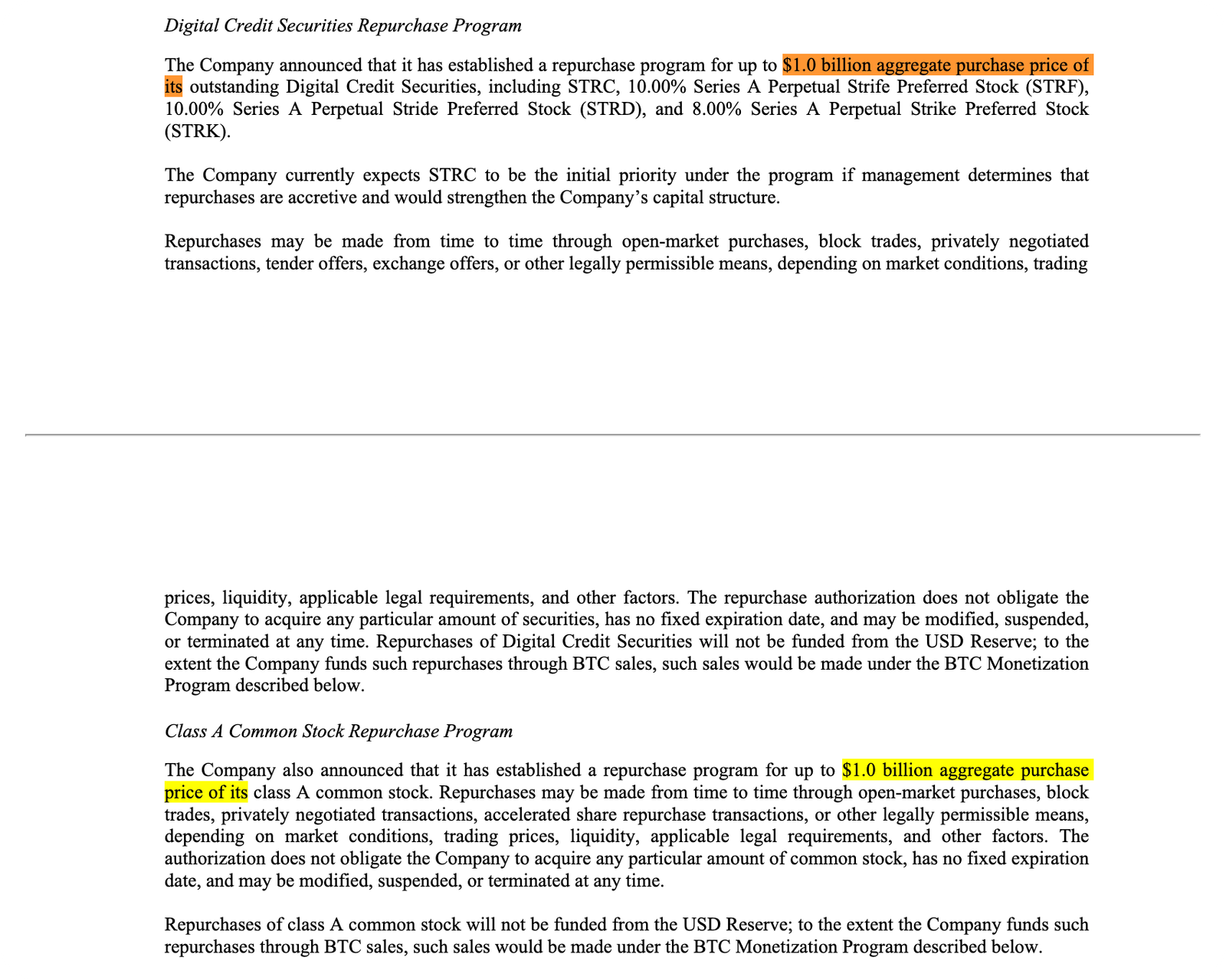
  3. 股份回购资金:出售比特币用于回购优先股或 MSTR 普通股,两类股份回购上限各 10 亿美元,售币收入还可覆盖回购产生的税费、手续费等相关开支。


只有第一类资金池拥有市场广为流传的 12.5 亿美元限额;第三类回购渠道合计可变现 20 亿美元比特币。仅这两类设有明确上限的渠道,合计就能抛售超 30 亿美元比特币,还未计入无额度限制的股息付息、储备补充资金池。


区分「构建」与「补充」:界限模糊的会计操作


美元储备设立的唯一作用,是兑付优先股股息与债务利息,按照现行规则,这笔资金不能用于股票回购。截至 6 月 28 日,美元储备余额为 25.5 亿美元,足以覆盖公司每年 17.6 亿美元刚性支出,支撑约 17 个月付息。董事会划定底线:储备至少要覆盖 12 个月付息,除非董事会另行批准下调标准。


这也是为何「构建储备」和「补充储备」的划分值得仔细推敲:


  • 派息前抛售比特币、新增现金存入储备:定义为构建储备;
  • 先动用储备发放股息,之后再抛售比特币补足储备缺口:定义为补充储备


方案将二者划分为两类操作,但最终目的完全一致:变卖比特币换取现金,兑付优先股股息与利息。相关细则早已对外披露,但本次抛售事件,直观体现出这套分类规则对公司有多便利。Strategy 卖出价值 2.16 亿美元的比特币,资金用于分红与回填储备,对外却依旧声称 12.5 亿美元储备构建额度分文未动。


如今市场都需要读懂这套「Strategy 专属话术」。「构建」与「补充」只是会计层面的细分表述,却直接决定一笔比特币抛售是否会消耗公开的额度上限。


从单纯囤币,转向主动资本管理


在 6 月 29 日的公告中,Michael Saylor 表示,这套资本框架是为了满足企业对流动性、规范化运营与主动资本管理的需求。CEO Phong Le 表述得更为直白:Strategy 正在转型,从单向增发股票购入比特币,升级为全方位主动资本运营。


正如 Castle Island 的 Matt Walsh 与 Jeff Dorman 上周做客播客节目时分析的那样,Strategy 实质上已经变成一只主动管理型对冲基金。


过去市场对 Strategy 的叙事十分简单:增发 MSTR 普通股,买入比特币,为投资者提供加杠杆的比特币敞口。但新框架彻底改变了这套逻辑:如今公司会主动买卖自身各类资本工具,以此平衡普通股、优先股、美元储备与比特币资产之间的多重压力。


Walsh 与 Dorman 指出,这套运营模式内部充满矛盾:增发普通股可以保障优先股分红,但会压低 MSTR 相对所持比特币的估值溢价;抛售比特币能延长现金可用周期,却彻底动摇「永不售币」的核心叙事;足额兑付优先股可以稳住市场信心,但会持续消耗现金储备;削减优先股分红能保住流动性,却可能导致优先股价格大幅暴跌。


储备额度的会计漏洞,正是本次战略转型的缩影。比特币不再是公司长期囤积的核心资产,而是调节资产负债表、维持优先股兑付体系运转的财务杠杆。


结论


投资者现在必须预判 Michael Saylor 这套资本运营模式的风险:每一项操作都会利好资本结构中的某一端,同时损害另一端。


这也是 7 月 6 日公告释放的关键信号:Strategy 并非没有抛售比特币的空间,其可售规模远不止市场表面看到的数字。只有当投资者误以为 12.5 亿美元是全部抛售上限时,这一数字才会代表公司优先保全比特币持仓;切勿陷入这个认知误区。


如今的 Strategy,已经是一家需要市场逐字解读规则的金融机构。每一个专业表述都至关重要:构建、补充、增发、回购、维稳。投资者要像美联储观察家逐字解读政策文稿一样,拆解每一个术语,判断其未来抛售比特币的潜在规模。


这套变现计划给了 Strategy 操作弹性,但底层的内在矛盾从未消失。它不再是单纯、清晰的比特币杠杆投资标的;押注这家公司,本质是赌其主动资本管理能力 —— 赌公司可以持续抛售、回填、发股、回购、维稳各类资本工具,且不会出现一环崩盘、全线失控的局面。


就我个人而言,我不会参与这场押注。

Criptomoedas em alta

Perguntas relacionadas

QStrategy公司的比特币变现计划中,除了构建储备的12.5亿美元额度,还包括哪些可以出售比特币的渠道?

A根据文章,Strategy的比特币变现计划允许出于三大目的出售比特币:1. 构建储备,上限为12.5亿美元;2. 覆盖优先股相关支出,用于支付股息、利息或回填储备,此部分没有明确上限;3. 股份回购资金,用于回购优先股或普通股,两类回购上限各10亿美元。后两者合计可抛售超过30亿美元的比特币。

Q在Strategy的框架下,“构建储备”和“补充储备”在会计操作上有何区别?这种区别如何影响其宣称的12.5亿美元额度?

A两者的主要区别在于操作顺序:“构建储备”是指在派发股息/利息之前出售比特币,将新获得的现金直接存入储备;“补充储备”则是先动用储备金支付股息/利息,之后再出售比特币来填补储备金的缺口。尽管最终目的相同(变卖比特币换取现金来兑付支出),但由于会计归类不同,用于“补充储备”的比特币抛售不计入那公开的12.5亿美元“构建储备”额度内,因此公司可在不影响该额度的情况下进行额外抛售。

Q文章提到Strategy已经从单纯囤积比特币的公司转变为一种什么类型的机构?这种转变的核心矛盾是什么?

A文章指出,Strategy已从单纯的比特币持仓公司转变为一家“主动管理型对冲基金”或需要“全方位主动资本运营”的金融机构。其核心矛盾在于:公司的各项操作(如增发股票、抛售比特币、支付股息、回购股份)会利好资本结构中的某一端(例如保障优先股分红、稳住市场信心),但同时必然会损害另一端(如压低普通股溢价、动摇“永不售币”的叙事、消耗现金储备),公司必须在这些相互冲突的目标间进行平衡,操作复杂且风险增加。

Q为什么说投资者不应被“12.5亿美元”这个抛售上限所误导?

A因为“12.5亿美元”仅仅是Strategy比特币变现计划中“构建储备”这一单一渠道的上限。该计划还包括用于支付优先股支出(无明确上限)和用于股份回购(合计上限20亿美元)的其他两个资金池。因此,公司理论上可抛售的比特币总规模远不止12.5亿美元,可能超过30亿美元。投资者若只关注12.5亿美元,会严重低估公司潜在的比特币抛售压力。

Q文章作者对投资转型后的Strategy持何种态度?其理由是什么?

A文章作者明确表示“不会参与这场押注”,即不看好或不愿投资转型后的Strategy。理由是:公司已成为一家操作复杂、充满内在矛盾的金融机构。投资它不再是赌比特币的简单上涨,而是赌公司管理层能在增发、抛售、回购、支付股息等多种相互冲突的资本操作中维持平衡,避免一环崩盘导致全线失控。作者认为这种主动资本管理带来的风险过高,不值得参与。

Leituras Relacionadas

Weng Li's New Blog Proposes 'Self-Evolution Should Start from Harness', DeepSeek's Cui Tianyi Endorses with Repost

Lilian Weng, former OpenAI security VP and co-founder of Thinking Machines Lab, has published a new blog post titled "Harness Engineering for Self-Improvement," proposing a pragmatic path for AI self-evolution. She argues that Recursive Self-Improvement (RSI) may practically begin at the "Harness" layer—the external runtime system governing how models use tools, manage context, and execute tasks—rather than directly from the model rewriting its own weights. The blog outlines a progression from optimizing prompts (Context Engineering) to designing workflows, and ultimately to Self-Improving Harness systems. These systems can identify their own weaknesses, propose targeted, verifiable modifications to the harness code, and validate improvements. Works like Self-Harness and Darwin Gödel Machine (DGM) demonstrate significant performance gains on benchmarks like SWE-bench through such automated harness evolution, rivaling handcrafted agents. DeepSeek researcher Tianyi Cui endorsed the view, noting harness-based self-evolution is as promising as model-based approaches. Weng emphasizes this is complementary to model training, with both reinforcing each other. However, key challenges remain: weak evaluators for subjective tasks, reward hacking, diversity collapse, managing long-term system health versus short-term success, and defining the human oversight role. The consensus is growing: the harness is a critical variable, as the same model can exhibit vastly different capabilities within different harness systems.

marsbitHá 4m

Weng Li's New Blog Proposes 'Self-Evolution Should Start from Harness', DeepSeek's Cui Tianyi Endorses with Repost

marsbitHá 4m

Odaily Editorial Department Tea Party (July 8)

Odaily Editorial Team Casual Chat (July 8) This is an informal column from Odaily's editorial team, sharing immediate thoughts on industry news, data, and hot topics from various angles. It presents investment ideas and opportunity hypotheses still under verification—which may not be direct wealth codes but questions in themselves—alongside observations from industry interactions and materials that genuinely enhance the team's understanding. The content is based on real investment and observation experiences, carries no advertising, and does not constitute investment advice. Its purpose is to broaden perspectives and supplement information sources, not to create consensus. Team Member Shares: * **Wenser (@wenser2010):** Noted a deeper correction (nearly 30%) in US and Korean stocks, including memory stocks, but remains bullish on DRAM due to perceived supply shortages. In prediction markets, personal small bets outperformed blind copying; favors France to win the World Cup. Views crypto-related stocks like STRK as bearish for now, while seeing Circle and Coinbase as potential rebound plays. Observes recent strength in software stocks like Microsoft but is unsure if it's a sustained recovery. * **Bcxiongdi (@bcxiongdi):** Discusses the recent "recovery training" in meme coin markets on Solana and BSC, characterized by small-scale PVP opportunities, admitting to having sold many assets too early. Suggests also watching the Robinhood chain. Found World Cup prediction markets challenging, advising to consider buying during matches rather than only before. * **Azuma (@azuma_eth):** Focuses on the US stock market, particularly the significant semiconductor correction. Believes demand fundamentals remain and considers buying the dip in DRAM stocks. Notes a potential rotation signal as hedge funds have recently concentrated buying in tech stocks. Plans to continue adding to RKLB (Rocket Lab) stock, seeing limited downside and high upside potential at current levels after its founder's share sale window closed.

Odaily星球日报Há 20m

Odaily Editorial Department Tea Party (July 8)

Odaily星球日报Há 20m

Former Huawei 'Genius Teen' Who Questioned DeepSeek Interview Lands in 'Crossfire' from Web3 Investor

Former Huawei "Genius Youth" Li Bojie recently drew public attention by criticizing his interview experience with DeepSeek. The controversy escalated when Du Jun, co-founder of Web3 investment firm ABCDE Capital, publicly accused Li of being "the founder with the least sense of contractual spirit" he had ever cooperated with, sparking a dispute over Li's startup project, Metagent. Li detailed a frustrating DeepSeek interview where he was accused of potential plagiarism, leading him to end the session. The spotlight then shifted to his venture, Metagent, a Web3+AI project aiming to tokenize AI agents. ABCDE invested $1.5 million, with an initial $500k disbursed. Du Jun claimed the project's progress was severely lacking, with a poor-quality demo and minimal social media activity. He alleged Li stopped communicating, deleted his Telegram, and failed to provide proper financial reporting. In response, Li argued the remaining $1 million was never received, crippling operations and forcing salary cuts. He stated he left Metagent in October 2024 due to family reasons and Web3 compliance concerns, with board approval. He claimed to have fulfilled disclosure duties and that his subsequent projects avoided conflicting fields. Other investors, including ArkStream Capital, shared negative due diligence experiences, citing unprofessional contracts and evasive answers on tokenomics. Metagent's social media went silent in June 2024, effectively stalling. Li has since moved to a new consumer AI agent platform, Pine AI (formerly Logenic AI), which has raised $25 million in Series A funding. He served as its Chief Scientist but recently left, clarifying he was not the founder and departed due to a shift in research interests.

Foresight NewsHá 50m

Former Huawei 'Genius Teen' Who Questioned DeepSeek Interview Lands in 'Crossfire' from Web3 Investor

Foresight NewsHá 50m

Trading

Spot

Artigos em Destaque

Como comprar CAP

Bem-vindo à HTX.com!Tornámos a compra de Cap (CAP) simples e conveniente.Segue o nosso guia passo a passo para iniciar a tua jornada no mundo das criptos.Passo 1: cria a tua conta HTXUtiliza o teu e-mail ou número de telefone para te inscreveres numa conta gratuita na HTX.Desfruta de um processo de inscrição sem complicações e desbloqueia todas as funcionalidades.Obter a minha contaPasso 2: vai para Comprar Cripto e escolhe o teu método de pagamentoCartão de crédito/débito: usa o teu visa ou mastercard para comprar Cap (CAP) instantaneamente.Saldo: usa os fundos da tua conta HTX para transacionar sem problemas.Terceiros: adicionamos métodos de pagamento populares, como Google Pay e Apple Pay, para aumentar a conveniência.P2P: transaciona diretamente com outros utilizadores na HTX.Mercado de balcão (OTC): oferecemos serviços personalizados e taxas de câmbio competitivas para os traders.Passo 3: armazena teu Cap (CAP)Depois de comprar o teu Cap (CAP), armazena-o na tua conta HTX.Alternativamente, podes enviá-lo para outro lugar através de transferência blockchain ou usá-lo para transacionar outras criptomoedas.Passo 4: transaciona Cap (CAP)Transaciona facilmente Cap (CAP) no mercado à vista da HTX.Acede simplesmente à tua conta, seleciona o teu par de trading, executa as tuas transações e monitoriza em tempo real.Oferecemos uma experiência de fácil utilização tanto para principiantes como para traders experientes.

30 Visualizações TotaisPublicado em {updateTime}Atualizado em 2026.06.26

Como comprar CAP

Discussões

Bem-vindo à Comunidade HTX. Aqui, pode manter-se informado sobre os mais recentes desenvolvimentos da plataforma e obter acesso a análises profissionais de mercado. As opiniões dos utilizadores sobre o preço de CAP (CAP) são apresentadas abaixo.

活动图片