Can Ethereum’s $150B stablecoin liquidity help ETH bulls reclaim control?

ambcryptoPublicado em 2026-07-07Última atualização em 2026-07-07

Resumo

Ethereum has established itself as a leading infrastructure for digital dollars, now holding over $150 billion in on-chain stablecoin liquidity, a sign of real economic activity. Despite trading at $1,748.47 with an 11% weekly gain, it faces a key resistance zone between $1,750 and $1,800, where selling pressure has historically capped rallies. However, recent inflows into ETH ETFs and a potential technical "double bottom" pattern suggest buyers may be regaining momentum. Analysts link long-term bullish prospects, with price targets as high as $8,500 by mid-2027, to the growth of stablecoins and real-world asset (RWA) tokenization on Ethereum. The ongoing "Lean Ethereum" protocol redesign further underscores the network's evolving utility beyond speculation.

According to a recent update, Ethereum has already taken the lead in the financial infrastructure for digital dollars and tokenized assets, and this is not just hype.

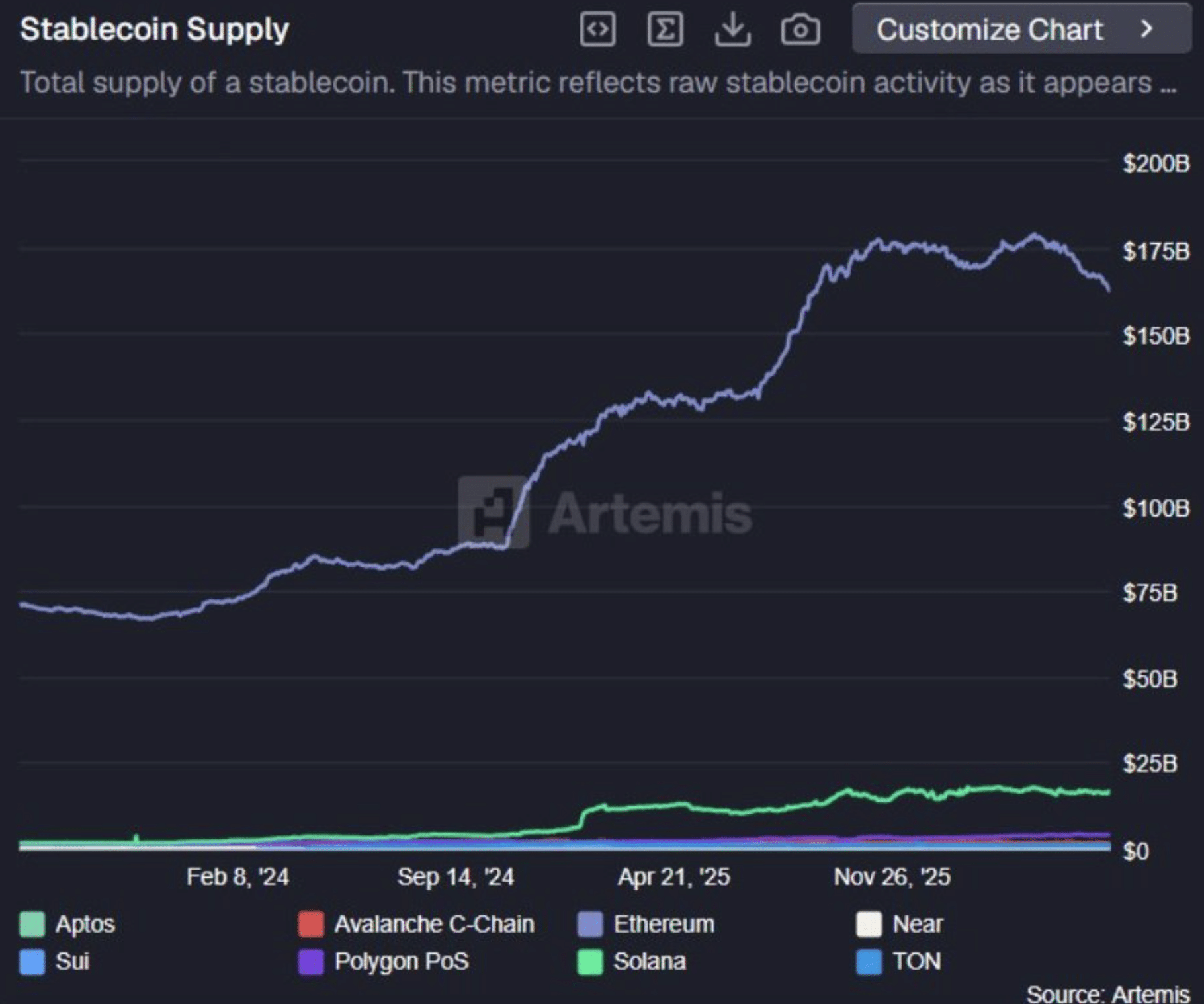
Artemis reported that Ethereum has more than $150 billion in on-chain stablecoin liquidity. This is noteworthy because stablecoins represent actual economic activity rather than speculative activity.
Source: Whale Factor/X

Ethereum’s market dynamics

This occurred at a time when the price of Ethereum [ETH] was trading at $1,748.47 at press time, following an 11% increase over the previous week.
Source: SoSo Value

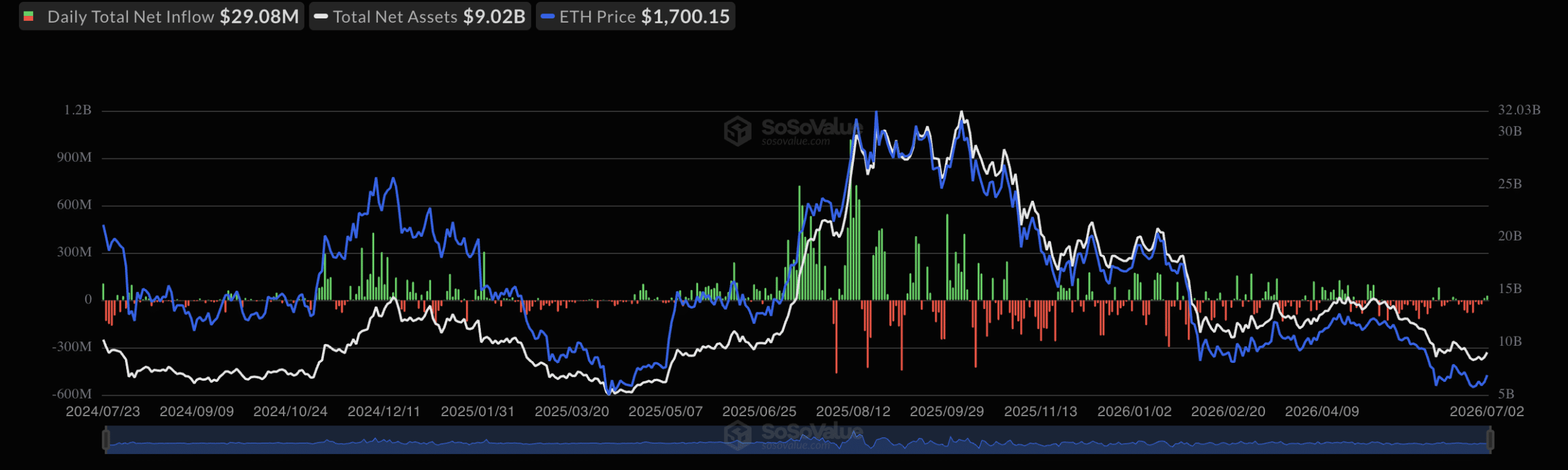
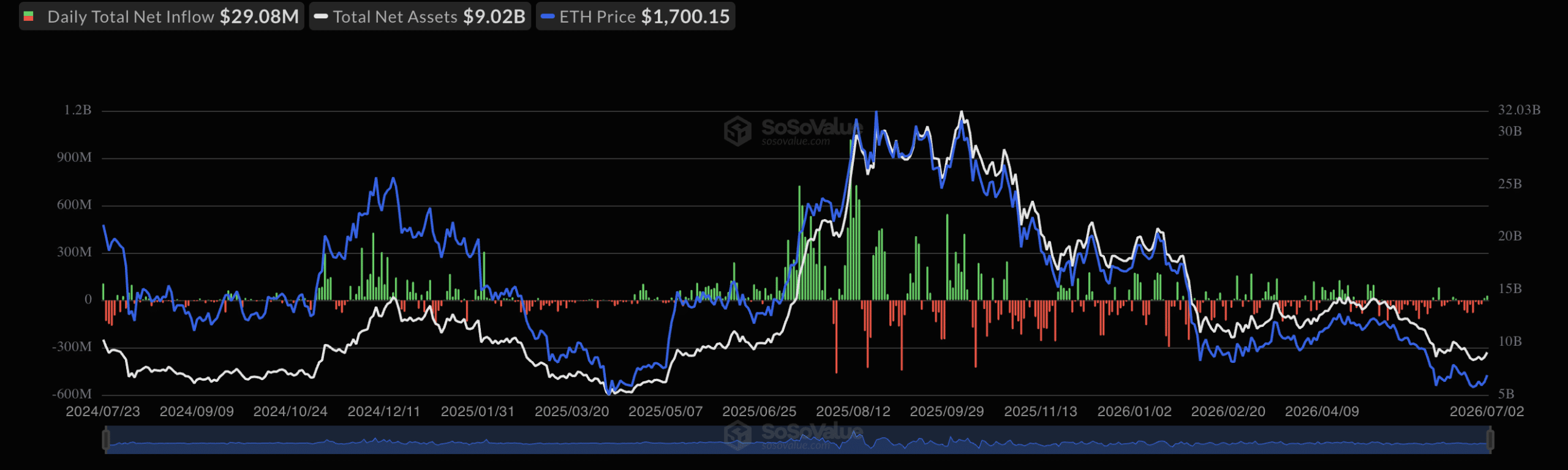
The ETH ETF, on the other hand, has been experiencing a prolonged period of outflows with a few exceptions.

However, on the 1st and 2nd of July, ETH ETFs recorded inflows worth $14.8 million and $29 million, respectively, highlighting renewed momentum.

Is buying momentum slowly rearing or ETH?

At the same time, many analysts are eyeing the $1,750–$1,800 range as a critical level because it has frequently served as a barrier where sellers have intervened to stop additional gains.


Ethereum has retreated in price every time it has approached this zone lately due to increased selling pressure from traders aiming to short the asset or take profits.

This shows that at those levels, supply has outpaced demand. However, Ethereum has the potential to indicate that buyers have absorbed the available selling pressure, provided it were to hold above $1,750–$1,800 with strong trading volume.

Community sentiments echo bullish notions for the altcoin

Interestingly, echoing somewhat similar sentiment, another analyst added,

ETH just double bottomed.

In other words, a double bottom occurs when the price of Ethereum hits a support level, bounces back, falls back to about the same level without breaking lower, and then rises once more. It is often seen as an indication that buyers are starting to regain control despite the selling pressure trying to barge in.

Therefore, the analyst predicted it best when he added,

~8,500 for ETH by mid 2027, thanks to stablecoins and RWA moving onchain.

What’s more?

Meanwhile, Ethereum has also entered a new stage of development with Lean Ethereum, a multi-year plan to completely redesign the network’s core protocol over the course of the next three to four years.

Ergo, as the gap between speculative capital inflow and network utility becomes more pronounced, it may result in further price appreciation.


Final Summary

  • Ethereum’s on-chain stablecoin liquidity skyrockets with its price trading at $1,748.47, and ETH ETF, experiencing a prolonged period of outflows.
  • Analysts consider the $1,750–$1,800 range as a critical price zone because it has frequently served as a barrier where sellers have intervened to stop additional gains.

Perguntas relacionadas

QAccording to the article, what is the significance of Ethereum's $150 billion on-chain stablecoin liquidity?

AThe significance is that stablecoins represent actual economic activity rather than just speculative activity, highlighting Ethereum's role in the financial infrastructure for digital dollars and tokenized assets.

QWhat was the price of Ethereum (ETH) at the time of writing, and what was its recent weekly performance?

AAt press time, Ethereum's price was $1,748.47, following an 11% increase over the previous week.

QWhy do analysts consider the $1,750–$1,800 price range as a critical level for Ethereum?

AAnalysts consider the $1,750–$1,800 range as critical because it has frequently acted as a barrier where sellers have intervened to stop additional gains, indicating supply has outpaced demand at those levels.

QWhat is a 'double bottom' pattern in technical analysis, and what does the analyst suggest it indicates for ETH?

AA 'double bottom' occurs when an asset's price hits a support level, bounces back, falls back to a similar level without breaking lower, and then rises again. The analyst suggests it indicates that buyers are starting to regain control despite selling pressure.

QWhat future development plan for Ethereum, mentioned in the article, aims to redesign its core protocol?

AThe future development plan is called 'Lean Ethereum,' which is a multi-year initiative aiming to completely redesign the network's core protocol over the next three to four years.

Leituras Relacionadas

Unitree's IPO Frenzy: The Real Mystery is How It Will Spend the 42 Billion Raised

Unitree, a Chinese robotics company, is set for a public listing after its IPO registration was approved by regulators. The company, which started with quadruped robots and has expanded into humanoids, plans to raise approximately 4.2 billion yuan through its offering. The article traces Unitree's rapid growth from its founding in 2016 to its current status. It highlights key milestones like the 2021 CCTV Spring Festival Gala performance, the 2023 launch of its affordable Go2 robot dog and the H1 humanoid robot, and a series of subsequent product launches. By 2025, the company reported revenue of 1.71 billion yuan, profitability, and sales exceeding 5,500 humanoid robots. As the first publicly-listed humanoid robot company on China's STAR Market, Unitree's main challenges are sustaining growth and deploying its newly raised capital effectively. The humanoid robot sector in China is crowded, with over 140 companies. Competitors include UBTech (focusing on industrial and consumer markets), Fourier, and international players like Tesla Optimus and 1X NEO. The article outlines three critical challenges for Unitree: establishing a strong second product line beyond its quadruped robots, maintaining its price advantage while ensuring quality, and successfully advancing its embodied AI capabilities through partnerships like the one with NVIDIA for the H2 Plus platform. Unitree's likely strategy involves a "developer tools + industry benchmarks" approach: using low-cost models like the R1 and G1 to build developer adoption and volume, leveraging high-end platforms for AI training, and securing pilot projects in sectors like logistics and manufacturing to build case studies. The company's future success hinges on converting its current momentum in shipments and pilot programs into sustainable, large-scale commercial contracts as the broader market evolves.

marsbitHá 1h

Unitree's IPO Frenzy: The Real Mystery is How It Will Spend the 42 Billion Raised

marsbitHá 1h

Examining the Open USD Partner Lineup: Follow Who's Joining to See Where the Money Flows

**Title: Deciphering the Open USD Partner Roster: Following the Money** The launch of Open USD is notable less for the stablecoin itself and more for its expansive list of over 140 founding partners, which reads like a "who's who" of global finance and tech. This coalition, including asset managers like BlackRock, card networks Visa and Mastercard, banks (BNY Mellon, Standard Chartered, etc.), tech giants (Google, IBM), merchants (Shopify), and crypto firms (Coinbase, Ripple, Aave, MetaMask), signals a strategic shift. The diverse membership reveals that stablecoins are increasingly viewed not as products to compete over, but as shared infrastructure too critical to be left to any single entity. Each partner category has distinct motives. Asset managers like BlackRock seek to manage the large, sticky cash reserves, a lucrative fee-generating opportunity. Merchants like Shopify aim for lower-cost settlement and potential yield on balances. Banks join defensively to retain custody and settlement roles, fearing deposit outflows to stablecoins. Tech companies bet on programmable money for future machine-to-machine commerce. Crypto firms gain mainstream legitimacy and distribution channels. Remarkably, the consortium includes direct competitors (Visa vs. Mastercard, Coinbase vs. Ripple), indicating that the fear of exclusion from this emerging financial layer outweighs competitive rivalries. However, this shared governance could also lead to slow decision-making. The roster's composition is the real message: it represents a collective bet that a widely accepted, consortium-owned stablecoin is preferable to proprietary versions or having none at all. For incumbents like Circle and Tether, this alliance poses a significant threat, as potential clients have collectively chosen to build their own alternative. The absence of major U.S. retail banks (busy with their own tokenized deposit networks) is equally telling. In essence, the partner list maps where the industry believes value and risk will flow in a tokenized dollar future, marking stablecoin's evolution from a product to a utility.

Foresight NewsHá 1h

Examining the Open USD Partner Lineup: Follow Who's Joining to See Where the Money Flows

Foresight NewsHá 1h

Trading

Spot
活动图片