Solana Ecosystem Shows Signs of Recovery: On-Chain Governance Upgrade, Tokenized Stocks and Meme Coins Heat Up

marsbitPublicado em 2026-07-03Última atualização em 2026-07-03

Resumo

Solana Ecosystem Shows Signs of Revival: Governance Upgrades, Tokenized Stocks, and Memecoins Heat Up While the broader crypto market faces a downturn, Solana has shown relative strength with its price rising nearly 15% recently. This resilience is attributed to warming ecosystem activity, particularly in tokenized stocks and memecoins, coupled with a major upgrade to its on-chain governance. In the Real World Assets (RWA) sector, Solana now leads all public chains in both the number of unique holder wallets and the quantity of RWA assets. Its tokenized stock weekly trading volume has surged to a record $1.42 billion, capturing about 96% of the market share, largely driven by the Backpack exchange. Simultaneously, the Solana memecoin sector has reignited, fueled by the rapid ascent of the ANSEM token following endorsements from a prominent crypto influencer. This has boosted activity across platforms like Pump.fun and increased fee revenue for several Solana-based exchanges. A key development is the launch of Solana Governance Proposals (SGP), a new on-chain mechanism. It allows validators with at least 100,000 SOL delegated to submit proposals for community vote, enhancing decentralized decision-making. SGP will operate alongside the existing technical proposal process (SIMD), focusing on broader ecosystem governance. Despite these positive signals in specific areas, overall on-chain activity and transaction volumes still lag behind previous bull market peaks, indicatin...

Author: Nancy, PANews

Recently, the crypto market has been shrouded in a chill once again, with Bitcoin once falling below the $60,000 mark, and mainstream crypto assets generally weakening.

In contrast, Solana has shown a relatively independent trend, rising about 14.9% in the past week. Behind the price increase lies the driving force of local ecosystem recovery and on-chain governance upgrades.

Ecosystem Shows Recovery Signals, RWA and Meme Coins Both Heating Up

Recently, the Solana ecosystem has released signals of recovery, especially in the two major sectors of tokenized stocks and meme coins.

In the RWA field, RWA.xyz data shows that as of July 3, based on the number of holding wallets, the number of RWA holding wallets on the Solana chain has exceeded 293,000, accounting for about 31.1% of the entire network, ranking first among all public chains. The second and third places, Plume and Ethereum, have approximately 248,000 and 205,000 respectively. Meanwhile, the number of RWA assets on the Solana chain has reached 2,119, also ranking first, surpassing mainstream public chains such as Arbitrum, Ethereum, and BNB Chain.
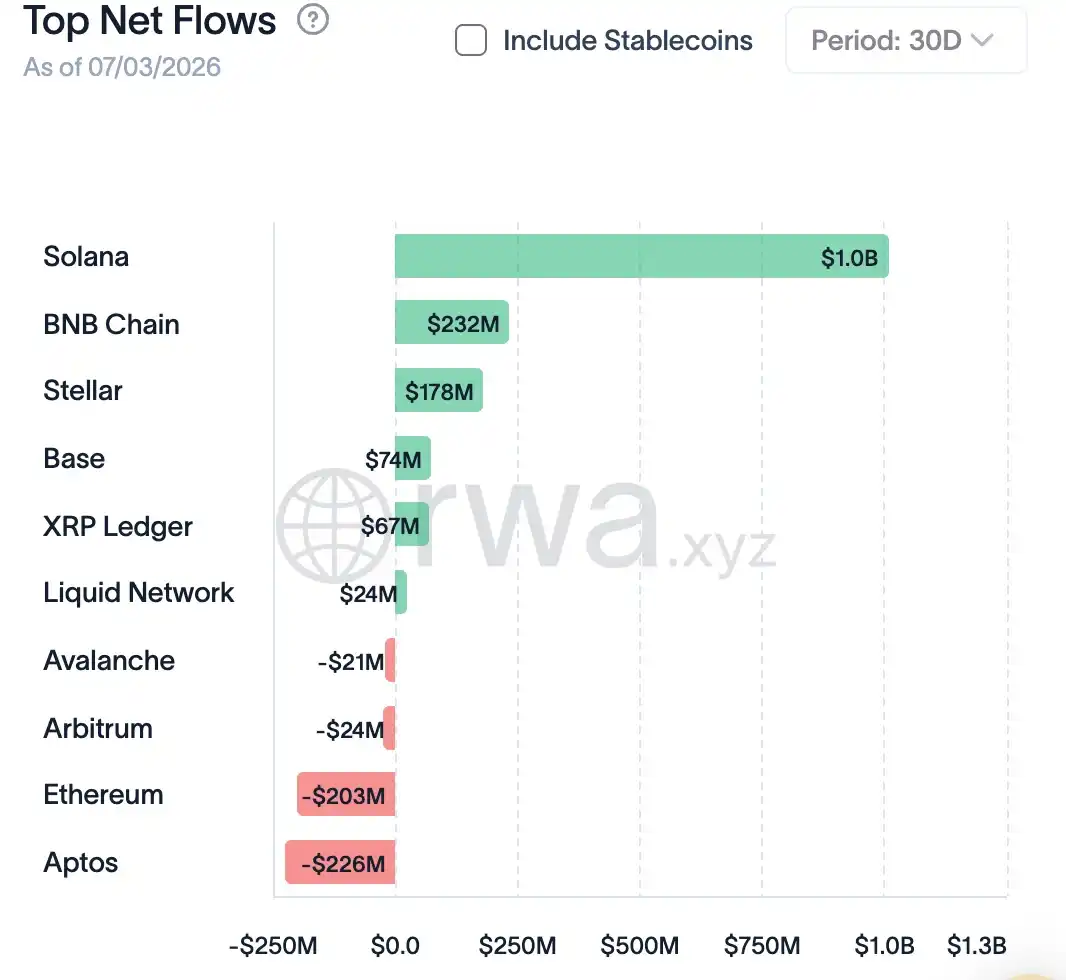
However, from the perspective of asset scale, Solana still has significant room for catch-up. Currently, the total value of RWAs on its chain is about $3.55 billion, still showing a considerable gap compared to Ethereum. But observing from capital flow, the net inflow of RWAs on the Solana chain over the past 30 days has exceeded $1 billion, significantly leading public chains such as Ethereum, BNB Chain, Arbitrum, Base, XRP Ledger, and Aptos, which confirms that funds have recently been flowing into the Solana ecosystem.

Behind this round of growth in the RWA market on Solana is the rapid expansion of the tokenized stock market.
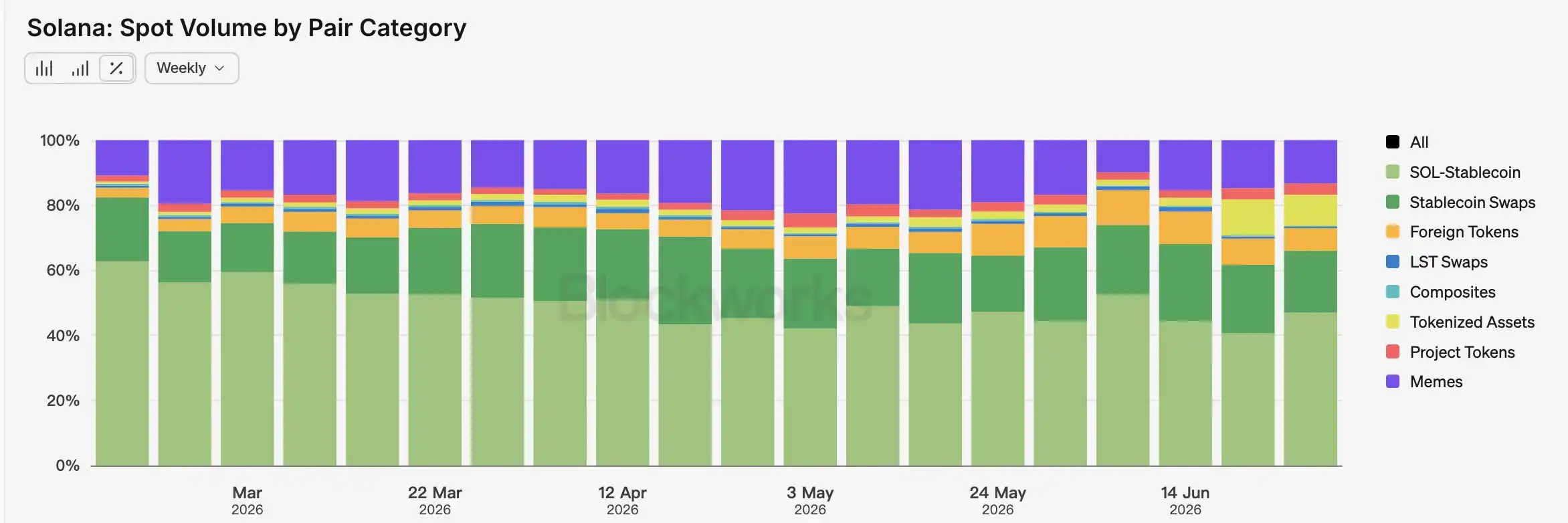
According to the latest data from Blockworks, tokenized assets now account for about 10% of Solana's weekly spot trading volume, a significant increase from just 1% at the beginning of the year. They have now become the second-largest trading category after meme coins.
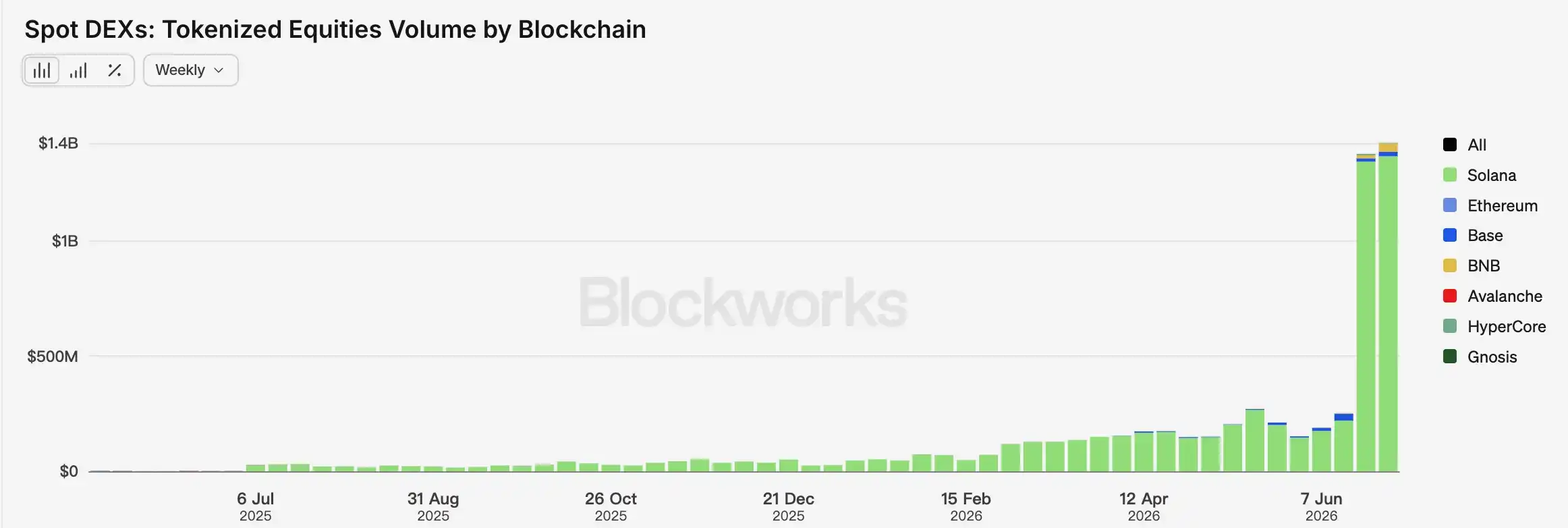
At the same time, the weekly trading volume of tokenized stocks on Solana has also reached a historical high, breaking $1.42 billion, a 30.9-fold increase compared to the beginning of the year, accounting for about 96% of the entire tokenized stock market's trading share. This growth mainly benefits from the tokenized stock business launched by Backpack last month. Currently, Backpack has become Solana's largest tokenized stock issuance platform. The tokenized stocks SPCX and MU it launched contribute about 95% and 99% of Solana's chain trading volume, respectively.

On the other hand, the meme coin market, which had been quiet for a long time, has also started to warm up.

Recently, crypto KOL Ansem publicly supported the eponymous meme coin ANSEM, quickly igniting "trench" trading enthusiasm on the Solana chain. Driven by factors such as celebrity endorsement, high concentration (Ansem holds 65% of the total token supply), and airdrop expectations, the market cap of ANSEM once surged to over $180 million within just a few days.

Dune data shows that as of July 3, Ansem has airdropped ANSEM tokens worth over $12.57 million to 979 addresses. Meanwhile, currently about 94.75% of ANSEM traders are in profit, further stimulating market sentiment.
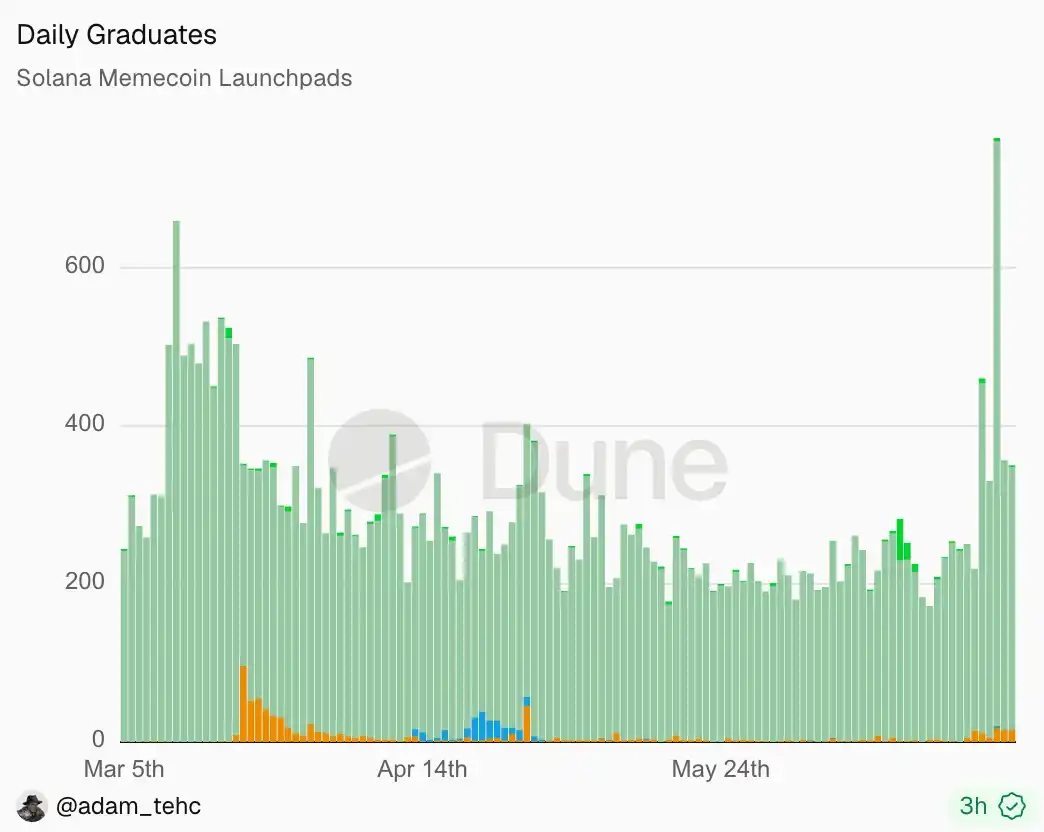
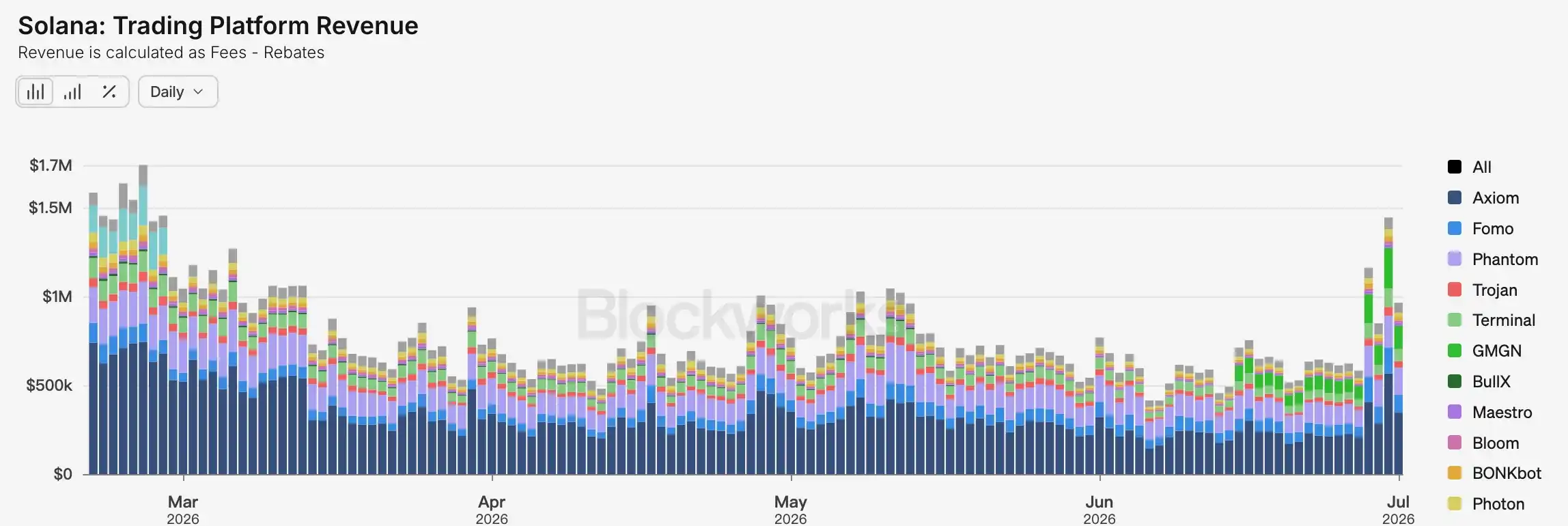
Driven by the ANSEM trend, the activity of the Solana meme ecosystem has also rebounded. Taking Pump.fun as an example, Dune data shows that the number of tokens successfully graduating from the platform daily has reached a new high since April, with daily trading volume more than doubling compared to a month ago. At the same time, Blockworks data shows that the daily revenue of Solana ecosystem trading platforms such as Axiom, Phantom, GMGN, and Fomo recently once again hit new highs since February of this year.
Solana On-Chain Governance Welcomes Key Upgrade: 100,000 SOL Required to Propose

Recently, Solana's on-chain governance mechanism has undergone an upgrade, further enhancing the decentralization of protocol decision-making, which is expected to promote the further healthy development of the ecosystem.

On July 2, the Solana Foundation announced the official launch of the on-chain governance mechanism Solana Governance Proposals (SGP). Validators can submit, support, and vote on core protocol decisions through SGP. The entire governance process is completed on-chain, employing a stake-weighted voting mechanism and verified through Merkle proofs.

According to the rules, any validator who has received at least 100,000 SOL delegated (approximately $8 million at the current price) can initiate a governance proposal. Previously, stakers mainly participated indirectly by delegating to validators. Voting weight will be calculated based on the amount staked. Additionally, delegates can override the voting choices of the validators they delegate to, which to some extent enhances community participation and further lowers the governance threshold.

Before the launch of SGP, Solana's protocol governance primarily relied on the SIMD (Solana Improvement Documents) process.

Developers typically submit technical proposals on GitHub. After open community discussion and review by core developers, the core team is responsible for completing the development and releasing a new client version. Subsequently, validators independently decide whether to upgrade their node software. When the active stake proportion running the new version reaches a sufficient threshold and the network is stable, the corresponding features are officially activated at a designated Slot or Epoch through Feature Gates.

This governance model is essentially off-chain consensus combined with practical client adoption, effectively avoiding network splits caused by hard forks while maintaining high iteration efficiency. However, direct community participation in major governance matters was relatively limited.

It is worth noting that SGP will not replace SIMD; the two will coexist in a division of labor. SIMD will continue to focus on protocol upgrades and technical improvements, while SGP will focus on important ecological governance issues, providing a unified, transparent, on-chain decision-making channel for the community and validators, also further lowering the governance threshold. This clear division of governance responsibilities both increases community engagement and helps maintain the independence and efficiency of core protocol development.

To prevent governance resources from being consumed by low-quality proposals, Solana has also set thresholds. Governance proposals must first be initiated through the SGP process and receive support from no less than 15% of the active stake before they can formally enter the on-chain voting stage. This ensures that proposals entering the voting stage have a certain foundation of community consensus. Currently, Solana's total staked amount is approximately 42.8 million SOL (about 68% of the total supply), meaning a proposal needs support from about 6.42 million SOL staked to enter the voting stage.

In addition to the governance mechanism upgrade, Solana is simultaneously advancing tokenomics optimization, with proposals SIMD-550 and SIMD-553 expected to be implemented in 2026. These two proposals aim to increase SOL's annual inflation reduction rate from 15% to 30% and are estimated to reduce the issuance of approximately 18.9 million new SOL over the next 6 years.

Looking at the entire ecosystem, the current recovery is still mainly concentrated in hot sectors. Whether it's the number of active on-chain addresses or the overall transaction scale, there is still a significant gap compared to the peak of the last bull market. This indicates that the Solana ecosystem is still in a stage of local recovery, with some distance to go before a full-scale recovery.

Criptomoedas em alta

Perguntas relacionadas

QAccording to the article, what are the two key areas showing signs of recovery within the Solana ecosystem?

AAccording to the article, the two key areas showing signs of recovery within the Solana ecosystem are tokenized stocks (a subcategory of RWA) and the Meme coin market.

QWhat is the name of the new on-chain governance mechanism launched by the Solana Foundation, and what is the minimum delegation requirement for a validator to submit a proposal?

AThe new on-chain governance mechanism is called Solana Governance Proposals (SGP). A validator needs at least 100,000 SOL delegated to them (approximately $8 million at the time of the article) to submit a governance proposal.

QWhich platform is identified as the largest tokenized stock issuance platform on Solana, and which two stocks contributed the most to its trading volume?

ABackpack is identified as the largest tokenized stock issuance platform on Solana. The tokenized stocks SPCX and MU contributed approximately 95% and 99% of Solana's tokenized stock trading volume, respectively.

QWhat role did the meme coin ANSEM play in the recent activity on Solana, and what was a key factor in its rapid growth?

AThe meme coin ANSEM ignited trading enthusiasm on Solana, leading to a surge in its market cap to over $180 million in a few days. A key factor in its rapid growth was the public endorsement and high token holdings (65% of total supply) by the crypto influencer Ansem, along with airdrop expectations.

QHow do the new Solana Governance Proposals (SGP) and the existing SIMD process differ in their focus, according to the article?

AAccording to the article, the Solana Governance Proposals (SGP) focus on important ecological governance issues, providing a unified and transparent on-chain decision-making channel for the community and validators. The existing SIMD (Solana Improvement Documents) process continues to focus on protocol upgrades and technical improvements. They are designed to coexist and serve different purposes.

Leituras Relacionadas

Want to Get Freebies from Robinhood Chain? Which Ecosystem Projects Are Worth Watching?

**Title: Want to Get the Robinhood Chain Airdrop? Which Ecosystem Projects Are Worth Watching?** **Summary:** Robinhood Chain, a key part of Robinhood's push into Layer 2, aims to build a comprehensive ecosystem covering stock tokens, RWAs, perpetual contracts, and spot trading. With its mainnet launch on July 2, 2026, came a 90-day gas fee waiver for swaps, cross-chain transactions, and Perp trading. While the ecosystem's TVL was still modest at around $76.73 million as of July 6, 2026, several early projects present potential opportunities. Key projects highlighted include: * **Arcus:** A stock token and crypto DEX built by dYdX Labs and Robinhood Crypto, focusing on spot and perpetual contracts. Future ARCUS tokens are expected to prioritize the existing dYdX community. * **Lighter:** A ZK-powered decentralized perpetual and spot exchange deployed on Robinhood Chain. It has committed $11 million worth of LIT tokens to the Robinhood community, with users earning points (and double points via Robinhood Wallet) for trading, convertible to LIT. * **Morpho:** Integral to the newly launched "Robinhood Earn" program in the US, where user-supplied USDG stablecoins are lent out via Morpho vaults, targeting a 7% APY. * **Rialto:** An on-chain spot exchange supporting crypto, stocks, ETFs, and commodities. It will initially list over 90 Robinhood stock tokens and uses a "propAMM" system where market makers provide quotes from their own inventory. * **Arrakis:** A non-custodial, on-chain market maker protocol for token issuers to manage concentrated liquidity on DEXs. * **Meridian:** A platform on Robinhood Chain focusing on RWA perpetual contracts and prediction markets, settled in USDe. It rebranded from Ethereal and had previously planned to allocate 15% of its future governance tokens to ENA stakers. * **Native:** An on-chain price discovery and execution system recently deployed on Robinhood Chain, though the team has stated there are no current plans for a token launch. The article emphasizes that this is not investment advice and urges participants to conduct their own research (DYOR).

Foresight NewsHá 29m

Want to Get Freebies from Robinhood Chain? Which Ecosystem Projects Are Worth Watching?

Foresight NewsHá 29m

End of Correction or Continuation of Trend: Technical Structure Review of BTC and HYPE | Guest Analysis

**Weekly Technical Analysis: BTC & HYPE Structure Review** This analysis covers the multi-timeframe technical structure for Bitcoin (BTC) and HYPE. **Bitcoin (BTC) Analysis:** BTC's correction from its May 6 high has formed a clear four-segment pattern on the daily chart. The market is currently in a (3-4) rebound phase. The key determinant for the short-term trend is the endpoint of this rebound ("Endpoint 4"): * **Path 1 (Preferred Scenario):** If the rebound surpasses the $65,700 resistance, subsequent pullbacks are less likely to break the key support at $57,820 (July 1 low). This would suggest a transition into a consolidating range, building energy for a potential bullish reversal. * **Path 2:** Failure to reach $65,700, or even $64,500, increases the probability of a breakdown below $57,820, continuing the downtrend. The 4-hour chart shows a completed five-wave decline from June 15, culminating in a momentum divergence at the low, which supported the recent bounce. **BTC Weekly Outlook & Strategy (Jul 6-12):** * **Core View:** Focus on the high point of the daily rebound from $57,820. * **Key Levels:** * Resistance: $64,500-$65,700; $67,300; $69,500-$71,000. * Support: $60,950-$62,300; $57,820; $55,000. * **Strategy:** * **Mid-term:** Maintain ~20% short position. Consider increasing shorts to <50% if price stalls in the $65,700-$67,300 zone with confirming model signals. * **Short-term:** Use 30% capital for swing trades between support/resistance. * **Plans:** * **Plan A (Short):** Enter shorts (~30%) if price is rejected at $65,700-$67,300. * **Plan B (Long):** Enter longs (~15%) only if price breaks above $65,700 first, then pulls back and finds support near $57,820. **HYPE Analysis:** The rebound from the June 25 low has developed a seven-segment structure on the 4-hour chart. Price is approaching the historical high zone near $76.94. Internal models have triggered top warnings, suggesting caution against chasing the rally and highlighting near-term pullback risks. **HYPE Weekly Outlook & Strategy:** * **Core View:** Observe price action in the $75-$76.94 resistance area. * **Key Levels:** * Resistance: $75-$76.94; $80. * Support: $68; $65.5; $60.5-$61.5. * **Strategy:** Prioritize profit-taking and risk management. If holding longs, consider moving stop-loss to ~$68 to protect gains. Close positions promptly on signs of a downturn. **Trade Recap:** A recent short-term long trade in HYPE, entered at $64 based on model buy signals and exited at ~$70.55 on sell signals, yielded a profit of approximately 10.23%. **General Risk Management:** Always set an initial stop-loss. Move stop-loss to breakeven at +1% profit, and trail it upwards by 1% for every subsequent 1% gain to lock in profits. *Disclaimer: Market conditions change rapidly. All analysis, models, and strategies presented are for educational/log purposes only and do not constitute investment advice. Trade at your own risk.*

Odaily星球日报Há 37m

End of Correction or Continuation of Trend: Technical Structure Review of BTC and HYPE | Guest Analysis

Odaily星球日报Há 37m

Trading

Spot

Artigos em Destaque

O que é MEME 2.0

Memecoin 2.0: A Ascensão do $MEME 2.0 no Mundo das Criptomoedas Introdução No panorama em constante evolução das criptomoedas, um novo concorrente surgiu. Memecoin 2.0, simbolizado como $MEME 2.0, eleva o conceito de moedas meme a um novo nível emocionante. Como um subproduto do Memecoin original, este projeto capturou a atenção da comunidade crypto ao mudar o foco de incentivos financeiros típicos para uma experiência envolvente e divertida. Operando na blockchain Ethereum, Memecoin 2.0 redefine audaciosamente o envolvimento da comunidade na esfera crypto. O que é Memecoin 2.0, $MEME 2.0? No seu cerne, Memecoin 2.0 é um projeto de criptomoeda que prioriza o espírito comunitário e a diversão associada à cultura meme. Ao contrário das criptomoedas convencionais, que se concentram em casos de uso práticos e benefícios tangíveis, Memecoin 2.0 distingue-se ao abraçar o lado mais leve da moeda digital. O projeto existe sem promessas de utilidade, um roteiro estruturado ou retornos financeiros, focando em vez disso em fomentar uma comunidade vibrante centrada em memes e no prazer partilhado. Ao fazer isso, aproveita a crescente tendência da cultura meme no espaço online, tornando-se num jogador único no mundo dos ativos digitais. Criador do Memecoin 2.0, $MEME 2.0 Apesar de extensa pesquisa sobre as origens do Memecoin 2.0, a identidade explícita do seu criador continua desconhecida. Esta anonimidade não é incomum na comunidade crypto, onde muitos projetos são liderados por indivíduos ou grupos que preferem ficar nos bastidores. A falta de informações publicamente disponíveis sobre o criador pode ser vista como um movimento estratégico, colocando os holofotes no envolvimento da comunidade em vez de na notoriedade individual dentro do espaço. Investidores do Memecoin 2.0, $MEME 2.0 As informações sobre os investidores ou o financiamento do Memecoin 2.0 são escassas. Esta ausência de detalhes pode sugerir que o projeto é autofinanciado ou que o seu foco na comunidade, em vez de estruturas de investimento tradicionais, atraiu um tipo diferente de apoiador. Como o mundo das moedas memes geralmente envolve mais envolvimento de base do que investimento institucional, esta abordagem alinha-se ao ethos de projetos orientados pela comunidade. Como Funciona o Memecoin 2.0, $MEME 2.0? O Memecoin 2.0 opera inteiramente na blockchain Ethereum, aproveitando as suas robustas características de segurança e escalabilidade. Ao aproveitar os pontos fortes da Ethereum, o Memecoin 2.0 pode oferecer um ambiente seguro para interações dos utilizadores enquanto assegura que as transações são eficientes e custo-efetivas. Uma das características únicas do Memecoin 2.0 reside na sua estrutura orientada pela comunidade. O valor e a popularidade do token $MEME 2.0 derivam da participação ativa dos seus utilizadores, em vez de uma utilidade inerente. Este design reforça o foco do projeto no aspecto de entretenimento das criptomoedas, implicando que o riso e o envolvimento da comunidade são as verdadeiras moedas que impulsionam o seu sucesso. Além disso, o projeto insere-se no ecossistema mais amplo das moedas meme, onde o valor de cada moeda meme oscila com base na cultura, nas tendências e no envolvimento da comunidade, em vez de nos princípios económicos tradicionais. Linhas do Tempo do Memecoin 2.0, $MEME 2.0 Para melhor entender a evolução e os marcos do Memecoin 2.0, aqui está uma linha do tempo que destaca eventos significativos na sua história: 2024: O início do Memecoin 2.0 é reconhecido como um desdobramento do Memecoin original, estabelecendo-se dentro do contexto próspero das moedas meme enquanto opera na blockchain Ethereum. 13 de Julho de 2024: O Memecoin 2.0 posiciona-se oficialmente como uma moeda meme centrada na comunidade na rede Ethereum, enfatizando a sua abordagem centrada no entretenimento que convida os utilizadores a participar e envolver-se no seu crescimento. Pontos Chave Sobre o Memecoin 2.0, $MEME 2.0 Várias características críticas definem o Memecoin 2.0: Abordagem Centrada na Comunidade: A missão primária do Memecoin 2.0 é criar uma experiência comunitária divertida e envolvente, capitalizando o prazer coletivo derivado da cultura meme. Construído na Ethereum: Operar na blockchain Ethereum fornece ao projeto uma infraestrutura essencial que garante segurança e escalabilidade. Falta de Utilidade ou Roteiro: Numa notável divergência das criptomoedas tradicionais, o Memecoin 2.0 não promete quaisquer características utilitárias ou retornos financeiros, reafirmando o seu compromisso com o envolvimento da comunidade e a participação social. Foco na Cultura Meme: Ao abraçar os aspectos humorísticos e culturais do fenómeno meme, o Memecoin 2.0 fornece uma plataforma para que os utilizadores se envolvam com a crypto offline e online. Contexto Adicional: A Importância das Moedas Meme As moedas meme emergiram como uma classe distinta de criptomoeda, frequentemente impulsionadas pelo humor e por uma abordagem leve ao comércio. Estas moedas geralmente carecem de utilidade significativa ou roteiros de desenvolvimento, atraindo os utilizadores com a promessa de diversão, interação comunitária e relevância cultural. No panorama do ecossistema crypto mais amplo, as moedas meme revive a importância do envolvimento da comunidade, resistindo contra abordagens exclusivamente orientadas para o lucro. Projetos como o Memecoin 2.0 inauguram uma era em que o entretenimento pode harmonizar-se com aspirações financeiras, transformando a blockchain numa plataforma para criatividade e interação social. Conclusão O Memecoin 2.0, ou $MEME 2.0, representa uma nova onda de criptomoeda que prioriza o envolvimento da comunidade em detrimento de estruturas financeiras rígidas. Com um foco no humor e na interação social, capitaliza a fascinação em torno da cultura meme. Ao operar na blockchain Ethereum, o Memecoin 2.0 aproveita as capacidades da tecnologia, enquanto mantém um compromisso firme com o valor de entretenimento da moeda digital. À medida que o espaço em torno das criptomoedas continua a evoluir, o Memecoin 2.0 serve como um testemunho da ideia de que o futuro dos ativos digitais pode muito bem depender de experiências partilhadas, risadas e conexões comunitárias sólidas. No mundo imprevisível da crypto, talvez a alegria possa ser tão valiosa quanto o ganho financeiro tradicional.

49 Visualizações TotaisPublicado em {updateTime}Atualizado em 2024.12.03

O que é MEME 2.0

Como comprar MEME

Bem-vindo à HTX.com!Tornámos a compra de Memeland (MEME) simples e conveniente.Segue o nosso guia passo a passo para iniciar a tua jornada no mundo das criptos.Passo 1: cria a tua conta HTXUtiliza o teu e-mail ou número de telefone para te inscreveres numa conta gratuita na HTX.Desfruta de um processo de inscrição sem complicações e desbloqueia todas as funcionalidades.Obter a minha contaPasso 2: vai para Comprar Cripto e escolhe o teu método de pagamentoCartão de crédito/débito: usa o teu visa ou mastercard para comprar Memeland (MEME) instantaneamente.Saldo: usa os fundos da tua conta HTX para transacionar sem problemas.Terceiros: adicionamos métodos de pagamento populares, como Google Pay e Apple Pay, para aumentar a conveniência.P2P: transaciona diretamente com outros utilizadores na HTX.Mercado de balcão (OTC): oferecemos serviços personalizados e taxas de câmbio competitivas para os traders.Passo 3: armazena teu Memeland (MEME)Depois de comprar o teu Memeland (MEME), armazena-o na tua conta HTX.Alternativamente, podes enviá-lo para outro lugar através de transferência blockchain ou usá-lo para transacionar outras criptomoedas.Passo 4: transaciona Memeland (MEME)Transaciona facilmente Memeland (MEME) no mercado à vista da HTX.Acede simplesmente à tua conta, seleciona o teu par de trading, executa as tuas transações e monitoriza em tempo real.Oferecemos uma experiência de fácil utilização tanto para principiantes como para traders experientes.

290 Visualizações TotaisPublicado em {updateTime}Atualizado em 2026.06.02

Como comprar MEME

Discussões

Bem-vindo à Comunidade HTX. Aqui, pode manter-se informado sobre os mais recentes desenvolvimentos da plataforma e obter acesso a análises profissionais de mercado. As opiniões dos utilizadores sobre o preço de MEME (MEME) são apresentadas abaixo.

活动图片