Aave V4 to Move Wall Street Securities Financing On-Chain: Composability Layer Transforms from Risk Point to Backbone

marsbitPublicado em 2026-07-03Última atualização em 2026-07-03

Resumo

Aave V4 aims to bring Wall Street securities financing on-chain, targeting the massive traditional markets for repo, securities lending, and margin financing. It proposes three core products: securities-backed loans, atomic repo settlements, and securities lending. This shifts the narrative from "RWA as collateral" to building foundational "on-chain securities finance infrastructure." The key innovation lies in its third-layer approach: composability. V4 doesn't alter underlying asset credit but systematically connects all on-chain assets to leverage and liquidation mechanisms, making composability the system's backbone instead of just a risk point. Aave's dominant market share and its relatively prudent engineering for its Horizon institutional RWA lending market support this ambition. However, a critical design choice introduces a new risk dimension. The "centralized liquidity Hub + multiple Spoke" architecture and Horizon's shared liquidity pools prioritize capital efficiency by allowing new assets instant access to deep liquidity. The trade-off is the loss of risk isolation: a problem with one collateral type in a stress period can draw from the same stablecoin pool backing all others, spreading risk across the entire market. This risk is not theoretical, as demonstrated by a 2026 incident where compromised collateral from a bridge attack created bad debt on Aave. As the system scales—with Horizon targeting over $1B—it remains untested in a genuine credit or liquidity ...

On June 19th, Aave founder Kulechov positioned the upcoming Aave V4 as an on-chain alternative to Wall Street securities financing, targeting the U.S. daily markets of approximately $12.6 trillion in repo, $4.6 trillion in securities available for lending, and margin financing. He proposed three product types: securities-backed loans, repo (atomic settlement), and securities lending. Its institutional-grade RWA lending market, Horizon, has accumulated about $440 to $550 million in deposits since its launch in August 2025, with a target of exceeding $1 billion by 2026. This upgrades the narrative from "RWA as collateral" as a single product to "on-chain securities financing infrastructure."

Using the three-layer framework, the essence of this lies in the third layer—composability. V4 does not change the credit of any underlying assets, nor does it directly create liquidity mismatches; what it does is uniformly connect any issues from the first two layers to on-chain leverage and liquidation. In other words, it transforms the composability layer we have consistently highlighted, from a risk point, into the backbone of the system.

Aave is qualified to do this. By the end of 2025, it commanded about 61.5% of the active lending market share and held over half of the total TVL in the entire lending sector. Its engineering is also more prudent than typical DeFi—Horizon uses Chainlink's NAV oracle for net asset value pricing, employs LlamaRisk and Chaos Labs for risk parameters, makes aTokens non-transferable, and maintains non-custodial contracts. These aspects should be acknowledged, not dismissed outright.

However, one design choice warrants closer examination. V4's "centralized liquidity Hub + multiple Spokes" architecture, along with Horizon's shared liquidity pool, reflects the same orientation—prioritizing capital efficiency. The shared pool allows new assets to immediately access deep liquidity upon listing, resulting in more stable interest rates, which is an advantage; the trade-off is the loss of risk isolation: if collateral of a certain type encounters problems during stress periods, it draws from the same stablecoin pool shared by all other collateral types. While enhancing efficiency, the shared pool expands the risk exposure of the composability layer from a single asset to the entire market. This is the other side of the trillion-dollar TAM narrative that is often overlooked.

This risk is not hypothetical. In April 2026, an attack on a third-party cross-chain bridge resulted in approximately 116,500 unbacked rsETH being deposited as collateral into Aave, creating bad debt—this is precisely the template for "collateral integrity issues → bad debt," unrelated to whether the underlying asset defaults.

In terms of scale, Horizon's current ~$500 million and target of $1 billion is just a starting point relative to the $12.6 trillion repo market it aims for (see chart below); precisely because of this, this mechanism for uniformly levering various RWAs has not yet been tested in any genuine credit or liquidity stress scenario. Combined with our previous estimate of 5%–10% NAV drift for CLO-like tokens during stress periods, leveraged positions might be wiped out before the NAV is rebalanced. We tend to believe that the first scaled bad debt or forced liquidation for RWA collateral will be triggered by a dislocation between the price/NAV of the collateral token during stress, rather than by underlying asset default—manifesting as a liquidation or loss distribution in an institutional-grade RWA lending market, while the underlying credit does not default.

The implications differ for various parties: Institutions supplying collateral to such markets should set discounts based on the "NAV vs. on-chain price" gap during stress, not just credit. Lenders supplying stablecoins to these markets must understand they are exposed to a shared pool and to every type of collateral within it, not just the specific type they favor. For risk service providers and protocols, the choice between isolated pools and shared pools is a trade-off between risk isolation and capital efficiency. Within our three-layer framework, this article, along with the concurrent stablecoin discussion (the assets being borrowed) and the previous CLO discussion (the assets being collateralized), point to the same main theme—the market still primarily focuses on the credit layer, while tokenization repeatedly creates new risks in the latter two layers. Independently pricing the liquidity and composability risks of collateral tokens is precisely Coinfound's position.
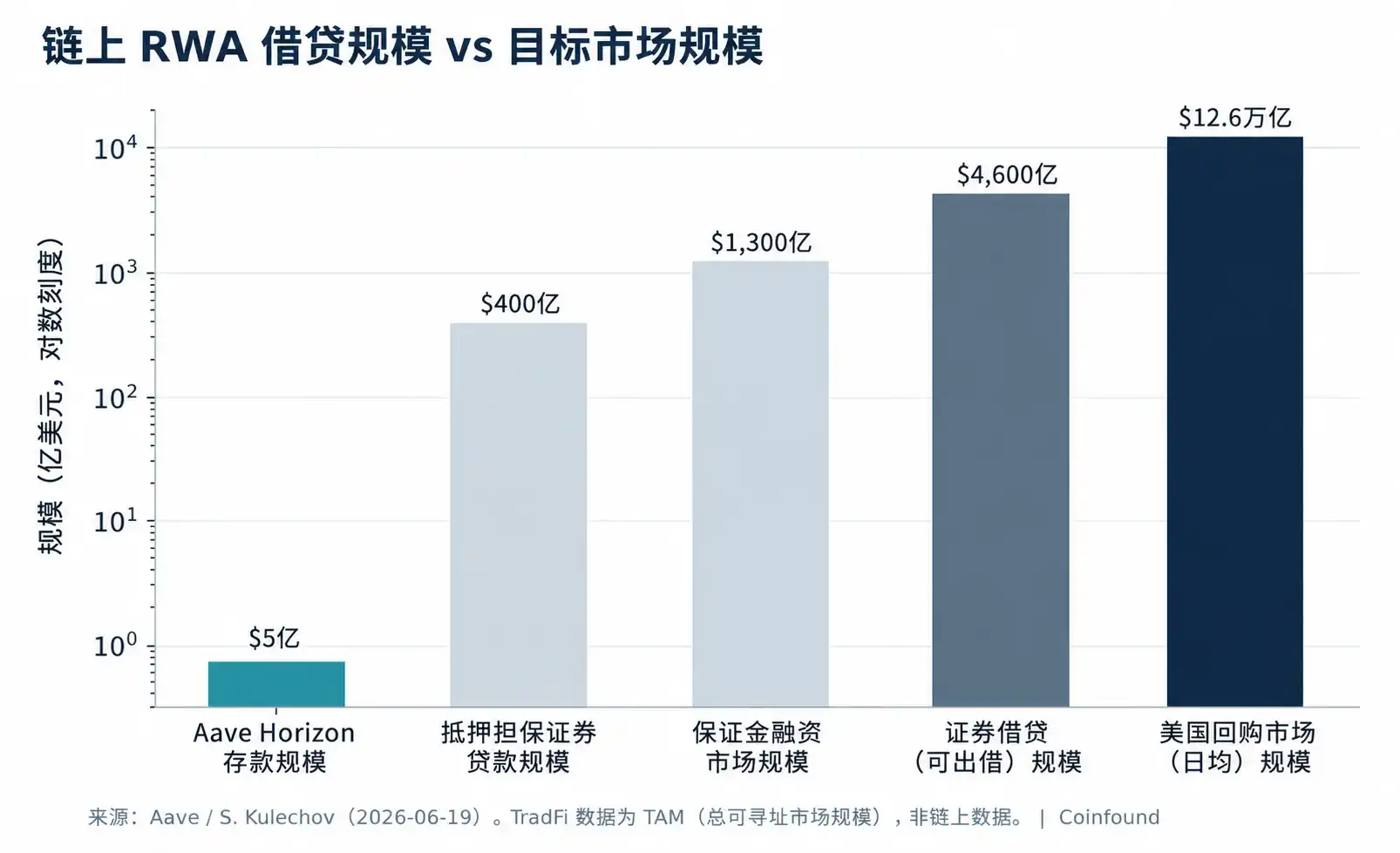
Chart: On-chain RWA lending remains minuscule relative to the traditional securities financing market it targets (Source: Aave / Kulechov, 2026-06)

Disclaimer: This article is for informational purposes only and does not constitute any investment advice; data may be delayed or contain errors, please refer to official disclosures.

Criptomoedas em alta

Perguntas relacionadas

QAccording to the article, what is the core innovation of Aave V4 and how does it change the role of the 'composability layer'?

AThe core innovation of Aave V4 is positioning itself as an on-chain alternative to Wall Street securities financing, targeting markets like repo and securities lending. It changes the role of the 'composability layer' from being a point of risk to becoming the main backbone of the system by connecting all underlying asset issues to on-chain leverage and liquidation mechanisms.

QWhat specific risk does the 'centralized liquidity Hub + multi-Spoke' architecture and shared liquidity pool design in Aave V4 introduce?

AThe 'centralized liquidity Hub + multi-Spoke' architecture and shared liquidity pool design prioritize capital efficiency but introduce a key risk: the loss of risk isolation. If one type of collateral experiences problems during a stress period, it can drain liquidity from the shared stablecoin pool that supports all other collateral types, potentially amplifying risks across the entire market.

QWhat real-world incident does the article cite as a template for the risk where 'collateral integrity failure leads to bad debt'?

AThe article cites an incident in April 2026 where a third-party cross-chain bridge was attacked, resulting in approximately 116,500 unbacked rsETH being deposited as collateral into Aave, creating bad debt. This serves as a template for the risk of collateral integrity failure leading to bad debt, independent of the underlying asset's default.

QWhat is the article's prediction for the likely first trigger of a large-scale bad debt or forced liquidation in RWA collateral markets?

AThe article predicts that the first trigger for large-scale bad debt or forced liquidation in RWA collateral markets will likely be a dislocation between the price/net asset value (NAV) of the tokenized collateral during stress periods, rather than an actual default of the underlying credit asset.

QFor providers of stablecoin liquidity to markets like Aave V4, what key understanding about their risk exposure does the article emphasize?

AThe article emphasizes that providers of stablecoin liquidity must understand they are exposed to every type of collateral asset within a shared liquidity pool, not just the specific collateral types they might individually favor or analyze. Their risk is pooled across the entire market supported by that shared capital.

Leituras Relacionadas

Is Anyone Still Buying in the Crypto Market? Unpacking 3 Common Watch-and-Wait Mentalities Today

Is Anyone Still Buying in the Crypto Market? Unpacking 3 Common Wait-and-See Mindsets This article analyzes the current cautious sentiment in the crypto market, distilled from conversations with sophisticated investors. The author identifies three dominant investor mindsets: 1. **Satisfied with Current Holdings:** Many retain a long-term belief in digital assets but see no immediate catalyst for significant price appreciation. They hold positions to avoid missing a future surge but allocate minimal new capital or attention. A shift requires a new, observable catalyst or a rotation from other portfolio areas. 2. **Waiting for Lower Prices:** This reflects not just short-term timing but a belief about crypto's total addressable market and upside potential. It could change if key perceived cycle bottoms pass without a crash, a major bullish event occurs (e.g., sovereign adoption), or price rebounds trigger FOMO-driven buying. 3. **High Opportunity Cost of Allocation:** The core question is comparative growth. With AI-related equities appearing to offer relentless, high-speed growth, justifying marginal investment into assets without similar perceived momentum is difficult. A slowdown in the AI trade could potentially mark a bottom and trigger capital reallocation into crypto. In conclusion, while long-term conviction persists for many, near-term marginal capital flows are constrained by these beliefs. The author suggests the market may be closer to a bottom than a top, but the current climate is defined by this wait-and-see approach, awaiting a catalyst to reignite broader investor commitment.

marsbitHá 38m

Is Anyone Still Buying in the Crypto Market? Unpacking 3 Common Watch-and-Wait Mentalities Today

marsbitHá 38m

China Added 67 New Unicorns in Half a Year, with AI and Robotics Accounting for Over Half

China added 67 new unicorn companies in the first half of 2026, reaching a total of 517 unicorns with a combined valuation of approximately $2.39 trillion. This surge marks a significant rebound after a post-2022 slowdown and sets a new semi-annual record. The growth is primarily driven by Artificial Intelligence (AI) and Robotics, which together account for over 53% of the new entrants. Specifically, 19 new unicorns are in robotics and 17 in AI. Notable companies include DeepSeek ($615.38B) and Kling AI ($18B). The trend indicates a decisive shift from internet consumer models to hard tech innovation. Geographically, new unicorns are highly concentrated in four cities: Beijing (19), Shanghai (18), Shenzhen (9), and Hangzhou (5), which together host 76.1% of the new companies. Hangzhou's overall valuation is boosted significantly by DeepSeek. Valuation distribution among new unicorns is pyramidal: 77.6% are valued between $1B and $2B, indicating early-stage status, while only two exceed $10B. There is a notable "speed divide": many AI/robotics startups achieved unicorn status in under three years, often via corporate spin-offs or led by star founders, while hard tech companies in semiconductors or biotech typically took over eight years. The report concludes that this wave reflects China's accelerating transition into an AI and robotics-powered innovation cycle, characterized by faster company formation, heightened geographic concentration, and a clear focus on foundational technologies.

marsbitHá 1h

China Added 67 New Unicorns in Half a Year, with AI and Robotics Accounting for Over Half

marsbitHá 1h

Trading

Spot

Artigos em Destaque

Como comprar LAYER

Bem-vindo à HTX.com!Tornámos a compra de Solayer (LAYER) simples e conveniente.Segue o nosso guia passo a passo para iniciar a tua jornada no mundo das criptos.Passo 1: cria a tua conta HTXUtiliza o teu e-mail ou número de telefone para te inscreveres numa conta gratuita na HTX.Desfruta de um processo de inscrição sem complicações e desbloqueia todas as funcionalidades.Obter a minha contaPasso 2: vai para Comprar Cripto e escolhe o teu método de pagamentoCartão de crédito/débito: usa o teu visa ou mastercard para comprar Solayer (LAYER) instantaneamente.Saldo: usa os fundos da tua conta HTX para transacionar sem problemas.Terceiros: adicionamos métodos de pagamento populares, como Google Pay e Apple Pay, para aumentar a conveniência.P2P: transaciona diretamente com outros utilizadores na HTX.Mercado de balcão (OTC): oferecemos serviços personalizados e taxas de câmbio competitivas para os traders.Passo 3: armazena teu Solayer (LAYER)Depois de comprar o teu Solayer (LAYER), armazena-o na tua conta HTX.Alternativamente, podes enviá-lo para outro lugar através de transferência blockchain ou usá-lo para transacionar outras criptomoedas.Passo 4: transaciona Solayer (LAYER)Transaciona facilmente Solayer (LAYER) no mercado à vista da HTX.Acede simplesmente à tua conta, seleciona o teu par de trading, executa as tuas transações e monitoriza em tempo real.Oferecemos uma experiência de fácil utilização tanto para principiantes como para traders experientes.

325 Visualizações TotaisPublicado em {updateTime}Atualizado em 2026.06.02

Como comprar LAYER

Discussões

Bem-vindo à Comunidade HTX. Aqui, pode manter-se informado sobre os mais recentes desenvolvimentos da plataforma e obter acesso a análises profissionais de mercado. As opiniões dos utilizadores sobre o preço de LAYER (LAYER) são apresentadas abaixo.

活动图片