Edel Finance loses $403K as flash-loan oracle exploit hits xStock lending reserves

ambcryptoPublicado em 2026-07-01Última atualização em 2026-07-01

Resumo

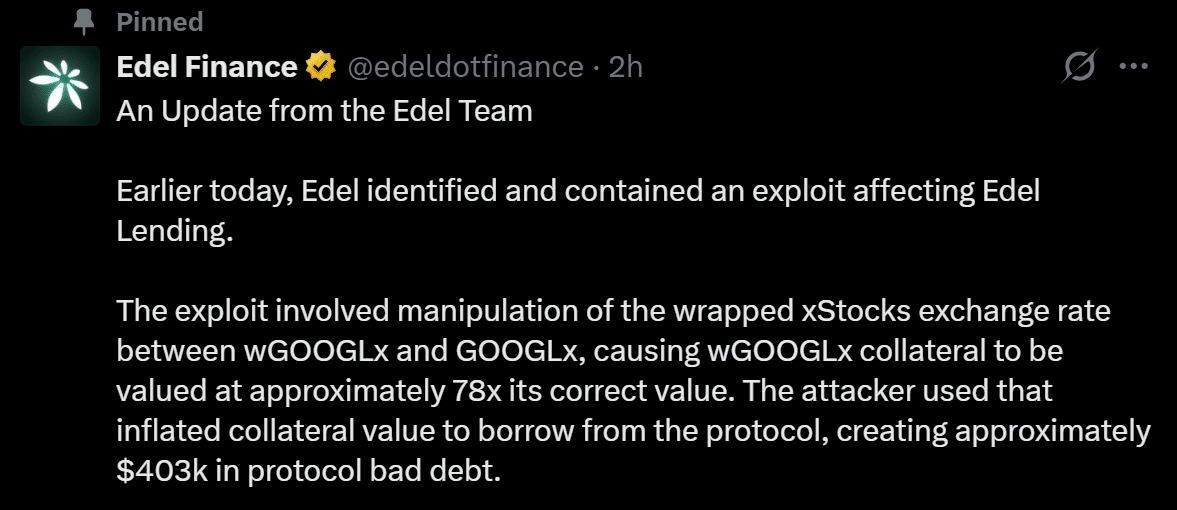
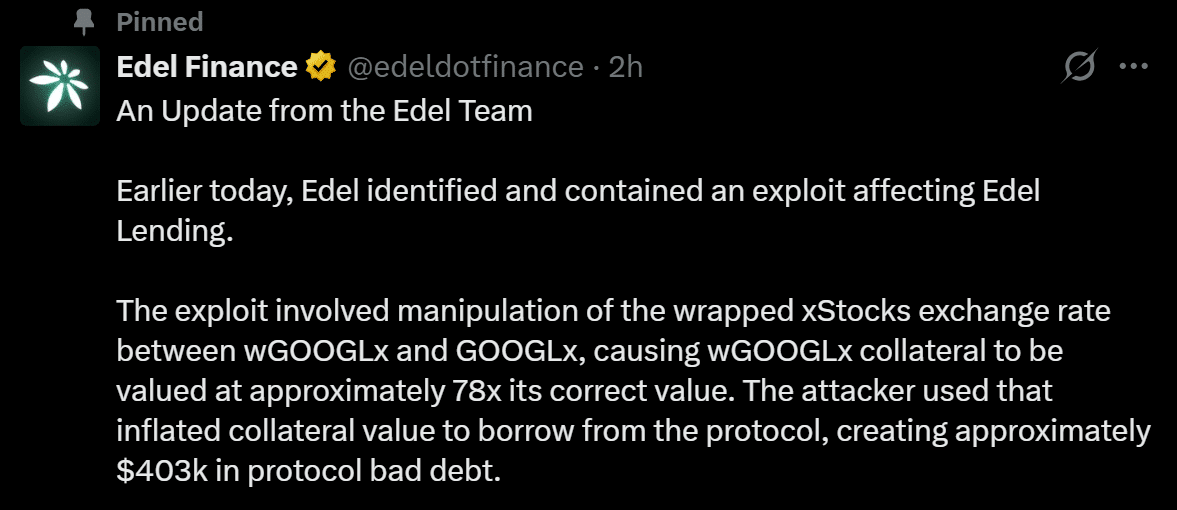
Edel Finance, a programmable market layer for tokenized equities, suffered a $403,000 exploit. An attacker manipulated the wrapped xStocks (wGOOGLx) exchange rate via a flash loan, briefly inflating the collateral's value 78-fold to borrow far beyond its true worth. Although the protocol acted promptly to limit losses, the attack revealed critical oracle and collateral pricing vulnerabilities in tokenized lending markets. The exploit severely impacted liquidity, causing total value locked (TVL) to plummet from around $630,000 to roughly $947 as users withdrew funds. A net outflow of approximately $630,000 followed. Recovery hinges on restoring user confidence through deposit growth, stabilized TVL, and stronger oracle protections and risk management practices.

Edel Finance, a programmable market layer for tokenized equities, suffered a roughly $403,000 exploit. This was after an attacker manipulated the wrapped xStocks exchange rate through a flash loan.

The wGOOGLx collateral briefly gained in value about 78-fold over its true value. The inflated valuation allowed the attacker to borrow far more than the collateral’s true value, leaving the lender with significant bad debt.

Fortunately for the users of Edel Finance, they were able to act promptly to contain the issue before additional loss occurring.
Source: X

In addition, a significant vulnerability was exposed by the attack despite the rapid response by Edel Finance. More importantly, the attack highlighted persistent weaknesses in oracle and collateral pricing across tokenized lending markets.

Conversely, unless the vulnerabilities are fully addressed, confidence remains fragile. Going forward, stronger oracle protections and collateral validation will likely determine how quickly trust returns.

Post-exploit withdrawals leave liquidity under pressure

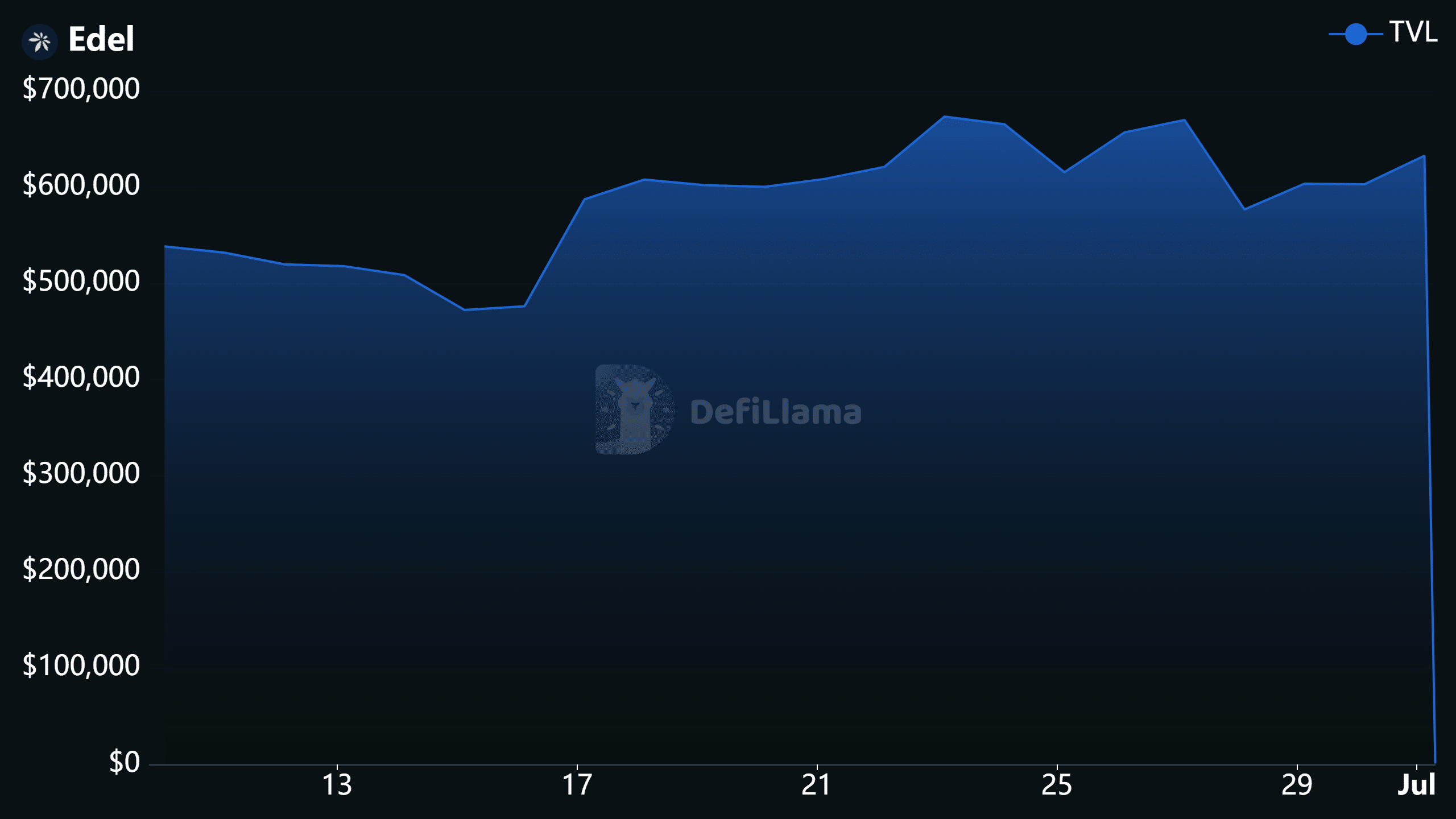
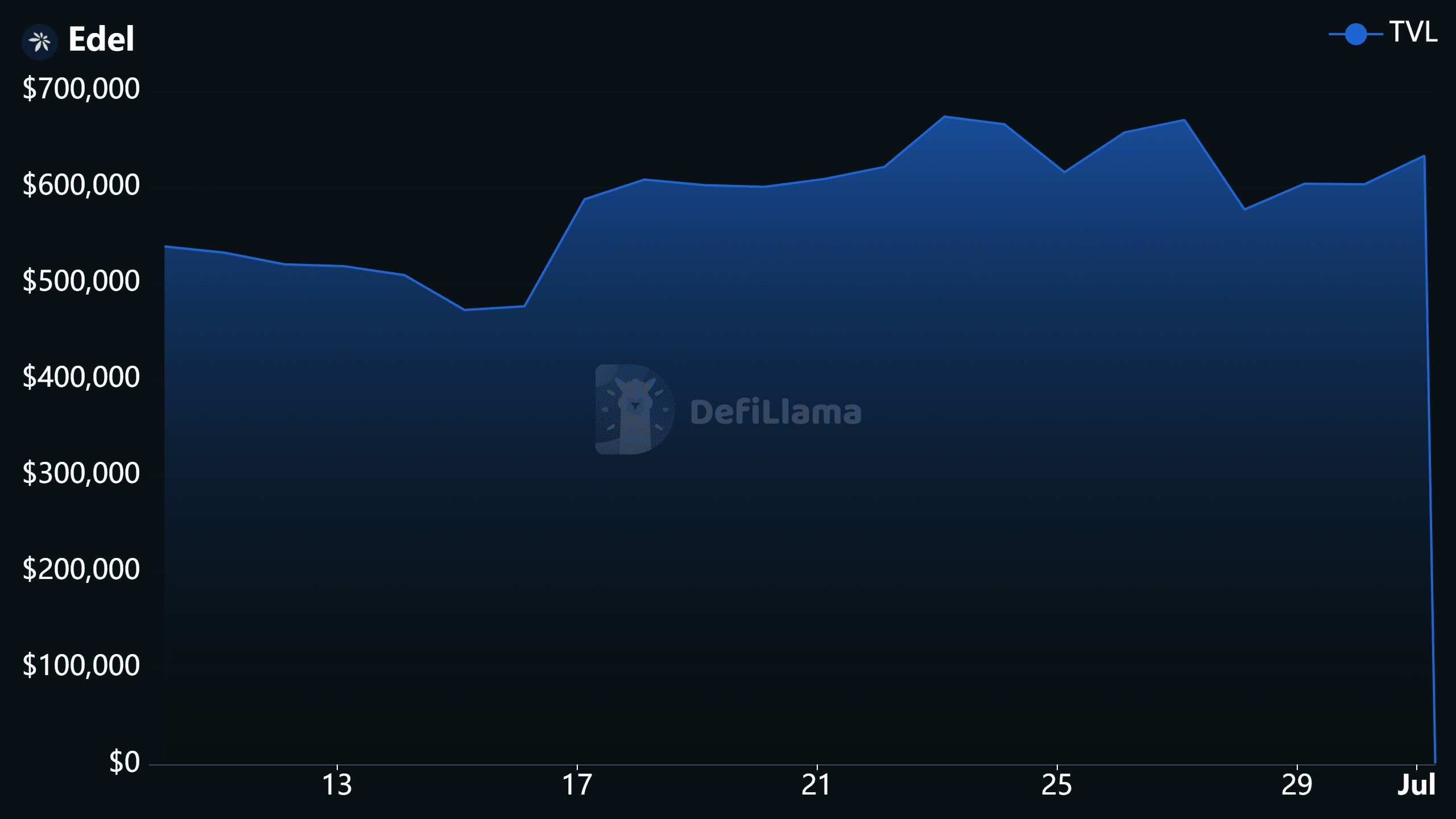
The aftermath of the exploit quickly spilled into Edel Finance’s liquidity. As confidence deteriorated, total value locked (TVL) plunged from approximately $630,000 to roughly $947, reflecting a rapid wave of user withdrawals.
Source: DeFiLlama

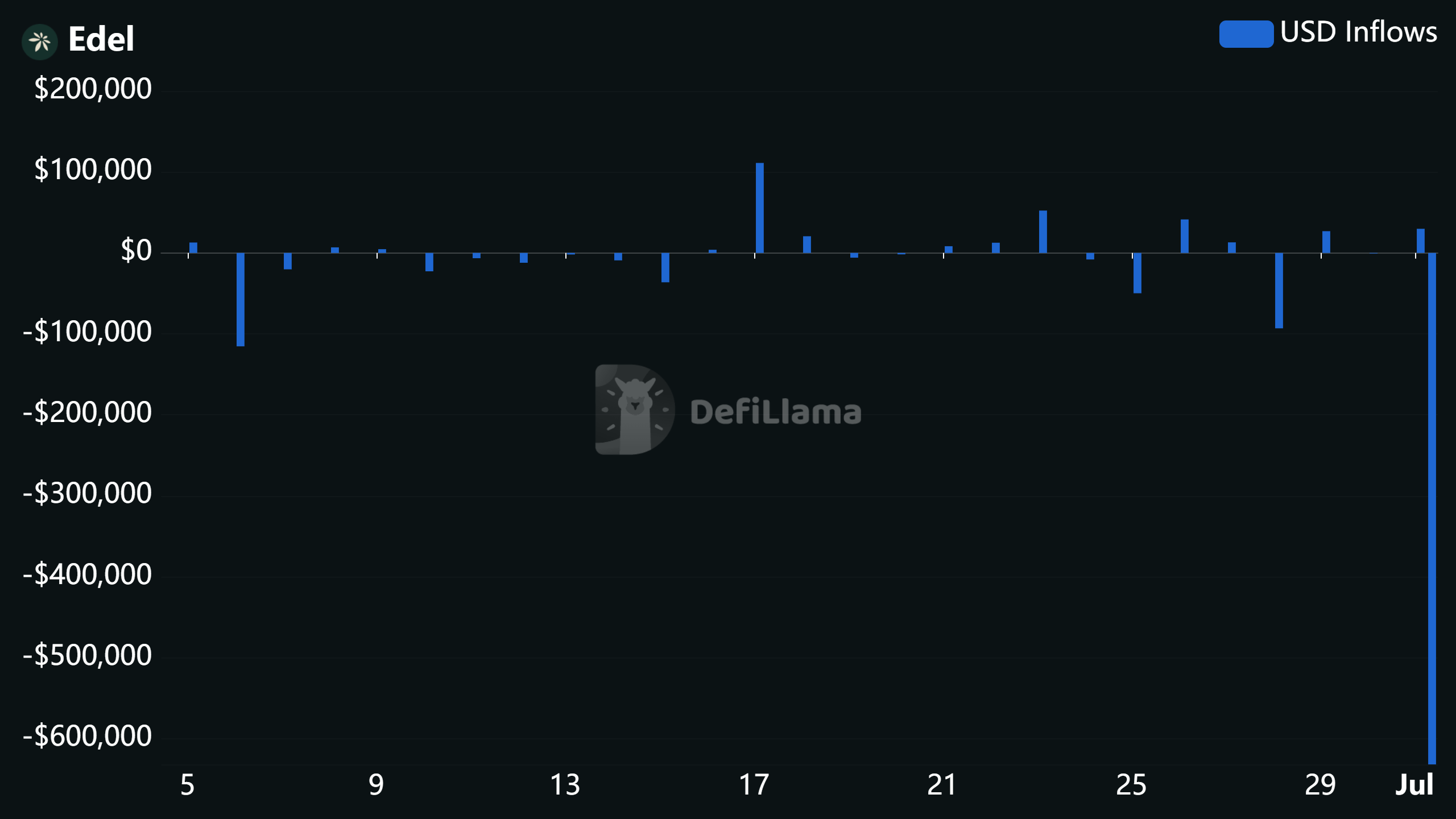
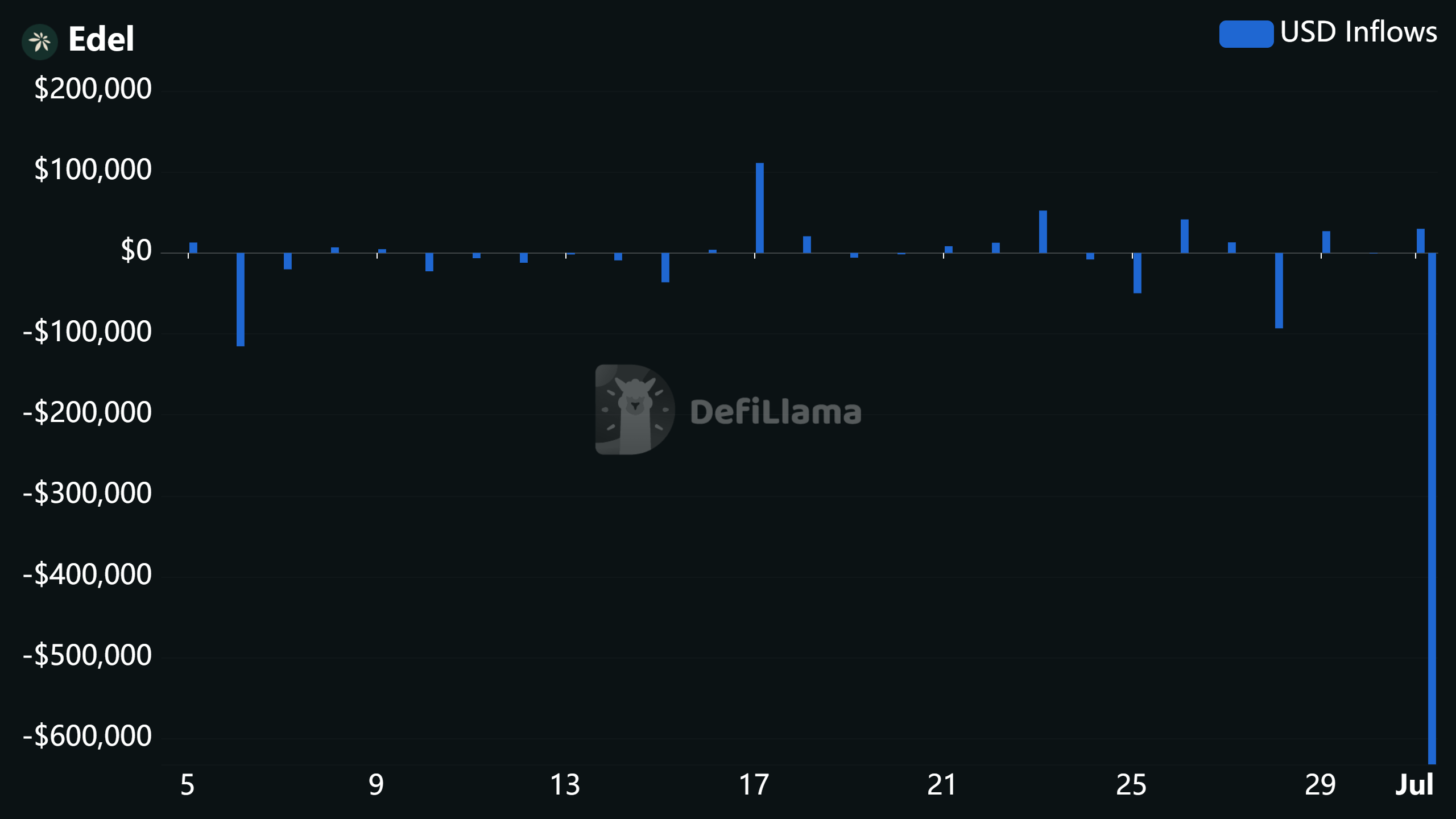
Capital flows reinforced the trend further. According to DeFiLlama data, Edel Finance recorded an estimated net outflow of $630,000, the largest on record. Earlier on, a $100,000 inflow had briefly supported liquidity. Even so, it failed to offset the accelerating withdrawals that followed the exploit.
Source: DeFiLlama

These actions suggest that lenders are taking precedence over preserving capital versus supporting the protocol. Going forward, recovery depends on sustained deposit growth, stabilizing TVL, and shrinking daily outflows.

Without continued deposit growth, borrowing will continue to have limited capacity, ultimately limiting the ability of the lending platform to normalize its liquidity and delaying a return to normalcy within the lending markets.

It will take rebuilding confidence among users for meaningful capital to begin returning to Edel Finance through continued use of the lending platform and strengthened risk management practices.


Final Summary

  • Edel Finance’s xStock (wGOOGLx) exploit exposed critical oracle risks, highlighting persistent weaknesses in tokenized lending security.
  • Edel Finance’s recovery now depends on restoring liquidity, rebuilding TVL, and regaining user confidence.


Criptomoedas em alta

Perguntas relacionadas

QWhat was the primary method used by the attacker to exploit Edel Finance?

AThe attacker manipulated the wrapped xStocks exchange rate through a flash loan, artificially inflating the value of wGOOGLx collateral.

QHow much financial loss did Edel Finance suffer due to this exploit?

AEdel Finance suffered a roughly $403,000 exploit.

QWhat specific vulnerability in the protocol did the attack highlight?

AThe attack highlighted persistent weaknesses in oracle and collateral pricing mechanisms across tokenized lending markets.

QWhat happened to Edel Finance's Total Value Locked (TVL) following the exploit?

AFollowing the exploit and user withdrawals, the TVL plunged from approximately $630,000 to roughly $947.

QWhat is identified as essential for Edel Finance's recovery and the return of user capital?

ARecovery depends on rebuilding user confidence, sustained deposit growth, stabilizing TVL, and implementing stronger oracle protections and risk management practices.

Leituras Relacionadas

Is Anyone Still Buying in the Crypto Market? Unpacking 3 Common Watch-and-Wait Mentalities Today

Is Anyone Still Buying in the Crypto Market? Unpacking 3 Common Wait-and-See Mindsets This article analyzes the current cautious sentiment in the crypto market, distilled from conversations with sophisticated investors. The author identifies three dominant investor mindsets: 1. **Satisfied with Current Holdings:** Many retain a long-term belief in digital assets but see no immediate catalyst for significant price appreciation. They hold positions to avoid missing a future surge but allocate minimal new capital or attention. A shift requires a new, observable catalyst or a rotation from other portfolio areas. 2. **Waiting for Lower Prices:** This reflects not just short-term timing but a belief about crypto's total addressable market and upside potential. It could change if key perceived cycle bottoms pass without a crash, a major bullish event occurs (e.g., sovereign adoption), or price rebounds trigger FOMO-driven buying. 3. **High Opportunity Cost of Allocation:** The core question is comparative growth. With AI-related equities appearing to offer relentless, high-speed growth, justifying marginal investment into assets without similar perceived momentum is difficult. A slowdown in the AI trade could potentially mark a bottom and trigger capital reallocation into crypto. In conclusion, while long-term conviction persists for many, near-term marginal capital flows are constrained by these beliefs. The author suggests the market may be closer to a bottom than a top, but the current climate is defined by this wait-and-see approach, awaiting a catalyst to reignite broader investor commitment.

marsbitHá 40m

Is Anyone Still Buying in the Crypto Market? Unpacking 3 Common Watch-and-Wait Mentalities Today

marsbitHá 40m

China Added 67 New Unicorns in Half a Year, with AI and Robotics Accounting for Over Half

China added 67 new unicorn companies in the first half of 2026, reaching a total of 517 unicorns with a combined valuation of approximately $2.39 trillion. This surge marks a significant rebound after a post-2022 slowdown and sets a new semi-annual record. The growth is primarily driven by Artificial Intelligence (AI) and Robotics, which together account for over 53% of the new entrants. Specifically, 19 new unicorns are in robotics and 17 in AI. Notable companies include DeepSeek ($615.38B) and Kling AI ($18B). The trend indicates a decisive shift from internet consumer models to hard tech innovation. Geographically, new unicorns are highly concentrated in four cities: Beijing (19), Shanghai (18), Shenzhen (9), and Hangzhou (5), which together host 76.1% of the new companies. Hangzhou's overall valuation is boosted significantly by DeepSeek. Valuation distribution among new unicorns is pyramidal: 77.6% are valued between $1B and $2B, indicating early-stage status, while only two exceed $10B. There is a notable "speed divide": many AI/robotics startups achieved unicorn status in under three years, often via corporate spin-offs or led by star founders, while hard tech companies in semiconductors or biotech typically took over eight years. The report concludes that this wave reflects China's accelerating transition into an AI and robotics-powered innovation cycle, characterized by faster company formation, heightened geographic concentration, and a clear focus on foundational technologies.

marsbitHá 1h

China Added 67 New Unicorns in Half a Year, with AI and Robotics Accounting for Over Half

marsbitHá 1h

Trading

Spot

Artigos em Destaque

Como comprar LAYER

Bem-vindo à HTX.com!Tornámos a compra de Solayer (LAYER) simples e conveniente.Segue o nosso guia passo a passo para iniciar a tua jornada no mundo das criptos.Passo 1: cria a tua conta HTXUtiliza o teu e-mail ou número de telefone para te inscreveres numa conta gratuita na HTX.Desfruta de um processo de inscrição sem complicações e desbloqueia todas as funcionalidades.Obter a minha contaPasso 2: vai para Comprar Cripto e escolhe o teu método de pagamentoCartão de crédito/débito: usa o teu visa ou mastercard para comprar Solayer (LAYER) instantaneamente.Saldo: usa os fundos da tua conta HTX para transacionar sem problemas.Terceiros: adicionamos métodos de pagamento populares, como Google Pay e Apple Pay, para aumentar a conveniência.P2P: transaciona diretamente com outros utilizadores na HTX.Mercado de balcão (OTC): oferecemos serviços personalizados e taxas de câmbio competitivas para os traders.Passo 3: armazena teu Solayer (LAYER)Depois de comprar o teu Solayer (LAYER), armazena-o na tua conta HTX.Alternativamente, podes enviá-lo para outro lugar através de transferência blockchain ou usá-lo para transacionar outras criptomoedas.Passo 4: transaciona Solayer (LAYER)Transaciona facilmente Solayer (LAYER) no mercado à vista da HTX.Acede simplesmente à tua conta, seleciona o teu par de trading, executa as tuas transações e monitoriza em tempo real.Oferecemos uma experiência de fácil utilização tanto para principiantes como para traders experientes.

325 Visualizações TotaisPublicado em {updateTime}Atualizado em 2026.06.02

Como comprar LAYER

Discussões

Bem-vindo à Comunidade HTX. Aqui, pode manter-se informado sobre os mais recentes desenvolvimentos da plataforma e obter acesso a análises profissionais de mercado. As opiniões dos utilizadores sobre o preço de LAYER (LAYER) são apresentadas abaixo.

活动图片