Hyperliquid: USDH fades to $20mln – Here’s what’s replacing it

ambcryptoPublicado em 2026-06-29Última atualização em 2026-06-29

Resumo

Hyperliquid's stablecoin market is showing a significant shift, with liquidity moving away from its native USDH and concentrating heavily around USD Coin (USDC). USDH holdings have sharply declined to only $20 million, while USDC now dominates the pool with $5.74 billion of the total $5.96 billion. This reflects a trader preference for deeper liquidity and established assets. To facilitate the transition, Hyperliquid Foundation has issued roughly $10 million in grants, and users can swap USDH for USDC via migration paths. Despite the stablecoin migration, protocol activity remains strong. Daily Active Addresses and Daily Transactions are sustained at high levels, and Perpetual Trading Volume stays near $2.8 billion, reinforcing Hyperliquid's position in on-chain derivatives. This activity generates substantial Annualized Fee Revenue, which increasingly flows into the HYPE token through staking, fees, and buybacks, shifting its value capture from speculation to recurring ecosystem fees. The continued growth of USDC liquidity and trading activity is seen as crucial for strengthening HYPE's long-term utility, while USDH would require significant utility improvements to regain market share.

Hyperliquid’s [HYPE] stablecoin market is becoming increasingly concentrated as liquidity continues shifting toward USD Coin [USDC] instead of the native USDH.

The trend reflects traders’ preference for deeper liquidity and established settlement assets over newer DeFi-native stablecoins.

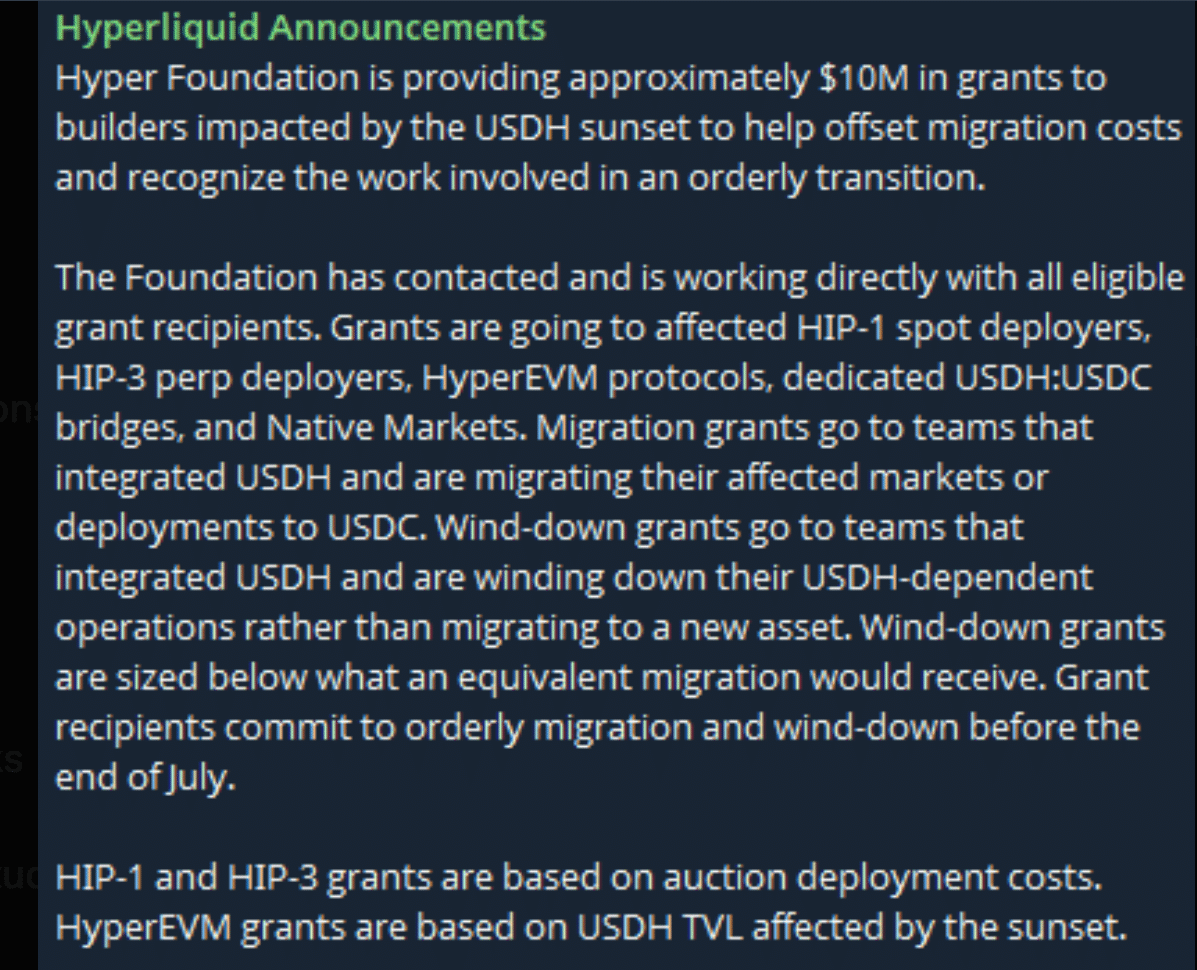
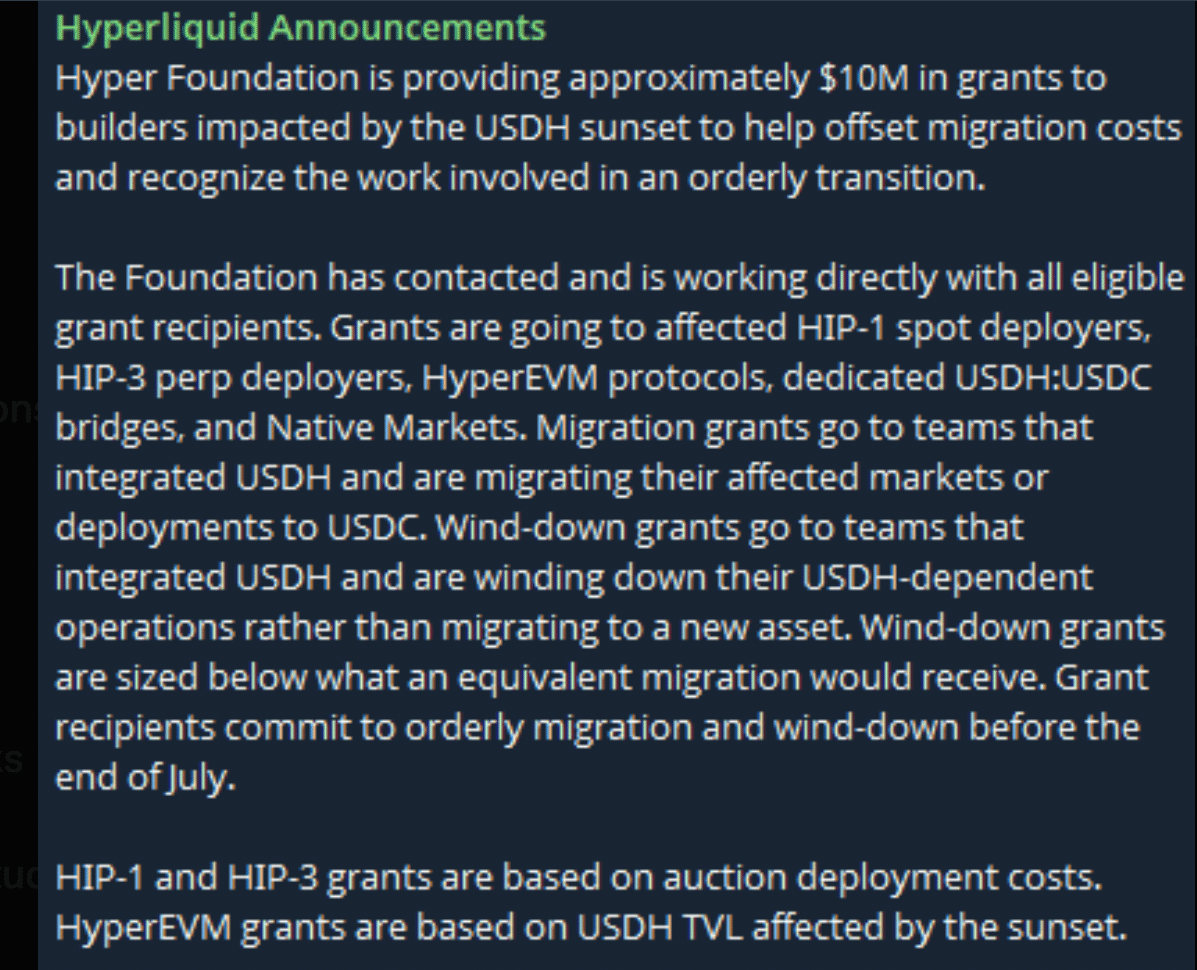
Hyperliquid Foundation has put out roughly $10 million in grants to assist in migration costs and ensure that each of its protocols continues to run smoothly. Those are HIP-1, HIP-3, HyperEVM protocols, bridges, and native markets.
Source: X

In addition, users can swap their USDH for USDC through the same migration paths, reducing friction during the transition.

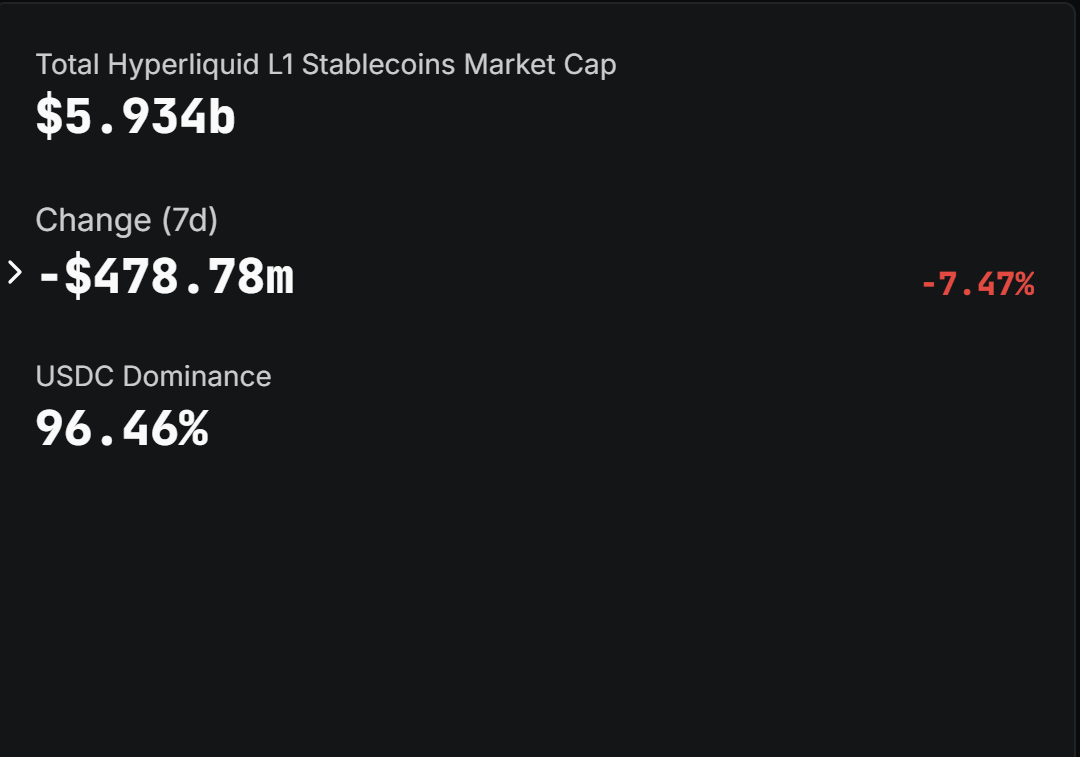
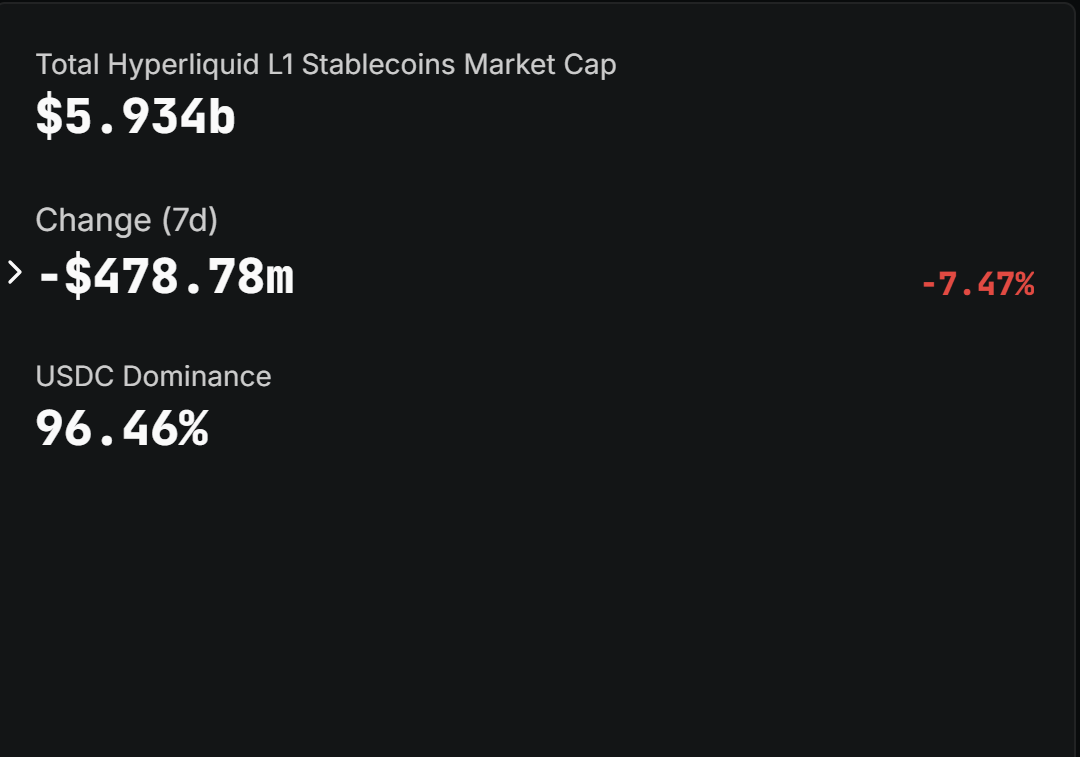
According to DeFiLlama, USDC now dominates Hyperliquid’s stablecoin liquidity.

In fact, USDC accounts for $5.74 billion of Hyperliquid’s $5.96 billion stablecoin pool. Conversely, USDH holdings have fallen sharply to just $20 million.
Source: DeFiLlama

Meanwhile, Tether [USDT] trails at around $155 million. These figures clearly indicate that network effects are supporting the growing dominance of USDC.

This imbalance suggests network effects are reinforcing USDC’s leadership, making it the preferred collateral across spot and perpetual markets. If institutional activity continues expanding, USDC’s dominance could strengthen further.

Otherwise, USDH would require meaningful utility improvements to regain market share.

Protocol activity reinforces HYPE utility

That orderly migration is already translating into stronger on-chain activity as Hyperliquid continues expanding around its USDC-first model. The shift did not disrupt the user participation.

It allowed for a sustained level of approximately 6,932 Daily Active Addresses and over 315,000 Daily Transactions, according to DeFiLlama data.

Meanwhile, Perpetual Trading Volume remained near $2.8 billion, reinforcing Hyperliquid’s leadership in on-chain derivatives.

Growing activity also generates Annualized Fee Revenue in the hundreds of millions, creating recurring value for the ecosystem. Those fees increasingly flow into HYPE through staking, priority fees, buybacks, and incentives instead of relying mainly on speculation.

If trading activity and USDC liquidity continue growing together, HYPE’s long-term value capture could strengthen further. Otherwise, slower network activity may gradually reduce revenue growth.



Final Summary

Criptomoedas em alta

Perguntas relacionadas

QWhat is the main trend in Hyperliquid's stablecoin market, according to the article?

AThe main trend is a significant shift in liquidity from the native stablecoin USDH towards USD Coin (USDC), which now dominates the stablecoin pool.

QWhat action has the Hyperliquid Foundation taken to facilitate the migration from USDH to USDC?

AThe Hyperliquid Foundation has provided approximately $10 million in grants to assist with migration costs and ensure the smooth operation of its protocols, including HIP-1, HIP-3, HyperEVM, bridges, and native markets.

QWhat is the current value of USDC in Hyperliquid's stablecoin pool compared to USDH, as per DeFiLlama data?

AAccording to DeFiLlama, USDC accounts for $5.74 billion of the $5.96 billion stablecoin pool, while USDH holdings have fallen sharply to just $20 million.

QHow has the migration to a USDC-first model affected Hyperliquid's on-chain user activity?

AThe orderly migration has not disrupted user participation. It has sustained a level of approximately 6,932 Daily Active Addresses, over 315,000 Daily Transactions, and Perpetual Trading Volume near $2.8 billion.

QThrough which mechanisms does growing activity on Hyperliquid generate value for the HYPE token?

AGrowing activity generates significant Annualized Fee Revenue, which flows into the HYPE token ecosystem through staking, priority fees, buybacks, and incentives, rather than relying mainly on speculation.

Leituras Relacionadas

In the AI Era, What's Left for Bitcoin?

As Bitcoin falls below $60,000, the author reflects on the relationship between AI and Bitcoin, seeing them as two sides of the same coin. In the AI era, the cost of generating content has plummeted, making fake text, images, and videos increasingly easy and cheap to produce. This has led to a fundamental shift: while AI dramatically lowers the cost of information production, it also undermines trust and authenticity online. What becomes truly valuable is not more content, but the ability to verify what is real—"verifiability." This perspective offers a new lens for Bitcoin. Its massive energy consumption, often criticized as wasteful, is reinterpreted. While AI burns energy to enhance "capability" and efficiency, Bitcoin burns energy to produce "verifiability." Its purpose is not to be trusted but to enable a system where no trust in intermediaries—banks, platforms, or developers—is needed. Every transaction and the entire ledger's history is secured by cryptography and a decentralized network of nodes, making it independently verifiable. AI cannot forge a transaction on the Bitcoin network because the system is designed for proof, not generation. The author draws a historical parallel to the Renaissance: the printing press drastically reduced the cost of copying knowledge, while double-entry bookkeeping reduced the cost of trust in commerce. Today, AI is the new printing press, reducing content creation costs to near zero. Blockchain, and Bitcoin as its pioneer, may be the modern equivalent of double-entry bookkeeping—a foundational technology for verifying digital asset ownership and historical records without centralized authorities. Thus, AI and blockchain are not competitors. AI lowers the cost of creation; blockchain lowers the cost of verification. In an age where AI can generate anything, true scarcity may lie not in more content, but in independently verifiable facts. Whether the market will reprice Bitcoin accordingly remains uncertain, but its core value proposition as a "machine for producing verifiability" becomes strikingly relevant.

marsbitHá 1h

In the AI Era, What's Left for Bitcoin?

marsbitHá 1h

In the Age of AI, What's Left for Bitcoin?

Author: Sevclub, Seven Research Amid Bitcoin's recent drop below $60k, the author reflects on a growing sense that AI and Bitcoin are two sides of the same coin. Today, encountering any content triggers a new default question: "Was this made by AI?" The cost of generating convincing text, images, and video is now negligible. While the internet lowered information *distribution* costs, AI is crashing information *production* costs to near zero. The consequence is a flood of content where truth and falsehood are increasingly indistinguishable. In this environment, what becomes truly valuable is not more information, but the ability to verify what is real—"verifiability." This reframes the common criticism that Bitcoin "wastes electricity." AI consumes power to produce "capability" (e.g., more powerful models). Bitcoin consumes power to produce something else: "verifiability." Bitcoin's core purpose isn't about belief or trust in any institution, developer, or even its creator. It's about enabling independent verification. Every bitcoin's origin, every transaction, and the integrity of the entire ledger are secured by mathematics, cryptography, and a global network of nodes. AI can fabricate convincing media, but it cannot falsify a transaction on the Bitcoin network. The expended energy makes篡改历史 (tampering with history) prohibitively expensive, purchasing a globally verifiable ledger. The author draws a historical parallel to the Renaissance. The printing press drastically reduced the cost of copying knowledge, while double-entry bookkeeping reduced the cost of trust in commerce—one enabled creation, the other verification. Today, AI is the new printing press, driving content production costs toward zero. The question becomes: what is this era's "double-entry bookkeeping"? Blockchain appears to be the leading candidate. It doesn't verify which news is true or which image is real, but it provides a foundational layer for independently verifying asset ownership and historical records in the digital realm without centralized authorities. Therefore, AI and blockchain are not in competition. AI lowers the cost of *generation*. Blockchain (and Bitcoin as a prime example) lowers the cost of *verification*. One creates, the other proves. Whether Bitcoin ultimately succeeds remains uncertain, facing potential challenges from quantum computing, regulation, and technical evolution. However, the author now sees it less as a "machine for making bitcoin" and more as a "machine for making verifiability." In an age where AI can generate anything, true scarcity may no longer be "more content," but "more independently verifiable facts." Whether the market will price this accordingly is a separate question.

链捕手Há 1h

In the Age of AI, What's Left for Bitcoin?

链捕手Há 1h

Trading

Spot

Artigos em Destaque

Como comprar HYPE

Bem-vindo à HTX.com!Tornámos a compra de Hyperliquid (HYPE) simples e conveniente.Segue o nosso guia passo a passo para iniciar a tua jornada no mundo das criptos.Passo 1: cria a tua conta HTXUtiliza o teu e-mail ou número de telefone para te inscreveres numa conta gratuita na HTX.Desfruta de um processo de inscrição sem complicações e desbloqueia todas as funcionalidades.Obter a minha contaPasso 2: vai para Comprar Cripto e escolhe o teu método de pagamentoCartão de crédito/débito: usa o teu visa ou mastercard para comprar Hyperliquid (HYPE) instantaneamente.Saldo: usa os fundos da tua conta HTX para transacionar sem problemas.Terceiros: adicionamos métodos de pagamento populares, como Google Pay e Apple Pay, para aumentar a conveniência.P2P: transaciona diretamente com outros utilizadores na HTX.Mercado de balcão (OTC): oferecemos serviços personalizados e taxas de câmbio competitivas para os traders.Passo 3: armazena teu Hyperliquid (HYPE)Depois de comprar o teu Hyperliquid (HYPE), armazena-o na tua conta HTX.Alternativamente, podes enviá-lo para outro lugar através de transferência blockchain ou usá-lo para transacionar outras criptomoedas.Passo 4: transaciona Hyperliquid (HYPE)Transaciona facilmente Hyperliquid (HYPE) no mercado à vista da HTX.Acede simplesmente à tua conta, seleciona o teu par de trading, executa as tuas transações e monitoriza em tempo real.Oferecemos uma experiência de fácil utilização tanto para principiantes como para traders experientes.

310 Visualizações TotaisPublicado em {updateTime}Atualizado em 2026.06.02

Como comprar HYPE

Discussões

Bem-vindo à Comunidade HTX. Aqui, pode manter-se informado sobre os mais recentes desenvolvimentos da plataforma e obter acesso a análises profissionais de mercado. As opiniões dos utilizadores sobre o preço de HYPE (HYPE) são apresentadas abaixo.

活动图片