Preferred Stock Is Not the Trigger for Corporate Bankruptcy, MicroStrategy's Dollar Reserves Can Cover Dividend and Interest Payments Until February 2027

marsbitPublicado em 2026-06-24Última atualização em 2026-06-24

Resumo

Preferred Shares Are Not the Catalyst for Corporate Bankruptcy; MicroStrategy's Dollar Reserves Can Cover Dividend and Interest Payments Until February 2027. This article analyzes the nature of preferred shares used by MicroStrategy (MSTR). Legally equity but economically similar to debt, these shares, including its Bitcoin-linked STR convertible preferred notes (STRC), offer fixed or floating dividends. Crucially, MicroStrategy's preferred shares lack rigid redemption clauses, meaning they are not classified as traditional debt. This eliminates principal repayment pressure and means missed dividends do not constitute default or trigger bankruptcy, creating a "self-contradictory virtuous cycle." The article clarifies that if funds are short, MicroStrategy can defer or suspend preferred share dividends (except for non-cumulative types like STRD) without immediate risk. The real potential crisis point lies with its convertible bonds. If a prolonged bear market prevents conversion, MicroStrategy might need to sell Bitcoin to repay these bonds starting from the earliest maturity in September 2027, potentially creating a downward spiral. Preferred dividend suspensions would only exacerbate market panic in such a scenario. Recent financial activity shows MicroStrategy strengthened its position through four weeks of common stock (MSTR) issuances, raising over $851 million without issuing new preferred shares. It increased its dollar reserves to approximately $1.4 billion, which i...

Author: TVBee

┈➤ Preferred Stock: Both Genius and Rogue

Preferred stock is a very special financing instrument. Its legal status is equity, but economically it carries strong debt-like attributes.

In financial treatment, some are accounted for as liabilities, while others are accounted for as equity.

╰✦ The Debt-Like Aspect

Preferred stockholders do not receive high dividends just because the company makes huge profits. Instead, they receive dividends periodically at a certain dividend rate, similar to debt interest.

STRC is an exception; its dividend rate is floating, but within a certain period, its dividend rate is also fixed.

On the other hand, STRC and common stock dividends work in opposite directions.

When an ordinary company performs well, common stock may pay more dividends. However, when BTC rises, STRC's dividend rate does not need to increase.

Conversely, when BTC falls, MicroStrategy may need to raise STRC's dividend rate to facilitate financing by issuing STRC.

Therefore, STRC, like MicroStrategy's other preferred stocks with fixed dividend rates, has the face of equity but carries strong debt-like attributes underneath.

╰✦ The Equity-Like Aspect

Unless it contains some rigid redemption and payment terms or other debt-like clauses (such preferred stock is classified as a liability in finance), preferred stock is typically included in equity accounts in finance: there is no principal repayment pressure before the company's bankruptcy liquidation, and preferred stock dividends are not mandatory liabilities.

This is the magic of Saylor using preferred stock for financing. Without rigid redemption and payment terms, these types of preferred stock for MicroStrategy are not liabilities in the traditional financial sense.

Thus, MicroStrategy's preferred stock:

Not considered traditional debt → Principal cannot cause insolvency, → Merely suspending dividends does not cause debt default → Does not trigger bankruptcy liquidation → No principal repayment pressure

Equity-class preferred stock itself forms a self-contradictory virtuous cycle, somewhat genius.

Therefore, preferred stock is also jokingly called "perpetual rogue leverage."

┈➤ Can't Afford Preferred Stock Dividends? They Can Accumulate

If, in the short term, MicroStrategy lacks sufficient funds to pay preferred stock dividends, it can simply defer them. STRD dividends are non-cumulative; they can even be suspended outright without accrual.

After BTC resumes its upward trend, MicroStrategy can continue issuing common stock, MSTR, to raise funds for making up the deferred preferred stock dividends.

┈➤ The Key to MicroStrategy's Bankruptcy Lies in Convertible Bonds

Unless BTC remains bearish for an extended period, market sentiment turns very pessimistic, and MicroStrategy is unable to raise funds by issuing MSTR for a long time, until the convertible bonds mature. If the conversion conditions are not met, MicroStrategy would need to repay the convertible bonds. At that point, MicroStrategy might be forced to sell BTC, creating a vicious cycle of selling pressure.

It is during such a convertible bond-induced vicious cycle that preferred stock dividends would exacerbate this death spiral.

Therefore, suspending preferred stock dividends would trigger emotional panic in the BTC market. However, convertible bonds are what would trigger a real crisis.

But the earliest date MicroStrategy's convertible bonds face repayment is September 16, 2027. By that time, the bear market will most likely have ended.

┈➤ MicroStrategy's Dollar Reserves

From June 15 to 21, MicroStrategy raised $335.5 million, all from the issuance of MSTR common stock, with no increase in preferred stock issuance.

After purchasing 520 BTC, its dollar reserves increased from $1.1 billion to $1.4 billion.

Preferred stock dividends can be covered in full until February 2027, and for about half of March 2027.
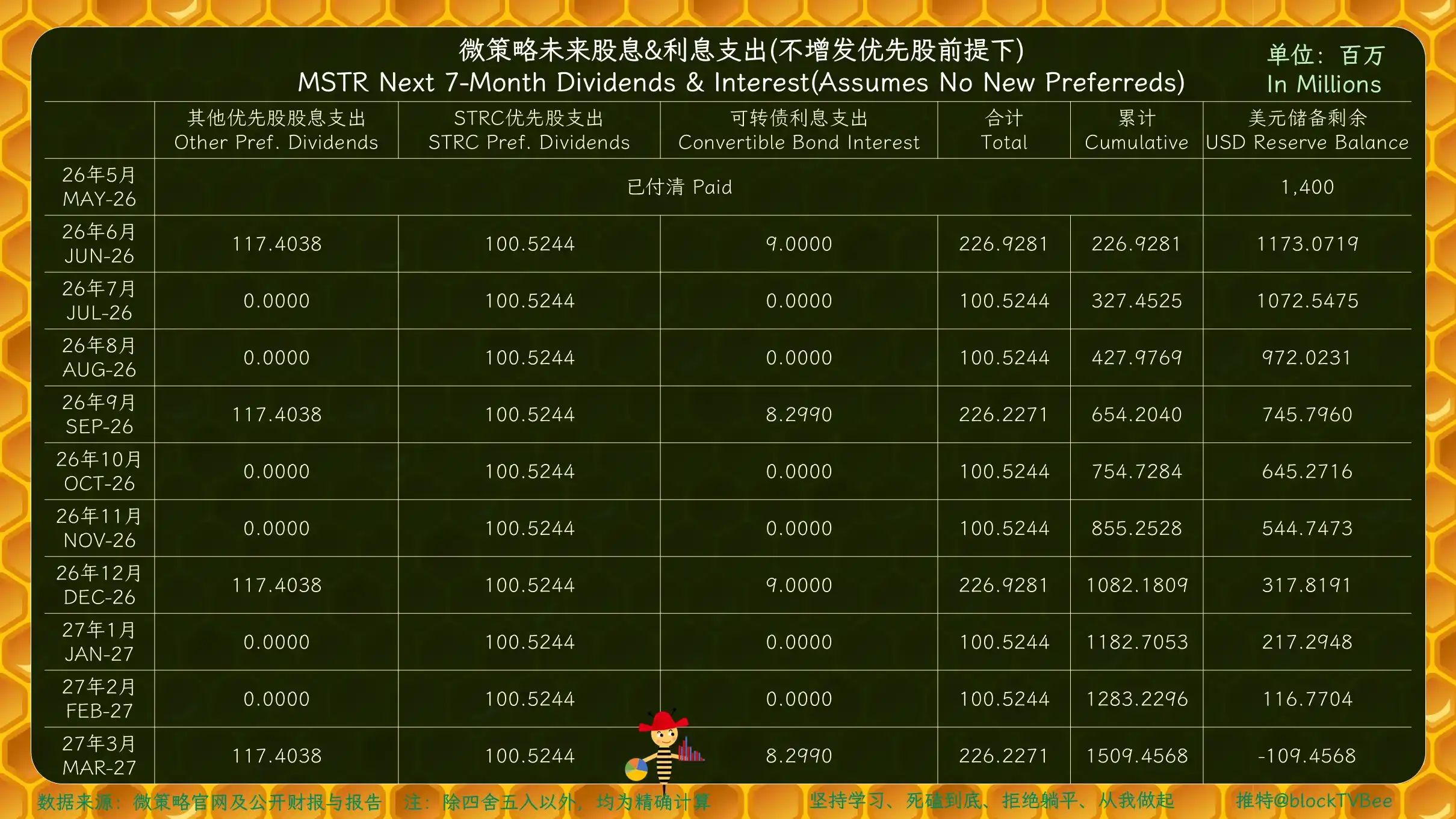
First, over the last 4 weeks, MicroStrategy has not issued any additional preferred stock at all, meaning it has not increased future dividend payments or expanded risk.

Second, over the last 4 weeks, MicroStrategy has strengthened its financing efforts by issuing common stock $MSTR, raising $128.3 million, $181 million, $209 million, and $333.5 million sequentially.

Third, over the last 4 weeks, MicroStrategy's BTC purchases were -32, 1550, 1587, and 520 BTC respectively. Although financing increased, BTC purchases did not rise proportionally, which is somewhat unfavorable for $MSTR in the short term but enhances the overall safety of the MicroStrategy system in the long run.

By March next year, the BTC bear market will most likely have ended. Once BTC and MSTR enter an upward trend, MicroStrategy can continue issuing MSTR to raise funds and use a portion to replenish its dollar reserves to cover future preferred stock dividend payments.

As BTC and MSTR rise, the expenditure and pressure from preferred stock dividends will gradually diminish.


Criptomoedas em alta

Perguntas relacionadas

QWhat is the key characteristic of convertible preferred stock mentioned in the article that makes it a clever financing tool for MicroStrategy?

AThe key characteristic is that these preferred stocks do not have rigid redemption or payment clauses. Therefore, they are not classified as traditional debt on the balance sheet. This means there is no principal repayment pressure, missed dividends do not trigger a debt default, and they do not directly lead to bankruptcy liquidation, creating a self-contradictory but virtuous cycle.

QAccording to the article, what happens if MicroStrategy cannot pay dividends on its preferred stock in the short term?

AIf MicroStrategy lacks sufficient funds to pay preferred stock dividends in the short term, it can defer or suspend the payments. For cumulative preferred stock, the unpaid dividends accumulate. For non-cumulative stock like STRD, dividends can simply be suspended without accruing. It can later resume or pay back dividends when funds are available, for example, by issuing more common stock after a Bitcoin price recovery.

QWhat is identified as the primary potential trigger for a real financial crisis at MicroStrategy, according to the article?

AThe article identifies convertible bonds (可转债) as the primary potential trigger for a real financial crisis. If a prolonged bear market prevents the bonds from meeting conversion conditions by their maturity dates (the earliest being September 16, 2027), MicroStrategy would be forced to repay them, potentially triggering a sell-off of Bitcoin and creating a downward spiral. Preferred stock dividends would only exacerbate this crisis, not initiate it.

QHow did MicroStrategy's recent financing activities (last 4 weeks) impact its financial safety, as described in the article?

AAccording to the article, MicroStrategy's recent activities increased its financial safety in three ways: 1) It did not issue any new preferred stock, avoiding an increase in future dividend obligations. 2) It significantly increased financing by issuing common stock (MSTR), raising hundreds of millions of dollars. 3) It increased its US dollar reserve (from $1.1B to $1.4B in the example week) more than its Bitcoin purchases, which is seen as bolstering the system's long-term safety despite being potentially negative for MSTR's stock price in the short term.

QUntil when can MicroStrategy's current US dollar reserves cover all its preferred stock dividend payments, based on the article's analysis?

ABased on the article's analysis, MicroStrategy's current US dollar reserves can cover all preferred stock dividend payments until February 2027, and approximately half of the payments due in March 2027.

Leituras Relacionadas

Chainlink Adds 6,100 Wallets In Two Days In Strongest Growth Burst Of 2026

Chainlink experienced its strongest wallet growth burst of 2026, adding approximately 6,100 new addresses in just two days. This notable increase in network participation occurred despite LINK's price trading in a difficult market environment alongside other altcoins. The surge in new wallets is seen as a positive signal for user and investor interest, suggesting the ecosystem continues to attract attention even when price action is weak. Wallet growth is considered a useful metric as it measures real participation rather than just price speculation. For an infrastructure project like Chainlink, whose value is tied to oracle services, data, and real-world assets, such growth indicates ongoing engagement with its core technology. However, the article notes that this data point, while constructive, is not conclusive on its own. The nature of the new wallets—whether they belong to small holders, new users, or exchange-related entities—remains unclear. The report maintains a balanced perspective, stating that while this wallet growth is a positive adoption signal for LINK bulls, it does not guarantee a price increase. Skeptics may question whether this user growth translates into value capture for the token. The key takeaway is that this burst of activity should be monitored alongside other factors like transaction volume, price structure, and broader market trends for a more complete picture. The signal requires follow-through in price and demand to be fully validated.

bitcoinistHá 4m

Chainlink Adds 6,100 Wallets In Two Days In Strongest Growth Burst Of 2026

bitcoinistHá 4m

In the AI Era, What's Left for Bitcoin?

As Bitcoin falls below $60,000, the author reflects on the relationship between AI and Bitcoin, seeing them as two sides of the same coin. In the AI era, the cost of generating content has plummeted, making fake text, images, and videos increasingly easy and cheap to produce. This has led to a fundamental shift: while AI dramatically lowers the cost of information production, it also undermines trust and authenticity online. What becomes truly valuable is not more content, but the ability to verify what is real—"verifiability." This perspective offers a new lens for Bitcoin. Its massive energy consumption, often criticized as wasteful, is reinterpreted. While AI burns energy to enhance "capability" and efficiency, Bitcoin burns energy to produce "verifiability." Its purpose is not to be trusted but to enable a system where no trust in intermediaries—banks, platforms, or developers—is needed. Every transaction and the entire ledger's history is secured by cryptography and a decentralized network of nodes, making it independently verifiable. AI cannot forge a transaction on the Bitcoin network because the system is designed for proof, not generation. The author draws a historical parallel to the Renaissance: the printing press drastically reduced the cost of copying knowledge, while double-entry bookkeeping reduced the cost of trust in commerce. Today, AI is the new printing press, reducing content creation costs to near zero. Blockchain, and Bitcoin as its pioneer, may be the modern equivalent of double-entry bookkeeping—a foundational technology for verifying digital asset ownership and historical records without centralized authorities. Thus, AI and blockchain are not competitors. AI lowers the cost of creation; blockchain lowers the cost of verification. In an age where AI can generate anything, true scarcity may lie not in more content, but in independently verifiable facts. Whether the market will reprice Bitcoin accordingly remains uncertain, but its core value proposition as a "machine for producing verifiability" becomes strikingly relevant.

marsbitHá 1h

In the AI Era, What's Left for Bitcoin?

marsbitHá 1h

In the Age of AI, What's Left for Bitcoin?

Author: Sevclub, Seven Research Amid Bitcoin's recent drop below $60k, the author reflects on a growing sense that AI and Bitcoin are two sides of the same coin. Today, encountering any content triggers a new default question: "Was this made by AI?" The cost of generating convincing text, images, and video is now negligible. While the internet lowered information *distribution* costs, AI is crashing information *production* costs to near zero. The consequence is a flood of content where truth and falsehood are increasingly indistinguishable. In this environment, what becomes truly valuable is not more information, but the ability to verify what is real—"verifiability." This reframes the common criticism that Bitcoin "wastes electricity." AI consumes power to produce "capability" (e.g., more powerful models). Bitcoin consumes power to produce something else: "verifiability." Bitcoin's core purpose isn't about belief or trust in any institution, developer, or even its creator. It's about enabling independent verification. Every bitcoin's origin, every transaction, and the integrity of the entire ledger are secured by mathematics, cryptography, and a global network of nodes. AI can fabricate convincing media, but it cannot falsify a transaction on the Bitcoin network. The expended energy makes篡改历史 (tampering with history) prohibitively expensive, purchasing a globally verifiable ledger. The author draws a historical parallel to the Renaissance. The printing press drastically reduced the cost of copying knowledge, while double-entry bookkeeping reduced the cost of trust in commerce—one enabled creation, the other verification. Today, AI is the new printing press, driving content production costs toward zero. The question becomes: what is this era's "double-entry bookkeeping"? Blockchain appears to be the leading candidate. It doesn't verify which news is true or which image is real, but it provides a foundational layer for independently verifying asset ownership and historical records in the digital realm without centralized authorities. Therefore, AI and blockchain are not in competition. AI lowers the cost of *generation*. Blockchain (and Bitcoin as a prime example) lowers the cost of *verification*. One creates, the other proves. Whether Bitcoin ultimately succeeds remains uncertain, facing potential challenges from quantum computing, regulation, and technical evolution. However, the author now sees it less as a "machine for making bitcoin" and more as a "machine for making verifiability." In an age where AI can generate anything, true scarcity may no longer be "more content," but "more independently verifiable facts." Whether the market will price this accordingly is a separate question.

链捕手Há 1h

In the Age of AI, What's Left for Bitcoin?

链捕手Há 1h

Trading

Spot

Artigos em Destaque

Como comprar GENIUS

Bem-vindo à HTX.com!Tornámos a compra de Genius (GENIUS) simples e conveniente.Segue o nosso guia passo a passo para iniciar a tua jornada no mundo das criptos.Passo 1: cria a tua conta HTXUtiliza o teu e-mail ou número de telefone para te inscreveres numa conta gratuita na HTX.Desfruta de um processo de inscrição sem complicações e desbloqueia todas as funcionalidades.Obter a minha contaPasso 2: vai para Comprar Cripto e escolhe o teu método de pagamentoCartão de crédito/débito: usa o teu visa ou mastercard para comprar Genius (GENIUS) instantaneamente.Saldo: usa os fundos da tua conta HTX para transacionar sem problemas.Terceiros: adicionamos métodos de pagamento populares, como Google Pay e Apple Pay, para aumentar a conveniência.P2P: transaciona diretamente com outros utilizadores na HTX.Mercado de balcão (OTC): oferecemos serviços personalizados e taxas de câmbio competitivas para os traders.Passo 3: armazena teu Genius (GENIUS)Depois de comprar o teu Genius (GENIUS), armazena-o na tua conta HTX.Alternativamente, podes enviá-lo para outro lugar através de transferência blockchain ou usá-lo para transacionar outras criptomoedas.Passo 4: transaciona Genius (GENIUS)Transaciona facilmente Genius (GENIUS) no mercado à vista da HTX.Acede simplesmente à tua conta, seleciona o teu par de trading, executa as tuas transações e monitoriza em tempo real.Oferecemos uma experiência de fácil utilização tanto para principiantes como para traders experientes.

256 Visualizações TotaisPublicado em {updateTime}Atualizado em 2026.06.02

Como comprar GENIUS

Discussões

Bem-vindo à Comunidade HTX. Aqui, pode manter-se informado sobre os mais recentes desenvolvimentos da plataforma e obter acesso a análises profissionais de mercado. As opiniões dos utilizadores sobre o preço de GENIUS (GENIUS) são apresentadas abaixo.

活动图片