Xpeng and NIO Compete on Computing Power, Li Auto Shifts Architecture

marsbitPublicado em 2026-06-16Última atualização em 2026-06-16

Resumo

On June 15, 2026, Li Auto unveiled details of its self-developed chip, Mahe M100, for its new L9 Livis model. CTO Xie Yan stated the goal was not just a faster chip, but a fundamentally different one, targeting the chip architecture itself. While competitors like NIO, Xpeng, and Huawei highlight TOPS (computing power) figures for their self-developed chips, Li Auto’s Mahe M100 focuses on redesigning the underlying architecture. It employs a "dynamic data flow architecture" to address memory bandwidth bottlenecks in large model inference, claiming up to 3x the effective computing power of Nvidia's Thor U for its specific workloads and a 40% reduction in latency. The chip's design was peer-reviewed and accepted at ISCA 2026. However, this performance is highly optimized for Li Auto's own VLA2.1 algorithm, meaning it may not generalize as well to other tasks. Li Auto aims to achieve full-stack in-house development with Mahe M100, covering chip, compiler, OS, AI algorithms, and domain controller—a level of vertical integration few competitors match. Beyond the chip, CEO Li Xiang introduced a new strategic narrative: the "embodied intelligent vehicle," defined as an integration of an EV, a professional driver, an AI computer, and a life assistant. This shifts competition from features like large screens to systemic AI capabilities. A key commitment was that Li Auto's Mahe VLA autonomous driving model will match Tesla's FSD V14 by Q4 2026, with specific OTA milestones set for J...

On June 15th, Li Auto detailed the specifics of its in-house developed chip, Mahe M100, during a launch event. This chip is designed for the next-generation L9 Livis. CTO Xie Yan emphasized: It's not just about creating a chip that's faster than before, but about creating a fundamentally different type of chip. This 'difference' refers to the chip architecture.

In 2026, amidst a wave of automakers developing their own chips, TOPS is the most commonly used marketing metric. The NIO Shenji NX9031, Xpeng Turing, and Huawei MDC 810 Pro all prominently feature their computational power figures. Li Auto has chosen to fundamentally alter the underlying architecture.

The Mahe M100 aims to prove that architecture is more important than raw compute numbers. But whether it's right or not still needs to be tested by the market.

01. The Divergence in Chip Development Amidst Compute Power Inflation

Developing in-house chips has become a common choice for leading domestic automakers.

The NIO Shenji NX9031 is the world's first 5nm high-performance autonomous driving chip. Its special feature is its self-developed ISP, which improves pedestrian recognition rate by 40% in low-light conditions of 1 lux at night, showing significant reinforcement at the perception layer.

Xpeng's Turing chip also demonstrates clear customization, specifically designed for Xpeng's autonomous driving large model, with plans to extend to flying cars and robots.

Huawei has taken another path, using Ascend for MDC, emphasizing complete alignment between cloud training and vehicle-side inference, "one minute of training in the cloud, one minute of following in the vehicle."

These companies' chips are variants of the von Neumann architecture: a central processing unit, with data being shuttled back and forth between computing units and memory. The more advanced the process node, the faster the data moves, but the Mahe M100 aims to change the very act of moving data itself.

02. Altering the Underlying Logic

The von Neumann architecture wasn't a problem in the era of general-purpose computing, but large model inference is a different computational paradigm. VLM inference involves large-scale matrix parallelism, not sequential instruction execution. The bottleneck is almost entirely in memory bandwidth; the overhead of data repeatedly moving in and out of memory directly consumes a significant portion of the effective computing power.

The concept of the dynamic dataflow architecture is to allow data to flow along the computational graph, eliminating the need to repeatedly store it back in memory. Li Auto claims the result is that a single Mahe M100 chip offers approximately 3 times the effective computing power of NVIDIA's Thor U, with a 40% reduction in end-to-end latency.
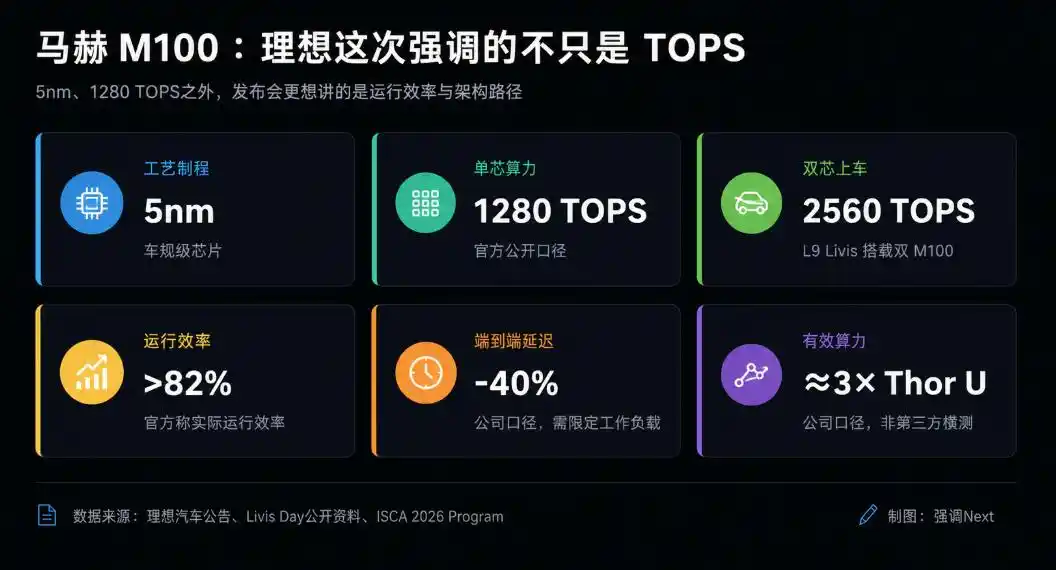
How credible is this "3 times" claim? There is one piece of external verification. The architecture paper for the Mahe M100 was accepted into the Industry Track of ISCA 2026. ISCA is a top-tier academic conference in computer architecture. Papers in the Industry Track undergo peer review, and the design details of the architecture are public. Li Auto is the first automobile manufacturer ever to be selected for this track since its establishment.

However, the 3x figure comes with its prerequisites. Effective computing power depends on the specific workload. The 3x performance achieved while running Li Auto's VLA2.1 algorithm may not hold up under a different system. The Mahe M100 is an algorithm-native chip, developed simultaneously with the model, deeply optimized for the company's own algorithms. It runs its own models best; performance on general tasks may vary.

This shares similarities with the design logic of Xpeng's Turing chip and Tesla's FSD Chip. The difference is that Tesla and Xpeng didn't make a paradigm shift at the architecture level; the Mahe M100 has made fundamental changes to the underlying logic. Whether an automaker can successfully bring a completely new architecture to reliable mass production is itself an unprecedented challenge.

With the deployment of the Mahe M100, Li Auto has achieved full-stack in-house development across chips, compilers, operating systems, AI algorithms, and domain controllers. This closed-loop system is uncommon among its peers.

NIO has its own chip but different levels of OS dependency. Xpeng develops its own chip but its compiler and OS still rely on external solutions. Huawei has a closed loop, but it is not a vehicle manufacturer. The strategic significance of Li Auto's chain lies in making it less susceptible to NVIDIA's supply chain control, keeping data within its own platform, and fully owning the optimization space for software-hardware synergy.

03. First-Mover Positioning in "Embodied AI"

The chip was only one of the stars of the launch event. Li Xiang also proposed a "Four-in-One" definition for embodied AI cars during the presentation: an electric vehicle, a professional driver, an AI computer, and a life assistant.

This marks a significant departure from Li Auto's past brand narrative.

In 2023, the L9 penetrated the 300,000 to 500,000 RMB market with its "Large Six-Seat Family SUV" positioning, followed by a generation of similarly styled models. The problem with this positioning is its low replication cost. Competitors like the AITO M9, NIO ES9, and Zeekr 9X have entered the fray. Refrigerators, screens, and large sofas have become industry standards, making it hard for any player to differentiate, leading only to price wars.

The "Embodied AI Car" shifts the competitive dimension from configurations to system capabilities. Within this framework, refrigerators and rear-seat screens are basic features. The differentiation point becomes "whose system can perceive, think, and grow." Defining a new category itself is a strategic asset; whoever articulates it first gains positioning.

Li Auto has matched this narrative with a relatively complete technological chain: the Mahe M100 computing foundation, the Mahe VLA2.1 autonomous driving large model, the Mahe Mind-Pro and Mind-Edge edge-side foundation models, and the Starlink OS for full-stack integration, with each layer having corresponding product implementations.

The launch event demonstrated features like the vehicle moving to music, a 4D racing simulator, and command-based parking – these are tangible experiences. Li Xiang also stated during the launch that autonomous driving is only the "first half" of embodied AI, with general-purpose humanoid robots being the "second half," but the specific timeline and implementation path for the second half remain unclear.

04. The Q4 Mandate

There was another crucial statement during the launch: Li Auto's autonomous driving large model, Mahe VLA, will comprehensively benchmark against Tesla's FSD V14 in Q4 of this year.

Li Xiang's consistent style is to make public commitments, using external pressure to drive internal execution. Having stated Q4 benchmarking against FSD V14, everyone will use that ruler to measure them by year-end.

In terms of technical route, Li Auto's choice is highly isomorphic to Tesla's: end-to-end + VLA large model + primarily vision-based. Huawei follows a path of lidar + multi-sensor fusion + a hybrid of rules and neural networks, offering stable short-term engineering implementation with lower compute demands. However, in the long run, if the vision-based + large model route ultimately prevails, Huawei's system may face greater switching costs. Li Auto is betting on the same technological belief as Tesla. Whether this judgment is correct will become clearer by year-end.

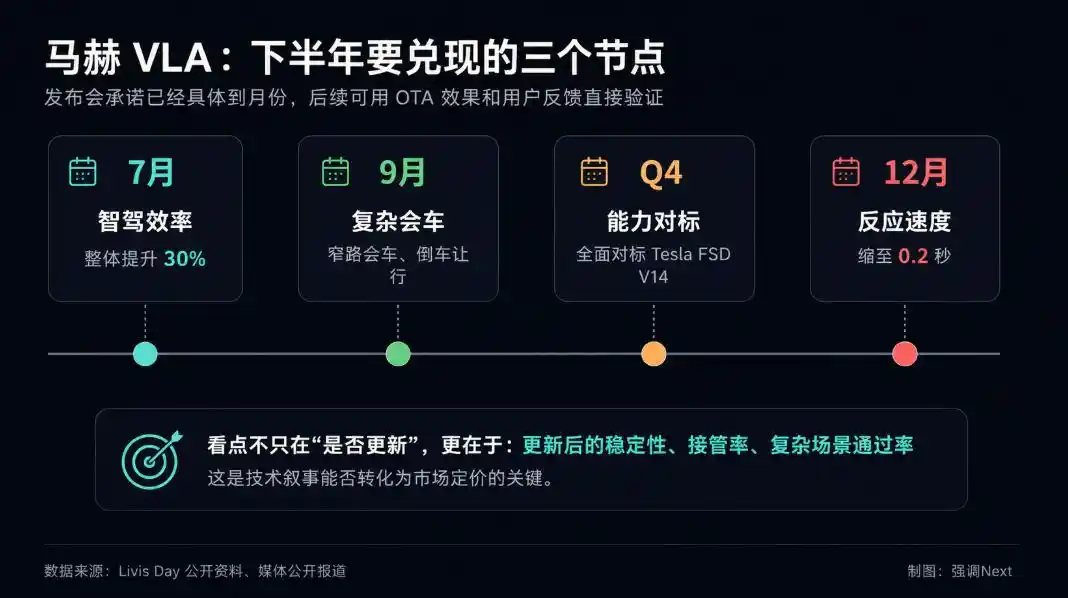
The OTA promises for the second half of the year are specified by month. July: a 30% improvement in autonomous driving efficiency. September: implementation of narrow-road meeting/backing-up yielding. December: vehicle response speed reduced to 0.2 seconds. Each milestone has clear technical indicators, providing data for comparison by year-end.
05. Several Data Points Beyond the Launch Event

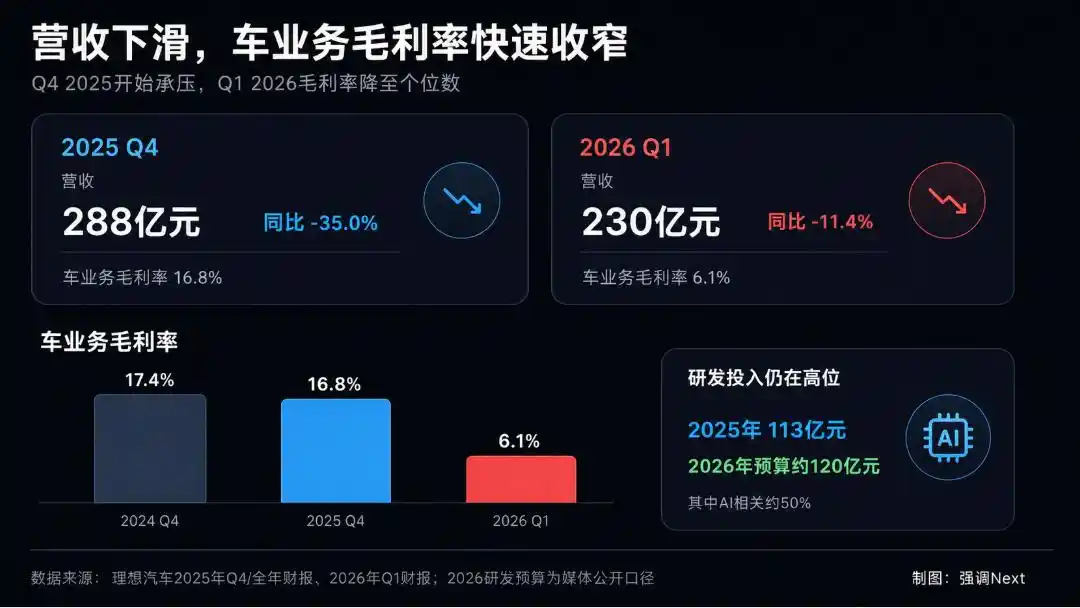
Li Auto's current financial situation is not easy. Since Q4 2025, its revenue has declined year-over-year, and automotive business gross margins have noticeably narrowed. Meanwhile, the R&D budget for 2026 remains around 12 billion RMB, with approximately 50% allocated to AI-related areas, essentially flat compared to 11.3 billion RMB and 50% in 2025. R&D investment is not decreasing, yet profitability pressure persists.
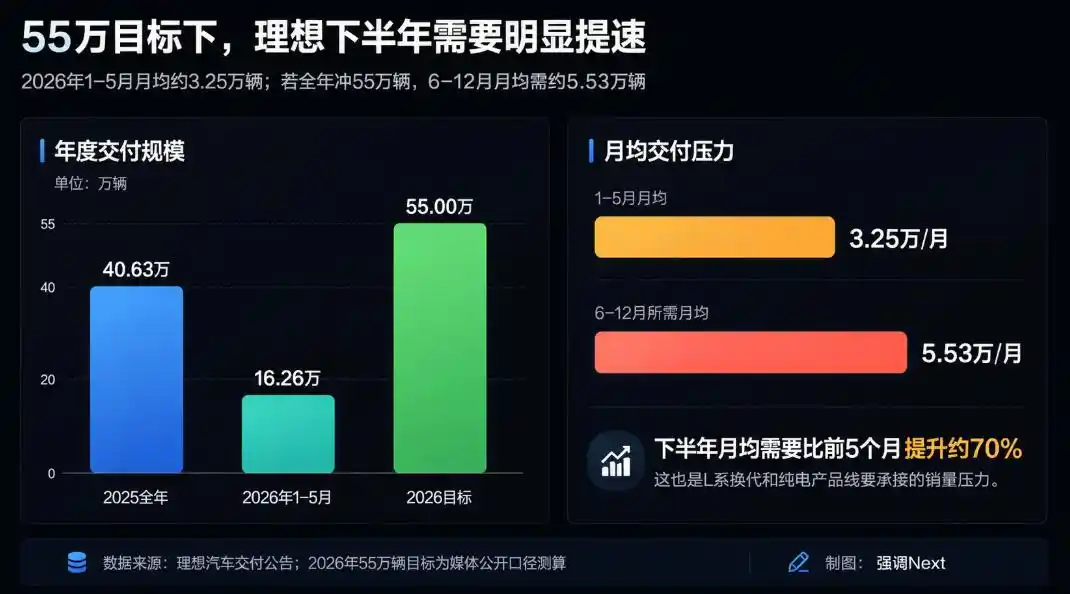
In terms of sales, Li Auto's target for 2026 is 550,000 units. Actual deliveries in 2025 were 406,000 units. May 2026 saw single-month deliveries of 33,000 units, still showing a year-over-year decline. The L9 Livis received over 10,000 non-refundable deposits within two weeks of launch, showing stable performance in the 500,000+ RMB market. However, overall delivery volume still relies on the full model changeover of the L series and the release of the pure electric product line in the second half of the year.
At the chip level, the deep binding of the Mahe M100 with its own algorithms is a design choice that brings advantages in software-hardware synergy efficiency. This also means that if future technological routes require adjustment, the switching cost would be higher than for manufacturers using third-party chip solutions. Xpeng's Turing, NIO's Shenji, and Tesla's FSD Chip face similar situations; this is an industry-wide characteristic of in-house developed, algorithm-native chips.

06. Q3 Will Reveal the Cards

The initial effects of the new L9 launch, the subsequent L8 update, and the first July OTA milestone will all be reflected in the Q3 financial report.

Xie Yan said he needed to create a completely different chip. Having the architecture paper pass peer review counts as external validation of the design concept. But the journey from design to mass production, and then to real user feedback in daily driving, is still long. The July OTA milestone is the first test; the year-end benchmarking against FSD V14 is an even more critical one.

This article is from the WeChat public account "EmphasizeNext" (ID: leo89203898), author: Yixiu, editor: Xiaobai


Perguntas relacionadas

QWhat is the key design choice that differentiates Li Auto's self-developed Mach M100 chip from its competitors?

ALi Auto's Mach M100 chip adopts a dynamic dataflow architecture, moving away from the traditional von Neumann architecture. This approach focuses on reducing the data movement bottleneck (data shuttling between memory and compute units) inherent in AI model inference, aiming to improve effective computing power and lower latency, rather than just increasing raw TOPS.

QAccording to the article, what is Li Auto's strategic goal with its 'Embodied Intelligent Vehicle' concept, and how does it differ from its previous branding?

ALi Auto's strategic goal with the 'Embodied Intelligent Vehicle' concept is to shift the competitive dimension from hardware configurations (like large screens and refrigerators) to system capabilities in perception, reasoning, and growth. This differs from its previous 'family SUV' branding focused on space and comfort. The new concept aims to establish a new product category and gain a first-mover positioning in the evolving smart car market.

QWhat specific public commitment did Li Xiang make regarding Li Auto's autonomous driving technology for Q4 2026?

ALi Xiang committed that Li Auto's Mach VLA intelligent driving large model will be comprehensively benchmarked against Tesla's FSD V14 in the fourth quarter of 2026. This public commitment uses external pressure to drive internal execution, with the results being measurable by year-end.

QWhat are the potential advantages and risks associated with Li Auto's full-stack in-house development approach (chip, OS, AI algorithm, etc.)?

AAdvantages: It creates a closed-loop system that prevents supply chain constraints (e.g., from Nvidia), keeps data within its own platform, and allows for deep, autonomous software-hardware co-optimization. Risks: The chip is algorithm-native, deeply optimized for its own models. This creates high switching costs if future technology paths require significant changes, and it may not perform as well on generic tasks compared to more general-purpose chips.

QWhat financial and sales challenges does Li Auto face in 2026, according to the article?

AFinancially, Li Auto faces pressure with year-on-year revenue decline since Q4 2025 and narrowing gross margins for its vehicle business, while maintaining high R&D investment (around 12 billion RMB, 50% AI-related). Sales-wise, it aims for 550,000 deliveries in 2026, but actual 2025 deliveries were 406,000, and monthly deliveries in May were down year-on-year. It relies on the new L9 Livis and upcoming full-line model refreshes and pure-electric products to boost sales in the second half of the year.

Leituras Relacionadas

M&A Deals in the Crypto Market Are Unusually Active

Title: M&A Activity in Crypto Market Becomes Unusually Active A rare signal is emerging in the crypto primary market: mergers and acquisitions (M&A) are nearing half of all financing deals. According to RootData, this month, M&A cases in the crypto industry reached 10, while financing rounds numbered only 14, meaning M&A accounts for approximately 42% of primary market transactions—the highest level in history. This does not signal a sudden industry boom. Instead, the rapid rise in M&A share primarily reflects the continued downturn in the financing market. Since November 2024, monthly crypto M&A deals have remained between 10-20, while financing deals have plummeted from around 100 to about 50, possibly hitting a new low this month. For project teams, this means the traditional path of relying on narratives, token expectations, and ecosystem subsidies to maintain valuations is narrowing. For leading companies, it presents a rare window to acquire teams, licenses, technology, liquidity, and market access at lower prices, with less competition and stronger bargaining power. Key active buyers include Coinbase, Kraken, Ripple, MoonPay, Polymarket, Kaiko, Sol Strategies, GSR, Keyrock, Jupiter, Paxos, and Ondo Finance. Their M&A logic is consistent: acquiring key capabilities at lower costs during the industry downturn. This is driven by more attractive valuations, reduced time and trial-and-error costs, the acquisition of licenses and compliance resources, and the integration of industry upstream and downstream segments. Current M&A focuses are concentrated in four areas: trading infrastructure (e.g., Coinbase acquiring Deribit, Kraken acquiring NinjaTrader), payments and stablecoins (e.g., MoonPay, Ripple expanding payment networks), compliance licenses, and asset issuance/distribution (e.g., acquisitions related to RWA and token issuance platforms like Coinbase's purchases of Liquifi and Echo). The rise in M&A is altering the primary market's exit logic. It provides an alternative path to the token-dependent model, encouraging teams to build tangible products, revenue, and strategic value that can be integrated. This could inject confidence into the market, showing that asset buyers and exit possibilities still exist, albeit with a stricter focus on real utility. However, this trend also indicates the crypto industry is becoming more centralized. As asset issuance, trading, market-making, custody, payments, and data gradually consolidate in the hands of a few major players, the industry's initial emphasis on openness and anti-monopoly is being reshaped by commercial realities. Coupled with rising compliance barriers, this signals the end of the low-barrier era for crypto entrepreneurship.

链捕手Há 6m

M&A Deals in the Crypto Market Are Unusually Active

链捕手Há 6m

M&A Deals Are Exceptionally Active in the Crypto Market

Mergers and acquisitions (M&A) activity in the cryptocurrency primary market has reached a historic high, accounting for approximately 42% of total deals in the current month, nearly matching the number of financing rounds. This shift does not signal a new boom cycle but rather reflects a severe contraction in the venture capital funding environment. As financing dwindles, established industry giants—including major exchanges, payment firms, and infrastructure providers—are seizing the opportunity to acquire strategic assets at lower valuations. Key drivers behind the surge in M&A include depressed project valuations, the need to quickly acquire talent and technology to capture short market windows, the pursuit of crucial regulatory licenses, and the strategic expansion into adjacent business verticals such as derivatives, payments, stablecoins, and real-world asset (RWA) issuance. Major acquisitions, like Coinbase's purchase of Deribit and Kraken's acquisition of NinjaTrader, exemplify the push to expand into high-margin areas like derivatives and multi-asset trading. This trend is reshaping the industry's exit landscape, offering an alternative to token-based exits and incentivizing startups to build tangible products and revenue streams with inherent strategic value for acquisition. However, it also points toward increasing centralization, as critical functions—trading, custody, payments, compliance—become concentrated within a few large, well-capitalized platforms, potentially raising barriers to entry for new ventures.

marsbitHá 7m

M&A Deals Are Exceptionally Active in the Crypto Market

marsbitHá 7m

Solana Privacy Ecosystem Panorama: A Complete Privacy Stack from Compute to AI

**Title: The Solana Privacy Ecosystem: A Full-Stack View from Compute to AI** **Summary:** This article provides a comprehensive overview of the emerging privacy landscape on the Solana blockchain, characterizing it as still in early development. It identifies two primary verticals—Neobanks and Private DeFi—as key drivers, while noting gaps in tooling and user experience. The discussion centers on two main approaches to private computation: Arcium, which utilizes Multi-Party Computation (MPC) networks (Multi-Party eXecution Environments) to process encrypted data with final settlement on Solana; and Magic Block, which leverages Trusted Execution Environments (TEEs) via its Private Ephemeral Rollup (PER). Both enable confidential applications like dark pools and private DeFi with minimal code changes. Building on this infrastructure, projects are creating privacy-focused applications. Umbra, built on Arcium, offers Encrypted Token Accounts (ETAs) for private balances, transfers, and selective disclosure for compliance. Other wallets like Privacy Cash and Hush provide mixer-like functionality for SOL. For private trading, encifherio uses TEEs to encrypt swap details routed through Jupiter, while VanishTrade and Darklake focus on shielding transaction intent and liquidity routing, with Darklake introducing a "blind slippage pool" to prevent front-running. Further applications include private prediction markets (e.g., Melee Markets using Arcium's encrypted order books) and private AI. Loyal exemplifies the latter, using both Magic Block and Arcium to enable decentralized AI agents that store user data, conversations, and transactions confidentially on-chain. The article concludes by framing privacy not as a single technology but as an evolving "ultimate privacy stack," with experts like Helius's Mert envisioning a future combination of Fully Homomorphic Encryption (FHE) and Zero-Knowledge proofs (ZK). Helius Privacy itself is developing a ZK-based UTXO privacy layer for Solana.

Foresight NewsHá 12m

Solana Privacy Ecosystem Panorama: A Complete Privacy Stack from Compute to AI

Foresight NewsHá 12m

7 Key Questions Regarding 'DeepSeek Completes Over 50 Billion Yuan in Financing'

DeepSeek, the prominent Chinese AI company, has reportedly completed its first external funding round, raising over 50 billion RMB (approximately $6.9 billion USD), according to foreign media reports. This financing values the company at over $50 billion USD, a significant increase from a $10 billion valuation when the round began in April 2026. Founder Liang Wenfeng personally contributed 20 billion RMB, with other investors including Tencent, CATL (Contemporary Amperex Technology), JD.com, NetEase, and IDG Capital. Notably, the National Artificial Intelligence Industry Investment Fund also participated with a direct investment of 1 billion RMB. The funding round is distinctive for its structure. Most investors' capital is channeled into a limited partnership controlled by CEO Liang Wenfeng, rather than directly into DeepSeek. These investors face a five-year lock-up period, have no voting rights, but receive priority financial information and future investment rights. This arrangement is seen as a measure to ensure Liang's absolute control over the company's direction, aligning with its stated principles of prioritizing groundbreaking AGI (Artificial General Intelligence) research over short-term profitability. The report highlights strategic reasons for key investors. Tencent's involvement is viewed as a strategic alignment, building on existing collaborations. CATL's investment is linked to the critical energy and power infrastructure needed for AI data centers, a key growth area for the battery giant. The participation of a state-backed fund underscores the national strategic importance of AI development. Post-funding, DeepSeek is expected to accelerate infrastructure development, including building its own data centers, hire more talent, and release new model versions with enhanced capabilities like image and audio support. While this marks a major step, the company's long-term journey towards AGI remains a challenging path that will require balancing its foundational ideals with the expectations of its new investors.

marsbitHá 58m

7 Key Questions Regarding 'DeepSeek Completes Over 50 Billion Yuan in Financing'

marsbitHá 58m

Trading

Spot
Futuros

Artigos em Destaque

Como comprar HOUSE

Bem-vindo à HTX.com!Tornámos a compra de Housecoin (HOUSE) simples e conveniente.Segue o nosso guia passo a passo para iniciar a tua jornada no mundo das criptos.Passo 1: cria a tua conta HTXUtiliza o teu e-mail ou número de telefone para te inscreveres numa conta gratuita na HTX.Desfruta de um processo de inscrição sem complicações e desbloqueia todas as funcionalidades.Obter a minha contaPasso 2: vai para Comprar Cripto e escolhe o teu método de pagamentoCartão de crédito/débito: usa o teu visa ou mastercard para comprar Housecoin (HOUSE) instantaneamente.Saldo: usa os fundos da tua conta HTX para transacionar sem problemas.Terceiros: adicionamos métodos de pagamento populares, como Google Pay e Apple Pay, para aumentar a conveniência.P2P: transaciona diretamente com outros utilizadores na HTX.Mercado de balcão (OTC): oferecemos serviços personalizados e taxas de câmbio competitivas para os traders.Passo 3: armazena teu Housecoin (HOUSE)Depois de comprar o teu Housecoin (HOUSE), armazena-o na tua conta HTX.Alternativamente, podes enviá-lo para outro lugar através de transferência blockchain ou usá-lo para transacionar outras criptomoedas.Passo 4: transaciona Housecoin (HOUSE)Transaciona facilmente Housecoin (HOUSE) no mercado à vista da HTX.Acede simplesmente à tua conta, seleciona o teu par de trading, executa as tuas transações e monitoriza em tempo real.Oferecemos uma experiência de fácil utilização tanto para principiantes como para traders experientes.

287 Visualizações TotaisPublicado em {updateTime}Atualizado em 2026.06.02

Como comprar HOUSE

Discussões

Bem-vindo à Comunidade HTX. Aqui, pode manter-se informado sobre os mais recentes desenvolvimentos da plataforma e obter acesso a análises profissionais de mercado. As opiniões dos utilizadores sobre o preço de HOUSE (HOUSE) são apresentadas abaixo.

活动图片