More Popular Than SpaceX, Oversubscribed by Over 6586 Times, What's the Meme Power Behind Liuliumei (06658.HK)?

Odaily星球日报Publicado em 2026-06-15Última atualização em 2026-06-15

Resumo

Titled "More Popular than SpaceX, Over 6586 Times Oversubscribed: What's the Meme Power Behind Liuliumei (06658.HK)?", this article discusses the phenomenon of "stock memefication" through the case of Liuliumei's IPO. The Chinese snack company saw its stock price surge over 190% on its Hong Kong debut, fueled not by fundamentals but largely by a viral meme. Its stock ticker abbreviation "06658.HK" was humorously linked to "LLM" (Large Language Model), coinciding with a rally in AI-related stocks like Zhipu AI. This mirrors a broader trend where stocks gain traction based on internet jokes,谐音梗 (homophonic puns), celebrity mentions, or cultural moments—similar to meme coins in crypto. Examples include Gamestop's 2021 short squeeze, Trump-related stock movements ("川大智胜"), and "孚日股份" (interpreted as "capture Japan"). The article argues global markets are entering an era where attention and social media narratives can drive significant capital flows, blurring lines between traditional finance and meme culture. While offering quick gains, this trend also carries risks like pump-and-dump schemes. Liuliumei's explosive IPO, surpassing even蜜雪冰城's subscription record, exemplifies how meme-driven attention is being converted into market volatility and liquidity in today's fragmented, emotion-driven investment landscape.

Original|Odaily Planet Daily(@OdailyChina)

Author|Wenser(@wenser2010 )

"Are you okay? Okay? Okay? Then eat some Liuliumei!"

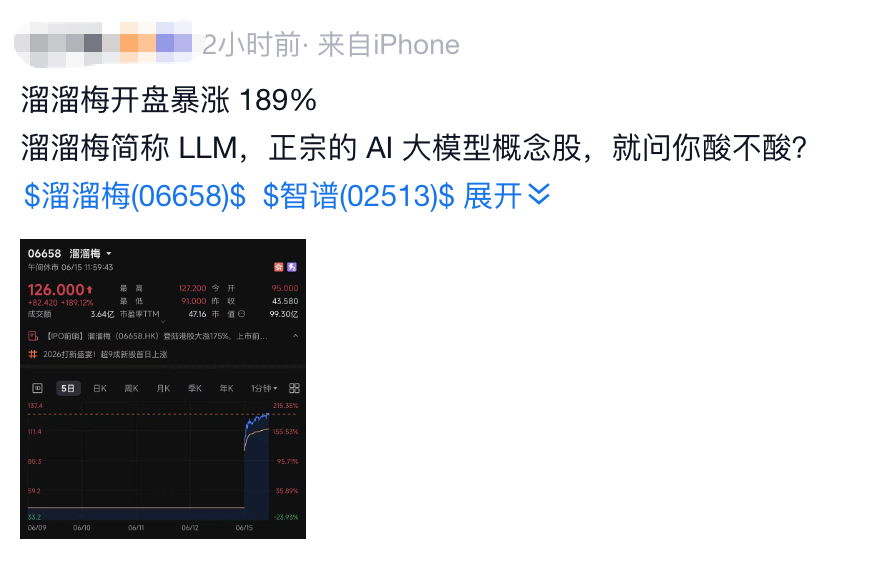
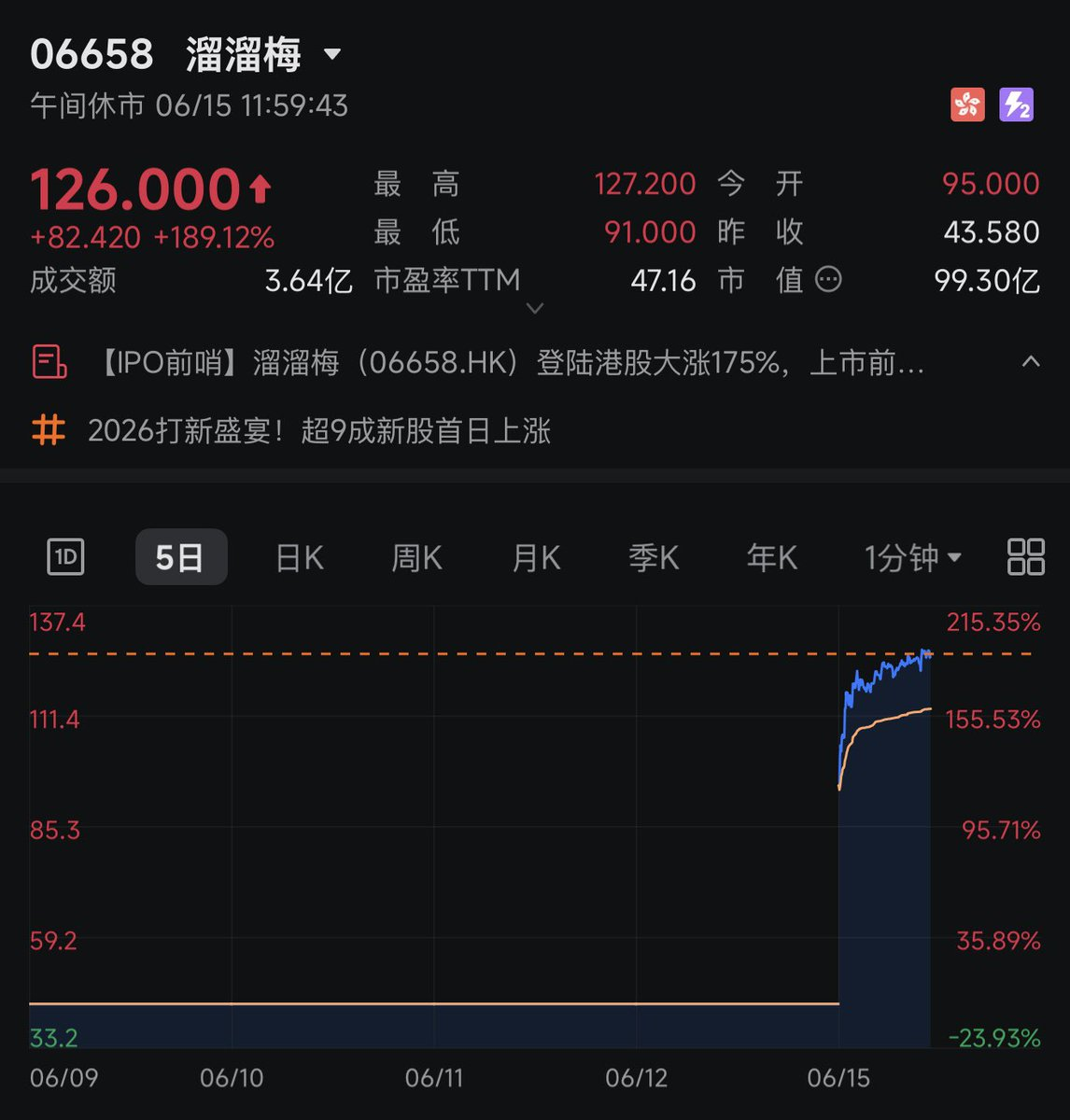
Once upon a time, a brainwashing commercial line from actress Yang Mi brought Liuliumei into thousands of households. Today, after decades of accumulation, the company behind it finally officially listed on the Hong Kong Stock Exchange, becoming the "first stock of plum snacks" on HKEx. It is reported that its issue price was HKD 43.58, the opening price was HKD 95, a surge of approximately 116% from the offering price of HKD 42; the intraday high reached HKD 127.50, an increase of over 190%; it has now pulled back to HKD 125, still up over 186%.

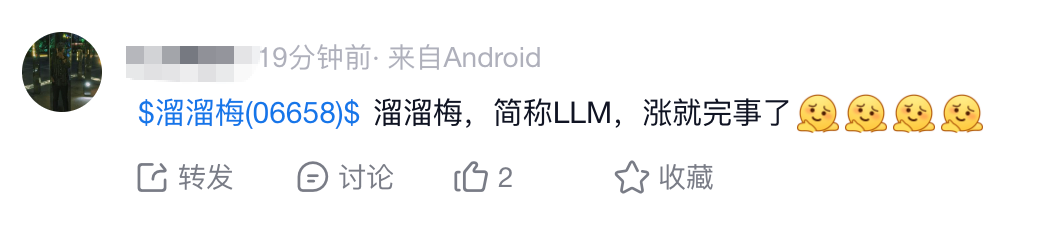
But contrary to many expectations, the stock price surge of Liuliumei (06658.HK) is not a revival of the concepts of "new consumption, new retail, new snacks." Instead, its name initials coincidentally align with the hot topic of "LLM" (Large Language Model), riding on the wave of today's 45% surge in Zhipu AI (02513.HK).

Many call it an "authentic AI Large Language Model stock," attracting countless hot money and capital inflows. Whether acknowledged or not, global stock markets may be entering the "Stock Meme-ification Era."

The New Era of Global Stock Markets: When Stocks Collide with Memes

First, the basics of Liuliumei's IPO: This was Liuliumei's fourth attempt at a capital market listing.

In 2019, its attempt to list on the A-share market failed; in 2025, its two applications to list on HKEx lapsed; it wasn't until May 21 this year, after updating its listing application materials for the third time and changing its main entity name from "Liuliumei Group Co., Ltd." to "Liuliumei Co., Ltd.," that it successfully listed in less than a month. It must be said, sometimes naming can be a mysterious thing.

According to the company's allocation results announcement, the public offering portion of this IPO recorded an oversubscription of approximately 6586.73 times. The final number of shares offered publicly was 1.1465 million, accounting for approximately 10% of the total global offering. There were approximately 180,500 valid applications received, with about 11,465 applications accepted. The ratio of allotment for one lot application was only 1.5%, meaning the one-lot winning rate was as low as 1.5%, indicating extremely fierce competition for subscription. Regarding the international placement, Liuliumei received a subscription of 2.64 times. The final number of international offering shares was 10.3176 million, accounting for 90% of the total offering shares. Comparing this data, the popularity of Liuliumei's IPO has surpassed that of "the first stock of milk tea stores by outlet number" Mixue Ice City, which listed on HKEx in March last year with a public offering oversubscription multiple of 5258.21 times.

In other words, institutions were not optimistic but held 90% of the shares; retail investors were optimistic but only held 10% of the shares. The main driving force behind the opening surge came more from the free market play of "retail investors and market makers dancing together." And this is precisely the power of "Meme stocks"—transforming the attention attracted by memes into buying power in the capital market.

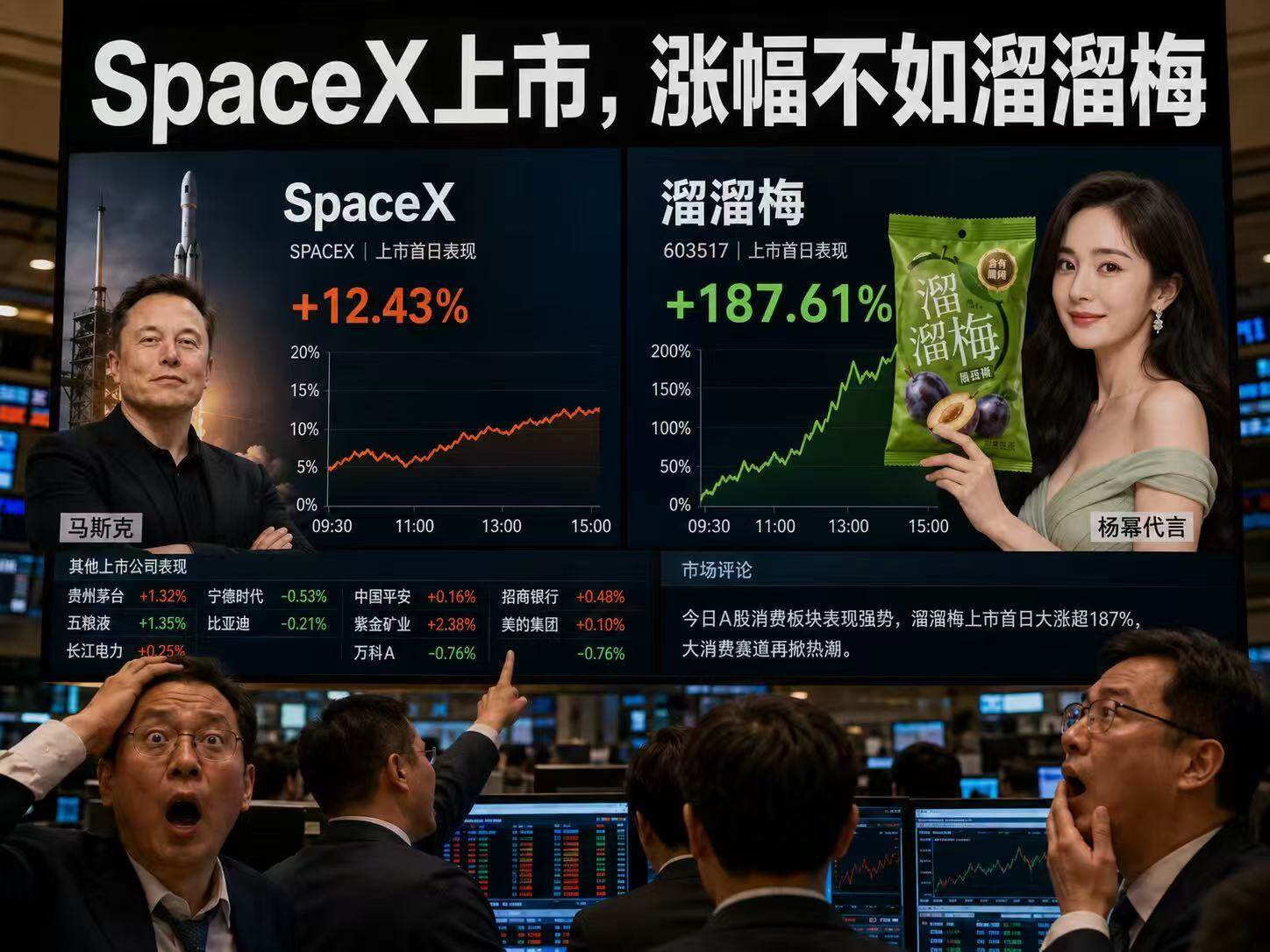
Some netizens even compared Liuliumei's opening performance to SpaceX, finding its market gains far more dazzling.
It is worth mentioning that "Meme stocks" is not a new term that recently appeared; they are an objectively existing category of stocks in major capital markets like the US, Hong Kong, and A-shares. However, the "Stock Meme-ification Era" is undoubtedly the latest trend emerging in the past 1-2 years, and its driving factors are also somewhat related to the crypto market.
The earliest Meme stocks are untraceable, so we'll only discuss some representative individual stock targets in recent years.

2021's Gamestop might be the starting point of Meme stock enlightenment for many in the US market. Led by well-known retail investors like Roaring Kitty, global retail investors united against Wall Street institutional capital, forcing a short squeeze that led many brokerage platforms and exchanges to "pull the plug" to avoid the storm. Recently, rumors of Gamestop acquiring eBay also caused market fluctuations and a temporary surge in its stock price.

Tesla and the recently IPO'd SpaceX have also been viewed as a type of Meme stock because both companies and stocks are strongly associated and deeply bound with the highly topical "world's first trillionaire" Elon Musk. Before the companies' businesses provided strong performance proof, they were considered "narrative-driven companies with sky-high dream valuations."

Before Donald Trump won the US presidential election in 2024, the A-share market had already started moving. "Chuanda Zhisheng" frequently topped platform trending lists and even experienced multiple limit-up days. That year, during Trump's campaign, an assassination attempt left his ear scratched by flying glass from a bullet. Stock "Goertek" (homophone for "cut ear") was also affected and saw a surge during trading.

Last year, when Sino-Japanese diplomatic relations deteriorated, the defense stock "Furi Shares" experienced a dramatic stock price surge due to the patriotic homophone pun "capturing Japan" (孚日 sounds like 'capture Japan'), pulling up for eight consecutive trading days, with cumulative gains exceeding 100%, becoming one of the short-term "monster stocks" in the A-share market.

In today's capital markets, similar to the crypto market with its fragmented attention and concentrated emotions, individual stock targets and sector themes that can spark the widest discussion and attention have become "attention foci" that stir up funds and liquidity.
Liuliumei's surge is also a prime example of the "Stock Meme-ification" era.

The Stock Meme-ification Era Begins: Homophone Puns, Abbreviations, AI Era Dividends

As the valuations of OpenAI and Anthropic rise close to the trillion-dollar scale, companies and stocks related to the AI industry chain—such as optics, communications, materials, and computing power—have successively entered an explosive growth period:

  • NVIDIA became the first listed company with a market cap exceeding $5 trillion;
  • Micron, SanDisk, etc., saw their stock prices break new highs consecutively, with institutions raising their bullish price targets;
  • The stock price fluctuations of SK Hynix and Samsung Electronics dictate the rises and falls of South Korea's KOSPI index;
  • A single statement from Nvidia's founder about "seeing Marvell as a future trillion-dollar giant" caused Marvell (MRVL) stock to rise accordingly;
  • Innolight (Zhongji Xuchuang) mentioned by the new stock god Serenity was misread due to translation issues as "Inno Laser," causing the latter's stock price to surge 10% due to an influx of 300 million hot money.

In the great tide of the "Stock Meme-ification" era, being associated with AI,蹭上 (catching the heat) of "large language models," having homophones with popular targets, or receiving mentions from celebrities have all become reasons for market attention and the best stage for the simultaneous influx of attention and capital.
"Trump concept stocks," "US stock government concept stocks," "TACO-style trading beneficiary targets," etc., are also manifestations of this industry trend. This is precisely the common play in the "attention-intensive industry" highly advocated by the crypto market—the Meme coin sector.

However, the capital markets are different now, the market rules are different, and the scale of funds and liquidity is also incomparable to the crypto market. After all, compared to the trading scale of the US, Hong Kong, A-share, and Japan/South Korea stock markets, the crypto market's total size of less than $3 trillion looks somewhat pitiful.

SpaceX, upon listing, immediately jumped into the top 10 of global major asset rankings. In contrast, BTC has fallen to the 17th position on that list. It must be said, numerical comparisons always look this cruel—over a decade of diligent development in the crypto industry is worth less than the market cap of one company's IPO.

Now, the emergence and increase of Meme stocks may have become an industry trend. The earlier incident where Joyoung Company produced corresponding products and saw its stock price rise due to the viral meme "North-South Mung Beans Hachimi" already illustrates one thing: for the younger generation and investor groups in today's society, investment targets that can trigger emotional fluctuations, attract market attention, and stir liquidity are more worthy of buying.

Even if this fleeting chasing sentiment is just a momentary frenzy, for most people, if you can't beat them, join them is the better choice. Of course, objectively speaking, the emergence of Meme stocks does not mean one-sided benefits, such as wealth creation effects or industry booms. Sometimes, this process is accompanied by negative phenomena like pump-and-dump schemes, one-sided harvesting, and emotional marketing.

Just like Liuliumei's opening surge, some angrily criticize it as a "pump to dump" scheme; others analyze that perhaps it's because Liuliumei joined the "Stock Connect" program, allowing A-share market funds to buy in, that pushed its stock price up. The truth and reasons are certainly multidimensional and chaotic. For us, perhaps all we can do is go with the flow of this era and find our own path to prosperity.

Perguntas relacionadas

QAccording to the article, what is the main reason behind the surge in Liuliumei's stock price on its IPO day?

AThe main reason is that its stock ticker abbreviation 'LLM' coincidentally matches the acronym for 'Large Language Model', allowing it to ride the hype of the AI and LLM trend, making it a so-called 'Meme stock'.

QHow does the article describe the level of oversubscription for Liuliumei's IPO public offering?

AThe article states that the IPO's public offering portion was oversubscribed by approximately 6586.73 times, indicating extremely high retail investor demand.

QWhat comparison does the article make to illustrate the concept of 'Meme stocks' besides Liuliumei?

AThe article mentions several examples: GameStop in 2021, Tesla and SpaceX associated with Elon Musk, '川大智胜' and '歌尔股份' in the A-share market related to Donald Trump events, and '孚日股份' due to a patriotic homophonic pun.

QWhat is the article's view on the relationship between the rise of 'Meme stocks' and the cryptocurrency market?

AThe article suggests that the trend of 'stock Meme-ization' is partly influenced by the cryptocurrency market, which pioneered the 'attention-intensive' model of meme coins. However, it notes that traditional stock markets have vastly larger capital scales than the crypto market.

QWhat potential risks or negative aspects does the article associate with the 'Meme stock' phenomenon?

AThe article points out that the Meme stock trend is not without downsides. It can be accompanied by negative phenomena such as 'pump and dump' schemes, one-sided harvesting of retail investors, and emotional marketing, rather than representing genuine value creation or industry growth.

Leituras Relacionadas

Pricing OpenAI Pre-IPO: A New, Life-or-Death Business on Hyperliquid Lasting Half a Year

Pricing OpenAI Pre-IPO: Hyperliquid's High-Stakes, Six-Month Business Venture The article analyzes the nascent market for pre-IPO perpetual contracts on the Hyperliquid blockchain, exemplified by two contrasting teams: Trade.xyz and Ventuals. Trade.xyz, an anonymous team, successfully built the largest pre-market on Hyperliquid. Its strategy focused on near-term events, like the SpaceX IPO. By listing a SpaceX contract with a known launch date and price, the market had a tangible "anchor" (the eventual Nasdaq opening price) to converge upon, which kept speculation in check. This approach fueled significant growth. In stark contrast, Ventuals, backed by Paradigm, failed despite holding coveted contracts for OpenAI and Anthropic. Its critical flaw was its pricing mechanism for these companies, which have no imminent IPO. Ventuals' oracle price was half-derived from infrequent private market transactions and half from its own contract's moving average. This created a self-reinforcing loop where buying pressure artificially inflated the price, disconnecting it from real supply and demand. The market became illiquid and structurally skewed. Ventuals shut down nine months after launch, reportedly through an acquisition. Its final settlement prices—OpenAI at ~$1,341 and Anthropic at ~$1,618—were thus partially products of its flawed model. Ironically, some company employees and late-stage VCs reportedly used these prices for valuation reference, highlighting the desperate demand for price discovery in opaque private markets. The failure of Ventuals exposes the core challenge of this business: price for illiquid, non-public assets requires a robust, self-correcting market, which is absent without a definitive public listing event. Nevertheless, demand is driving major players like Coinbase and traditional finance (e.g., Citi) to enter the space, aiming to provide 24/7 trading for coveted private company shares. The venture's ultimate viability, however, hinges on solving the fundamental pricing problem Ventuals could not.

marsbitHá 1h

Pricing OpenAI Pre-IPO: A New, Life-or-Death Business on Hyperliquid Lasting Half a Year

marsbitHá 1h

Trading

Spot
Futuros

Artigos em Destaque

O que é MEME 2.0

Memecoin 2.0: A Ascensão do $MEME 2.0 no Mundo das Criptomoedas Introdução No panorama em constante evolução das criptomoedas, um novo concorrente surgiu. Memecoin 2.0, simbolizado como $MEME 2.0, eleva o conceito de moedas meme a um novo nível emocionante. Como um subproduto do Memecoin original, este projeto capturou a atenção da comunidade crypto ao mudar o foco de incentivos financeiros típicos para uma experiência envolvente e divertida. Operando na blockchain Ethereum, Memecoin 2.0 redefine audaciosamente o envolvimento da comunidade na esfera crypto. O que é Memecoin 2.0, $MEME 2.0? No seu cerne, Memecoin 2.0 é um projeto de criptomoeda que prioriza o espírito comunitário e a diversão associada à cultura meme. Ao contrário das criptomoedas convencionais, que se concentram em casos de uso práticos e benefícios tangíveis, Memecoin 2.0 distingue-se ao abraçar o lado mais leve da moeda digital. O projeto existe sem promessas de utilidade, um roteiro estruturado ou retornos financeiros, focando em vez disso em fomentar uma comunidade vibrante centrada em memes e no prazer partilhado. Ao fazer isso, aproveita a crescente tendência da cultura meme no espaço online, tornando-se num jogador único no mundo dos ativos digitais. Criador do Memecoin 2.0, $MEME 2.0 Apesar de extensa pesquisa sobre as origens do Memecoin 2.0, a identidade explícita do seu criador continua desconhecida. Esta anonimidade não é incomum na comunidade crypto, onde muitos projetos são liderados por indivíduos ou grupos que preferem ficar nos bastidores. A falta de informações publicamente disponíveis sobre o criador pode ser vista como um movimento estratégico, colocando os holofotes no envolvimento da comunidade em vez de na notoriedade individual dentro do espaço. Investidores do Memecoin 2.0, $MEME 2.0 As informações sobre os investidores ou o financiamento do Memecoin 2.0 são escassas. Esta ausência de detalhes pode sugerir que o projeto é autofinanciado ou que o seu foco na comunidade, em vez de estruturas de investimento tradicionais, atraiu um tipo diferente de apoiador. Como o mundo das moedas memes geralmente envolve mais envolvimento de base do que investimento institucional, esta abordagem alinha-se ao ethos de projetos orientados pela comunidade. Como Funciona o Memecoin 2.0, $MEME 2.0? O Memecoin 2.0 opera inteiramente na blockchain Ethereum, aproveitando as suas robustas características de segurança e escalabilidade. Ao aproveitar os pontos fortes da Ethereum, o Memecoin 2.0 pode oferecer um ambiente seguro para interações dos utilizadores enquanto assegura que as transações são eficientes e custo-efetivas. Uma das características únicas do Memecoin 2.0 reside na sua estrutura orientada pela comunidade. O valor e a popularidade do token $MEME 2.0 derivam da participação ativa dos seus utilizadores, em vez de uma utilidade inerente. Este design reforça o foco do projeto no aspecto de entretenimento das criptomoedas, implicando que o riso e o envolvimento da comunidade são as verdadeiras moedas que impulsionam o seu sucesso. Além disso, o projeto insere-se no ecossistema mais amplo das moedas meme, onde o valor de cada moeda meme oscila com base na cultura, nas tendências e no envolvimento da comunidade, em vez de nos princípios económicos tradicionais. Linhas do Tempo do Memecoin 2.0, $MEME 2.0 Para melhor entender a evolução e os marcos do Memecoin 2.0, aqui está uma linha do tempo que destaca eventos significativos na sua história: 2024: O início do Memecoin 2.0 é reconhecido como um desdobramento do Memecoin original, estabelecendo-se dentro do contexto próspero das moedas meme enquanto opera na blockchain Ethereum. 13 de Julho de 2024: O Memecoin 2.0 posiciona-se oficialmente como uma moeda meme centrada na comunidade na rede Ethereum, enfatizando a sua abordagem centrada no entretenimento que convida os utilizadores a participar e envolver-se no seu crescimento. Pontos Chave Sobre o Memecoin 2.0, $MEME 2.0 Várias características críticas definem o Memecoin 2.0: Abordagem Centrada na Comunidade: A missão primária do Memecoin 2.0 é criar uma experiência comunitária divertida e envolvente, capitalizando o prazer coletivo derivado da cultura meme. Construído na Ethereum: Operar na blockchain Ethereum fornece ao projeto uma infraestrutura essencial que garante segurança e escalabilidade. Falta de Utilidade ou Roteiro: Numa notável divergência das criptomoedas tradicionais, o Memecoin 2.0 não promete quaisquer características utilitárias ou retornos financeiros, reafirmando o seu compromisso com o envolvimento da comunidade e a participação social. Foco na Cultura Meme: Ao abraçar os aspectos humorísticos e culturais do fenómeno meme, o Memecoin 2.0 fornece uma plataforma para que os utilizadores se envolvam com a crypto offline e online. Contexto Adicional: A Importância das Moedas Meme As moedas meme emergiram como uma classe distinta de criptomoeda, frequentemente impulsionadas pelo humor e por uma abordagem leve ao comércio. Estas moedas geralmente carecem de utilidade significativa ou roteiros de desenvolvimento, atraindo os utilizadores com a promessa de diversão, interação comunitária e relevância cultural. No panorama do ecossistema crypto mais amplo, as moedas meme revive a importância do envolvimento da comunidade, resistindo contra abordagens exclusivamente orientadas para o lucro. Projetos como o Memecoin 2.0 inauguram uma era em que o entretenimento pode harmonizar-se com aspirações financeiras, transformando a blockchain numa plataforma para criatividade e interação social. Conclusão O Memecoin 2.0, ou $MEME 2.0, representa uma nova onda de criptomoeda que prioriza o envolvimento da comunidade em detrimento de estruturas financeiras rígidas. Com um foco no humor e na interação social, capitaliza a fascinação em torno da cultura meme. Ao operar na blockchain Ethereum, o Memecoin 2.0 aproveita as capacidades da tecnologia, enquanto mantém um compromisso firme com o valor de entretenimento da moeda digital. À medida que o espaço em torno das criptomoedas continua a evoluir, o Memecoin 2.0 serve como um testemunho da ideia de que o futuro dos ativos digitais pode muito bem depender de experiências partilhadas, risadas e conexões comunitárias sólidas. No mundo imprevisível da crypto, talvez a alegria possa ser tão valiosa quanto o ganho financeiro tradicional.

33 Visualizações TotaisPublicado em {updateTime}Atualizado em 2024.12.03

O que é MEME 2.0

Como comprar MEME

Bem-vindo à HTX.com!Tornámos a compra de Memeland (MEME) simples e conveniente.Segue o nosso guia passo a passo para iniciar a tua jornada no mundo das criptos.Passo 1: cria a tua conta HTXUtiliza o teu e-mail ou número de telefone para te inscreveres numa conta gratuita na HTX.Desfruta de um processo de inscrição sem complicações e desbloqueia todas as funcionalidades.Obter a minha contaPasso 2: vai para Comprar Cripto e escolhe o teu método de pagamentoCartão de crédito/débito: usa o teu visa ou mastercard para comprar Memeland (MEME) instantaneamente.Saldo: usa os fundos da tua conta HTX para transacionar sem problemas.Terceiros: adicionamos métodos de pagamento populares, como Google Pay e Apple Pay, para aumentar a conveniência.P2P: transaciona diretamente com outros utilizadores na HTX.Mercado de balcão (OTC): oferecemos serviços personalizados e taxas de câmbio competitivas para os traders.Passo 3: armazena teu Memeland (MEME)Depois de comprar o teu Memeland (MEME), armazena-o na tua conta HTX.Alternativamente, podes enviá-lo para outro lugar através de transferência blockchain ou usá-lo para transacionar outras criptomoedas.Passo 4: transaciona Memeland (MEME)Transaciona facilmente Memeland (MEME) no mercado à vista da HTX.Acede simplesmente à tua conta, seleciona o teu par de trading, executa as tuas transações e monitoriza em tempo real.Oferecemos uma experiência de fácil utilização tanto para principiantes como para traders experientes.

274 Visualizações TotaisPublicado em {updateTime}Atualizado em 2026.06.02

Como comprar MEME

Discussões

Bem-vindo à Comunidade HTX. Aqui, pode manter-se informado sobre os mais recentes desenvolvimentos da plataforma e obter acesso a análises profissionais de mercado. As opiniões dos utilizadores sobre o preço de MEME (MEME) são apresentadas abaixo.

活动图片