Pricing OpenAI Pre-IPO: A New, Life-or-Death Business on Hyperliquid Lasting Half a Year

marsbitPublicado em 2026-06-16Última atualização em 2026-06-16

Resumo

Pricing OpenAI Pre-IPO: Hyperliquid's High-Stakes, Six-Month Business Venture The article analyzes the nascent market for pre-IPO perpetual contracts on the Hyperliquid blockchain, exemplified by two contrasting teams: Trade.xyz and Ventuals. Trade.xyz, an anonymous team, successfully built the largest pre-market on Hyperliquid. Its strategy focused on near-term events, like the SpaceX IPO. By listing a SpaceX contract with a known launch date and price, the market had a tangible "anchor" (the eventual Nasdaq opening price) to converge upon, which kept speculation in check. This approach fueled significant growth. In stark contrast, Ventuals, backed by Paradigm, failed despite holding coveted contracts for OpenAI and Anthropic. Its critical flaw was its pricing mechanism for these companies, which have no imminent IPO. Ventuals' oracle price was half-derived from infrequent private market transactions and half from its own contract's moving average. This created a self-reinforcing loop where buying pressure artificially inflated the price, disconnecting it from real supply and demand. The market became illiquid and structurally skewed. Ventuals shut down nine months after launch, reportedly through an acquisition. Its final settlement prices—OpenAI at ~$1,341 and Anthropic at ~$1,618—were thus partially products of its flawed model. Ironically, some company employees and late-stage VCs reportedly used these prices for valuation reference, highlighting the desperate demand...

Author: Curry, TechFlow Shenchao

During SpaceX's listing days, the pre-IPO price of SPCX on Hyperliquid flooded social feeds, but few took a closer look at who was deploying this market behind the scenes.

Actually, it's a team called Trade.xyz. Anonymous, emerging only this year, and now it alone accounts for over 90% of the open interest in pre-IPO contracts on Hyperliquid. The hype around SpaceX's on-chain Pre-IPO was largely driven by this single entity.

And just three days after SpaceX's bell ringing, on June 15th, another team in the same business announced it was shutting down.

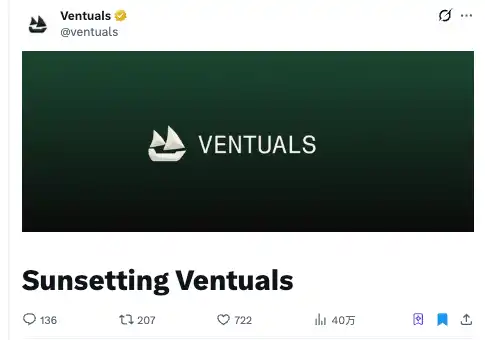
This one was called Ventuals, backed by Paradigm, and it also offered SpaceX pre-IPO contracts, plus ones for OpenAI and Anthropic. It launched earlier this year and lasted only nine months from start to finish.
The same chain, the same HIP-3 play, the same track. One made SpaceX the largest market on the platform, while the other held OpenAI and Anthropic in its hands, only to end up failing.

What's noteworthy is the way Ventuals exited. According to its official social media posts, it wasn't a case of running away after losing too much; the announcement stated it was acquired, with the team integrated into another project within the Hyperliquid ecosystem. User principal was returned 1:1, marking a respectable exit.

The paradox lies right here. Holding the two most coveted brands, OpenAI and Anthropic, it should have been the last one to fail. What went wrong?

Trade XYZ vs. Ventuals

The successful one, Trade.xyz, remains anonymous to this day.

The project founder only gave a glimpse of his background in an interview with Hyperliquid founder Jeff Yan, saying he bought his first Bitcoin for $66 in 2013, had been an investor since, never built a project before, and would have left the crypto space long ago if not for meeting Jeff.

It was this relative newcomer who built the largest pre-IPO market on Hyperliquid. According to Colossus, Trade.xyz has grown 38% weekly since last October, with cumulative trading volume exceeding $130 billion.

It started with silver, then crude oil, then the S&P 500, and finally SpaceX.
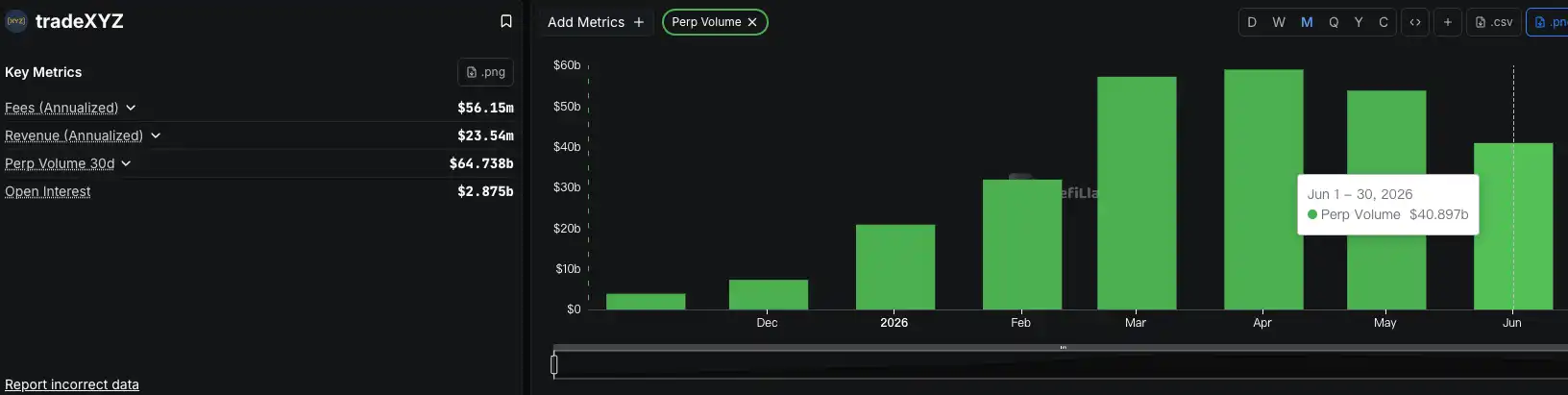
Its choice of SpaceX was shrewd.

SpaceX was set to ring the bell on Nasdaq on June 12th, with its IPO price and listing date already fixed. By listing pre-IPO contracts, Trade.xyz was essentially betting on an event with a certain outcome; the Nasdaq would provide a real price on listing day. This real price acted like an anchor, preventing the pre-IPO price from straying too far. Even if the quote deviated in between, it would snap back at the moment of listing.

This is exactly what happened. SPCX traded between $154 and $172 in the days before listing, betting on a premium above the $135 IPO price, and indeed surged on debut, proving the bet correct.

Ventuals chose a different type of asset.

Backed by Paradigm, one of crypto's top-tier VCs, its pedigree was far more respectable than the anonymous Trade.xyz. Its chosen assets were also bigger names: OpenAI and Anthropic, the two most coveted targets.

However, these two companies have no imminent listing date.

It's not that there's no external reference price. According to Bloomberg, Anthropic allowed employees to sell shares this year at a $350 billion valuation, and OpenAI does similar periodically. But such prices are set behind closed doors; often in secondary share transactions, buyers and sellers are existing major shareholders, and the asset hasn't genuinely changed hands in a public market.

This pricing might be precise at times, but it lacks a public order book where everyone can participate to correct errors.

By putting such prices on-chain as contracts, Ventuals essentially hung the entire market on a couple of off-chain price feeds. Even more problematic, it added a mechanism that pits the price against itself.

Some on-chain analysts have dissected Ventuals' pricing logic:

Its oracle price, half came from external secondary transactions and funding round valuations, and the other half came from a moving average of its own contract price. In other words, half the price was referencing itself. When buy orders pushed the price up, the moving average was pulled higher, the oracle followed suit, raising the price ceiling further, inviting more buying pressure.

The result was that contracts for OpenAI, Anthropic, etc., were perpetually pinned near their upper limits, with sell orders and liquidations difficult to execute. The chart looked like a steady uptrend, but in reality, it was structurally stuck, having little to do with real supply and demand.
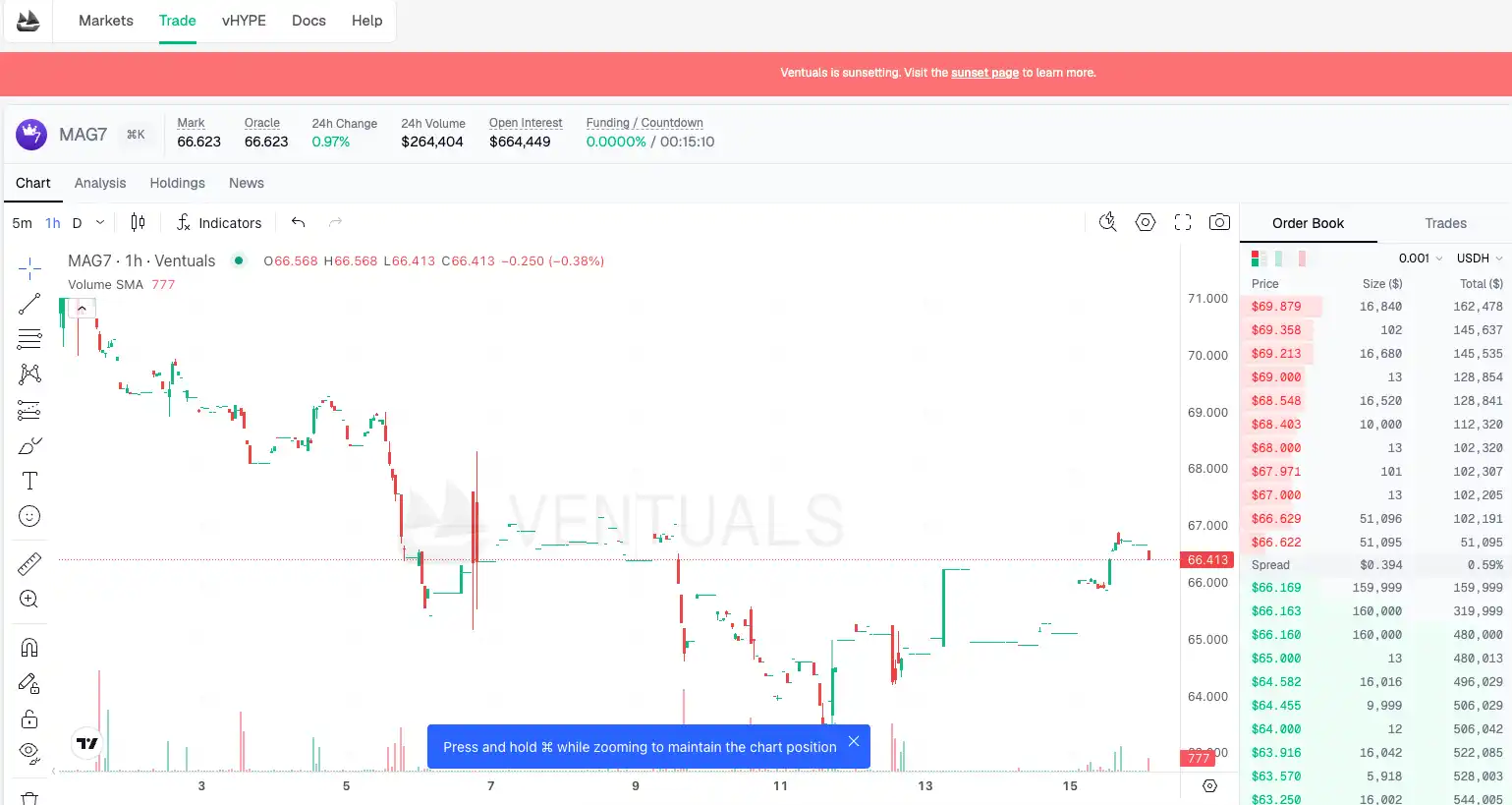
Source: Chart for MAG7 targets on Ventuals, showing intermittent candlesticks with no trades in some periods

So this kind of Pre-IPO trading wasn't so much the market telling you OpenAI's value, but rather a machine pushing the price up and then climbing higher based on the price it had already elevated.

Trade.xyz bet on an asset that would inevitably be settled by Nasdaq, with the real price as a backstop; Ventuals bet on assets existing only in internal valuations, then layered a self-referential price feed on top, leaving the price suspended in mid-air with no floor.

Shutdown Reference Prices: OpenAI $1300, Anthropic $1600

When it came time to shut down, did the last quoted price count?

To settle all positions upon closure, Ventuals needed a final price for its contracts. Its method was to freeze the 24-hour average price. OpenAI was ultimately set at $1,341.80 per share, Anthropic at $1,618.90.

These two numbers are now etched into the settlement records, becoming the final on-chain quotes for these companies.

As mentioned earlier, this price was half external reference, half moving average of its own price, perpetually climbing along the ceiling. In other words, a significant portion of $1,341.80 resulted from the machine lifting the price further based on the price it had already inflated.

It's precise down to two decimal places, but it may not be true.

The ultimate irony is that some people outside actually took this price seriously.

According to Bloomberg, employees of SpaceX, OpenAI, Anthropic, and some late-stage venture capitalists approached Ventuals, saying they used the platform to value their own equity holdings.

This needs to be examined carefully.

These individuals hold real, valuable equity; in theory, they should know best what their stock is worth. But private market valuations are only updated once a year like squeezing toothpaste; between funding rounds is a void, with no indication of price movement.

Meanwhile, a place like Ventuals, however unreliable, at least quotes a number 24/7 and shows price movements.

Thus, a paradoxical situation emerged. Those who should have the most pricing power were instead looking to a number from a retail-facing trading table for some psychological comfort.

This is the most twisted aspect of the pre-IPO pricing business.

The most coveted assets lack a fair price the most; the greater this lack, the more people are willing to grasp at anything that resembles a price, even if it's a machine-generated, self-referential figure.

Ventuals is gone, and those final prices are frozen. But the demand for such reference points likely hasn't diminished one bit.

The Pre-IPO Pricing Business: Players Flocking In

Demand hasn't waned, yet supply is increasing, and becoming more formalized.

In the same week Ventuals shut down, Coinbase launched its own pre-IPO perpetual contracts, with SpaceX as the first target, available to users outside the US.

Not just Coinbase. Polymarket uses Nasdaq data to open prediction markets for private company valuations; Citi introduced tokenized private company stock for wealth and institutional clients. The crypto side is doing it, and traditional investment banks are too.

This is no longer just small-scale experiments by a few anonymous teams on Hyperliquid. Providing a continuously tradeable price for pre-public companies is becoming a legitimate business everyone wants a piece of.

For readers in China, this demand isn't unfamiliar. IPO subscriptions involve long queues, private market shares are only allocated among institutions and high-net-worth individuals, leaving ordinary people shut out. Now, someone is posting prices for companies like OpenAI and SpaceX, allowing 24/7 trading; for many, it's the first time they can touch such assets. The demand is real.

But Ventuals' shutdown over these past six months also laid bare the Achilles' heel of this business.

A price isn't enough just because people are willing to trade it; it requires a public, open market where anyone can participate and oppose to continuously correct errors. If Coinbase takes over, this fundamental issue doesn't magically disappear. It just swaps the credibility of an anonymous team for the credibility of a bigger brand. The underlying company still isn't public, and that fair, consensus price still doesn't exist.

Will the next entity tasked with pricing it be more accurate than Ventuals? The answer might only be revealed when OpenAI actually stands before the bell on its listing day.


Perguntas relacionadas

QWhat is the main topic discussed in the article regarding the Hyperliquid pre-market?

AThe article discusses the business of pre-market pricing for private companies like SpaceX and OpenAI on the Hyperliquid platform. It contrasts the success of an anonymous team, Trade.xyz, with the failure of the well-funded Ventuals, which handled OpenAI and Anthropic contracts, highlighting the challenges of pricing companies without a near-term IPO date and the reliance on self-referential or illiquid external price feeds.

QWhy did Ventuals fail despite having high-profile assets like OpenAI and Anthropic?

AVentuals failed primarily because its pricing mechanism was flawed. For assets like OpenAI and Anthropic, which have no imminent IPO date, it relied on a hybrid oracle: half from external private share transactions and half from its own contract's price moving average. This created a self-reinforcing loop where buy pressure would raise the average, which then raised the oracle price, pushing the price ceiling higher artificially. This led to illiquid markets with prices detached from real supply and demand, unlike Trade.xyz's successful SpaceX contracts which were anchored to a definitive public Nasdaq listing price.

QWhat were the final settlement prices for OpenAI and Anthropic on Ventuals, and what is the article's critique of these prices?

AThe final settlement prices on Ventuals were $1,341.80 per share for OpenAI and $1,618.90 per share for Anthropic, based on a 24-hour average before shutdown. The article criticizes these prices as potentially unreliable because they were significantly influenced by Ventuals' own self-referential pricing mechanism, where the contract's price moving average fed back into the oracle. Thus, while precise, these numbers may not reflect a true market consensus or fair value.

QAccording to the article, what ironic behavior did some SpaceX, OpenAI, and Anthropic insiders exhibit regarding Ventuals?

AIronically, some employees and late-stage venture capitalists of SpaceX, OpenAI, and Anthropic reportedly used Ventuals' platform to gauge the value of their own private holdings. This is ironic because these insiders, who possess the actual private shares and should have the most informed view of their value, turned to a potentially flawed and illiquid public derivatives market for price discovery, seeking psychological comfort due to the lack of frequent, transparent pricing in the private primary market.

QHow is the broader landscape for pre-market pricing of private companies evolving beyond platforms like Hyperliquid?

AThe landscape is expanding and becoming more institutional. Major players like Coinbase have launched pre-market perpetual contracts (starting with SpaceX for non-US users). Polymarket uses Nasdaq data for prediction markets on private company valuations, and traditional institutions like Citi are offering tokenized private company shares to wealth and institutional clients. This indicates that providing tradable prices for pre-IPO companies is becoming a serious, mainstream business opportunity, moving beyond niche crypto platforms to attract established financial entities.

Leituras Relacionadas

Dalio's Latest Warning: Don't Get Carried Away by AI, Real Returns on US Stocks in the Next 5-10 Years Could Be -5% to -10%

Ray Dalio, founder of Bridgewater Associates, warns investors against excessive concentration in AI stocks. He argues the current market, dominated by a few AI giants, mirrors historical patterns where revolutionary new technologies lead to high risk, volatility, and uncertainty. While acknowledging AI's transformative potential, Dalio emphasizes that most investors fail at this stage of the cycle by over-concentrating in a handful of leading companies. He cites inherent risks: companies cannot accurately forecast investment needs or external shocks (e.g., monetary policy, geopolitics, taxes), face potential disruption from future technologies and international competition (notably from China), and experience significant price swings. Dalio's core advice is diversification, calling it his "Holy Grail of Investing." He presents a mathematical case that a well-diversified portfolio of 15-20 uncorrelated, good bets offers a superior risk-adjusted return compared to a concentrated position. Dalio also offers a cautious outlook, suggesting U.S. stocks may deliver real returns of -5% to -10% over the next 5-10 years based on valuation and bubble indicators. He concludes that in the face of high uncertainty, the prudent strategy is not to avoid betting entirely, but to avoid large, concentrated bets where one lacks sufficient informational edge. Instead, investors should build a strategically balanced, diversified portfolio.

marsbitHá 22m

Dalio's Latest Warning: Don't Get Carried Away by AI, Real Returns on US Stocks in the Next 5-10 Years Could Be -5% to -10%

marsbitHá 22m

Rain Valuation Approaches $20 Billion: The Battle for U-Cards Extends to Rewards Systems

Rain, a stablecoin payments infrastructure company, is shifting the competitive focus for U Cards from simple issuance to user retention and repeated usage. On June 15, Rain launched "Rain Rewards," an embedded loyalty program capability within its card-issuing infrastructure. This allows partner businesses—like fintech platforms and neobanks—to configure branded loyalty points, earning rules, redemptions, and merchant promotions directly within their card products. The system, built from the 2025 acquisition of Uptop, ensures points are only issued upon final transaction settlement, preventing liabilities from refunds. Trials, such as with Avalanche Card, reportedly boosted spending by 25% among enrolled users. Founded by Farooq Malik and Charles Yoo-Naut, Rain evolved from a tool for managing Web3 company expenses into a full-stack enterprise platform. It is a Principal Member of Visa and Mastercard, enabling partners to issue stablecoin-backed cards and wallets while leveraging traditional payment networks. Notably, the popular U Card Plasma One is issued by Rain under Visa's authority. Rain also integrates with Visa's stablecoin settlement pilot, using USDC for network settlement. Rain's rapid funding reflects growing institutional interest in stablecoin payment infrastructure. It raised a $245 million Series A in March 2025, a $58 million Series B in August 2025, and a $250 million Series C in January of this year, reaching a $19.5 billion valuation. Annualized transaction volume exceeds $3 billion, serving over 200 partners including Western Union and Nuvei. Beyond cards, Rain is expanding into programmable payments. Its June 2026 "Agent Control Layer" allows businesses to set spending rules—like merchant categories, amounts, and frequency—for AI agents before transactions occur. This positions Rain not as a single product but as an operating system for stablecoin payments, handling everything from card issuance and wallet management to rewards, on/off-ramps, and automated compliance. The goal is to enable seamless, often invisible, real-world spending of on-chain assets.

Foresight NewsHá 26m

Rain Valuation Approaches $20 Billion: The Battle for U-Cards Extends to Rewards Systems

Foresight NewsHá 26m

Google TPU Shipments Revised Up by 50%

Recent industry research indicates a significant upward revision in the shipments of Google's TPU (Tensor Processing Unit) chips. Previous expectations for 2027 were set at around 10 million units, but new estimates now point to 15 million units, a 50% increase. This substantial boost directly translates to higher demand across the entire supporting supply chain. Google's TPU clusters utilize a standardized all-optical interconnect architecture. Consequently, key hardware components are deeply integrated and scaled in fixed ratios with the chips. The 15 million TPU target will drive corresponding demand increases for NPO optical engines (roughly a 1:1 match), 1.6T optical modules, OCS optical switches, high-end server power supplies, fiber optics & MPO connectors, and liquid cooling solutions. Among these, liquid cooling is highlighted as the sector experiencing the most significant transformation and offering the most stable potential for excess returns. As next-generation TPU chips reach power levels where traditional air cooling is insufficient, liquid cooling becomes essential. 2026 is forecasted as the first year of substantial adoption for Google's liquid cooling solutions. This shift, coupled with delivery and capacity bottlenecks faced by incumbent overseas manufacturers, is creating a prime window for domestic Chinese suppliers to enter and secure Google's core supply chain. The market size for Google-specific liquid cooling is projected to potentially triple from a baseline of hundreds of billions to around 300 billion units by 2028. The logic for the fiber optic sector is also being rewritten. Once considered a cyclical commodity tied to telecom operator procurement, fiber is now a strategic and scarce resource for AI Data Centers (AIDC). A severe supply-demand imbalance, driven by the long lead time for preform production (18-24 months) and surging demand from cloud giants, is supporting strong performance. Chinese fiber manufacturers are well-positioned to capture a significant share of global AIDC demand, with exports potentially reaching 200-300 million core kilometers in 2026. Overall, the investment focus within the AI computing industry is shifting from pure "chip performance speculation" towards the more certain incremental growth in computing infrastructure and its supporting ecosystem. The upward revision in Google TPU shipments, along with the potential for further doubling by 2028, is seen as solidifying performance visibility for the entire supporting supply chain over the next two years.

marsbitHá 2h

Google TPU Shipments Revised Up by 50%

marsbitHá 2h

What Wall Street Really Wants After the Crypto Story Recedes

The tide of speculative crypto narratives has receded, revealing Wall Street's true objective: building a controlled, yield-generating, and compliant financial pipeline on distributed ledgers. They are migrating core functions onto blockchains, not for decentralization, but for efficiency and new revenue streams. Key developments include BlackRock's BUIDL fund, a tokenized treasury fund acting as a foundational reserve asset, and the rise of Securitize, which is going public and partnering with the NYSE to build a 24/7 digital securities trading and settlement system. This signals a major shift of securities clearing to blockchain technology. To make volatile assets like Bitcoin palatable for institutional investors, firms like BlackRock and Goldman Sachs are creating "covered call" ETFs (e.g., BITA). These products systematically sell options on Bitcoin holdings, transforming price volatility into stable monthly income, effectively repackaging crypto as a yield-bearing asset. Stablecoins are being positioned not as speculative tools but as efficient payment rails. Companies like Stripe and Mastercard are integrating them for instant, low-cost merchant settlements and cross-border card payments, respectively. Critically, new legislation like the GENIUS Act shapes them as non-interest-bearing, heavily regulated extensions of the US dollar system. In summary, Wall Street is quietly constructing a parallel, blockchain-based financial infrastructure featuring tokenized traditional assets, structured crypto yields, and programmable dollar pipelines—all under its control and fully integrated with existing regulatory and credit frameworks.

marsbitHá 2h

What Wall Street Really Wants After the Crypto Story Recedes

marsbitHá 2h

Trading

Spot
Futuros
活动图片




