$414mln exits crypto funds – Why sentiment is suddenly shifting

ambcryptoPublicado em 2026-03-31Última atualização em 2026-03-31

Resumo

In the last week of March, cryptocurrency investment products experienced significant outflows totaling $414 million, marking the first net withdrawals in five weeks. This shift was driven by escalating global tensions, high inflation, and anticipation around Federal Reserve meetings, reducing total assets under management to $129 billion. Ethereum was hit hardest with $222 million in outflows, while Bitcoin saw $194 million withdrawn despite strong year-to-date inflows. Solana also recorded outflows, whereas XRP was the sole asset with inflows of $15.8 million. On-chain metrics showed reduced network engagement for major cryptocurrencies. The U.S. led outflows with $454 million, while Canada and Germany saw modest inflows. Despite a recent market cap rebound to $2.34 trillion, short-term volatility remains high due to macroeconomic uncertainty, cautioning investors against relying on temporary rallies for long-term predictions.

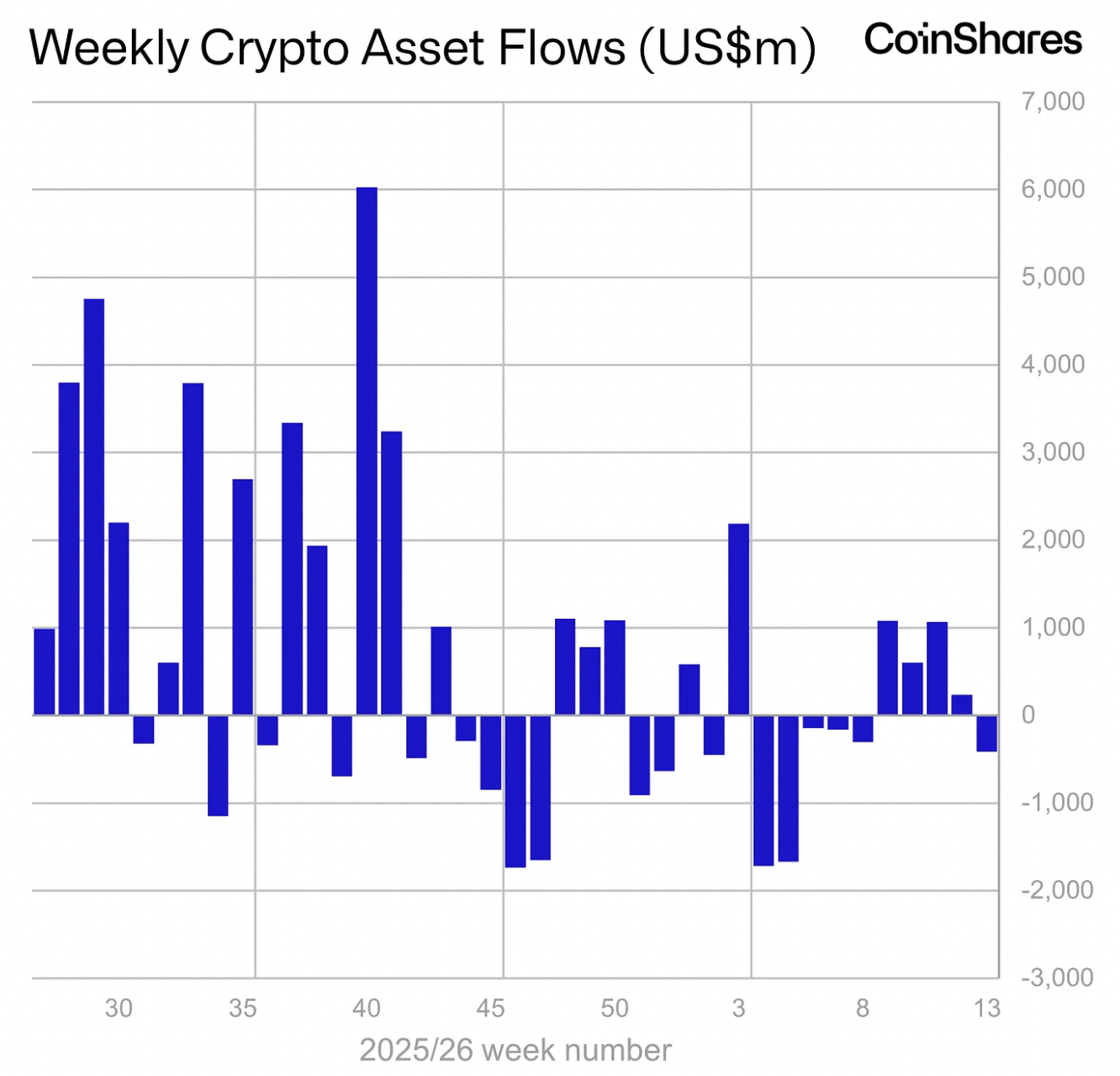
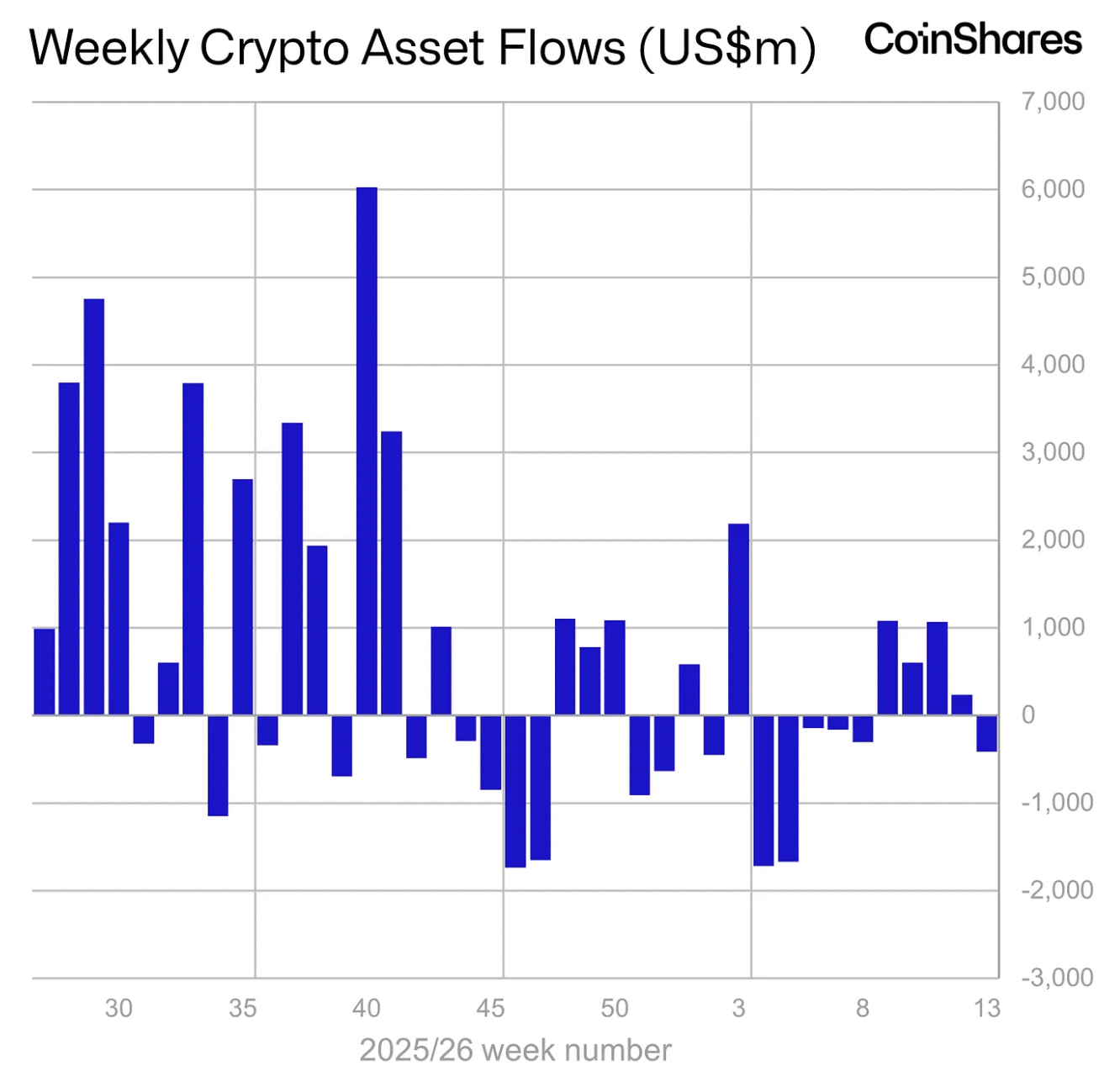
The last week of March (from the 23rd to the 24th) was not good for the cryptocurrency investment product. As per a weekly report from CoinShares, digital assets funds recorded their first outflows in five weeks, worth $414 million.

This has more to do with just investors’ sentiments and price actions.

Escalating global tensions involving the U.S and Iran, accompanied by high inflation and the growing expectations around the upcoming Federal Reserve meetings, are the major reasons behind this shift.

Because of these developments from politics to economics, the total Assets under Management (AuM) have declined to $129 billion. If looked carefully, such levels have already been hit during early February and back in April 2025, when volatility was high due to changing tariff policies.
Source: CoinShares

Winners and losers of the last week

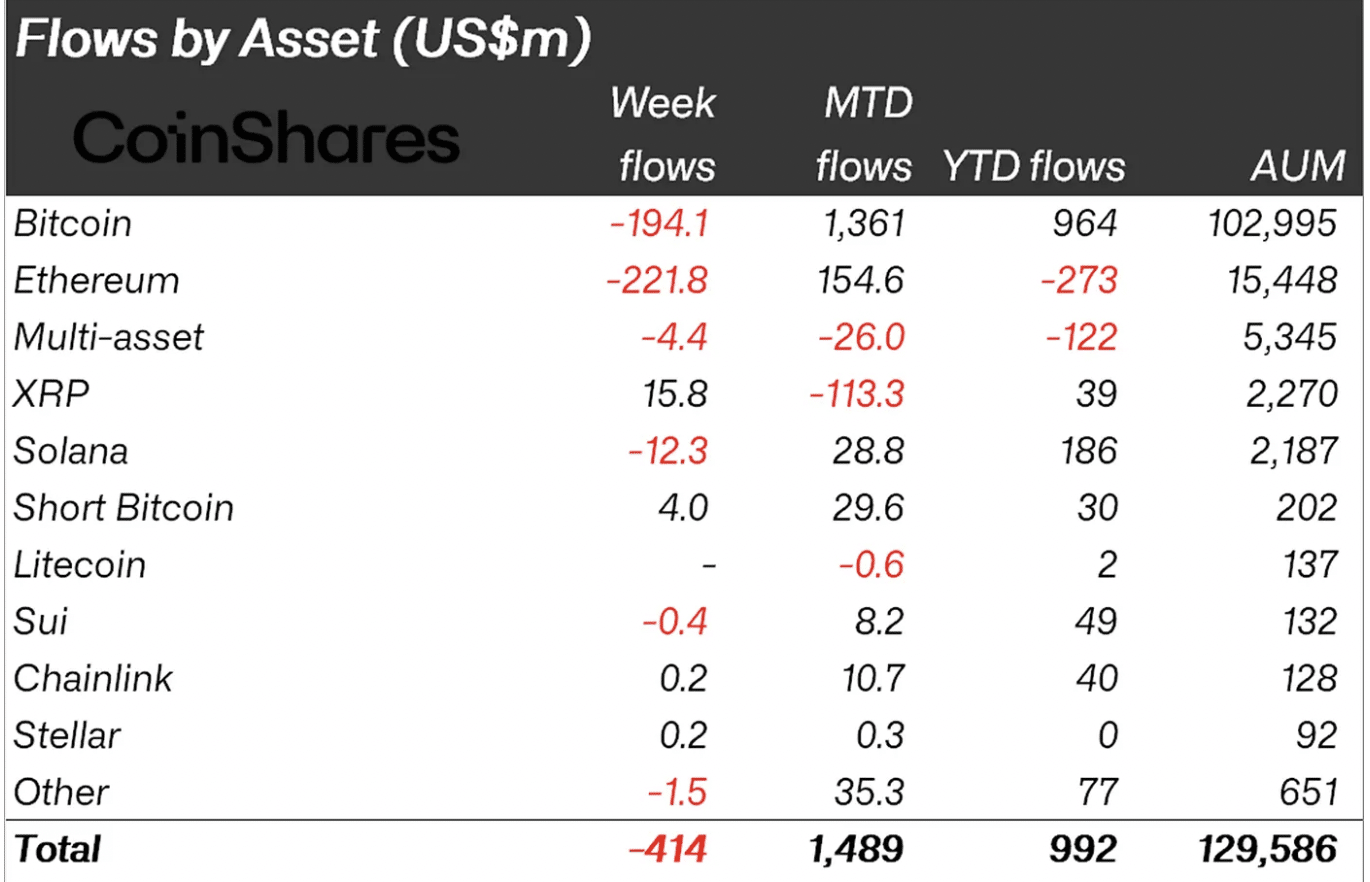
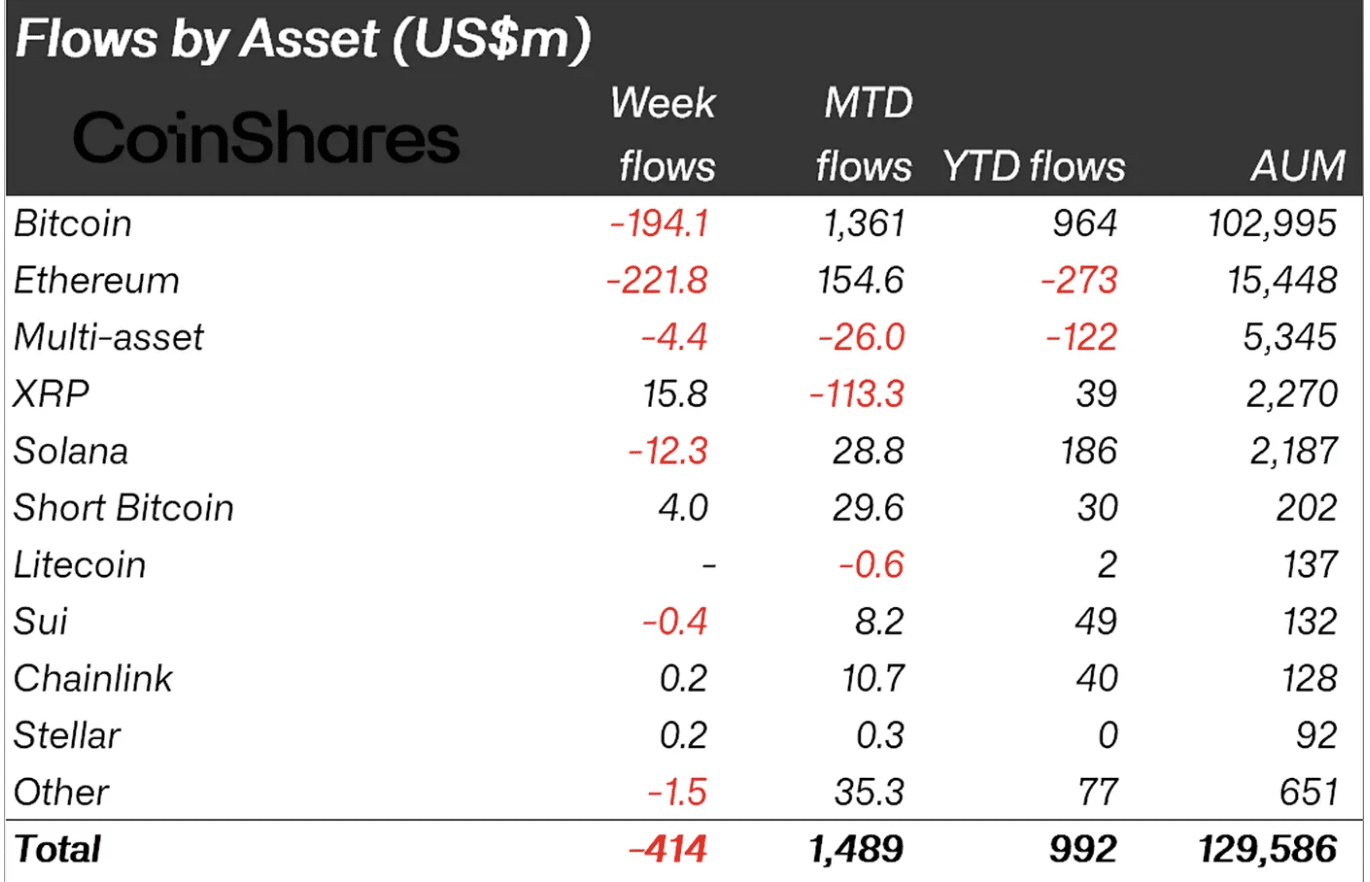
That said, in this outflow, Ethereum [ETH] was hit the hardest, recording $222 million worth of outflows. This further caused its year-to-date outflow to fall to $273 million.

Well, this drop might be due to the ongoing uncertainty around the CLARITY Act. Meanwhile, ETH’s price was also choppy as it faced a downturn of 2.48% in the past week.

Interestingly, Bitcoin [BTC] was standing strong, but the room for caution still remained. The leading cryptocurrency recorded outflows worth $194 million in the last week.

However, if you looked at its year-to-date data, its net inflow stood strong at $964 million. This came as Bitcoin’s price witnessed a weekly drop of 3.48%.
Source: CoinShares

Needless to say, Solana [SOL] was no exception as it too recorded $12.3 million in outflows as its price swung down by 5.97% in the past week.

Interestingly, Ripple’s XRP was the only one to record inflows worth $15.8 million. However, its price mirrored the broader market downturn, dropping by 4.68% in the past week.

Thus, XRP was the winner of the digital asset funds in the past week, whereas ETH was the loser.

Are on-chain metrics in favour?

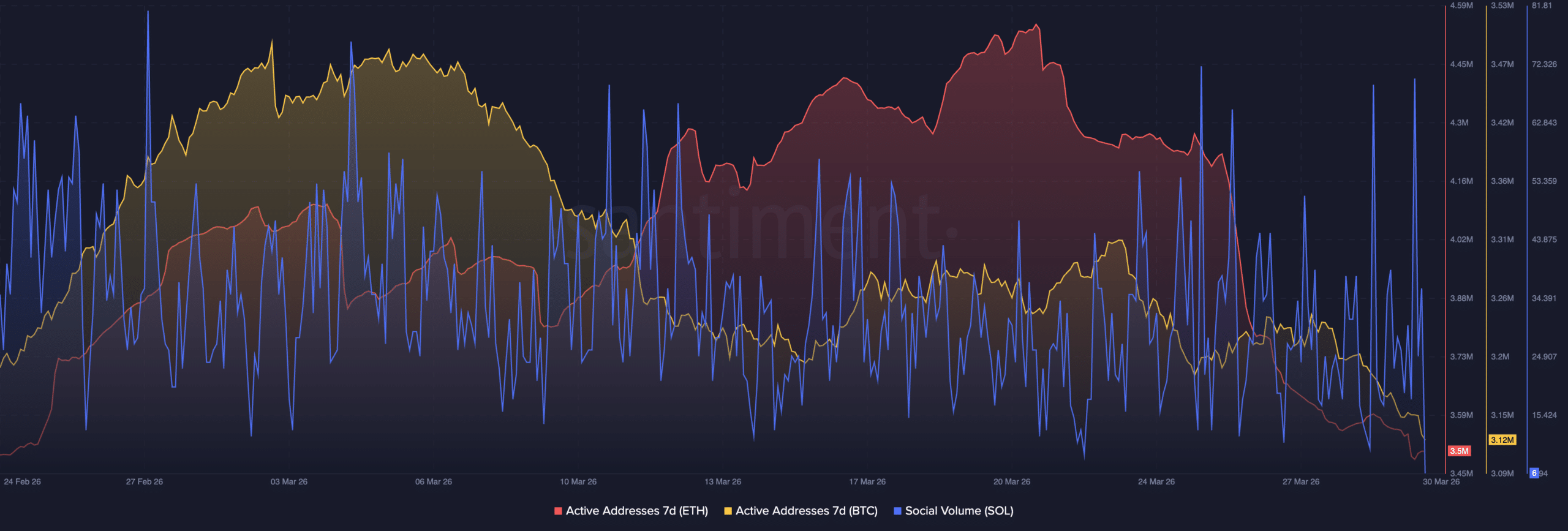
This sentiment was further confirmed by the active address metric by Santiment, wherein Bitcoin and Ethereum had both seen a drop in the aforementioned metric by the end of March.
Source: Santiment

This suggests that only a few people were invested in the network as compared to the high activity seen in early March.

Meanwhile, Solana’s Social Volume has also dropped, meaning fewer people are talking about the altcoin.

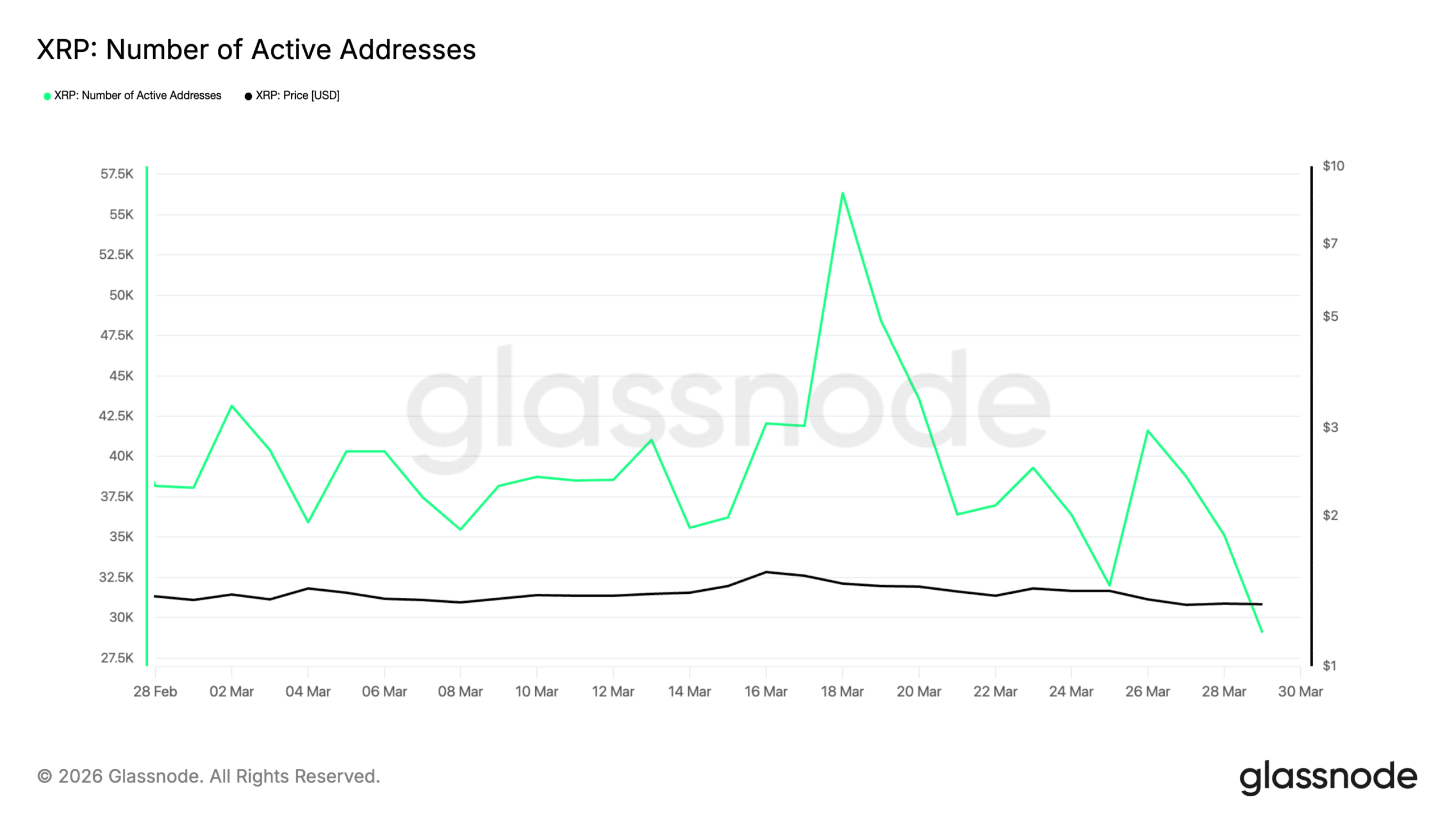
Lastly, though XRP was the winner, its network activity suggests that caution remains due to a sharp drop in active addresses in late March.
Source: Glassnode

The U.S faces the most choppy week

Now, while the U.S saw maximum outflows worth $454 million, Switzerland saw $4 million in outflows. Whereas Canada and Germany saw inflows worth $15.9 million and $21.2 million, respectively

However, as we move towards the end of March and with the 30th of March being the first day of a fresh week, the market is picking up again. The total crypto market cap is back in bullish hands, trading at $2.34 trillion at press time.

Yet despite this surge, investors should not be fooled by short-term booms, as even last week $635 millon had flowed in just before the Fed meeting and created optimism in the market.

However, as soon as the meeting drew to a conclusion, $405 million flowed out of the market, leaving investors in shock. Therefore, until situations calm down globally, short-term prices are not a clear sign for long-term market predictions.


Final Summary

  • The shift from inflows to outflows suggests that there is a lot of FUD in the market, and investors are positioning their bets cautiously.
  • Bitcoin is holding strong, but XRP stealing the spotlight highlights that investors are no longer just betting on Bitcoin.


Perguntas relacionadas

QWhat was the total value of outflows from cryptocurrency investment funds in the last week of March, and what was the primary reason for this shift?

AThe total value of outflows was $414 million. The primary reasons were escalating global tensions involving the U.S. and Iran, high inflation, and growing expectations around the upcoming Federal Reserve meetings.

QWhich cryptocurrency was hit the hardest with outflows, and what was the specific amount?

AEthereum (ETH) was hit the hardest, recording $222 million worth of outflows.

QDespite the overall outflows, which digital asset was the only one to record inflows, and how much was it?

ARipple's XRP was the only digital asset to record inflows, worth $15.8 million.

QAccording to on-chain metrics from Santiment, what trend was observed for Bitcoin and Ethereum by the end of March?

ABoth Bitcoin and Ethereum saw a drop in their active address metrics by the end of March, suggesting reduced network activity.

QWhich country faced the maximum outflows, and what was the amount? Which countries saw inflows?

AThe U.S. faced the maximum outflows, worth $454 million. Canada and Germany saw inflows of $15.9 million and $21.2 million, respectively.

Leituras Relacionadas

Will the Fed Still Cut Interest Rates? Tonight's Data Is Crucial

The core debate surrounding the Federal Reserve's potential interest rate cuts is intensifying amid geopolitical conflict and rebounding inflation. The key question is whether high energy prices will cause persistent inflation or weaken consumer demand enough to force the Fed to cut rates. Citigroup presents a bullish case for cuts, arguing that oil supply disruptions from the Strait of Hormuz are temporary and will not lead to lasting inflationary pressure. They point to receding bond yields and oil prices as evidence the market is pricing in a short-lived shock. Citi's data also shows tightening financial conditions, a stabilizing labor market, and healthy tax returns, supporting their view that the path to lower rates remains open. Conversely, Deutsche Bank offers a starkly contrasting, more hawkish outlook. They argue the Fed's current policy is already neutral and expect rates to remain unchanged indefinitely. Their view is based on stalled disinflation progress and a shift toward more hawkish rhetoric from key Fed officials like Waller, who cited risks from prolonged Middle East conflict and tariffs. Other officials, including Williams and Hammack, signaled rates would likely stay on hold for a "considerable time." The market pricing has shifted dramatically, now forecasting zero cuts in 2026. The imminent release of the March retail sales "control group" data is highlighted as a critical test. This metric, which excludes gas station sales, will reveal if high gasoline prices are eroding consumer spending in other areas. A weak reading could support the case for imminent rate cuts, while a strong one would bolster the argument for the Fed to hold steady. This data is pivotal for determining the near-term policy path.

marsbitHá 11m

Will the Fed Still Cut Interest Rates? Tonight's Data Is Crucial

marsbitHá 11m

The Second Half of Macro Influencer Fu Peng's Career

Fu Peng, a prominent Chinese macroeconomist and former chief economist of Northeast Securities, has joined Hong Kong-based digital asset management firm Bitfire Group (formerly New Huo Group) as its chief economist. This move, announced in April 2026, triggered an 11% surge in Bitfire's stock price. Fu, known for his accessible macroeconomic commentary and large social media following, will focus on integrating digital assets into global asset allocation frameworks, particularly combining FICC (fixed income, currencies, and commodities) with cryptocurrencies for institutional clients. His career includes roles at Lehman Brothers and Solomon International, with significant influence gained through public communication. However, in late 2024, Fu faced temporary social media bans after a controversial private speech at HSBC on China's economic challenges, though he denied regulatory sanctions. He later left Northeast Securities citing health reasons. Bitfire, a licensed virtual asset manager serving high-net-worth clients, seeks to build trust and attract traditional capital through Fu’s expertise and credibility. The partnership represents a strategic shift for both: Fu enters the crypto sector after a traditional finance peak, while Bitfire aims to leverage his macro framework for institutional adoption. Outcomes remain uncertain regarding capital inflows and compatibility within corporate structure.

marsbitHá 1h

The Second Half of Macro Influencer Fu Peng's Career

marsbitHá 1h

Trading

Spot
Futuros
活动图片