Chainlink Catat 480 Juta Interaksi Sosial: Apa Artinya bagi Harga LINK Selanjutnya

ambcryptoPublicado em 2026-04-06Última atualização em 2026-04-06

Resumo

Chainlink (LINK) mengalami lonjakan popularitas dengan 480 juta interaksi sosial dalam setahun terakhir, didorong oleh tiga faktor utama: peluncuran ETF Chainlink oleh Grayscale (GLINK) dan Bitwise (CLINK) yang berhasil menarik dana signifikan, kolaborasi dengan Mastercard untuk menghubungkan 3,5 miliar kartu ke ekosistem DeFi, serta integrasi dengan Coinbase untuk mengirim data perdagangan on-chain. Meskipun sentimen positif meningkat 82%, metrik on-chain seperti penurunan Alamat Aktif dan Open Interest menunjukkan aktivitas yang melambat, menimbulkan kekhawatiran atas kelangsungan hype ini. Harga LINK naik 5,24% menjadi $8,97, mencerminkan optimisme pasar namun diiringi sinyal kehati-hatian dari data rantai.

Pada saat berita ini ditulis, kapitalisasi pasar kripto global berada di angka $2,37 triliun, naik 3,04%. Di antara altcoin, Chainlink [LINK] mendapatkan daya tarik yang signifikan, diperdagangkan pada $8,97 setelah kenaikan 5,24% dalam 24 jam terakhir.

Sementara itu, platform intelijen sosial LunarCrush melaporkan "akselerasi 480 juta interaksi sosial dalam setahun terakhir," bersamaan dengan kenaikan 82% dalam sentimen positif terhadap altcoin.
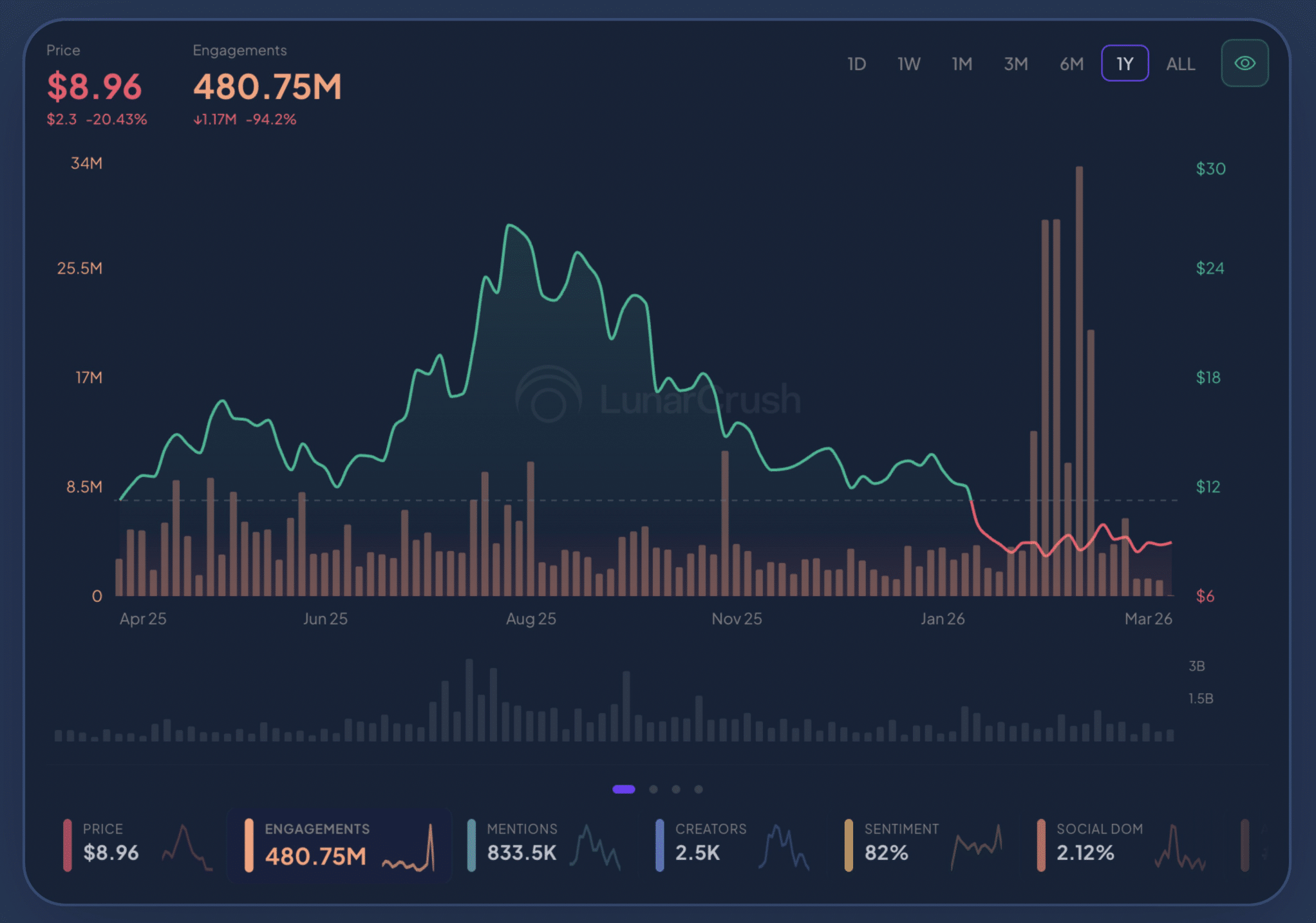
Sumber: Lunar Crush

Apa yang menyebabkan lonjakan hype di sekitar Chainlink ini?

Lonjakan interaksi sosial ini disebabkan oleh tiga alasan utama. Dimulai dengan pencatatan ETF Chainlink pertama Grayscale ($GLINK) di NYSE Arca, di mana ETF tersebut menarik $41 juta hanya dalam satu hari. Bahkan, menurut data perdagangan terbaru pada tanggal 4 April, GLINK mencatat aliran bersih kumulatif sebesar $82,79 juta.

Sementara itu, ETF Chainlink Bitwise ($CLINK) mencatat $11,82 juta pada hari yang sama dalam aliran bersih kumulatif.
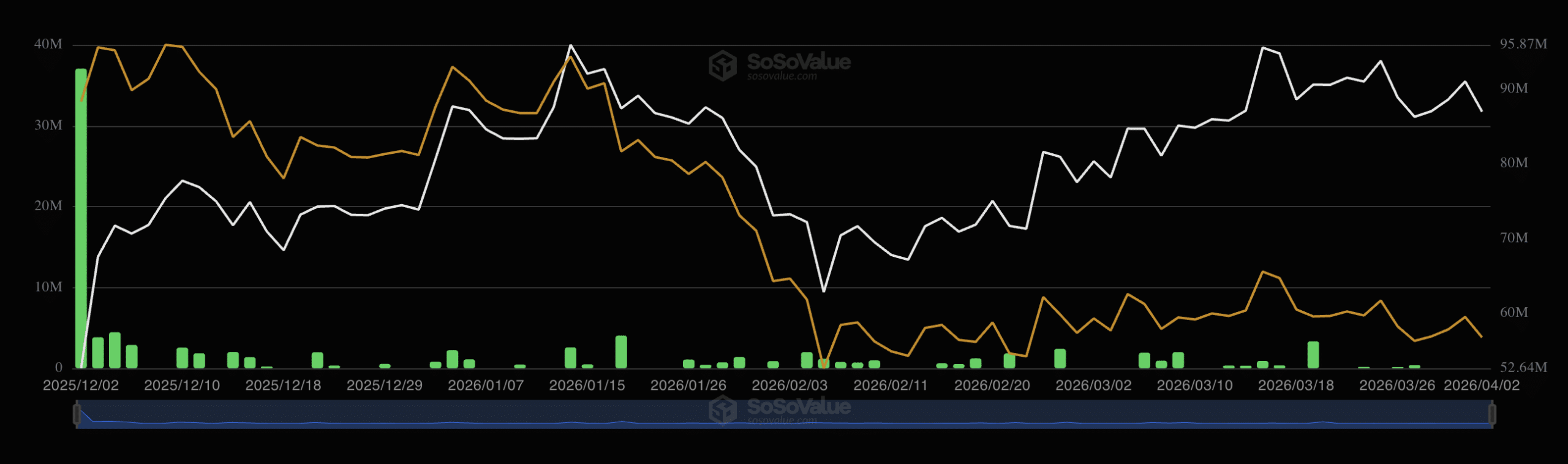
Sumber: SoSoValue

Kedua, Mastercard memilih Chainlink untuk menghubungkan 3,5 miliar kartunya (pembayaran off-chain) langsung ke dunia DeFi on-chain. Dengan langkah ini, pemegang Mastercard dapat mengakses aset kripto langsung on-chain dengan bantuan Swapper Finance, memanfaatkan protokol Uniswap.

Mengomentari hal yang sama pada tahun 2025, Raj Dhamodharan, wakil presiden eksekutif, Blockchain & Aset Digital di Mastercard, mengatakan,

Tidak diragukan lagi – orang ingin dapat dengan mudah terhubung ke ekosistem aset digital, dan sebaliknya.

Chainlink bertindak sebagai jembatan

Terakhir, Coinbase mengirimkan data perdagangan, yang mencakup "data order book dan perps (perpetual) on-chain" langsung ke blockchain menggunakan Chainlink. Ini menunjukkan bagaimana Chainlink bertindak sebagai jembatan antara kelas aset tradisional dan digital.

Melihat hype di sekitar LINK ini, LunarCruh menyimpulkannya dengan sangat baik ketika mencatat,

Itu adalah akses Wall Street, akses konsumen mainstream, dan data tingkat bursa, semua mendarat dalam siklus yang sama.

Metrik on-chain semakin membingungkan investor

Namun, metrik on-chain menunjukkan bahwa hype ini mungkin bersifat sementara. Grafik di bawah ini oleh Santiment dengan jelas menunjukkan penurunan dalam Alamat Aktif dan Open Interest.
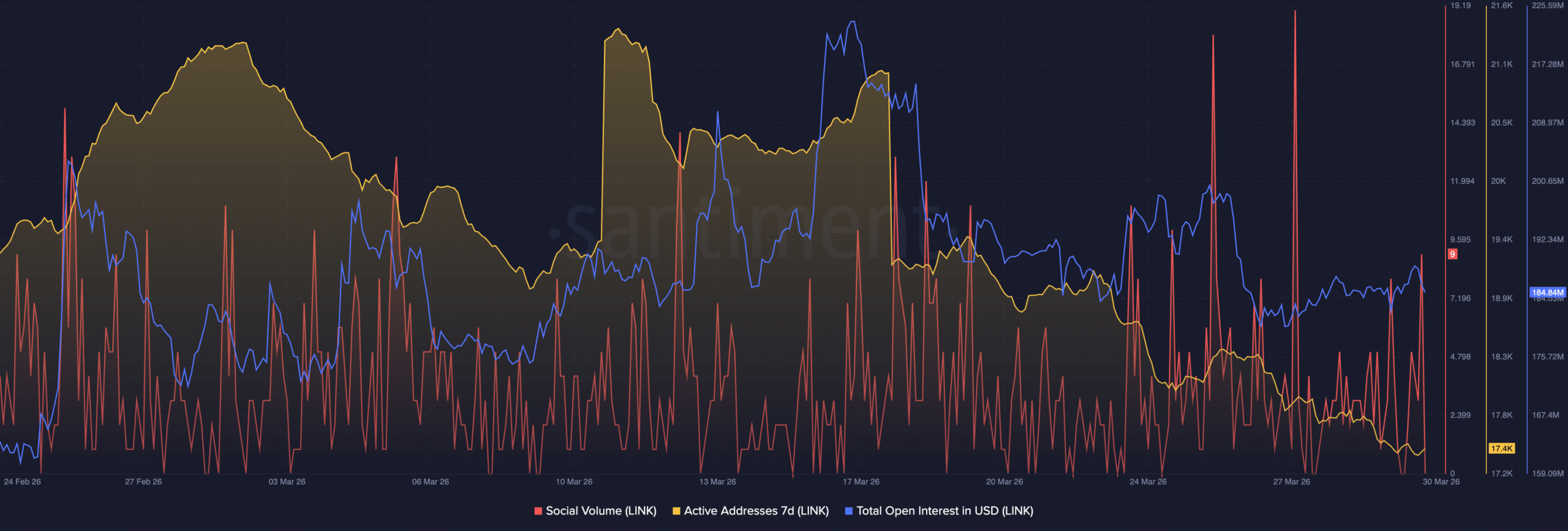
Sumber: Santiment

Bersama-sama, penurunan ini menunjukkan berkurangnya aktivitas on-chain dan posisioning jangka pendek. Patut dicatat, ini bertepatan dengan LINK menghadapi inflow terbesar tahun ini, di mana sekitar 14,9 juta LINK ditransfer antar dompet.


Ringkasan akhir

  • Interaksi sosial Chainlink memecahkan rekor berkat ETF, Mastercard, dan Coinbase.
  • Metrik on-chain justru memunculkan kekhawatiran negatif, bukan sentimen positif.

Perguntas relacionadas

QApa yang menyebabkan lonjakan keterlibatan sosial Chainlink (LINK) mencapai 480 juta?

ALonjakan ini disebabkan oleh tiga faktor utama: peluncuran ETF Chainlink oleh Grayscale (GLINK) yang menarik $41 juta dalam satu hari, kemitraan Mastercard yang menghubungkan 3,5 miliar kartu ke dunia DeFi on-chain, dan integrasi data perdagangan Coinbase ke blockchain menggunakan Chainlink.

QBagaimana performa harga LINK berdasarkan artikel ini?

APada saat penulisan artikel, LINK diperdagangkan pada harga $8,97 setelah mengalami kenaikan sebesar 5,24% dalam 24 jam terakhir, bersamaan dengan kenaikan kapitalisasi pasar kripto global sebesar 3,04%.

QApa yang ditunjukkan oleh metrik on-chain Santiment tentang aktivitas LINK?

AMetrik on-chain dari Santiment menunjukkan penurunan dalam Alamat Aktif dan Open Interest, yang mengindikasikan berkurangnya aktivitas on-chain dan posisi jangka pendek, meskipun ada arus masuk terbesar LINK tahun ini.

QApa peran Chainlink dalam kemitraan dengan Mastercard?

AChainlink bertindak sebagai jembatan yang menghubungkan 3,5 miliar kartu Mastercard (pembayaran off-chain) langsung ke dunia DeFi on-chain, memungkinkan pemegang kartu mengakses aset kripto melalui Swapper Finance dengan protokol Uniswap.

QApa kesimpulan utama dari artikel mengenai prospek LINK?

AArtikel menyimpulkan bahwa meskipun keterlibatan sosial dan adopsi institusional (ETF, Mastercard, Coinbase) sangat positif, metrik on-chain menimbulkan kekhawatiran negatif tentang aktivitas jangka pendek, menciptakan kebingungan di kalangan investor.

Leituras Relacionadas

Has the 'Digital Gold' Narrative for BTC Failed?

**Title: Has the "Digital Gold" Narrative for Bitcoin Failed?** The article argues that Bitcoin's "digital gold" narrative remains valid despite a recent sharp price decline (from a peak near $126k in Oct 2025 to briefly under $61k in Feb 2026). It presents a long-term investment framework based on three core points: **1. Viewing Bitcoin as an Asset:** Bitcoin is presented as a superior potential store of value compared to gold. Key arguments are its absolute scarcity (21 million cap), superior portability, and transparent auditability via its public ledger. While acknowledging its current use in early, volatile stages (~3-4% global adoption), the author draws parallels to the early, disruptive phases of the internet and e-commerce. **2. Understanding the Recent Downturn:** The current ~50% correction is framed as a predictable, consensus-driven cycle following its post-halving peak (the 2024 halving preceded the Oct 2025 high). A crucial factor is a historic "changing of hands": the influx of new institutional buyers via ETFs allowed early, low-cost holders (miners, OG believers) to take profits. The author notes that while severe, Bitcoin's historical drawdowns (e.g., 93% in 2011, 77% in 2021-22) have been progressively smaller, suggesting maturing holder structure and decreasing volatility over time. **3. The Long-Term Perspective:** The long-term thesis hinges on Bitcoin capturing a portion of gold's market value. With Bitcoin's market cap at ~$1.4 trillion (at $70k) versus gold's ~$20 trillion, significant upside potential exists if the "digital gold" narrative is partially realized. However, the author strongly cautions that short-term risks remain, the bottom is unpredictable, and high volatility is inherent. The real risk is not Bitcoin failing but poor personal position management (over-leverage, wrong capital) and a lack of deep understanding, which can force investors out during severe downturns. The conclusion uses Amazon's 95% crash post-2000 dot-com bubble and subsequent 42x recovery as an analogy. The ultimate question is not if Bitcoin's price will rise, but if an investor's strategy and conviction can withstand the volatility to see the long-term play out. The recent divergence (gold up, Bitcoin down) is posed not as a narrative failure, but as potential evidence of this ongoing, painful transition from a speculative asset to a mainstream allocation.

marsbitHá 6h

Has the 'Digital Gold' Narrative for BTC Failed?

marsbitHá 6h

Has BTC's 'Digital Gold' Narrative Failed?

The article discusses Bitcoin's "digital gold" narrative, its recent price drop, and long-term outlook through the perspective of "Jason". It argues the narrative is not a failure but that Bitcoin represents a superior, new asset class due to its fixed supply (21 million), portability, and auditability. The piece compares its current ~3-4% global adoption rate to early internet/e-commerce, suggesting significant growth potential. Regarding the 2025-2026 price decline (from ~$126k to briefly under $61k), the author views it as a predictable, consensus-driven sell-off within Bitcoin's ~4-year cycle post-halving, exacerbated by a major "handover" from early, low-cost holders to new institutional buyers via ETFs. A key observation is that historical peak-to-trough drawdowns have lessened over time (e.g., 93% in 2011 to ~50% in 2026), indicating maturing volatility as holder structure changes. For the long term, the author uses a simple framework: Bitcoin's total market cap (~$1.4T at $70k) is only about 7% of gold's (~$20T). Even capturing 30-50% of gold's value would imply substantial upside. However, the article strongly cautions against viewing this as investment advice, emphasizing extreme volatility and the critical importance of risk management, position sizing, and deep fundamental understanding to survive severe drawdowns. It concludes by drawing a parallel to Amazon's 95% crash in 2000 and subsequent 42x recovery, stressing that the key is surviving market cycles to realize long-term potential.

链捕手Há 6h

Has BTC's 'Digital Gold' Narrative Failed?

链捕手Há 6h

From Code to Cognition: A Ten-Thousand-Word Guide to the Evolution of the Robot Brain

"From Code to Cognition: The Evolution of Robot Brains" The journey of robotic intelligence has shifted dramatically from manually coded systems to AI-driven brains. For decades, robots relied on layered software stacks—perception, state estimation, planning, control—each handcrafted. While predictable, they lacked adaptability. The 2010s saw deep learning revolutionize perception (e.g., object detection) and control (via reinforcement learning), but learned skills remained narrow. The arrival of Large Language Models (LLMs) marked a turning point. LLMs acted as high-level planners, interpreting natural language instructions and generating sequences of actions for traditional robotic systems to execute. However, true integration came with Visual-Language-Action (VLA) models, which fused vision, language, and motion prediction into a single network. Pioneered by models like RT-2 and open-source projects like OpenVLA, VLAs enable robots to reason and act directly from visual input and commands. The most advanced humanoid robots now employ a "dual-brain" architecture: a slow-thinking, large VLA (System 2) for reasoning and planning, and a fast-reacting, small network (System 1) for high-frequency motion control, sometimes with an even lower-level System 0 for balance. This split balances cognition with the physics of real-time movement. Computation is split between onboard hardware (e.g., NVIDIA Jetson) for safety-critical control loops and cloud/edge servers for non-critical tasks like learning and interfaces. A crucial driver is the open-source ecosystem—models like GR00T and OpenVLA allow startups to build upon pre-trained brains and fine-tune them with their own data, accelerating development. Despite progress, current systems struggle with recovery from errors, sample inefficiency, and long-horizon tasks. This has spurred the rise of **World Models**—neural networks that predict the consequences of actions. By simulating possible futures before acting (like NVIDIA Cosmos or Meta V-JEPA), robots can plan, recover, and generalize better. This represents the next frontier: shifting intelligence from learned reactions to an internal model of physics and cause-and-effect. The field is rapidly evolving. While not yet at its "ChatGPT moment," the convergence of cheaper hardware, scalable simulation, and world models points toward robots that are increasingly capable, adaptive, and useful. The question is shifting from "what can robots do?" to "what *should* they do?"

marsbitHá 6h

From Code to Cognition: A Ten-Thousand-Word Guide to the Evolution of the Robot Brain

marsbitHá 6h

Trading

Spot
Futuros

Artigos em Destaque

Como comprar LINK

Bem-vindo à HTX.com!Tornámos a compra de ChainLink (LINK) simples e conveniente.Segue o nosso guia passo a passo para iniciar a tua jornada no mundo das criptos.Passo 1: cria a tua conta HTXUtiliza o teu e-mail ou número de telefone para te inscreveres numa conta gratuita na HTX.Desfruta de um processo de inscrição sem complicações e desbloqueia todas as funcionalidades.Obter a minha contaPasso 2: vai para Comprar Cripto e escolhe o teu método de pagamentoCartão de crédito/débito: usa o teu visa ou mastercard para comprar ChainLink (LINK) instantaneamente.Saldo: usa os fundos da tua conta HTX para transacionar sem problemas.Terceiros: adicionamos métodos de pagamento populares, como Google Pay e Apple Pay, para aumentar a conveniência.P2P: transaciona diretamente com outros utilizadores na HTX.Mercado de balcão (OTC): oferecemos serviços personalizados e taxas de câmbio competitivas para os traders.Passo 3: armazena teu ChainLink (LINK)Depois de comprar o teu ChainLink (LINK), armazena-o na tua conta HTX.Alternativamente, podes enviá-lo para outro lugar através de transferência blockchain ou usá-lo para transacionar outras criptomoedas.Passo 4: transaciona ChainLink (LINK)Transaciona facilmente ChainLink (LINK) no mercado à vista da HTX.Acede simplesmente à tua conta, seleciona o teu par de trading, executa as tuas transações e monitoriza em tempo real.Oferecemos uma experiência de fácil utilização tanto para principiantes como para traders experientes.

894 Visualizações TotaisPublicado em {updateTime}Atualizado em 2026.06.02

Como comprar LINK

Discussões

Bem-vindo à Comunidade HTX. Aqui, pode manter-se informado sobre os mais recentes desenvolvimentos da plataforma e obter acesso a análises profissionais de mercado. As opiniões dos utilizadores sobre o preço de LINK (LINK) são apresentadas abaixo.

活动图片