Plasma surges 12% – Can XPL break past THIS resistance?

ambcryptoPublicado em 2026-03-17Última atualização em 2026-03-17

Resumo

Plasma (XPL) surged 12.89% to $0.1238 on March 17, with trading volume up over 155%, signaling renewed buyer interest. The token rebounded from recent lows, reclaiming the $0.1045 support level and approaching the $0.1259 resistance. Technical indicators show buyers gaining dominance, with the +DI line above -DI and ADX around 21, indicating strengthening trend momentum. Exchange outflows of $664K suggest reduced selling pressure and accumulation behavior. Liquidity clusters above $0.128 could trigger a short squeeze if resistance is broken. Holding above $0.1045 is crucial for further upside, with a break above $0.1259 likely accelerating gains toward $0.128.

On the 17th of March, Plasma [XPL] surged 12.89% to $0.1238, while trading volume climbed over 155%, reflecting a sharp rise in participation.

The token has rebounded from recent lows, and buyers have stepped in aggressively during the latest sessions. This move suggests that interest has returned after a prolonged cooling phase.

However, the rally has not occurred in isolation, as both market structure and liquidity dynamics have started aligning with the upside.

The expansion in activity indicates that traders are repositioning rather than exiting.

As a result, this shift places XPL in a critical phase where continuation depends on how price interacts with nearby resistance zones and underlying demand strength.

Can XPL hold support and challenge resistance?

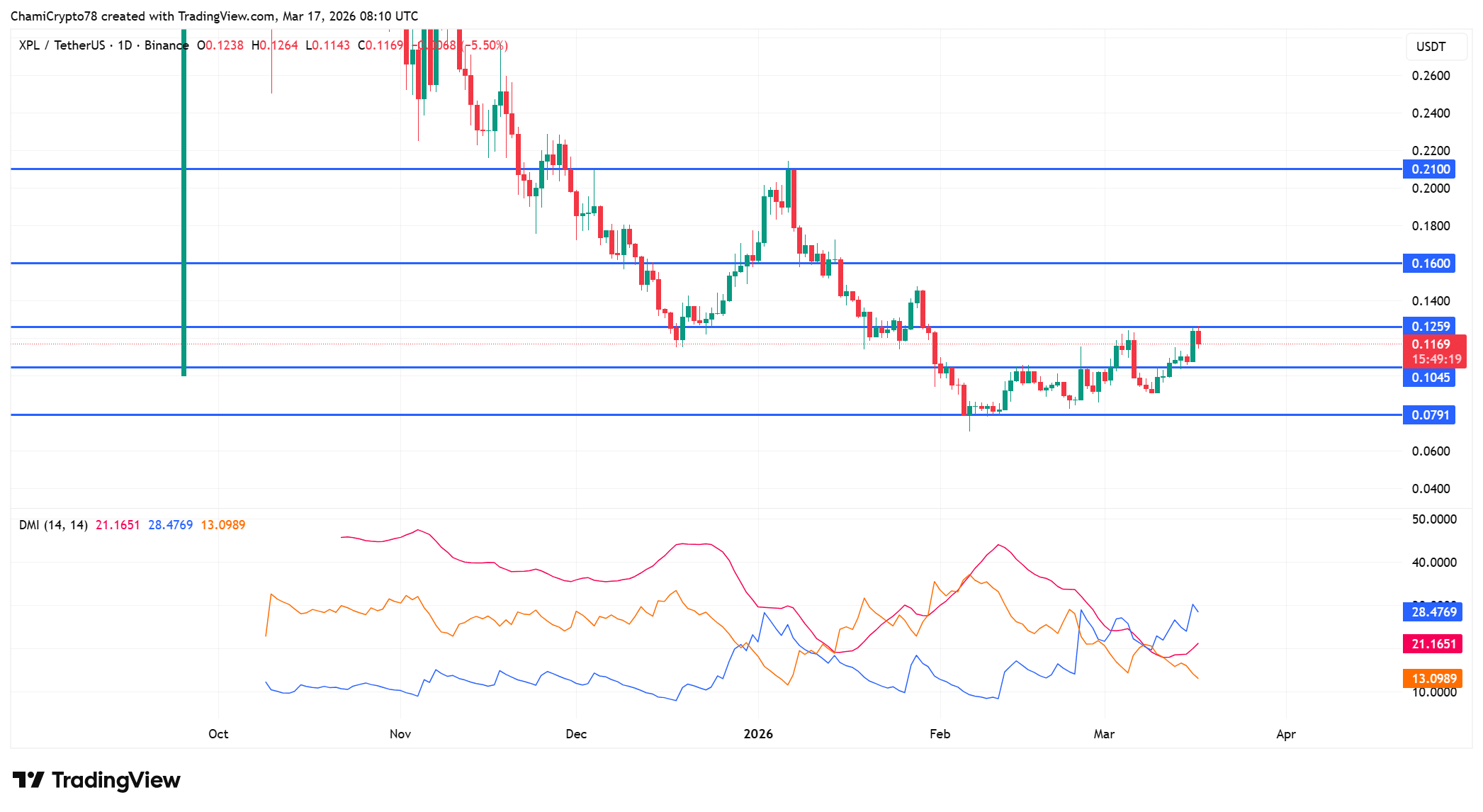
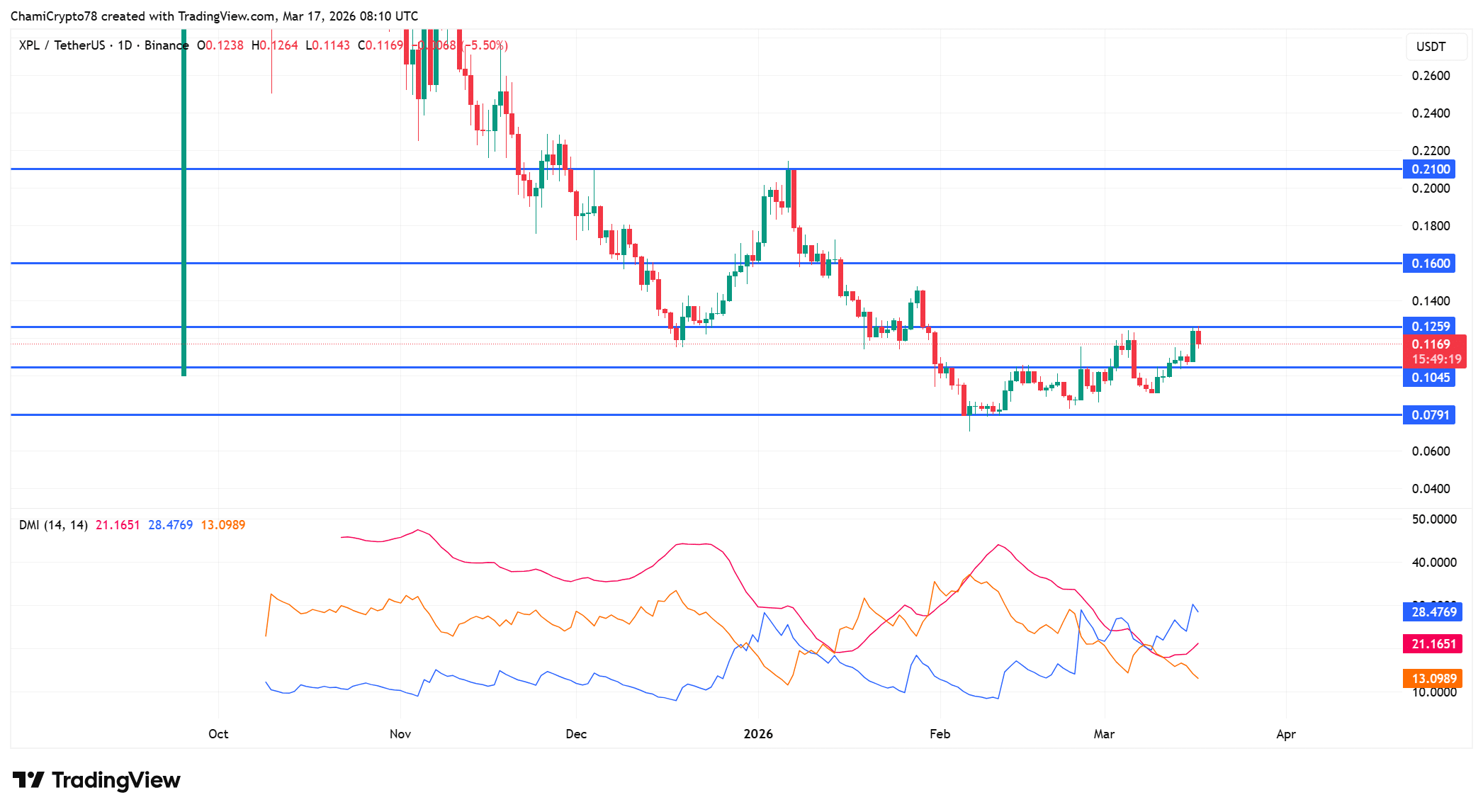
Price has reclaimed the $0.1045 level, which previously acted as a strong support base during consolidation.

Since then, XPL has pushed toward the $0.1259 resistance, where rejection has appeared before.

This area now serves as a key barrier that could define the next directional move.

However, the structure shows higher lows forming, which reflects strengthening buyer control. Each dip has attracted demand, preventing deeper retracements.

The DMI structure has shifted notably, as the +DI line has moved above the -DI line, signaling that buyers have started dominating recent price action.

At the same time, the ADX has hovered around 21, indicating that the trend strength has started building rather than fading.

This alignment reflects a transition from a neutral phase into a developing directional trend.

As the price compresses below the resistance, pressure continues building within this range.

A sustained hold above $0.1045 keeps the structure intact, while repeated tests of $0.1259 increase breakout probability.

This setup suggests that XPL is positioning for a decisive move rather than drifting sideways.
Source: TradingView

Exchange outflows tighten available supply

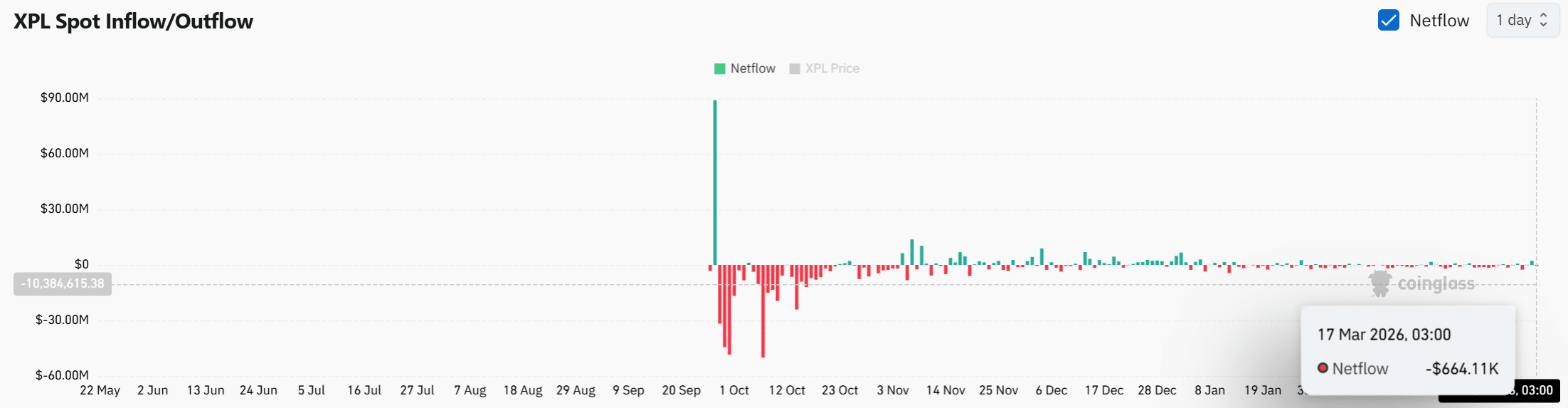
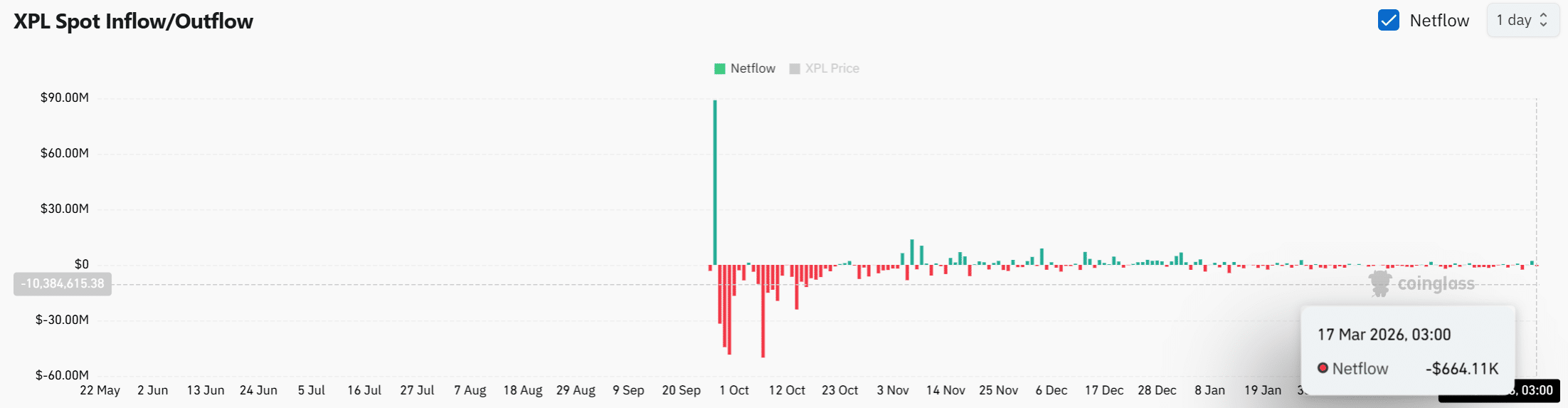
Spot Netflows have remained negative at press time, with recent outflows of approximately $664K from exchanges.

This shift indicates that tokens have been moving off trading platforms rather than preparing for immediate selling.

As supply on exchanges declines, available liquidity tightens, which can amplify price reactions during periods of strong demand.

Besides, reduced sell-side pressure creates conditions where upward moves face less resistance.

However, this dynamic also depends on whether demand continues to match the reduced supply.

As long as outflows persist, the market structure supports accumulation behavior rather than distribution.

This pattern reinforces the bullish context already visible in price action and technical indicators.
Source: CoinGlass

Liquidity clusters above price signal squeeze setup

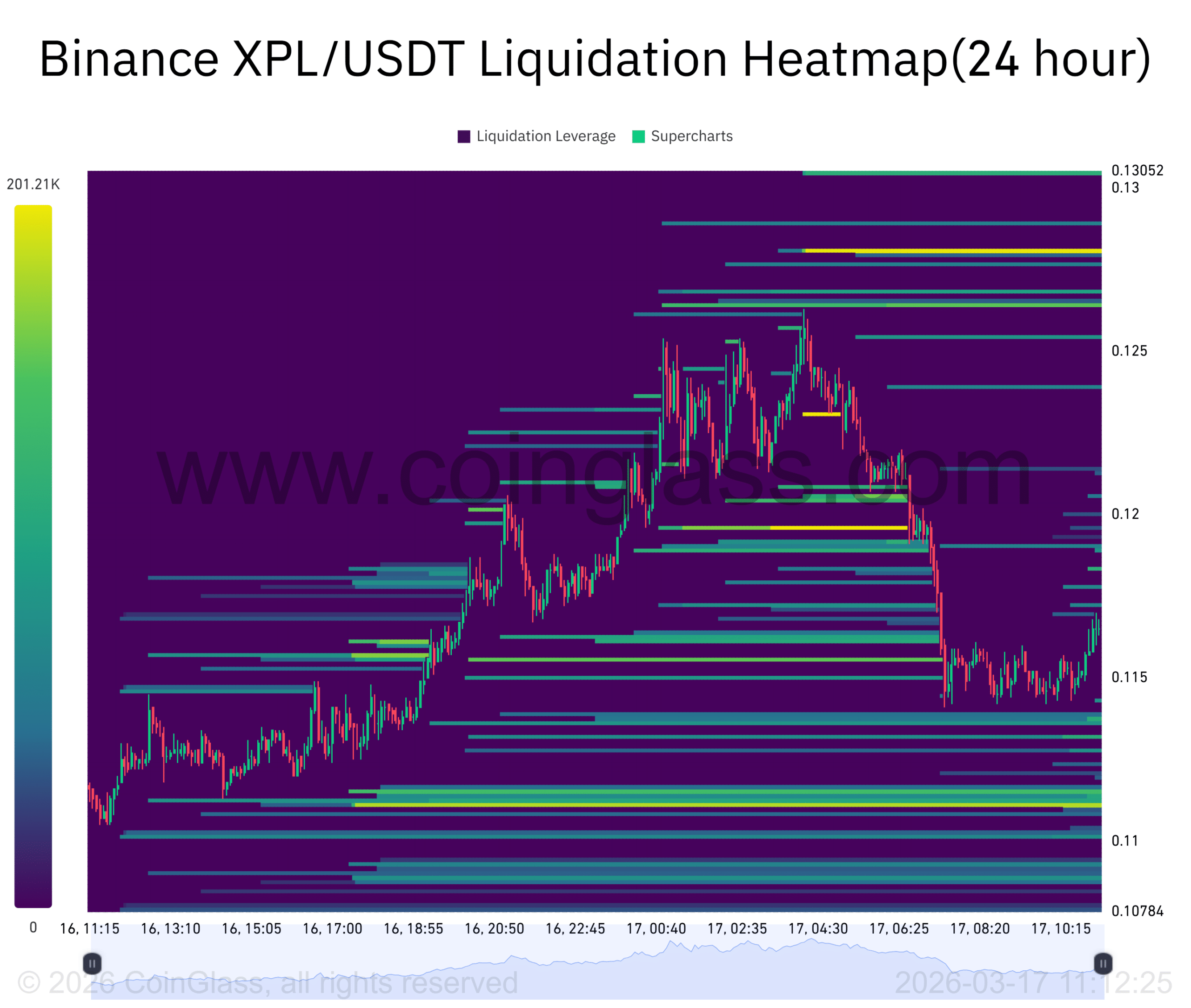
The Liquidation Heatmap has revealed dense liquidity clusters sitting above the current price, particularly around the $0.128 region.

These zones represent areas where short positions could face forced closures if the price moves higher. As XPL approaches these levels, upward pressure could accelerate due to cascading liquidations.

However, the price must first break through nearby resistance to trigger this effect.

The presence of stacked liquidity above current levels creates a magnet-like effect, drawing price toward those zones.
Source: CoinGlass

XPL appears positioned for continuation as strengthening structure, rising demand, and tightening supply align with bullish pressure.

A decisive move above $0.1259 would likely unlock liquidity around $0.128, accelerating the rally.

However, sustained strength depends on holding $0.1045 support. As long as buyers defend this base, the current setup favors further upside expansion.


Final Summary

  • XPL structure shows buyers stepping in early, building pressure that could drive continuation beyond nearby resistance levels.
  • Liquidity sitting above Plasma [XPL] price creates a path for rapid upside expansion if bullish strength remains sustained here.


Criptomoedas em alta

Perguntas relacionadas

QWhat was the percentage increase in Plasma [XPL] price on March 17th, and what was the new price?

APlasma [XPL] surged 12.89% to $0.1238 on March 17th.

QWhat is the critical resistance level that XPL needs to break for a potential rally continuation?

AThe critical resistance level that XPL needs to break is $0.1259.

QWhat does the negative Spot Netflows value of approximately $664K indicate for XPL?

AThe negative Spot Netflows value of approximately $664K indicates that tokens are being moved off exchanges, suggesting accumulation behavior and a reduction in immediate selling pressure.

QAccording to the Liquidation Heatmap, what is the significance of the liquidity cluster around the $0.128 region?

AThe liquidity cluster around $0.128 represents a dense zone of short position liquidations. If the price reaches this level, it could trigger cascading liquidations, accelerating upward price movement.

QWhat key support level must XPL hold to maintain its current bullish structure?

AXPL must hold the key support level at $0.1045 to maintain its current bullish structure and favor further upside expansion.

Leituras Relacionadas

GPT-5.6 Countdown: Abandon the Illusion of a Single API, Computational Iteration Can't Outpace a Single Page of Compliance

In mid-June, three seemingly independent industry events—the compliance-driven throttling of Fable 5, the open-sourcing of GLM-5.2, and the leaked release timeline for GPT-5.6—are pushing the global AI industry toward a watershed moment. These shifts signal a fundamental restructuring of the industry's underlying logic. First, **"usability" has substantially overtaken "advanced capabilities"** as the primary weight, pushing the global large language model (LLM) supply chain into a "dual-track" phase of controlled closed-source and local open-source coexistence. Second, **the competitive moats of closed-source giants are shifting**. Their technical focus is moving from "language intelligence" toward "spatial intelligence (world models)"—a domain heavily reliant on computing power. Third, faced with常态化 transnational compliance risks, **a "model-agnostic" decoupled design has become a survival necessity for application-layer developers to maintain business continuity.** The article details how Anthropic's Fable 5, despite its advanced engineering feats, was restricted for non-U.S. citizens within 72 hours of launch, highlighting how geopolitical compliance can instantly limit even the most advanced models. In response, the open-source camp, exemplified by Zhipu AI's MIT-licensed GLM-5.2, is gaining market share by offering stable performance improvements and significant cost advantages (up to 70% savings for enterprises), while achieving full adaptation with domestic semiconductor platforms. Meanwhile, closed-source leaders like OpenAI are pivoting. The anticipated GPT-5.6 reportedly shifts focus from language to spatial intelligence and world models, aiming to rebuild a generational gap in areas like 3D understanding, simulation, and industrial design that demand immense compute. The core conclusion is that the LLM supply chain's logic has changed. Enterprises must now evaluate infrastructure based on a composite of technical performance and policy compliance. For developers, complete reliance on a single closed-source API poses unacceptable risk. Implementing a truly model-agnostic architecture—enabling swift switches to compliant, locally deployable open-source alternatives—is no longer just good practice but a fundamental baseline for business continuity.

marsbitHá 2h

GPT-5.6 Countdown: Abandon the Illusion of a Single API, Computational Iteration Can't Outpace a Single Page of Compliance

marsbitHá 2h

Is the 'Token Subsidy War' Among AI Giants Almost Over?

The article discusses the ongoing "token subsidy war" among AI giants like OpenAI and Anthropic, questioning whether it's nearing its end. It reveals that current AI subscription prices are heavily subsidized, with some plans offering tokens at up to 70 times the actual cost to attract and retain heavy users, especially developers and enterprises. This strategy mirrors past internet-era subsidy battles, but with a key difference: AI tokens lack "lock-in" effects. Unlike ride-hailing or food delivery apps, users can easily switch between AI providers as APIs become standardized, making it difficult for companies to raise prices post-subsidy. The piece highlights a structural asymmetry in the competition. Giants like Google, with massive advertising revenue, can afford to subsidize tokens indefinitely, akin to using "tokens as a weapon." In contrast, venture-backed companies like OpenAI and Anthropic face pressure to become profitable, especially as they approach IPO. The article cites Google Ventures founder Bill Maris, who suggests Google could slash token prices by 80%, putting immense pressure on competitors. Two potential endgames are presented: the "internet service" model (subsidize, monopolize, then raise prices) and the "utility" model (tokens become a standardized, low-margin commodity like electricity). Given the low switching costs, the latter seems more likely. The competition may not have a single winner but could instead accelerate AI's evolution into a foundational, infrastructure-level technology, akin to a public utility. For now, users continue to benefit from heavily subsidized token costs.

marsbitHá 2h

Is the 'Token Subsidy War' Among AI Giants Almost Over?

marsbitHá 2h

Beyond the Stadium: The Profitable Games Surrounding the World Cup

"Beyond the Pitch: The Profit Game Around the World Cup" The FIFA World Cup transcends being a sporting spectacle, evolving into a massive global arena for speculation and profit-seeking. The 2026 tournament has amplified this dynamic, creating a multi-layered ecosystem of financial opportunism alongside the football. **Prediction markets** have surged into the mainstream. Platforms like Polymarket and Kalshi saw trading volumes for World Cup contracts soar, attracting new users with their financial trading model and high-profile, chain-based wealth stories that overshadow traditional sports betting in terms of growth and narrative. However, **traditional sportsbooks** remain the dominant force, leveraging established user habits, legal markets, and comprehensive product offerings to handle the vast majority of speculative wagers, with projections suggesting record-breaking betting volumes. Capital markets also react. **"Concept stocks"** in countries like South Korea and Japan experience volatile price swings based on team performance and anticipated fan spending on items like chicken, beer, and viewing parties, effectively becoming a stock market reflecting fan sentiment. The **ticket resale market** has become a sophisticated arena for arbitrage. Prices fluctuate wildly based on team draws and star power, with sellers sometimes listing tickets they don't yet own in a practice akin to short-selling, while FIFA's own "Right to Buy" tokens add another layer of speculative trading. **Collectibles and merchandise** offer another avenue. Panini sticker albums, with their inherent scarcity and nostalgic value, can become high-value collectibles. Limited-edition or locally themed jerseys command significant premiums on secondary markets, and even counterfeit vendors profit from fans' desire for affordable match-day identity. The **cryptocurrency** space has seen a frenzy of speculative, unauthorized World Cup-themed meme coins on chains like Solana. These tokens, often exploiting team names and player imagery, experience extreme pump-and-dump cycles, creating stories of massive gains for a few early entrants and steep losses for many others. Finally, an entire industry thrives on **providing information and tools** to other speculators. Developers create platforms like SeatSidekick to track ticket inventory and prices, while paid Telegram groups and subscriptions sell betting tips and predictions, monetizing the widespread desire for an informational edge. In essence, the World Cup has become a compressed, global laboratory for speculation. While the games determine champions on the field, a parallel, complex network of financial transactions—spanning prediction contracts, bets, stocks, tickets, collectibles, crypto, and information services—settles its own scores in the global market.

marsbitHá 3h

Beyond the Stadium: The Profitable Games Surrounding the World Cup

marsbitHá 3h

Trading

Spot
Futuros

Artigos em Destaque

O que é PLASMA

Plasma: Uma Solução de Ponta para a Escalabilidade da Blockchain Introdução ao Plasma À medida que o panorama das criptomoedas evolui, também aumenta a necessidade de uma maior eficiência nas redes blockchain. O Plasma, uma solução de escalabilidade de Camada 2, surge como um jogador pioneiro neste domínio, particularmente no campo do desenvolvimento Web3. Ao deslocar estrategicamente uma parte substancial das tarefas da cadeia principal para uma série de cadeias menores, o Plasma promete aumentar significativamente a escalabilidade e o desempenho do Ethereum — uma plataforma de blockchain amplamente utilizada na vanguarda das aplicações descentralizadas. O que é o Plasma? O Plasma é uma solução inovadora de escalabilidade off-chain particularmente desenhada para a blockchain Ethereum. Foi apresentado em agosto de 2017 por Vitalik Buterin, co-fundador do Ethereum, e Joseph Poon, um proeminente defensor de soluções de escalabilidade como a Lightning Network. O Plasma serve como uma estrutura que permite a criação de aplicações escaláveis, estabelecendo uma estrutura hierárquica de cadeias filhas acima da cadeia principal do Ethereum. No seu núcleo, o Plasma permite o desenvolvimento de cadeias laterais potencialmente infinitas que podem operar de forma independente, enquanto ainda dependem da rede Ethereum para segurança e consenso. Esta arquitetura é suportada por contratos inteligentes e Árvores de Merkle, que gerenciam eficientemente transações e armazenamento de dados. Objetivos Principais do Plasma O objetivo primário do Plasma é aumentar o throughput da rede Ethereum. Ao desviar um volume substancial de transações da congestionada cadeia principal, a arquitetura do Plasma oferece velocidades de transação mais altas, processamento de dados mais eficiente e custos de transação mais baixos. Isto é particularmente vital numa era em que a demanda por aplicações descentralizadas — especialmente nas áreas das finanças, jogos e gestão da cadeia de abastecimento — está a atingir níveis sem precedentes. Criadores do Plasma O Plasma é obra de duas figuras renomadas na comunidade blockchain: Vitalik Buterin e Joseph Poon. Buterin é celebrado principalmente por co-fundar o Ethereum e por expandir os limites do que a tecnologia blockchain pode alcançar. Poon, por outro lado, é conhecido por defender soluções escaláveis, que permitem transações mais rápidas e custo-efetivas nas redes blockchain. A colaboração deles na estrutura do Plasma contribuiu amplamente para a sua natureza inovadora, combinando perceções técnicas avançadas com aplicações práticas. Investidores do Plasma Embora as fundações ou organizações específicas que apoiam o Plasma permaneçam não reveladas, o projeto atraiu o interesse de várias figuras proeminentes e intervenientes no espaço blockchain e criptomoeda. Com o seu potencial para melhorar a escalabilidade dentro do Ethereum, chamou a atenção de várias entidades que visam expandir os limites da tecnologia blockchain. Como Funciona o Plasma? A funcionalidade única do Plasma deve-se à sua estrutura arquitetónica que depende das cadeias filhas e da sua interação com a rede principal do Ethereum. Abaixo estão alguns fatores chave que contribuem para a abordagem inovadora do Plasma: Cadeias Filhas: O Plasma estabelece numerosas cadeias filhas que podem executar transações independentemente da cadeia principal do Ethereum. Cada cadeia filha opera como um contrato inteligente separado com características únicas, permitindo que os desenvolvedores criem soluções personalizadas com base nas suas necessidades específicas. Contratos Inteligentes e Árvores de Merkle: A estrutura utiliza contratos inteligentes, que são acordos autoexecutáveis com condições pré-definidas, juntamente com Árvores de Merkle que permitem a verificação eficiente de dados. Esta tecnologia permite que o Plasma alcance tanto alta escalabilidade quanto segurança. Compressão de Transações: Ao agrupar transações nas cadeias filhas, o Plasma reduz a carga de dados na rede Ethereum. Isto significa que menos transações precisam ser registadas na cadeia principal — libertando espaço e reduzindo a congestão. Segurança Aumentada: Apesar de estar off-chain, o Plasma aproveita as medidas de segurança da rede principal do Ethereum, garantindo que todas as transações nas cadeias filhas mantenham um alto nível de integridade e segurança. Linha do Tempo do Plasma Compreender o desenvolvimento do Plasma envolve traçar os seus marcos significativos: Agosto de 2017: O Plasma foi apresentado pela primeira vez por Vitalik Buterin e Joseph Poon como uma solução escalável para enfrentar os desafios de desempenho do Ethereum. 2018: A estrutura do Plasma foi oficialmente desenvolvida e disponibilizada no GitHub, marcando um passo crucial para a sua implementação em aplicações práticas. 2019: À medida que a conscientização sobre o Plasma cresceu, começou a atrair desenvolvedores interessados em escalar aplicações Ethereum, aumentando assim a sua adoção. 2020: O Plasma continuou a evoluir, com melhorias substanciais feitas à sua arquitetura e funcionalidade, tornando-o ainda mais apelativo para os desenvolvedores. Principais Características do Plasma O Plasma possui várias características que o tornam uma solução transformadora no espaço blockchain: Escalabilidade: Ao criar múltiplas cadeias filhas, o Plasma pode lidar com um volume maior de transações sem sobrecarregar ainda mais a cadeia principal do Ethereum. Velocidade: Cada cadeia filha pode processar transações mais rapidamente, proporcionando aos utilizadores uma melhor experiência e serviço. Custos de Transação Reduzidos: A estrutura do Plasma reduz efetivamente os custos associados às transações, minimizando o fardo na cadeia principal. Interoperabilidade: A arquitetura permite que o Plasma interaja de forma contínua com múltiplas blockchains, melhorando a funcionalidade entre redes. Segurança: Ao aproveitar a segurança da cadeia principal do Ethereum, o Plasma garante a integridade das suas operações enquanto utiliza as suas cadeias filhas. Casos de Uso para o Plasma A arquitetura inovadora do Plasma abre portas para várias aplicações práticas em diferentes setores: Finanças Descentralizadas (DeFi): O Plasma tem a capacidade de melhorar a escalabilidade e eficiência das aplicações DeFi, criando processos de negociação mais suaves e eficazes. Jogos: A estrutura facilita o desenvolvimento de experiências de jogos rápidas e custo-efetivas, tornando-a atraente para os desenvolvedores na indústria de jogos. Gestão da Cadeia de Abastecimento: Com a capacidade de arquivar processamento de transações eficiente, o Plasma pode promover o desenvolvimento de soluções descentralizadas de gestão da cadeia de abastecimento. Conclusão O Plasma está na vanguarda da tecnologia blockchain, posicionado como uma solução de escalabilidade de Camada 2 fundamental destinada a melhorar a eficiência da rede Ethereum e além. Através da sua estrutura única de cadeias filhas, contratos inteligentes e Árvores de Merkle, o Plasma oferece uma solução convincente para a crise de escalabilidade que tem afligido as redes blockchain por muito tempo. À medida que a tecnologia blockchain continua a avançar, soluções como o Plasma prometem remodelar a forma como os desenvolvedores abordam os desafios de escalabilidade, potencialmente revolucionando a forma como as aplicações descentralizadas funcionam. Os esforços contínuos dos seus criadores e o interesse de diversas partes interessadas sinalizam um futuro promissor para o Plasma enquanto procura elevar as capacidades da blockchain a novas alturas no domínio digital.

210 Visualizações TotaisPublicado em {updateTime}Atualizado em 2024.12.03

O que é PLASMA

Como comprar XPL

Bem-vindo à HTX.com!Tornámos a compra de Plasma (XPL) simples e conveniente.Segue o nosso guia passo a passo para iniciar a tua jornada no mundo das criptos.Passo 1: cria a tua conta HTXUtiliza o teu e-mail ou número de telefone para te inscreveres numa conta gratuita na HTX.Desfruta de um processo de inscrição sem complicações e desbloqueia todas as funcionalidades.Obter a minha contaPasso 2: vai para Comprar Cripto e escolhe o teu método de pagamentoCartão de crédito/débito: usa o teu visa ou mastercard para comprar Plasma (XPL) instantaneamente.Saldo: usa os fundos da tua conta HTX para transacionar sem problemas.Terceiros: adicionamos métodos de pagamento populares, como Google Pay e Apple Pay, para aumentar a conveniência.P2P: transaciona diretamente com outros utilizadores na HTX.Mercado de balcão (OTC): oferecemos serviços personalizados e taxas de câmbio competitivas para os traders.Passo 3: armazena teu Plasma (XPL)Depois de comprar o teu Plasma (XPL), armazena-o na tua conta HTX.Alternativamente, podes enviá-lo para outro lugar através de transferência blockchain ou usá-lo para transacionar outras criptomoedas.Passo 4: transaciona Plasma (XPL)Transaciona facilmente Plasma (XPL) no mercado à vista da HTX.Acede simplesmente à tua conta, seleciona o teu par de trading, executa as tuas transações e monitoriza em tempo real.Oferecemos uma experiência de fácil utilização tanto para principiantes como para traders experientes.

261 Visualizações TotaisPublicado em {updateTime}Atualizado em 2026.06.02

Como comprar XPL

Discussões

Bem-vindo à Comunidade HTX. Aqui, pode manter-se informado sobre os mais recentes desenvolvimentos da plataforma e obter acesso a análises profissionais de mercado. As opiniões dos utilizadores sobre o preço de XPL (XPL) são apresentadas abaixo.

活动图片