Monad sube un 13% – Pero ESTAS señales de alerta podrían limitar a MON

ambcryptoPublicado em 2026-02-11Última atualização em 2026-02-11

Resumo

El token Monad (MON) ha registrado un aumento del 13% en 24 horas, destacándose en un mercado cripto bajo presión. Este repunte se debe al fuerte volumen de operaciones, que superó los 160 millones de dólares, y al lanzamiento del acelerador Nitro, que atrae a desarrolladores con financiamiento de hasta 500.000 dólares. Además, el Valor Total Bloqueado (TVL) en la red alcanzó los 628 millones de dólares. Sin embargo, en el gráfico de 4 horas se observa una tendencia lateral con posible debilidad: el precio fue rechazado tras superar temporalmente el rango lateral, y indicadores como el MACD y el CMF sugieren una pérdida de impulso. Si no se mantiene por encima de 0,01979 dólares, MON podría caer al soporte de 0,01679 dólares.

El mercado de criptomonedas sigue bajo presión, pero algunos tokens muestran resistencia. Monad [MON] destacó en las últimas 24 horas, subiendo alrededor de un 13% al cierre de esta edición.

Los datos de CoinMarketCap sugieren que los tokens más nuevos con narrativas convincentes siguen atrayendo atención. En el caso de MON, el fuerte respaldo comunitario y de la fundación han jugado un papel clave en impulsar este repunte.

¿Qué está impulsando el precio de Monad?

En primer lugar, Monad repuntó después de que el volumen aumentara más de un 140%, superando los 160 millones de dólares. Esto indicó que había un interés de compra fuerte y concentrado, superando así la presión de venta del mercado en general.

Además, conversaciones sentimentales llenaron los espacios sociales, impulsando una vez más a la criptomoneda Monad. La introducción del acelerador Nitro, que abrió oportunidades para desarrolladores de todas las cadenas, desató las discusiones de moda.

Como tal, el acelerador permitiría convertir proyectos de criptomonedas ya financiados en productos globales con alcance real. De esa manera, los equipos de desarrollo recibirían alrededor de 500.000 dólares en financiación de firmas de capital riesgo (VC) líderes.

En el frente on-chain, el Valor Total Bloqueado (TVL) ha estado aumentando desde el lanzamiento de Monad el 22 de diciembre. De hecho, el TVL estaba en 628 millones de dólares, lo que supuso un cambio de más de un 4% al alza.

El volumen de los DEX estaba ligeramente por debajo de los 100 millones de dólares, lo que indica una actividad comercial constante desde finales de diciembre. Sin embargo, el volumen de Perps fue insignificante, con 3,32 millones de dólares.

Adicionalmente, la altcoin disfrutaba del impulso en el sector de las stablecoins. Para contexto, la capitalización de mercado de stablecoins de MON había superado la marca de 444 millones de dólares.

Aunque los fundamentos y la actividad de la red demostraron fortaleza, la acción del precio estaba dividida en términos de sesgo direccional.

¿Se está debilitando el precio de MON?

En el gráfico de 4 horas, el precio de MON cotizaba en un mercado lateral. Un solo movimiento de vela cubrió el rango entre 0,01679 dólares y 0,01979 dólares, confirmando la fuerza de la compra.

Sin embargo, la vuelta a la horquilla inmediatamente después del breakout fue una indicación de debilidad. Esto señaló que el repunte podría no durar.

Para contexto, las barras del MACD se reducían de tamaño mientras su color se desvanecía al momento de escribir. Adicionalmente, el Flujo de Dinero de Chaikin (CMF) caía a -0,09. Los dos mostraron que el impulso se desvanecía y el capital estaba saliendo.

Por lo tanto, la cuestión de si Monad se dirigía hacia la base de la consolidación. Desde una perspectiva técnica, MON cotizaba hacia el soporte inferior en 0,01679 dólares.

Por otro lado, superar con éxito los 0,01979 dólares significaría un cambio en la estructura del mercado. De lo contrario, el precio de MON se mantiene en una estructura bajista, y el movimiento de hoy parece débil.


Reflexiones finales

  • Monad subió un 13% tras el hype del acelerador Nitro y la actividad de la red.
  • El precio de MON rompió por encima de un rango con fuerza, pero fue rechazado inmediatamente, señalando debilidad del impulso.


Criptomoedas em alta

Perguntas relacionadas

Q¿Qué porcentaje subió Monad (MON) en las últimas 24 horas según el artículo?

AMonad (MON) subió aproximadamente un 13% en las últimas 24 horas.

Q¿Cuál fue uno de los principales factores que impulsó el rally de MON mencionado en el texto?

AEl lanzamiento del acelerador Nitro, que ofrece oportunidades y financiación para desarrolladores, generó hype y fue un factor clave.

QSegún el análisis técnico, ¿qué indicador mostró que el capital estaba saliendo de MON?

AEl Chaikin Money Flow (CMF), que se situaba en -0.09, mostró que el capital estaba saliendo.

Q¿A qué nivel de soporte clave se estaba acercando el precio de MON en el gráfico de 4 horas?

AEl precio de MON se estaba acercando al soporte inferior en 0,01679 dólares.

Q¿Qué debe superar el precio de MON para que cambie la estructura de mercado de bajista a alcista?

ADebe superar con éxito el nivel de 0,01979 dólares para cambiar la estructura del mercado.

Leituras Relacionadas

STRC Unpegged by 11%, Can Strategy's Perpetual Motion Machine Keep Turning?

STRC, the perpetual preferred stock of MicroStrategy, is experiencing a persistent de-pegging from its target par value of $100, with the discount recently widening to over 11%. This de-anchoring challenges the core design of STRC, which was intended as a stable, income-oriented security operating near $100. As a crucial funding engine for MicroStrategy's Bitcoin acquisition strategy, STRC's price reflects market confidence in the company's entire capital model. The company's "capital flywheel" relies on issuing STRC at or above $100 via an At-the-Market (ATM) program to raise cash for buying Bitcoin, thereby boosting company equity and theoretically supporting STRC's value. A monthly adjustable dividend mechanism was designed to maintain this peg. Despite raising the dividend to 11.5% and increasing payment frequency, the de-pegging persists. Market concerns extend beyond technical factors like leveraged arbitrage unwinding. Analysts point to MicroStrategy's limited cash reserves relative to its ~$1.7 billion annual dividend obligation for preferred shares. While the company counters that its vast Bitcoin holdings could cover decades of payments, this argument hinges on the potential need to sell Bitcoin—a shift from its longstanding "hodl" narrative. The company's recent sale of a small amount of BTC, framed as a test, amplified these liquidity and strategy concerns. If STRC remains discounted, impairing MicroStrategy's ability to raise cheap capital, fears may grow that the company could sell more Bitcoin to meet obligations. This scenario could transform MicroStrategy from a major market buyer into a potential seller, posing significant downside risk for Bitcoin. The re-pegging of STRC is thus a key indicator for the health of MicroStrategy's capital structure and its market impact.

Odaily星球日报Há 14m

STRC Unpegged by 11%, Can Strategy's Perpetual Motion Machine Keep Turning?

Odaily星球日报Há 14m

Silicon Valley's Most Sought-After New Role Has Emerged

Silicon Valley's New Most Wanted Job: The Rise of the Forward Deployment Engineer The AI industry is witnessing a significant shift. The focus has moved from developing cutting-edge models to deploying them effectively within enterprises. This has made the "Forward Deployment Engineer" (FDE) a critical and highly sought-after role at major firms like OpenAI, Anthropic, and Google. For the past three years, the industry prioritized model scientists. However, companies are now facing a harsh reality: purchasing powerful AI tools does not guarantee productivity gains or organizational change. The biggest hurdle is not the technology itself, but integrating it into complex legacy systems, workflows, and corporate cultures. This includes challenges like data silos, compliance requirements, and internal resistance. The FDE role, pioneered by Palantir Technologies, addresses this "last-mile" problem. FDEs are deployed on-site with clients for extended periods. Their job is to deeply understand the client's specific organizational structure, processes, and pain points, then tailor and implement the AI solution accordingly. They combine skills in technology, project management, and organizational change. A clear signal of this trend emerged in May 2026 when three AI giants made major moves. Anthropic launched a $1.5B joint venture for enterprise deployment. OpenAI formed an independent deployment subsidiary, DeployCo, with over $4B in commitments and acquired a deployment consultancy. Google Cloud's CEO publicly announced a large-scale recruitment drive for FDEs. This shift represents a fundamental change in the software business model: from selling tools to selling guaranteed outcomes. FDEs are the agents of this change, responsible for delivering a working system within the production environment, not just a demo. Real-world cases, such as challenges at Goldman Sachs (compliance barriers) and Target (internal cultural resistance), illustrate that the primary obstacles to AI adoption are organizational, not technical. An FDE's value lies in navigating these human and procedural complexities to facilitate a successful "AI migration." In essence, as core AI technology becomes more accessible and affordable, the true premium is shifting to the human expertise required to understand organizations and drive change—making the FDE role pivotal for the next phase of the AI revolution.

marsbitHá 14m

Silicon Valley's Most Sought-After New Role Has Emerged

marsbitHá 14m

When the World Cup Collides with Agents: From Web2 to Web3, How Are Wallets Evolving into Agentic Wallets?

World Cup as a Catalyst for Agentic Wallets: From Web2 to Web3 This article explores how the World Cup provides a real-world scenario for observing the evolution of digital wallets from simple asset managers towards "Agentic Wallets"—intelligent, AI-powered interfaces. Using the example of prediction markets like Polymarket, it illustrates how AI Agents can lower the barrier to Web3 interaction. Instead of navigating complex DApps, users can express intent in natural language (e.g., "I think Portugal will win") within platforms like Discord or web pages. The Agent then interprets this intent, finds the relevant market, and seamlessly guides the user through the on-chain transaction via their wallet. The core shift is from wallets as mere "function menus" for signing transactions to "intent interpreters" that understand user goals. The article highlights parallel developments in traditional finance, such as Mastercard's "Agent Pay" and WeChat Pay's AI tests, which focus on granting AI controlled, authorized, and auditable payment capabilities. This underscores a broader trend of AI entering the financial layer. However, the article emphasizes that the primary challenge for Agentic Wallets in Web3 is not automation but establishing clear security boundaries. Unlike traditional systems with chargebacks, on-chain transactions are often irreversible. Therefore, future wallets must ensure users retain ultimate control and comprehension. They need to transparently communicate an Agent's permissions, spending limits, authorized durations, and provide easy ways to pause or revoke access. The World Cup experiments represent early steps toward wallets that are not just applications but ubiquitous, intelligent interfaces that simplify Web3 while keeping users securely in control.

marsbitHá 1h

When the World Cup Collides with Agents: From Web2 to Web3, How Are Wallets Evolving into Agentic Wallets?

marsbitHá 1h

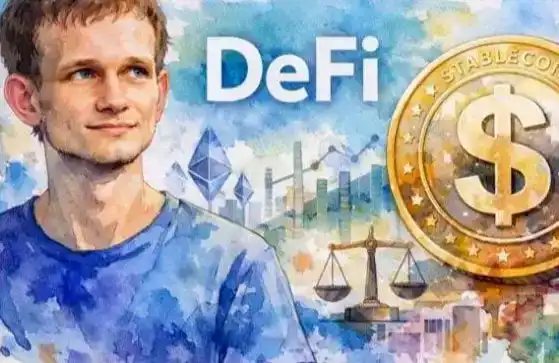
Options Don't Work in DeFi? Vitalik Might Not Agree

For years, the prevailing view has been that options struggle to gain traction in DeFi due to complexity, fragmented liquidity, and lack of natural demand compared to products like perpetual futures. However, a recent algorithmic stablecoin design proposed by Vitalik Buterin presents a different perspective, using options not as a standalone trading product, but as foundational infrastructure for other financial instruments. In this design, one unit of ETH is split into two components: a "stable" side (P) that retains value up to a specified strike price, and an "upside" side (N) that captures all appreciation above that strike. Combined, they always equal one ETH, eliminating debt, margin, and liquidation risks inherent in typical collateralized debt position (CDP) stablecoins. The stable component essentially mimics the payoff of a covered call option. To function as a stablecoin, this structure requires continuously rolling deep in-the-money calls, which introduces challenges like rollover slippage, predictable transaction flow vulnerable to front-running, and persistent liquidity needs. A core hurdle is finding consistent buyers for the leveraged ETH upside exposure (N). While it offers leverage without funding rates or liquidation, it must compete with simpler alternatives like direct call options or perpetuals. The system's scalability depends on a sustained demand for this specific form of leverage. The author draws parallels to their experience with Rysk, where earlier versions of DeFi options protocols struggled. The breakthrough came with Rysk V12, which aligns incentives: asset holders generate yield by selling covered calls against their holdings, while market makers efficiently acquire the desired option exposure. This demonstrates that options can find product-market fit when embedded as a risk distribution and pricing engine within structured products, stablecoins, or yield-generating assets, rather than marketed as a complex direct trading instrument. Vitalik's proposal reinforces this architectural approach—using fully collateralized, non-custodial, and physically settled options as a fundamental building block. The real opportunity for options in DeFi may lie not in becoming the next perpetual swap, but in powering the next generation of on-chain financial products.

marsbitHá 2h

Options Don't Work in DeFi? Vitalik Might Not Agree

marsbitHá 2h

Trading

Spot
Futuros

Artigos em Destaque

Como comprar MONAD

Bem-vindo à HTX.com!Tornámos a compra de Monad (MONAD) simples e conveniente.Segue o nosso guia passo a passo para iniciar a tua jornada no mundo das criptos.Passo 1: cria a tua conta HTXUtiliza o teu e-mail ou número de telefone para te inscreveres numa conta gratuita na HTX.Desfruta de um processo de inscrição sem complicações e desbloqueia todas as funcionalidades.Obter a minha contaPasso 2: vai para Comprar Cripto e escolhe o teu método de pagamentoCartão de crédito/débito: usa o teu visa ou mastercard para comprar Monad (MONAD) instantaneamente.Saldo: usa os fundos da tua conta HTX para transacionar sem problemas.Terceiros: adicionamos métodos de pagamento populares, como Google Pay e Apple Pay, para aumentar a conveniência.P2P: transaciona diretamente com outros utilizadores na HTX.Mercado de balcão (OTC): oferecemos serviços personalizados e taxas de câmbio competitivas para os traders.Passo 3: armazena teu Monad (MONAD)Depois de comprar o teu Monad (MONAD), armazena-o na tua conta HTX.Alternativamente, podes enviá-lo para outro lugar através de transferência blockchain ou usá-lo para transacionar outras criptomoedas.Passo 4: transaciona Monad (MONAD)Transaciona facilmente Monad (MONAD) no mercado à vista da HTX.Acede simplesmente à tua conta, seleciona o teu par de trading, executa as tuas transações e monitoriza em tempo real.Oferecemos uma experiência de fácil utilização tanto para principiantes como para traders experientes.

364 Visualizações TotaisPublicado em {updateTime}Atualizado em 2026.06.02

Como comprar MONAD

Discussões

Bem-vindo à Comunidade HTX. Aqui, pode manter-se informado sobre os mais recentes desenvolvimentos da plataforma e obter acesso a análises profissionais de mercado. As opiniões dos utilizadores sobre o preço de MONAD (MONAD) são apresentadas abaixo.

活动图片