[Key interpretation] ETH's open interest grows rapidly, pay attention to leverage risk

Huobi ResearchPublicado em 2022-07-29Última atualização em 2022-08-01

Resumo

BTC rebounded quickly and paid attention to the change of selling pressure.

1. BTC triple positive rebound

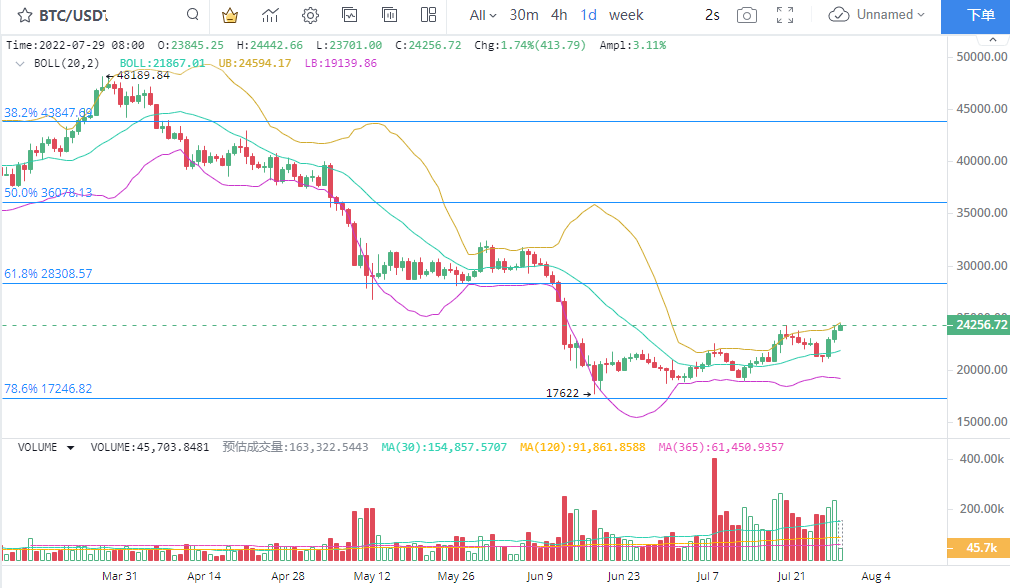
Trading volume remained high, pushing BTC higher for three consecutive trading days. From the perspective of trading volume performance, the current volume can still support the strong performance of BTC, and the short-term rebound space needs to pay attention to the performance of pressure level. The important price platform is around us $28308, which is the corresponding point of 61.8% in Fibonacci. Considering the increase of BTC activity, there is room for further upward movement in the short term in terms of amplitude. Next, we can pay attention to the performance of volume and price. In the case of large-scale operation, the risk of holding currency is low.
2. Large amount transactions are active on the BTC chain

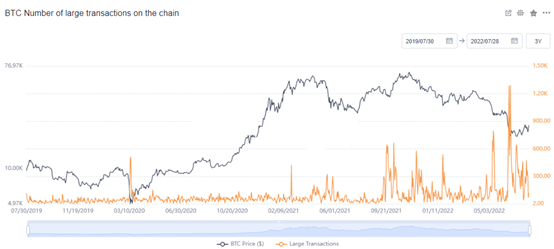
Large transactions on the chain cannot directly prompt the trading direction of the main force, but the high number of transfers on the chain means that the main force has changed hands relatively fully. Based on the fact that the trading volume of BTC in the exchange also maintained a relatively high level, it is judged that BTC is in a relatively active stage. During the month, large value transactions on the BTC chain were particularly frequent, and the peak value was high, which means that there is a possibility of a large number of successful BTC turnover in the near future. Therefore, the current price rebound of BTC may be caused by the new main force. Next, the market development may still be limited to the range, focusing on selling pressure below the pressure level of $28000.
3. Decrease in unrecognized losses of BTC

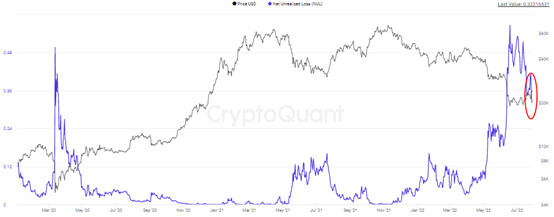
The number of unrecognized losses of BTC has decreased significantly and at a faster rate, which is relatively consistent with the rebound rhythm of BTC. On June 28, the nul index fell to around 0.322, indicating a decline from the year's high of 0.566. Under normal circumstances, the proportion of unrecognized losses of BTC will be less than 0.12. Before the unconfirmed loss drops to 0.12, the existence of loss will always affect the expectation of price rebound. Importantly, BTC kept approaching the cost price of more investors in the rebound stage, which was one of the sources of selling pressure.
4. Eth reconfirmed the rebound expectation

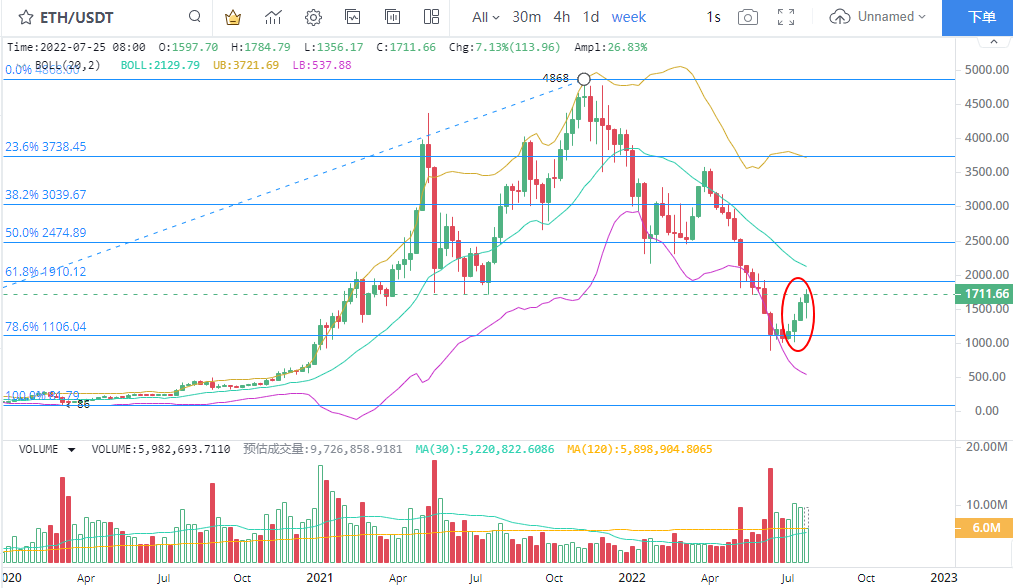
The technical rebound of eth has turned into a weekly range fluctuation, the maximum increase in price has doubled, and is about to hit the pressure level of $1910. In terms of weekly K-line, ETH accumulated a large trading volume, which made this price increase easily exceed expectations. Recently, the number of eth active addresses has rebounded, and the address activity of sending eth is very high. Therefore, ETH is still a technical rebound. Therefore, we should pay attention to price adjustment factors while making profits by holding money.
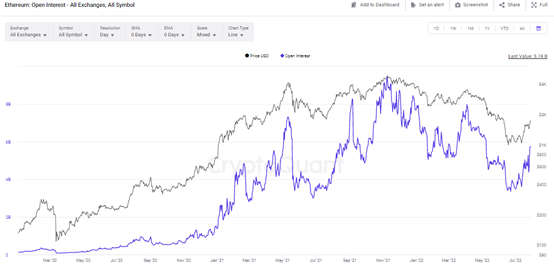
5. Eth positions rebounded

Eth rebounded faster. Compared with the price trend, its contract position has more room for rapid growth. At present, the contract sprint has rebounded to near the one-year average. This shows that investors are relatively sensitive to market changes. The rapid growth rate of contract positions makes it easy for eth to prompt bullish trading signals.

Leituras Relacionadas

Gate Research Institute: ETF Outflows Suppress Risk Appetite, Two-Way System Navigates Weak Market

Gate Institute Research Report: May 2026 Crypto Market Review & Strategy Analysis In May 2026, the crypto market shifted from an early-month rally to a mid-month correction, concluding with low-volatility consolidation. BTC, ETH, and SOL peaked in early May before declining. The primary market dynamic was a divergence between weakening spot ETF inflows and persistently high leverage-driven perpetual trading volume. A dual-direction moving average cluster breakout strategy outperformed, returning +2.11% for an equally-weighted BTC/ETH/SOL portfolio. This contrasted with a -6.09% return for buy-and-hold and -3.65% for a long-only version of the strategy. Profits were primarily generated from short positions on ETH and SOL during the mid-to-late May downtrend, demonstrating the month's suitability for two-way trend trading. Market structure evolved in three phases: an initial surge (May 1-6), a failure and reversal (starting May 7), and low-volatility compression (May 22 onward). While stablecoin supply remained stable, significant outflows from mainstream BTC and ETH ETFs created selling pressure. Concurrently, high correlation with the S&P 500 (~0.6) and stronger performance from AI equities like Nvidia highlighted crypto's position as a high-beta risk asset within a broader risk-budget framework, lacking independent momentum. The successful strategy employed a 4-hour chart system using a cluster of six moving averages (EMA6,12,24 & SMA6,12,24). A breakout signal was triggered after the cluster width compressed below 2.2%. Trades were managed with a 2.5% fixed stop-loss, a 3:1 Risk/Reward (7.5%) take-profit, and an EMA12-based exit rule to control losses from false breakouts. The strategy's low win rate but high payoff from a few large trend moves was effective in May's conditions. The report concludes that for June, a disciplined, bidirectional approach remains superior to subjective directional bets. The framework should adapt signal weighting based on BTC's position relative to key EMAs, ETF flow trends, and the relative strength of the Nasdaq, prioritizing risk management and trend preservation.

marsbitHá 20m

Gate Research Institute: ETF Outflows Suppress Risk Appetite, Two-Way System Navigates Weak Market

marsbitHá 20m

Anthropic CEO's Latest Interview: On Technological Explosion, Safety Red Lines, and the Civilization Contract

Interview with Anthropic CEO Dario Amodei covers the intense pressures and ethical dilemmas of leading AI development. He describes the experience as "exponential growth," feeling constant acceleration akin to relativistic time dilation. The discussion delves into his departure from OpenAI, rooted in a fundamental loss of trust and divergent values rather than mere technical disagreements. Amodei emphasizes Anthropic's enterprise-focused business model, arguing it aligns better with safety and responsible deployment than consumer-facing, ad-driven models. He addresses critical issues like AI's impact on employment, advocating for proactive macroeconomic policies and a shift towards "doing more with the same resources" to avoid widespread job displacement. On safety and governance, he details Anthropic's cautious approach, including delaying the release of the powerful "Mythos" model due to its advanced cyber capabilities. He stresses the need for "human-in-the-loop" principles in military applications, setting red lines against autonomous weapons and mass surveillance. Amodei calls for industry collaboration among trustworthy actors to establish standards and advocates for a balanced regulatory framework with checks and balances, such as Anthropic's Long-term Benefit Trust, rather than corporate or government monopoly over the technology. He expresses geopolitical concerns, particularly regarding China, and a belief that AI should bolster liberal democracies. While acknowledging a non-zero risk of civilizational catastrophe from advanced AI, he asserts Anthropic's actions are aimed at significantly reducing that probability. The interview concludes with Amodei arguing that trust must be earned through concrete actions, like sacrificing commercial gain for safety, to distinguish Anthropic in a Silicon Valley landscape he criticizes for eroded public trust.

marsbitHá 23m

Anthropic CEO's Latest Interview: On Technological Explosion, Safety Red Lines, and the Civilization Contract

marsbitHá 23m

The Brutal Truth Behind CARDS' $535M FDV: Only $43M in Net Revenue and Halved Profit Margins

The article titled "The Brutal Truth Behind CARDS' $535 Million FDV: Only $43 Million Net Revenue, Profit Margins Halved" provides a critical analysis of Collector Crypt (CC), a platform combining physical collectible cards with NFTs in a gacha-style system. Key findings include: * CC has generated $635 million in total user deposits. However, 90.6% ($576 million) is instantly returned to users via automatic card buybacks, resulting in only $43 million in net platform revenue (6.7% retention). * Activity is highly concentrated among dozens of high-frequency wallets, with an average of only ~420 daily active players. * There is minimal secondary market activity for the cards (under $5 million total), indicating the platform functions more as a gambling casino than a collector's marketplace. eBay sales as a percentage of gacha volume have declined for six consecutive quarters. * Despite a tripling in transaction volume, net profit margins have been halved from 11.2% to 5.8% as activity shifts to higher-priced card packs with lower margins. * Value captured by the CARDS token is minimal: only $140,000 (from burns and recent buybacks), representing just 3.4% of CC's cumulative net revenue. In contrast, wallets linked to operational infrastructure have off-ramped $45.7 million in USDC. * The token's ~$535 million Fully Diluted Valuation (FDV) represents a 7.3x multiple of annualized net revenue. Only 20.5% of the token supply is floating, with 72% allocated to insiders and locked until November 2027. The conclusion is that CC has found product-market fit as a high-speed gambling platform for a niche user base, not as a growing collector economy. The token currently captures a negligible share of the platform's revenue.

Foresight NewsHá 48m

The Brutal Truth Behind CARDS' $535M FDV: Only $43M in Net Revenue and Halved Profit Margins

Foresight NewsHá 48m

Trading

Spot
Futuros
活动图片