In-Depth Report on the Privacy Coin Sector: A Paradigm Shift from Anonymous Assets to Compliant Privacy Infrastructure

HTX LearnPublicado em 2026-01-22Última atualização em 2026-04-22

Resumo

As institutional capital continues to account for a rising share of the crypto market, privacy is evolving from a marginalized demand for anonymity into a core infrastructure capability required for blockchain’s integration into the real financial system. Public transparency was once regarded as blockchain’s most fundamental value proposition. However, as institutional participation becomes the dominant force, this very feature is revealing structural limitations. For enterprises and financial institutions, the full exposure of transactional relationships, position structures, and strategic timing constitutes a material commercial risk in itself. Privacy is therefore no longer an ideological choice, but a prerequisite for blockchain’s transition toward scalable and institutionalized adoption. Competition in the privacy sector is also accordingly shifting from a race for “maximum anonymity” to a test of “institutional compatibility”.

I. The Institutional Ceiling of Full Anonymity: Strengths and Constraints of the Monero Model

Fully anonymous privacy models, represented by Monero, constitute the earliest and “purest” technical path within the privacy sector. Their core objective is not to strike a balance between transparency and privacy, but to minimize observable on-chain information to the greatest extent possible, severing the ability of third parties to extract transactional semantics from a public ledger. In pursuit of this goal, Monero employs mechanisms such as ring signatures, stealth addresses, and Ring Confidential Transactions (RingCT), simultaneously obscuring the three key elements of a transaction: sender, recipient, and amount. External observers can verify that “a transaction has occurred”, but are unable to deterministically reconstruct transaction paths, counterparties, or value. For individual users, this “privacy by default, privacy without conditions” experience is highly compelling. It turns privacy from an optional feature into a system-wide norm, significantly reducing the risk that financial behavior is persistently tracked by data analytics tools, and granting users a level of anonymity and unlinkability in payments, transfers, and asset holdings that closely resembles cash.

At a technical level, the value of full anonymity lies not merely in “concealment”, but in its systematic resistance to on-chain analysis. The greatest externality of transparent blockchains is “composable surveillance”: Public information from individual transactions is continuously pieced together through address clustering, behavioral pattern recognition, and cross-referencing with off-chain data, gradually linking on-chain activity to real-world identities and ultimately forming monetizable and potentially abusive “financial profiles”. Monero’s significance lies in raising the cost of this process to prohibitively high levels that discourage such behavior. When large-scale, low-cost attribution analysis is no longer reliable, both the deterrent effect of surveillance and the feasibility of fraud are reduced. In this sense, Monero is not designed solely for “bad actors”; it also responds to a more fundamental reality: In a digital environment, privacy is an integral component of security. However, the fundamental limitation of full anonymity is that it is irrevocable and unconditional. For financial institutions, transaction information is not only essential for internal risk management and auditing, but also a legally mandated carrier of compliance obligations. Institutions must retain traceable, explainable, and submit-ready evidence under frameworks such as KYC/AML, sanctions compliance, counterparty risk management, anti-fraud controls, taxation, and accounting audits. Fully anonymous systems permanently “lock away” this information at the protocol level, rendering institutions structurally incapable of compliance even if they are subjectively willing to comply. When regulators require explanations of fund sources, proof of counterparty identity, or disclosure of transaction amounts and purposes, institutions cannot reconstruct critical information from the chain, nor can they provide verifiable disclosures to third parties. This is not a case of “regulators failing to understand technology”, but a direct collision between institutional objectives and technical design. The baseline of modern finance is “auditability when necessary”, whereas the baseline of full anonymity is “non-auditability under any circumstances”.
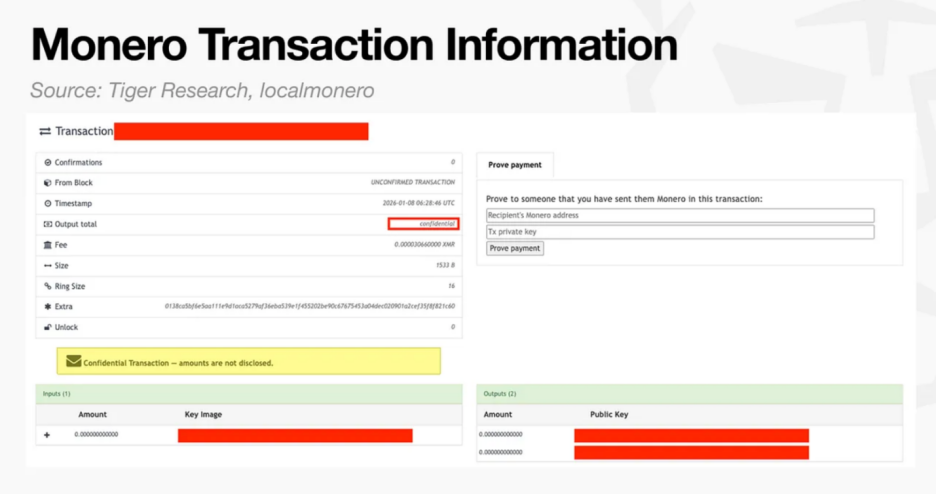
The external manifestation of this conflict is the systematic exclusion of strongly anonymous assets from mainstream financial infrastructure: exchange delistings, lack of support from payment and custody providers, and the inability of compliant capital to integrate into the infrastructure. Importantly, this does not mean that genuine demand for anonymity disappears. Instead, demand often migrates to more opaque, higher-friction channels, fostering “compliance vacuums” and the proliferation of gray intermediaries. In Monero’s case, instant exchange services have, at times, absorbed substantial purchasing and conversion demand. Users pay higher spreads and fees for accessibility, while bearing risks related to fund freezes, counterparty exposure, and lack of transparency. More critically, such intermediaries can introduce persistent structural sell pressure. When service providers rapidly convert collected Monero fees into stablecoins and cash out, the market experiences continuous passive selling unrelated to organic buy demand, suppressing price discovery over the long term. A paradox thus emerges: The more excluded an asset is from compliant channels, the more demand concentrates in high-friction intermediaries; the stronger these intermediaries become, the more distorted price formation becomes; and the more distorted prices are, the harder it is for mainstream assets to assess and enter the market through “normal” channels. This vicious cycle is not evidence that “the market rejects privacy”, but rather the outcome of institutional constraints and channel structures.

Therefore, any assessment of the Monero model should move beyond moralized debate and return to the realities of institutional compatibility. Fully anonymous privacy is “secure by default” in the individual realm, but “unviable by default” in the institutional realm. The more absolute its advantages, the more rigid its constraints. Even if the privacy narrative gains renewed momentum, fully anonymous assets will likely remain concentrated in non-institutional use cases and specific communities. In the institutional era, mainstream finance is far more likely to adopt models of “controlled anonymity” and “selective disclosure”: protecting commercial confidentiality and user privacy while enabling authorized auditability and regulatory evidence when required. In other words, Monero is not a technological failure, but a solution locked into a use case that institutions cannot accommodate. It proves that strong anonymity is technically feasible, while equally demonstrating that, in a compliance-driven financial era, the competitive focus of privacy will shift from “hiding everything” to “proving everything when necessary”.


II. The Rise of Selective Privacy

As fully anonymous privacy approaches its institutional ceiling, the privacy sector is undergoing a directional shift. “Selective privacy” is emerging as a new technological and institutional compromise. Its core objective is not to oppose transparency, but to introduce controllable, authorizable, and disclosable privacy layers on top of a verifiable ledger. The underlying logic of this transition fundamentally lies in that privacy is no longer framed as a tool to evade regulation, but redefined as an infrastructure capability that can be leveraged by institutional systems. Zcash represents the most prominent early implementation of the selective privacy approach. By allowing transparent addresses (t-addresses) and shielded addresses (z-addresses) to coexist, it gives users the freedom to choose between public and private transactions. When shielded addresses are used, the sender, recipient, and amount are encrypted on-chain; when compliance or audit needs arise, users can disclose full transaction details to designated third parties via view keys. Conceptually, this architecture is a milestone. It was among the first mainstream privacy projects to explicitly demonstrate that privacy does not have to come at the expense of verifiability, and that compliance does not necessarily require full transparency.

From an institutional evolution perspective, Zcash’s value lies less in adoption metrics than in its role as a proof of concept. It demonstrates that privacy can be optional rather than a system default, and that cryptographic tools can reserve technical interfaces for regulatory disclosure. This is particularly relevant in today’s regulatory environment where major jurisdictions have not rejected privacy per se, but have firmly opposed “unauditable anonymity”. Zcash’s design directly addresses this core concern. However, as selective privacy moves from “personal transfer tools” to “institutional transaction infrastructure”, Zcash’s structural limitations become apparent. Its privacy model remains fundamentally a transaction-level binary choice: A transaction is either fully public or fully private. For real-world financial scenarios, this binary structure is overly simplistic. Institutional transactions involve not just “two counterparties”, but a variety of participants and responsibility holders. Counterparties need to verify contractual performance, clearing and settlement institutions require visibility into amounts and timing, auditors must validate complete records, and regulators may only be concerned with fund provenance and compliance attributes. These stakeholders have asymmetric and partially overlapping information requirements.

In such contexts, Zcash cannot modularize transaction data or support differentiated authorization. Institutions cannot disclose only “necessary information”, but must choose between full disclosure and full concealment. As a result, once integrated into complex financial workflows, Zcash either exposes excessive commercially sensitive information or fails to meet baseline compliance requirements. Its privacy capabilities therefore struggle to embed into real institutional processes, remaining largely peripheral or experimental. By contrast, the Canton Network represents a fundamentally different selective privacy paradigm. Rather than originating from “anonymous assets”, Canton is designed from the outset around institutional workflows and regulatory constraints. Its core philosophy is not “hiding transactions”, but “managing access to information”. Through the smart contract language Daml, Canton decomposes transactions into multiple logical components, ensuring that each participant can only view the data segments relevant to their authorized role, while all other information is isolated at the protocol level. This design produces a fundamental shift. Privacy is no longer an after-the-fact attribute of transactions, but an embedded feature of contract architecture and permission systems, forming an integral part of compliant processes. 

From a broader perspective, the contrast between Zcash and Canton highlights the divergence within the privacy sector. The former remains rooted in the crypto-native world, seeking a balance between individual privacy and compliance. The latter actively embraces the real financial system, engineering privacy into workflows, processes, and institutions. As institutional capital continues to gain share in the crypto market, the primary battleground of privacy will move accordingly. The future will not be defined by who can conceal the most, but by who can be regulated, audited, and adopted at scale without exposing unnecessary information. Under this standard, selective privacy is no longer merely a technical route, but an inevitable path toward mainstream finance.


III. Privacy 2.0: From Transaction Obfuscation to Privacy-Computing Infrastructure Upgrade

Once privacy is redefined as a prerequisite for institutional blockchain participation, the technical boundaries and value scope of the privacy sector expand accordingly. Privacy is no longer merely understood as “whether a transaction is visible”, but instead evolves toward a deeper question: Whether a system can perform computation, collaboration, and decision-making without exposing the underlying data. This shift marks the transition of the privacy sector from the “privacy assets / private transfers” 1.0 phase to a 2.0 phase centered on privacy computing, upgrading privacy from an optional feature to a general infrastructure capability. In the Privacy 1.0 era, technical focus was primarily on “what to hide” and “how to hide”—that is, how to obscure transaction paths, amounts, and identity linkages. In the Privacy 2.0 era, the focus turns to “what can still be done under conditions of concealment”. This distinction is critical. Institutions do not merely require private transfers; they need to execute complex operations such as trade matching, risk computation, clearing and settlement, strategy execution, and data analytics while preserving privacy. If privacy only covers the payment layer and cannot extend to the business logic layer, its value to institutions remains limited.

The Aztec Network represents one of the earliest manifestations of this shift within the blockchain ecosystem. Aztec does not treat privacy as a tool for resisting transparency, but instead embeds it as a programmable attribute of the smart contract execution environment. Through a rollup architecture built on zero-knowledge proofs, Aztec allows developers to define, at the contract layer, which states should remain private and which should be publicly visible. This enables a hybrid logic of “selective privacy and selective transparency”, allowing privacy to extend beyond simple value transfers to support complex financial structures such as lending, trading, treasury management, and DAO governance. However, Privacy 2.0 does not stop at the blockchain-native world. With the rise of AI, data-intensive finance, and cross-institution collaboration requirements, relying solely on on-chain zero-knowledge proofs is increasingly insufficient to cover the full range of scenarios. Consequently, the privacy sector has begun evolving toward a broader class of “privacy computing networks”. Projects like Nillion and Arcium emerge against this backdrop. Rather than attempting to replace blockchains, these platforms function as privacy collaboration layers between blockchains and real-world applications—a common feature among them. By combining multi-party computation (MPC), fully homomorphic encryption (FHE), and zero-knowledge proofs (ZKP), data can be stored, accessed, and computed while remaining encrypted throughout the process; and participants can jointly complete model inference, risk assessment, or strategy execution without ever accessing the raw data. This approach upgrades privacy from a “transaction-layer attribute” to a "computation-layer capability", expanding its potential market into areas such as AI inference, institutional dark pool trading, RWA data disclosure, and enterprise data collaboration.

Compared with traditional privacy coins, the value logic of privacy-computing projects changes significantly. These projects do not rely on a “privacy premium” as the core narrative. Instead, their value lies in functional indispensability. When certain computations simply cannot be performed in a public environment, or doing so on plaintext would create severe commercial risk or security issues, privacy computing ceases to be a question of “whether it is needed”, and becomes one of “whether operations are even possible without it”.This shift gives the privacy sector, for the first time, the potential for a fundamental moat: Once data, models, and workflows are entrenched in a given privacy computing network, migration costs are significantly higher than with ordinary DeFi protocols. Another notable feature of the Privacy 2.0 stage is the engineering, modularization, and invisibility of privacy. Privacy no longer exists in the explicit forms of “privacy coins” or “privacy protocols”, but is deconstructed into reusable modules embedded into wallets, account abstraction, Layer 2 solutions, bridges, and enterprise systems. End users may not even realize they are “using privacy”, yet their asset balances, trading strategies, identity linkages, and behavioral patterns are protected by default. This kind of “invisible privacy” is paradoxically more aligned with the realistic path to large-scale adoption.

At the same time, regulatory concerns also shift. In the Privacy 1.0 era, the core regulatory question was whether anonymity existed. However, in the Privacy 2.0 era, the question becomes whether compliance can be verified without exposing raw data. Zero-knowledge proofs, verifiable computation, and rule-level compliance thus become the key interfaces between privacy computing projects and institutional environments. Privacy is no longer viewed as a source of risk, but is redefined as a technical means to achieve compliance. Taken together, Privacy 2.0 is not a simple upgrade of privacy coins, but a systematic solution to how blockchains can integrate with the real economy. It signifies that the competitive dimensions of the privacy sector are shifting from asset layer to execution layer, from payment layer to computation layer, and from ideological discourse to engineering capability. In the institutional era, truly valuable long-term privacy projects are not those that are the “most mysterious”, but those that are the "most usable". Privacy computing is the concentrated embodiment of this logic at the technological level.


IV. Conclusion

In summary, the core dividing line in the privacy sector is no longer whether privacy exists, but how privacy can be used under compliant conditions. Fully anonymous models have irreplaceable security value at the individual level, but their institutional non-auditability makes them unsuitable for institutional finance; selective privacy, through designs that enable disclosure and authorization, provides a feasible technical interface between privacy and regulation; and the rise of Privacy 2.0 further upgrades privacy from an asset attribute to an infrastructure capability for computation and collaboration. In the future, privacy will no longer be an explicit feature, but will be embedded as a default system assumption across various financial and data workflows. Privacy projects with long-term value are not necessarily the most “secretive”, but those that are the most usable, verifiable, and compliant. This shift marks a key milestone in the maturation of the privacy sector.


Leituras Relacionadas

Hong Kong Web3 Carnival: The Watershed Moment for Web3 Entering the Execution Phase

The 2026 Hong Kong Web3 Carnival marked a significant shift from previous industry discussions, signaling that Web3 has moved beyond theoretical validation into a phase of institutional and structural implementation. Hong Kong is not merely building a "Web3 industry cluster" but developing an operating system for the next-generation financial infrastructure. Key developments include the expansion of asset tokenization beyond cryptocurrencies to encompass bonds, real estate, and future income rights. This transition represents a fundamental restructuring of financial logic—shifting from institution-dominated asset control to rule-driven, programmable asset流动性 and distribution. Tokenization enables lower-friction participation and broader access to financial resources. Concurrently, AI is evolving from a tool into an autonomous economic agent. The proposed Decentralized Agentic Economy (DAE) framework suggests AI agents, empowered by blockchain-based identity and programmable money, will independently execute transactions and strategies—redefining market dynamics and reducing intermediation. Regulatory progress has been systematic: Hong Kong has expanded oversight to include exchanges, custody, staking, and derivatives, while gradually approving products like tokenized funds and stablecoins. The "same risk, same regulation" principle, combined with sandbox mechanisms, provides stability and transparency—key advantages in a globally fragmented regulatory landscape. Hong Kong’s approach integrates three core elements: real-world asset (RWA) tokenization, stablecoin settlement networks, and AI-driven economic agents. This systemic build-up positions Hong Kong not just as a participant but as a potential rule-maker in the next-era financial system, where asset flow, rules, and participants are simultaneously transformed.

marsbitHá 46m

Hong Kong Web3 Carnival: The Watershed Moment for Web3 Entering the Execution Phase

marsbitHá 46m

ENI Officially Announces Completion of Strategic Brand Upgrade: Evolving from Underlying Protocol to Global Institutional-Grade Financial Infrastructure

ENI Announces Strategic Brand Upgrade: Evolving from Underlying Protocol to Global Institutional-Grade Financial Infrastructure At the Hong Kong Web3 Festival on April 20, 2026, ENI founder and CEO Arion Ho announced the completion of a comprehensive brand, website, and visual system upgrade. This marks a significant shift from being an "underlying public chain" to an enterprise-grade Blockchain-as-a-Service (BaaS) platform, positioning ENI as a key infrastructure provider bridging traditional finance (TradFi) and Web3. The rebranding emphasizes precision and professionalism, reflected in a refined visual identity featuring a 25-degree tilt and a 1:4 golden ratio in its design elements. This aesthetic upgrade, led by a top-tier design team with experience from Hermès and ByteDance, underscores ENI’s commitment to institutional-grade trust and global sophistication. ENI now functions as a bridge between technological innovation and real-world business applications. It offers tailored architecture solutions for large institutions and standardized, low-friction BaaS tools for SMEs, enabling seamless integration of Web3 capabilities into existing business models. The announcement in Hong Kong, a global financial hub, signals ENI’s matured, global-ready approach to supporting the commercial adoption of Web3. By providing a stable, standardized platform, ENI aims to facilitate the secure migration of real-world assets and operations into the digital economy.

marsbitHá 1h

ENI Officially Announces Completion of Strategic Brand Upgrade: Evolving from Underlying Protocol to Global Institutional-Grade Financial Infrastructure

marsbitHá 1h

Trading

Spot
Futuros

Artigos em Destaque

O que é ETH 2.0

ETH 2.0: Uma Nova Era para o Ethereum Introdução ETH 2.0, amplamente conhecido como Ethereum 2.0, marca uma atualização monumental à blockchain do Ethereum. Esta transição não é meramente uma mudança estética; visa melhorar fundamentalmente a escalabilidade, segurança e sustentabilidade da rede. Com uma mudança do mecanismo de consenso em Proof of Work (PoW), intensivo em energia, para um Proof of Stake (PoS) mais eficiente, o ETH 2.0 promete uma abordagem transformadora ao ecossistema blockchain. O que é ETH 2.0? ETH 2.0 é um conjunto de atualizações distintas e interconectadas focadas na otimização das capacidades e desempenho do Ethereum. Esta reformulação foi projetada para abordar desafios críticos que o mecanismo atual do Ethereum enfrentou, particularmente em relação à velocidade das transações e à congestão da rede. Objetivos do ETH 2.0 Os principais objetivos do ETH 2.0 giram em torno da melhoria de três aspectos centrais: Escalabilidade: Com o objetivo de melhorar significativamente o número de transações que a rede pode manejar por segundo, o ETH 2.0 procura ultrapassar a limitação atual de aproximadamente 15 transações por segundo, alcançando potencialmente milhares. Segurança: Medidas de segurança melhoradas são integrais ao ETH 2.0, especialmente através da resistência aprimorada contra ciberataques e da preservação do ethos descentralizado do Ethereum. Sustentabilidade: O novo mecanismo PoS foi projetado não apenas para melhorar a eficiência, mas também para reduzir drasticamente o consumo de energia, alinhando a estrutura operacional do Ethereum com considerações ambientais. Quem é o Criador do ETH 2.0? A criação do ETH 2.0 pode ser atribuída à Ethereum Foundation. Esta organização sem fins lucrativos, que desempenha um papel crucial no apoio ao desenvolvimento do Ethereum, é liderada pelo co-fundador notável Vitalik Buterin. A sua visão de um Ethereum mais escalável e sustentável tem sido a força motriz por trás desta atualização, envolvendo contribuições de uma comunidade global de desenvolvedores e entusiastas dedicados a melhorar o protocolo. Quem são os Investidores do ETH 2.0? Embora os detalhes sobre os investidores do ETH 2.0 não tenham sido tornados públicos, é sabido que a Ethereum Foundation recebe apoio de várias organizações e indivíduos no espaço da blockchain e tecnologia. Esses parceiros incluem firmas de capital de risco, empresas de tecnologia e organizações filantrópicas que compartilham um interesse mútuo em apoiar o desenvolvimento de tecnologias descentralizadas e infraestrutura de blockchain. Como Funciona o ETH 2.0? ETH 2.0 é notável por introduzir uma série de características chave que o diferenciam do seu predecessor. Proof of Stake (PoS) A transição para um mecanismo de consenso PoS é uma das mudanças de destaque do ETH 2.0. Ao contrário do PoW, que depende da mineração intensiva em energia para a verificação de transações, o PoS permite que os utilizadores validem transações e criem novos blocos de acordo com a quantidade de ETH que apostam na rede. Isso leva a uma maior eficiência energética, reduzindo o consumo em aproximadamente 99,95%, tornando o Ethereum 2.0 uma alternativa consideravelmente mais ecológica. Shard Chains As shard chains são outra inovação crítica do ETH 2.0. Estas cadeias menores operam em paralelo com a cadeia principal do Ethereum, permitindo que várias transações sejam processadas simultaneamente. Esta abordagem melhora a capacidade geral da rede, abordando preocupações de escalabilidade que têm atormentado o Ethereum. Beacon Chain No coração do ETH 2.0 está a Beacon Chain, que coordena a rede e gere o protocolo PoS. Ela atua como uma espécie de organizador: supervisiona os validadores, garante que as shards permaneçam conectadas à rede e monitora a saúde geral do ecossistema blockchain. Linha do Tempo do ETH 2.0 A jornada do ETH 2.0 tem sido marcada por vários marcos chave que traçam a evolução desta atualização significativa: Dezembro de 2020: O lançamento da Beacon Chain marcou a introdução do PoS, preparando o caminho para a migração para o ETH 2.0. Setembro de 2022: A conclusão de “The Merge” representa um momento crucial em que a rede Ethereum fez a transição com sucesso de um quadro PoW para um PoS, anunciando uma nova era para o Ethereum. 2023: O lançamento esperado das shard chains visa melhorar ainda mais a escalabilidade da rede Ethereum, solidificando o ETH 2.0 como uma plataforma robusta para aplicações e serviços descentralizados. Características Chave e Benefícios Escalabilidade Melhorada Uma das vantagens mais significativas do ETH 2.0 é a sua escalabilidade melhorada. A combinação de PoS e shard chains permite que a rede expanda a sua capacidade, permitindo que acomode um volume de transações muito maior em comparação com o sistema legado. Eficiência Energética A implementação do PoS representa um enorme passo em direção à eficiência energética na tecnologia blockchain. Ao reduzir drasticamente o consumo de energia, o ETH 2.0 não só reduz os custos operacionais, mas também se alinha mais estreitamente com os objetivos globais de sustentabilidade. Segurança Aprimorada Os mecanismos atualizados do ETH 2.0 contribuem para uma segurança melhorada em toda a rede. O uso do PoS, juntamente com medidas de controle inovadoras estabelecidas através das shard chains e da Beacon Chain, assegura um maior grau de proteção contra potenciais ameaças. Custos Mais Baixos para os Utilizadores À medida que a escalabilidade melhora, os efeitos sobre os custos de transação também serão evidentes. Aumentada a capacidade e reduzida a congestão, espera-se que isso se traduza em taxas mais baixas para os utilizadores, tornando o Ethereum mais acessível para transações do dia a dia. Conclusão ETH 2.0 marca uma evolução significativa no ecossistema da blockchain do Ethereum. Ao abordar questões fundamentais como a escalabilidade, o consumo de energia, a eficiência das transações e a segurança geral, a importância desta atualização não pode ser subestimada. A transição para o Proof of Stake, a introdução das shard chains e o trabalho fundamental da Beacon Chain são indicativos de um futuro em que o Ethereum pode atender à crescente demanda do mercado descentralizado. Em uma indústria movida pela inovação e progresso, o ETH 2.0 representa um testemunho das capacidades da tecnologia blockchain em pavimentar o caminho para uma economia digital mais sustentável e eficiente.

100 Visualizações TotaisPublicado em {updateTime}Atualizado em 2024.12.03

O que é ETH 2.0

O que é ETH 3.0

ETH3.0 e $eth 3.0: Uma Análise Profunda do Futuro do Ethereum Introdução No ambiente em rápida evolução da criptomoeda e da tecnologia blockchain, o ETH3.0, frequentemente denotado como $eth 3.0, emergiu como um tema de considerável interesse e especulação. O termo abrange dois conceitos principais que merecem esclarecimento: Ethereum 3.0: Esta representa uma potencial atualização futura destinada a aumentar as capacidades da atual blockchain do Ethereum, focando especialmente na melhoria da escalabilidade e desempenho. ETH3.0 Meme Token: Este distinto projeto de criptomoeda procura aproveitar a blockchain do Ethereum na criação de um ecossistema centrado em memes, promovendo o envolvimento na comunidade de criptomoedas. Compreender esses aspectos do ETH3.0 é essencial não apenas para entusiastas de criptomoedas, mas também para aqueles que observam as tendências tecnológicas mais amplas no espaço digital. O que é ETH3.0? Ethereum 3.0 Ethereum 3.0 é promovido como uma atualização proposta para a rede Ethereum já estabelecida, que tem sido a espinha dorsal de muitas aplicações descentralizadas (dApps) e contratos inteligentes desde a sua criação. As melhorias vislumbradas concentram-se principalmente na escalabilidade—integrando tecnologias avançadas como sharding e provas de conhecimento zero (zk-proofs). Essas inovações tecnológicas visam facilitar um número sem precedentes de transações por segundo (TPS), potencialmente alcançando milhões, abordando assim uma das limitações mais significativas enfrentadas pela tecnologia blockchain atual. A melhoria não é meramente técnica, mas também estratégica; visa preparar a rede Ethereum para uma adoção generalizada e utilidade em um futuro marcado por uma maior demanda por soluções descentralizadas. ETH3.0 Meme Token Em contraste com o Ethereum 3.0, o ETH3.0 Meme Token aventura-se por um domínio mais leve e divertido, combinando a cultura dos memes da internet com a dinâmica das criptomoedas. Este projeto permite que os usuários comprem, vendam e negociem memes na blockchain do Ethereum, proporcionando uma plataforma que fomenta o envolvimento da comunidade através da criatividade e interesses compartilhados. O ETH3.0 Meme Token visa demonstrar como a tecnologia blockchain pode interseccionar com a cultura digital, criando casos de uso que são tanto divertidos quanto financeiramente viáveis. Quem é o Criador do ETH3.0? Ethereum 3.0 A iniciativa em direção ao Ethereum 3.0 é impulsionada principalmente por um consórcio de desenvolvedores e pesquisadores dentro da comunidade Ethereum, notavelmente incluindo Justin Drake. Conhecido por suas percepções e contribuições para a evolução do Ethereum, Drake tem sido uma figura proeminente nas discussões sobre a transição do Ethereum para uma nova camada de consenso, referida como “Beam Chain”. Esta abordagem colaborativa ao desenvolvimento significa que o Ethereum 3.0 não é fruto de um único criador, mas sim uma manifestação da engenhosidade coletiva focada no avanço da tecnologia blockchain. ETH3.0 Meme Token Os detalhes sobre o criador do ETH3.0 Meme Token são atualmente indetectáveis. A natureza dos tokens de meme frequentemente leva a uma estrutura mais descentralizada e impulsionada pela comunidade, o que poderia explicar a falta de atribuição específica. Isso alinha-se com a ethos da comunidade de criptomoedas mais ampla, onde a inovação geralmente surge de esforços colaborativos em vez de esforços individuais. Quem são os Investidores do ETH3.0? Ethereum 3.0 O apoio ao Ethereum 3.0 provém principalmente da Fundação Ethereum, juntamente com uma comunidade entusiástica de desenvolvedores e investidores. Esta associação fundacional proporciona um grau significativo de legitimidade e melhora as perspectivas de uma implementação bem-sucedida, uma vez que aproveita a confiança e credibilidade construída ao longo de anos de operações de rede. Em um clima em rápida mudança no mundo das criptomoedas, o apoio da comunidade desempenha um papel crucial no impulso ao desenvolvimento e adoção, posicionando o Ethereum 3.0 como um sério candidato a futuros avanços na blockchain. ETH3.0 Meme Token Embora as fontes atualmente disponíveis não forneçam informações explícitas sobre as fundações ou organizações de investimento que apoiam o ETH3.0 Meme Token, é indicativo do modelo típico de financiamento para tokens de meme, que frequentemente depende de apoio base e engajamento da comunidade. Os investidores em tais projetos costumam consistir em indivíduos motivados pelo potencial de inovação impulsionada pela comunidade e pelo espírito de cooperação encontrado dentro da comunidade cripto. Como Funciona o ETH3.0? Ethereum 3.0 As características distintivas do Ethereum 3.0 residem em sua proposta de implementação de sharding e tecnologia zk-proof. Sharding é um método de partição da blockchain em partes menores e gerenciáveis ou “shards”, que podem processar transações simultaneamente em vez de sequencialmente. Esta descentralização do processamento ajuda a prevenir congestionamentos e garante que a rede permaneça responsiva mesmo sob carga pesada. A tecnologia de prova de conhecimento zero (zk-proof) contribui com outra camada de sofisticação ao permitir a validação de transações sem revelar os dados subjacentes envolvidos. Este aspecto não apenas melhora a privacidade, mas também aumenta a eficiência geral da rede. Há também conversas sobre a incorporação de uma Máquina Virtual Ethereum de conhecimento zero (zkEVM) nesta atualização, amplificando ainda mais as capacidades e utilidade da rede. ETH3.0 Meme Token O ETH3.0 Meme Token distingue-se ao capitalizar sobre a popularidade da cultura dos memes. Estabelece um mercado para que os usuários participem da negociação de memes, não apenas para entretenimento, mas também para potencial ganho econômico. Ao integrar recursos como staking, provisão de liquidez e mecanismos de governança, o projeto fomenta um ambiente que incentiva a interação e participação da comunidade. Ao oferecer uma mistura única de entretenimento e oportunidade econômica, o ETH3.0 Meme Token visa atrair um público diversificado, variando de entusiastas de criptomoedas a conhecedores casuais de memes. Cronologia do ETH3.0 Ethereum 3.0 11 de novembro de 2024: Justin Drake sugere a próxima atualização do ETH 3.0, centrada nas melhorias de escalabilidade. Este anúncio sinaliza o início de discussões formais sobre a futura arquitetura do Ethereum. 12 de novembro de 2024: A proposta antecipada para Ethereum 3.0 deve ser revelada no Devcon em Bangkok, preparando o cenário para um feedback mais amplo da comunidade e potenciais próximos passos no desenvolvimento. ETH3.0 Meme Token 21 de março de 2024: O ETH3.0 Meme Token é oficialmente listado no CoinMarketCap, marcando sua entrada no domínio público das criptomoedas e aumentando a visibilidade de seu ecossistema baseado em memes. Pontos Chave Em conclusão, Ethereum 3.0 representa uma evolução significativa dentro da rede Ethereum, focando em superar limitações quanto à escalabilidade e desempenho através de tecnologias avançadas. As atualizações propostas refletem uma abordagem proativa às futuras demandas e usabilidade. Por outro lado, o ETH3.0 Meme Token encapsula a essência da cultura impulsionada pela comunidade no espaço das criptomoedas, aproveitando a cultura dos memes para criar plataformas envolventes que incentivam a criatividade e participação dos usuários. Compreender os distintos propósitos e funcionalidades do ETH3.0 e $eth 3.0 é fundamental para qualquer pessoa interessada nos desenvolvimentos contínuos dentro do espaço cripto. Com ambas as iniciativas a pavimentar caminhos únicos, elas sublinham coletivamente a natureza dinâmica e multifacetada da inovação em blockchain.

98 Visualizações TotaisPublicado em {updateTime}Atualizado em 2024.12.03

O que é ETH 3.0

Como comprar ETH

Bem-vindo à HTX.com!Tornámos a compra de Ethereum (ETH) simples e conveniente.Segue o nosso guia passo a passo para iniciar a tua jornada no mundo das criptos.Passo 1: cria a tua conta HTXUtiliza o teu e-mail ou número de telefone para te inscreveres numa conta gratuita na HTX.Desfruta de um processo de inscrição sem complicações e desbloqueia todas as funcionalidades.Obter a minha contaPasso 2: vai para Comprar Cripto e escolhe o teu método de pagamentoCartão de crédito/débito: usa o teu visa ou mastercard para comprar Ethereum (ETH) instantaneamente.Saldo: usa os fundos da tua conta HTX para transacionar sem problemas.Terceiros: adicionamos métodos de pagamento populares, como Google Pay e Apple Pay, para aumentar a conveniência.P2P: transaciona diretamente com outros utilizadores na HTX.Mercado de balcão (OTC): oferecemos serviços personalizados e taxas de câmbio competitivas para os traders.Passo 3: armazena teu Ethereum (ETH)Depois de comprar o teu Ethereum (ETH), armazena-o na tua conta HTX.Alternativamente, podes enviá-lo para outro lugar através de transferência blockchain ou usá-lo para transacionar outras criptomoedas.Passo 4: transaciona Ethereum (ETH)Transaciona facilmente Ethereum (ETH) no mercado à vista da HTX.Acede simplesmente à tua conta, seleciona o teu par de trading, executa as tuas transações e monitoriza em tempo real.Oferecemos uma experiência de fácil utilização tanto para principiantes como para traders experientes.

2.9k Visualizações TotaisPublicado em {updateTime}Atualizado em 2025.03.21

Como comprar ETH

Discussões

Bem-vindo à Comunidade HTX. Aqui, pode manter-se informado sobre os mais recentes desenvolvimentos da plataforma e obter acesso a análises profissionais de mercado. As opiniões dos utilizadores sobre o preço de ETH (ETH) são apresentadas abaixo.

活动图片