InfoFi Narrative Collapses, Kaito, Cookie, and Others Shut Down Related Products

marsbitPublicado em 2026-01-15Última atualização em 2026-01-15

Resumo

The InfoFi narrative, which gained significant traction in the crypto industry, experienced a sudden collapse following an announcement by X's product lead, Nikita Bier, regarding changes to the platform’s API policy. The new policy prohibits applications that reward users for posting on X, citing concerns over AI-generated spam and low-quality replies. This decision effectively undermines the core functionality of many InfoFi projects that rely on X’s API to access user data and distribute tokenized rewards. Key projects, Kaito and Cookie, quickly responded to the policy shift. Kaito announced it would pivot toward Kaito Studio, a more selective, brand-driven platform that moves beyond the crypto space. Its founder, Yu Hu, emphasized a broader focus beyond cryptocurrency. Similarly, Cookie decided to shut down its Snaps platform but is developing Cookie Pro, a real-time crypto market intelligence tool, while exploring potential future adaptations in line with X’s guidelines. The abrupt policy change highlights the vulnerability of InfoFi models that depend heavily on-platform engagement metrics. While some projects, such as those focused on monetizing narratives rather than direct posting rewards, may remain unaffected, the incident marks a significant shift for the attention economy within crypto. The evolution of InfoFi may continue in new forms, but its current iteration has been severely disrupted.

Author: Gu Yu, ChainCatcher

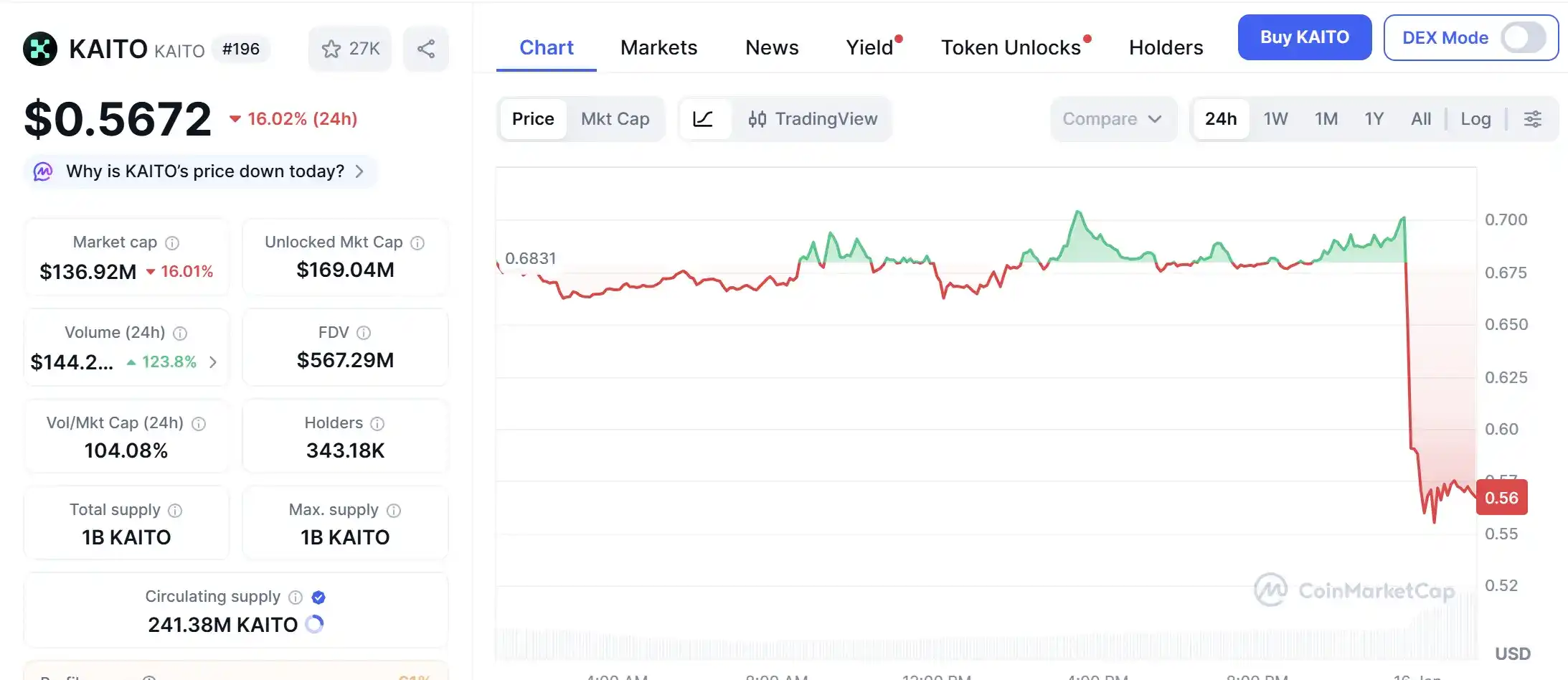
At 1:16 AM Beijing time on January 16, the crypto industry was once again as the highly popular InfoFi narrative suddenly collapsed. Kaito, Cookie, and others successively announced the shutdown of InfoFi-related products and attempted to pivot, with their token prices plummeting by nearly 20% at one point.
And this was all triggered by a tweet from X Product Lead Nikita Bier. Nikita Bier stated that the team is revising its developer API policy and will no longer allow any applications that reward users for posting on the X platform (e.g., "infofi"). This has led to the platform being flooded with a large amount of AI spam and reply spam.

"We have revoked the API access for these applications, so your X experience should start to improve soon (once the bots realize they are no longer being paid)." Nikita Bier said.

Since most InfoFi projects rely on the X product API to obtain user tweet data and determine reward schemes, once the API is disabled, the vast majority of content for such products will stop updating, losing their foundation.

An hour after the news was released, projects like Kaito and Cookie quickly issued response statements on their official Twitter accounts, showing that they had anticipated and prepared for this situation. Let's first see how they specifically responded.

Kaito: To Focus More on Areas Beyond Crypto

Kaito stated that in response to the large number of spam tweets, the project tried stricter eligibility reviews, higher leaderboard thresholds, social + on-chain screening mechanisms, and different incentive mechanisms. However, due to platform-wide X algorithm changes and the launch of other InfoFi projects with varying thresholds, the problem of low-quality and spam information remains widespread across the cryptocurrency field.

After discussions with the X team, both parties agreed that a completely permissionless distribution system is no longer feasible and does not meet the needs of high-quality brands, serious content creators, or X as a platform.

Next, Kaito will focus on launching Kaito Studio, which will be closer to a traditional tiered marketing platform where brands can selectively collaborate with creators based on established criteria and clear project scopes.

Kaito founder Yu Hu said that the past few months have been busy with the development of Kaito Studio, hence the low profile on social media and announcements, with little mention of project construction and strategic adjustments. Additionally, he personally met with some large brands outside the cryptocurrency field to learn from the successful experiences of traditional industry.

"We should no longer build and create for cryptocurrency, but for the broader world." Yu Hu believes that 2026 will be the year Kaito transcends CT as its main platform and cryptocurrency as its primary vertical.

Cookie: To Launch Real-Time Crypto Market Wallet Tool

Cookie posted that deciding to shut down the Snaps platform and all active creator campaigns was a difficult and sudden decision, but it was necessary to maintain the integrity of the Cookie data layer and products.

After discussions with the X team regarding its API and X usage policies, Cookie decided to immediately shut down Snaps and all ongoing activities.

However, the project still holds hope for the future of the Snaps product. "Currently, we are actively negotiating with X to determine if Snaps can continue to operate in a new form." Cookie believes, "We have always firmly believed that we fully comply with all of X's rules and policies. We will await confirmation and guidance from X on whether creator activities (such as Snaps) can operate in any form in the future."

At the same time, Cookie also proposed future product iteration plans, "For the past six months, we have been developing Cookie Pro—a real-time market intelligence tool for the cryptocurrency field, planned for official launch in the first quarter."

Has InfoFi Fallen?

It is undeniable that InfoFi has brought much vitality and change to the industry in recent years. It combines information and finance, creating a mechanism that evaluates user contributions based on the attention generated by their content (e.g., views, comments, and shares) and links it to token rewards.

In essence, InfoFi transforms attention from an abstract concept into quantifiable and tradable data. User participation shifts from simple content consumption to productive activity, and projects can more targetedly provide rewards to their content contributors.

However, when attention becomes the standard for rewards, the purpose of creating content now shifts from providing information or encouraging meaningful engagement to merely seeking rewards. And generative AI makes content creation easier, leading to the rapid spread of bulk content lacking real information or insight.

Several key members of the X team have mentioned the decline in Twitter content quality brought by InfoFi, so projects like Kaito have tried to optimize their algorithmic solutions, but never expected X to directly block this path from its foundation.

It is worth noting, however, that not all InfoFi projects incentivize users to post for rewards. For example, projects like xHunt and Ethos that rely on the X API primarily use the API to obtain tweet data for scoring and other operations. The impact of this X API policy adjustment on these projects is not yet known and requires further observation.

Additionally, some types of InfoFi projects mainly focus on the monetization of industry hotspot narratives, such as Noise and Narrative, and are expected to be largely unaffected.

Now that the InfoFi narrative has quickly collapsed, the attention economy and creator economy remain key focuses of the entire internet industry. In the future, InfoFi may reappear in front of the public in new forms and concepts.


Criptomoedas em alta

Perguntas relacionadas

QWhat major event led to the collapse of the InfoFi narrative and the shutdown of products like Kaito and Cookie?

AThe collapse was triggered by X's product lead Nikita Bier announcing a revision to the developer API policy, which no longer allows applications that reward users for posting on X (such as 'infofi') due to the proliferation of AI-generated spam and low-quality replies.

QHow did Kaito respond to X's API policy change, and what is their new strategic direction?

AKaito responded by shifting focus to Kaito Studio, a more traditional graded marketing platform where brands can selectively collaborate with creators based on set criteria. They aim to expand beyond the cryptocurrency领域 and target broader industries.

QWhat product did Cookie announce it was developing after shutting down its Snaps platform?

ACookie announced it is developing 'Cookie Pro,' a real-time market intelligence tool for the cryptocurrency space, planned for launch in the first quarter.

QWhy did X decide to restrict API access for InfoFi applications according to the article?

AX restricted API access because InfoFi applications incentivized users to post content primarily for rewards, leading to an influx of low-quality, AI-generated spam that degraded the overall user experience on the platform.

QAre all types of InfoFi projects affected equally by X's API policy change, as per the article?

ANo, not all InfoFi projects are equally affected. Projects like xHunt and Ethos that use X API for data scoring may be impacted, while others like Noise and Narrative, which focus on monetizing industry narratives, are expected to remain largely unaffected.

Leituras Relacionadas

Breaking News: Musk Delivers the Most Powerful Grok 4.5, Slashes Price of Top-tier Opus Intelligence Drastically

**Elon Musk Launches Grok 4.5: A Cost-Effective, High-Performance AI Rival** SpaceXAI, in collaboration with Cursor, has released Grok 4.5, its new flagship AI model designed specifically for coding and agentic tasks. Trained on tens of thousands of NVIDIA GB300 GPUs using massive, high-quality data filtered from trillions of Cursor developer interactions, the model emphasizes "per-token intelligence." In benchmark performance, Grok 4.5 is highly competitive. It scores 64.7% on SWE Bench Pro (surpassing GPT-5.5's 58.6% and Opus 4.7's 64.3%), 83.3% on Terminal Bench 2.1 (nearly matching GPT-5.5), and 62.0% on DeepSWE 1.0 (beating Opus 4.8). Overall, it ranks fourth in AAAI official tests and first in the Harvey legal agent benchmark. The model's key advantage is its combination of speed, efficiency, and low cost. It generates responses at 80 tokens per second and, crucially, uses far fewer tokens to complete tasks—4.2 times fewer than Opus 4.8 on SWE Bench Pro. It is priced at $2 per million input tokens and $6 per million output tokens, significantly undercutting competitors. Musk stated it is "roughly equivalent to Opus 4.7, but much faster." Early user tests show Grok 4.5 can generate functional code for applications like 3D solar system simulators and basic games from simple prompts, though some note it still lags behind top models in certain creative tasks. Musk has hinted at a major update next month, leveraging real-world engineering data from his companies, with an even larger 2-trillion parameter version reportedly in development. Grok 4.5 positions itself not as the absolute strongest model, but as a highly efficient and affordable alternative in the top tier.

marsbitHá 7m

Breaking News: Musk Delivers the Most Powerful Grok 4.5, Slashes Price of Top-tier Opus Intelligence Drastically

marsbitHá 7m

Today, The Hong Kong Exchange Was Once Again Overwhelmed

Hong Kong's stock exchange witnessed an exceptionally busy day on July 9, with a record seven companies conducting initial public offerings (IPOs) simultaneously. The list included major firms such as Luxshare Precision, which launched the largest Hong Kong IPO of the year, and other notable names like Tri-Ring Group and Qiyunshan Food. However, the market reception was sharply divided on the first trading day. While Qiyunshan Food's shares surged over 110%, several other newcomers, including Luxshare Precision, Dingtai High-Tech, and Rigol Technologies, opened below their issue prices, with some falling nearly 20%. This event highlights a broader, bustling IPO scene in Hong Kong for 2024, with 82 Chinese companies listing in the first half alone—more than double the figure from the same period last year. A significant portion of this activity comes from dual "A+H" listings, where mainland China-listed firms seek secondary listings in Hong Kong. These larger companies have accounted for nearly 60% of total fundraising. Despite the high volume, recent trends show a cooling market sentiment for many new listings. Several IPOs in early July, including that of Tongrentang Healthcare, debuted with significant losses, indicating increased investor caution and selectivity. The market narrative is shifting, with capital increasingly concentrating on high-growth sectors like artificial intelligence, robotics, and semiconductors, while traditional manufacturing and consumer goods face greater pressure and volatility. This divergence underscores a market where success is no longer guaranteed by merely listing, but depends heavily on a company's growth prospects and sector appeal.

marsbitHá 12m

Today, The Hong Kong Exchange Was Once Again Overwhelmed

marsbitHá 12m

Glassnode: Crypto Market Enters Later Stages of Bottoming Phase

Glassnode: Crypto Market Enters Later Stages of Bottom Formation Bitcoin has traded below the true market average and the short-term holder cost basis for five consecutive months, indicating a deep undervaluation. On-chain data reveals a significant shift in selling pressure, with long-term holders now accounting for 43% of all realized losses. Daily realized losses for this group recently peaked at $280 million, the highest level since December 2022. While this large-scale capitulation is a hallmark of bear market bottoms, a sustained decline in this metric is a prerequisite for a sustained recovery. Institutional demand remains weak. US spot Bitcoin ETFs continue to see monthly net outflows, although the pace has moderated from June's peak. Furthermore, average daily ETF trading volumes have contracted by approximately 80% from their October 2025 peak, reflecting subdued institutional participation. Derivatives markets present a mixed picture. Overall positioning has shifted to cautiously bullish, with the put/call ratio dropping to a yearly low. However, the options volatility skew remains elevated, signaling that traders are still paying a premium for downside protection. The spot price also trades below the gamma "max pain" level. In summary, multiple indicators suggest the market is in the later phases of a bottoming process, characterized by long-term holder capitulation and weak institutional inflows. However, key confirmation signals for a durable trend reversal—a sustained drop in long-term holder selling pressure, stabilization of ETF flows, and a price recovery above key cost bases—are still pending.

Foresight NewsHá 38m

Glassnode: Crypto Market Enters Later Stages of Bottoming Phase

Foresight NewsHá 38m

Private Credit in US Dollar

Stablecoins are evolving into a new type of money market fund, channeling crypto deposits into the $2 trillion private credit market. This mirrors the 1970s innovation where money market funds pooled small deposits to buy high-yield government securities, bypassing bank restrictions. Today, platforms like Apollo's ACRED tokenized fund and Figure's on-chain lending system allow stablecoin holders to access institutional private credit strategies with no minimum investment, offering yields of 8-12%. On-chain tokenization enables greater liquidity and DeFi composability (e.g., using tokens as collateral for leveraged positions) compared to traditional, locked-up private credit funds. Consequently, on-chain private credit has grown 15x in a year to $5.87 billion, though it remains a tiny fraction (0.3%) of the global market. However, this model carries significant risks, as illustrated by the failure of Goldfinch. Launched in 2021, it directed crypto deposits to motorcycle loans in Kenya and Nigeria. Critical issues included a lack of local oversight, leading to unauthorized fund transfers and borrower defaults. With $56 million now trapped in non-performing loans, its collapse highlights that while blockchain streamlines capital transfer, the essential 90% of lending—underwriting, monitoring, and recovery—remains a costly, localized challenge. Success requires robust, traditional credit infrastructure, not just on-chain execution.

marsbitHá 58m

Private Credit in US Dollar

marsbitHá 58m

Trading

Spot

Artigos em Destaque

Como comprar COOKIE

Bem-vindo à HTX.com!Tornámos a compra de Cookie DAO (COOKIE) simples e conveniente.Segue o nosso guia passo a passo para iniciar a tua jornada no mundo das criptos.Passo 1: cria a tua conta HTXUtiliza o teu e-mail ou número de telefone para te inscreveres numa conta gratuita na HTX.Desfruta de um processo de inscrição sem complicações e desbloqueia todas as funcionalidades.Obter a minha contaPasso 2: vai para Comprar Cripto e escolhe o teu método de pagamentoCartão de crédito/débito: usa o teu visa ou mastercard para comprar Cookie DAO (COOKIE) instantaneamente.Saldo: usa os fundos da tua conta HTX para transacionar sem problemas.Terceiros: adicionamos métodos de pagamento populares, como Google Pay e Apple Pay, para aumentar a conveniência.P2P: transaciona diretamente com outros utilizadores na HTX.Mercado de balcão (OTC): oferecemos serviços personalizados e taxas de câmbio competitivas para os traders.Passo 3: armazena teu Cookie DAO (COOKIE)Depois de comprar o teu Cookie DAO (COOKIE), armazena-o na tua conta HTX.Alternativamente, podes enviá-lo para outro lugar através de transferência blockchain ou usá-lo para transacionar outras criptomoedas.Passo 4: transaciona Cookie DAO (COOKIE)Transaciona facilmente Cookie DAO (COOKIE) no mercado à vista da HTX.Acede simplesmente à tua conta, seleciona o teu par de trading, executa as tuas transações e monitoriza em tempo real.Oferecemos uma experiência de fácil utilização tanto para principiantes como para traders experientes.

228 Visualizações TotaisPublicado em {updateTime}Atualizado em 2026.06.02

Como comprar COOKIE

Discussões

Bem-vindo à Comunidade HTX. Aqui, pode manter-se informado sobre os mais recentes desenvolvimentos da plataforma e obter acesso a análises profissionais de mercado. As opiniões dos utilizadores sobre o preço de COOKIE (COOKIE) são apresentadas abaixo.

活动图片