From ETH’s Merge to ‘surge, verge, purge, splurge’- Making sense of it all

AmbcryptoPublicado em 2022-07-23Última atualização em 2022-07-23

Resumo

The annual Ethereum community Conference (ETHCC) took place on 21 July in Paris. Ethereum [ETH] co-founder Vitalik Buterin addressed the audience at this conference and spoke about the long-term potential of the network.

The annual Ethereum community Conference (ETHCC) took place on 21 July in Paris. Ethereum [ETH] co-founder Vitalik Buterin addressed the audience at this conference and spoke about the long-term potential of the network.

The developer-focused conference saw Buterin speak of the upcoming “Merge,” which will see Ethereum’s transition from proof-of-work (PoW) to proof-of-stake (PoS).

Moreover, while describing the long- and short-term effects of the Merge, Buterin stated: “After the merge, you will be able to design an Ethereum client that does not even know the proof-of-work phase has happened.”

He also went on to state that, “At the end of this road map, Ethereum will be a much more scalable system. By the end, Ethereum will be able to process 100,000 transactions per second.”

According to him, post Merge, the protocol will be “55% complete” in terms of the overall evolution of the Ethereum network. Therefore, developers have a lot of work ahead of them.

Change is the only constant

The intended “deep changes” are being made to make Ethereum a more potent and reliable network, according to Buterin. He informed the audience that following the integration, Ethereum will go through additional upgrades that he refers to as the “surge,” “verge,” “purge,” and “splurge.”

The surge refers to the addition of Ethereum sharding, a scaling solution that, according to the Ethereum Foundation will make layer-2 blockchains even more affordable.

It will also reduce the cost of rollups or bundled transactions, and make it simpler for users to run nodes that protect the Ethereum network. Buterin added that the Ethereum network will handle transactions more quickly after the surge is over.

The Verge will introduce “stateless clients” and “Verkle trees,” a kind of mathematical proof. Users won’t need to keep a lot of data on their computers to function as network validators because of these technological advancements.

Validators in a proof-of-stake network authenticate and verify transactions using locked-up or “staked” ETH.

To streamline storage and lessen network traffic, the Purge will help eliminate old data. Following the previous upgrades, there will be a Splurge that will consist of several smaller upgrades and fine-tuning to ensure seamless network operations.

Vitalik further claimed that accomplishing these decentralized goals is difficult because of the network’s complexity and how quickly it is evolving. But, he asserted, these network upgrades have long been anticipated by all parties.

Notably, the price of ETH increased by about 33% this week. The altcoin also crossed the $1,600 mark to trade at $1,628 at press time.
Leituras Relacionadas

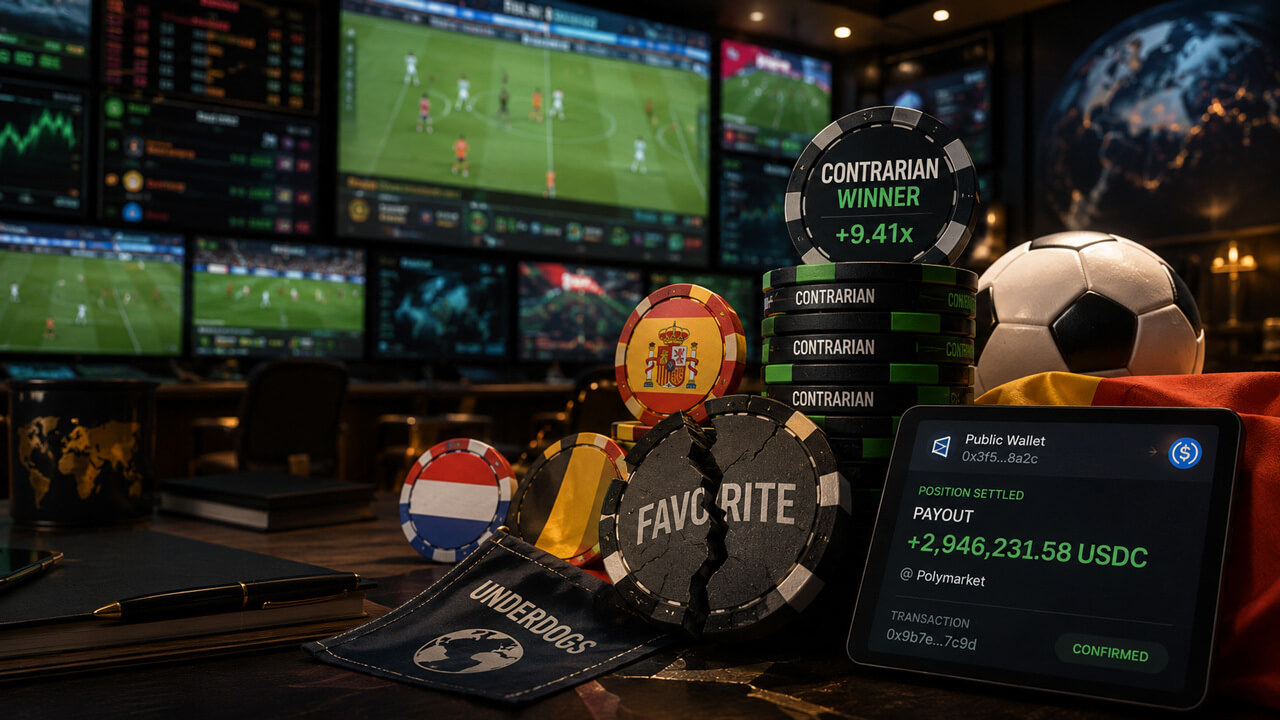
Football Draw Harvests Whales: Extreme Profit-Loss Divergence on Polymarket's World Cup

A bettor known as "fishalive" made a stunning profit of nearly $9 million on the Polymarket prediction platform by correctly wagering against favorites during the 2026 FIFA World Cup group stage. The account, registered just before the tournament, risked roughly $400,000 on two contracts for a Spain vs. Cape Verde match: one that Spain would *not* win, and another on a Cape Verde +2.5 goal handicap. The resulting 0-0 draw triggered both payouts. This single event, with a total market volume of $64 million, highlighted extreme profit-and-loss divergence. Other traders, like "betoor619" and "leeeeroyjenkins," lost millions by betting heavily on favorites Spain and Belgium to win outright—contracts that become worthless in a draw. The article explains that while markets heavily favored strong teams, the "team to win" contracts are binary and do not account for the common outcome of a draw. This creates high-risk, low-reward scenarios for favorite backers, while asymmetric profits flow to those betting on underdogs or against outright wins. The transparency of Polymarket's on-chain ledger publicly documents these massive wins and losses, driving mainstream media coverage. As the tournament progresses, the author suggests traders may shift towards hedging strategies that account for draws. The piece also notes growing regulatory scrutiny in the US and Europe, questioning whether such large-scale, anonymous sports prediction markets should be regulated as gambling or financial derivatives.

Foresight NewsHá 23m

Football Draw Harvests Whales: Extreme Profit-Loss Divergence on Polymarket's World Cup

Foresight NewsHá 23m

ChatGPT Loses Half Its Market: From Monopoly to Shared Market in Three and a Half Years

In a landmark shift three and a half years after its debut, ChatGPT's global market share in the AI assistant market has fallen below 50% for the first time, dropping to 46.4% as of May 2026. This signals the end of its initial dominance, with the market now diversifying among competitors like Gemini (27.7%) and Claude (10.3%). The report from Sensor Tower indicates the AI assistant landscape has matured from a phase of awe and experimentation into one of product comparison, ecosystem integration, and monetization. Users are increasingly pragmatic, readily switching between assistants based on specific use cases, brand trust, and value propositions. The industry is moving past the "free lunch" era, with users demonstrating a willingness to pay for premium features, driving significant in-app expenditure. Major players are adopting varied monetization strategies: Claude boasts a high subscription conversion rate, while ChatGPT is increasingly testing ads and shopping integrations to complement its subscription revenue. However, this growth comes with immense costs, as exemplified by OpenAI's soaring cash burn for model training and infrastructure. While ChatGPT remains the largest single player, its declining share symbolizes a broader normalization of AI. The technology is no longer a novelty but an integral, scrutinized part of daily digital life, judged on practical utility, price, and seamless integration. The battle has shifted from proving AI's potential to competing in a crowded field where no single product holds a permanent monopoly.

marsbitHá 34m

ChatGPT Loses Half Its Market: From Monopoly to Shared Market in Three and a Half Years

marsbitHá 34m

Trading

Spot
Futuros
活动图片