Les Sorties Nettes des ETF Bitcoin et Ethereum Persistent : Les Flux Nets Mensuels Restent dans le Rouge

bitcoinistPublicado em 2025-12-31Última atualização em 2025-12-31

Resumo

Les flux nets des ETF Bitcoin et Ethereum restent négatifs sur 30 jours, avec des sorties de capitaux persistantes de -656 millions de dollars pour le BTC et -422 millions de dollars pour l'ETH. Cette tendance, similaire à celle du premier semestre 2025, reflète une demande institutionnelle atone. Les ETF spot, approuvés en 2024, permettent une exposition indirecte aux cryptomonnaies sans interaction blockchain. Parallèlement, les trésoreries d'actifs numériques dépassent désormais 185 milliards de dollars détenus par 368 entités, dont 73% par des entreprises. Malgré cette consolidation, le Bitcoin maintient un cours stable autour de 88 100 dollars, laissant incertaine une reprise prochaine des flux comme observée lors du rallye précédent.

Les données montrent que le flux net des ETF sur 30 jours est toujours négatif pour le Bitcoin et l'Ethereum, ce qui suggère que les capitaux s'éloignent des actifs numériques.

Les Flux Nets des ETF Bitcoin et Ethereum Ont Été Négatifs Récemment

Comme l'explique l'analyste de la communauté CryptoQuant, Maartunn, dans un nouveau post sur X, les fonds négociés en bourse (ETF) au comptant de Bitcoin et d'Ethereum ont enregistré un flux net négatif au cours du mois dernier.

Les ETF au comptant sont des véhicules d'investissement qui permettent aux investisseurs d'obtenir une exposition indirecte aux mouvements de prix d'un actif sous-jacent. Dans le contexte des cryptomonnaies, cela signifie qu'un investisseur en ETF n'a jamais à interagir on-chain ; le fonds achète et conserve les jetons en son nom.

Les ETF au comptant américains sont un phénomène relativement nouveau dans le secteur des actifs numériques, n'ayant été approuvés par la Securities and Exchange Commission (SEC) qu'en janvier 2024 pour le Bitcoin et en juillet 2024 pour l'Ethereum.

Les ETF au comptant peuvent sembler un mode d'investissement pratique pour les traders qui ne sont pas familiers avec les portefeuilles et les plateformes d'échange de cryptomonnaies. Les entités institutionnelles, en particulier, préfèrent obtenir une exposition par leur intermédiaire.

Depuis leur arrivée, ces véhicules d'investissement ont rapidement gagné en popularité en répondant à cette demande des investisseurs traditionnels et se sont imposés comme l'une des pierres angulaires du secteur.

Ci-dessous un graphique montrant l'évolution des flux nets sur 30 jours des ETF au comptant de Bitcoin et d'Ethereum depuis leur création.
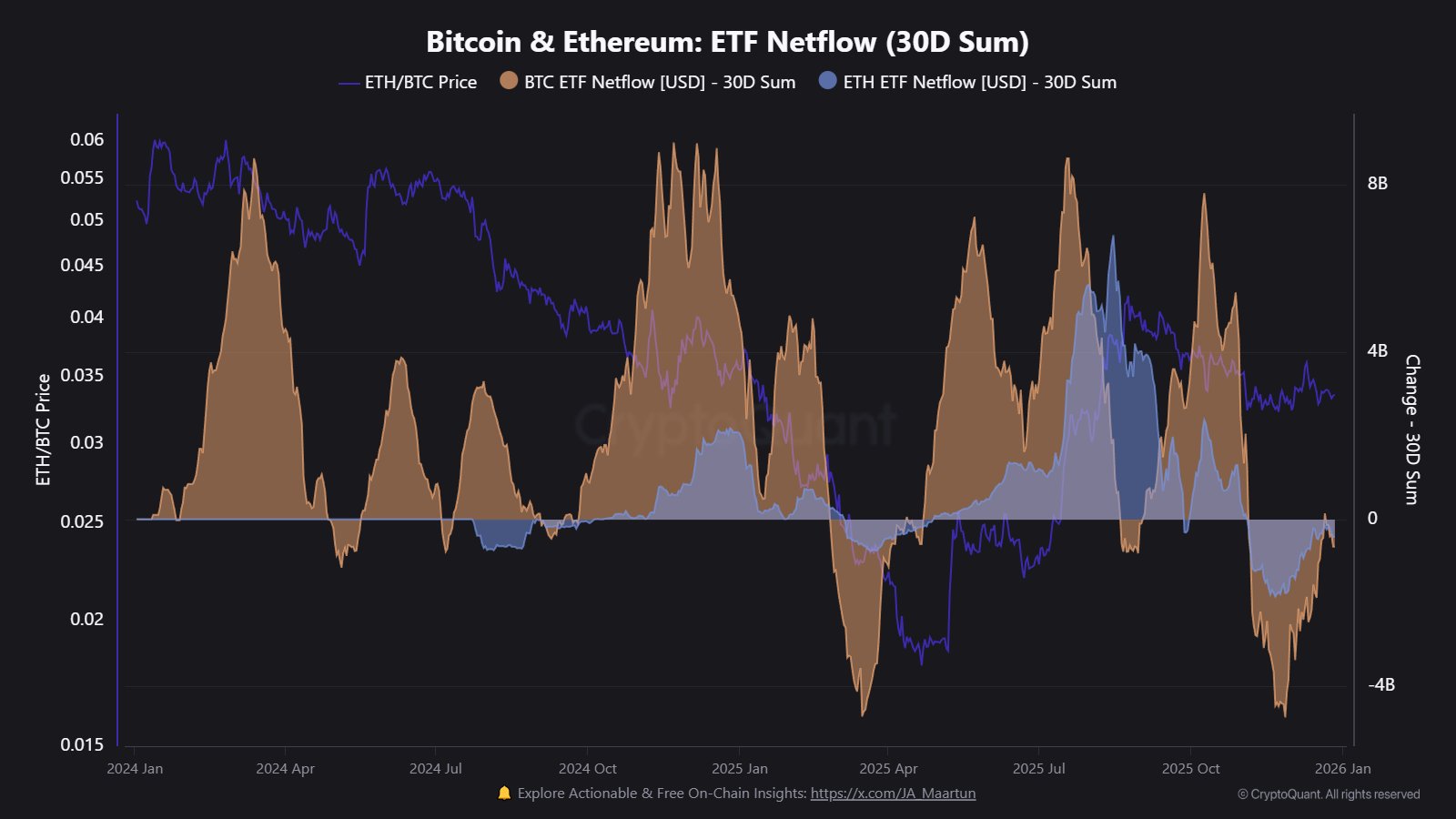
Il semble que la valeur de la métrique ait été négative pour ces deux actifs ces dernières semaines | Source : @JA_Maartun sur X

Comme on peut le voir sur le graphique, le flux net des ETF au comptant sur 30 jours est négatif pour le Bitcoin et l'Ethereum depuis un certain temps déjà, ce qui suggère que les fonds ont connu des sorties nettes soutenues.

La situation s'est légèrement améliorée très récemment, mais l'indicateur est toujours dans le rouge pour les deux actifs, se situant à -656 millions de dollars pour le BTC et -422 millions de dollars pour l'ETH. La faible demande sur le marché est similaire à la phase de sorties de capitaux de la première moitié de 2025.

À l'époque, la demande avait fini par faire un retour explosif, le Bitcoin et l'Ethereum enregistrant de fortes hausses de prix. Il reste à voir si un tel retour se produira cette fois-ci ou si le ralentissement de la demande est là pour rester pour le moment.

Une autre source de demande relativement récente sur le marché est celle des trésoreries d'actifs numériques. Comme le souligne Sentora, fournisseur de solutions DeFi institutionnelles, dans un nouveau post sur X, les actifs des trésoreries en cryptomonnaies dépassent désormais 185 milliards de dollars répartis entre 368 entités.
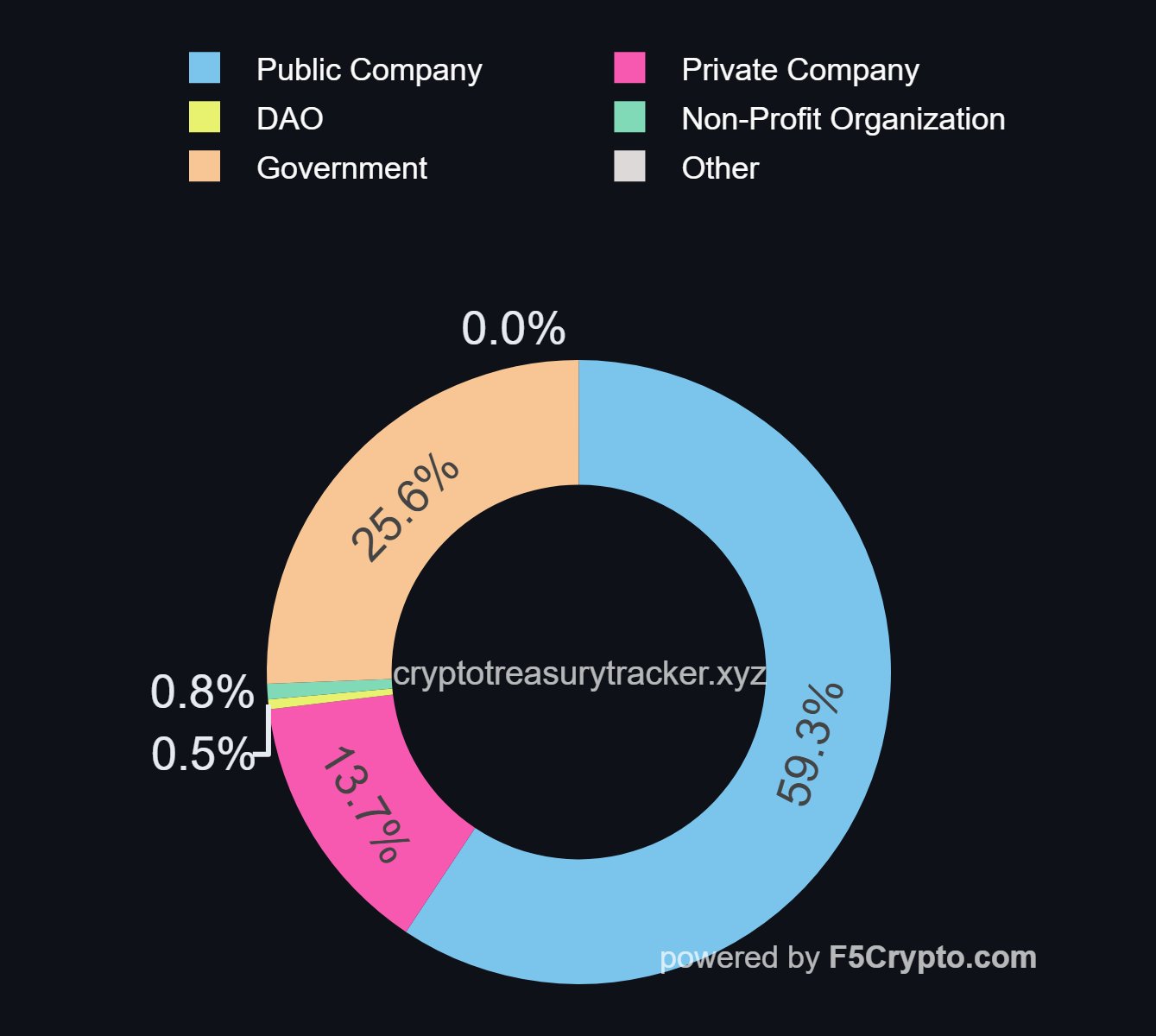
La répartition des trésoreries selon divers secteurs | Source : Sentora sur X

Sur ce montant, 73 % des trésoreries d'actifs numériques sont contrôlées par des entreprises, le reste étant entre les mains de gouvernements.

Prix du BTC

Au moment de la rédaction, le Bitcoin s'échange autour de 88 100 $, inchangé par rapport à la semaine dernière.

Le prix de la cryptomonnaie semble avoir été en consolidation récemment | Source : BTCUSDT sur TradingView


Perguntas relacionadas

QQu'est-ce que les flux nets négatifs des ETF Bitcoin et Ethereum indiquent ?

ALes flux nets négatifs des ETF Bitcoin et Ethereum indiquent que les capitaux s'écoulent hors de ces actifs numériques, ce qui suggère une faible demande des investisseurs institutionnels et traditionnels.

QQuand les ETF spot Bitcoin et Bitcoin ont-ils été approuvés par la SEC ?

ALes ETF spot Bitcoin ont été approuvés par la SEC en janvier 2024, tandis que les ETF spot Ethereum ont été approuvés en juillet 2024.

QQuel est le montant actuel des flux nets négatifs pour Bitcoin et Ethereum ?

ALes flux nets négatifs s'élèvent actuellement à -656 millions de dollars pour Bitcoin et -422 millions de dollars pour Ethereum.

QQuelle est la valeur totale des trésoreries d'actifs numériques détenues par les entreprises et les gouvernements ?

ALa valeur totale des trésoreries d'actifs numériques dépasse 185 milliards de dollars, détenus par 368 entités, dont 73 % sont contrôlés par des entreprises et le reste par des gouvernements.

QÀ quel prix Bitcoin se négocie-t-il actuellement et quelle est sa tendance récente ?

ABitcoin se négocie actuellement autour de 88 100 dollars, un prix stable par rapport à la semaine dernière, ce qui suggère une phase de consolidation récente.

Leituras Relacionadas

Trump’s Dual Pressure: When the Iran Deal Meets the Midterm Elections

U.S. President Donald Trump’s efforts to negotiate a deal with Iran are triggering a political backlash within his own Republican Party, as the approach of midterm elections intensifies internal divisions. Reports of a potential agreement—involving a temporary ceasefire, phased sanctions relief, and the unfreezing of Iranian assets in exchange for discussions on Tehran diluting or transferring its stockpile of highly enriched uranium—have drawn sharp criticism from GOP hawks. Key allies like Senators Lindsey Graham and Ted Cruz warned that such concessions could allow Iran to recuperate, undermine recent U.S. military gains, and ultimately strengthen a hostile regime. The dispute highlights a broader political struggle for Trump, who must reconcile his "America First" posture with diplomatic compromise while facing a tough electoral landscape. With Republicans fighting to maintain control of Congress and Trump’s approval ratings declining, the Iran deal has quickly become a test of party loyalty and perceived toughness. Public sparring between Trump aides and critics—including former Secretary of State Mike Pompeo—underscores the internal pressure. While Secretary of State Marco Rubio defended Trump’s historically hardline stance, skeptics like Senator Thom Tillis questioned the logic of any deal that leaves nuclear materials in Iran. The outcome now hinges on whether Trump can persuade his party’s hardliners to accept a negotiated exit.

marsbitHá 3m

Trump’s Dual Pressure: When the Iran Deal Meets the Midterm Elections

marsbitHá 3m

Raised $1.3 Billion in Seven Weeks, Yet SpaceX's Weighting Halved: The Dilution Trap of the NASA ETF

A new ETF named NASA, launched just seven weeks ago, has rapidly become the world's largest space-themed fund, amassing $1.3 billion in assets. Its primary draw is its unique position as a "pure" space ETF holding SpaceX stock through a special purpose vehicle (SPV). However, its exposure to SpaceX has been drastically diluted from 10.3% to 4.6% due to a massive, rapid inflow of investor cash. New money is forced into buying other public space stocks like Rocket Lab, meaning investors seeking SpaceX exposure end up with a portfolio of other companies. Further complications arise from the SPV's valuation mechanism, which only updates during specific manager trades, potentially lagging behind SpaceX's market price. This SPV will also face a six-month lock-up post-IPO, preventing investors from selling that portion if SpaceX shares drop after listing. The article highlights a valuation bubble in the broader space sector, with stocks like Planet Labs surging nearly 1000% in a year, driven more by the "SpaceX IPO narrative" than underlying fundamentals. Meanwhile, SpaceX's own financials show significant losses in 2024, and its record-breaking IPO valuation bundles its space business with other Musk assets like xAI, creating a complex investment proposition. The core warning is that the NASA ETF essentially uses SpaceX as bait but delivers a different product. The real beneficiaries may be the ETF issuers collecting high fees, while investors face dilution and hidden risks ahead of SpaceX's historic IPO on June 12th.

marsbitHá 23m

Raised $1.3 Billion in Seven Weeks, Yet SpaceX's Weighting Halved: The Dilution Trap of the NASA ETF

marsbitHá 23m

NEAR Doubles: 3 Major Trends Become the 'Engine' for Token Price Surge

NEAR token price surged from around $1.24 in early May to over $2.5, with its market cap returning above $3 billion. This significant growth, occurring amidst broader market volatility, is attributed to three key factors. First, the AI narrative has been a major driver. NEAR co-founder Illia Polosukhin is a co-author of the seminal Transformer paper, the foundation of modern AI models like ChatGPT. NEAR has integrated AI capabilities into its ecosystem, notably through the Near.com super-app, positioning itself as a key decentralized AI infrastructure project. Endorsements from figures like Arthur Hayes further boosted market sentiment. Second, NEAR is enhancing its utility as a privacy-focused blockchain. With the launch of NEAR Intents for cross-chain transactions, privacy features like Confidential Payments and Confidential Intents have become critical to protect users from MEV attacks. These functionalities allow private transfers of assets like ETH and BTC across more than 35 chains, balancing privacy with usability and appealing to institutional and enterprise users. Third, a new tokenomics mechanism is providing buy-side pressure. Following the full unlocking of its initial supply in late 2025, NEAR now employs a fee-burn model. All protocol fees generated by the NEAR Intents layer are used to buy back and effectively remove NEAR tokens from circulation. With NEAR Intents TVL exceeding $80 million, this creates consistent monthly buybacks estimated around $3 million, reducing sell pressure. Additional technical upgrades planned for mid-2026, including dynamic re-sharding and post-quantum security, aim to further strengthen the network's scalability and robustness.

marsbitHá 25m

NEAR Doubles: 3 Major Trends Become the 'Engine' for Token Price Surge

marsbitHá 25m

After $HYPE Hits a New High, Is It Worth Considering the Stock of "HYPE Version MicroStrategy" $PURR?

**HYPE Hits New Highs: Is $PURR, the "HYPE Version of MicroStrategy," Worth Considering?** The stock of Hyperliquid Strategies (NASDAQ: $PURR), a publicly-traded company that exclusively buys and holds the cryptocurrency HYPE, has gained over 100% year-to-date, mirroring HYPE's own 150% surge to new all-time highs. This has sparked discussions about PURR being a more "capital-efficient" play than MicroStrategy's bitcoin strategy, given its reported ~$1 billion unrealized gain on a ~$220 million investment. The article clarifies that PURR is essentially a pure-play wrapper for HYPE, with no other business. It resulted from a 2025 SPAC merger led by firms like Paradigm and Atlas Merchant Capital, bringing traditional finance veterans to its board. Its value is entirely derived from the price of HYPE. While PURR offers a crucial compliance bridge for US-based institutional and retirement accounts unable to access HYPE directly, the analysis questions the "capital efficiency" narrative. The outsized gains are attributed to HYPE's exceptional performance, not superior corporate strategy. For investors who can buy HYPE directly, holding PURR introduces unnecessary risks: potential shareholder dilution from future stock offerings, incomplete passthrough of staking rewards, market hour mismatches, and counterparty risk via its single custodian. A key metric is its mNAV (modified net asset value). Current calculations show PURR trades at a discount to its HYPE holdings, but this could flip to a premium depending on the execution of registered share issuances. The article concludes that PURR is primarily a "conduit product." The investment thesis hinges entirely on one's bullishness on HYPE itself, not on the PURR wrapper, which adds friction and risk for those with direct crypto access.

marsbitHá 55m

After $HYPE Hits a New High, Is It Worth Considering the Stock of "HYPE Version MicroStrategy" $PURR?

marsbitHá 55m

The Real Progress and Investment Opportunities of Decentralized AI Computing Power Networks in 2026

In 2026, the AI compute market is marked by centralized GPU consolidation and a significant GPU shortage for smaller players. In this context, Decentralized Physical Infrastructure Networks (DePIN), valued at $9.4B+, have emerged as a viable, revenue-generating alternative. Leading protocols like Aethir ($150M ARR), io.net (130k+ GPUs), Akash, Bittensor, and Render are carving out distinct niches, moving beyond hype to deliver verifiable income primarily from non-crypto-native clients. The key advantage of decentralized GPU networks lies in serving latency-tolerant, cost-sensitive workloads like AI inference, fine-tuning, data preprocessing, and agent operations, offering substantial cost savings (45-80%) compared to major cloud providers. However, reliability variance, lack of robust SLAs, and fragmented tech stacks remain significant adoption hurdles. The sector is maturing with critical 2026 shifts: 1) Evolution of tokenomics towards demand-driven, revenue-linked models (e.g., Render's BME, io.net's IDE), and 2) Clearer enterprise adoption pathways, with traditional firms integrating decentralized compute. For new entrants, opportunities are now concentrated in specialized tooling layers (orchestration, verification, SLA management), vertical applications (e.g., bio-med, content generation), and innovative token designs tied to real usage, rather than generic GPU aggregation. The convergence with the emerging AI Agent economy presents a significant future growth vector.

marsbitHá 56m

The Real Progress and Investment Opportunities of Decentralized AI Computing Power Networks in 2026

marsbitHá 56m

Trading

Spot
Futuros

Artigos em Destaque

Como comprar RED

Bem-vindo à HTX.com!Tornámos a compra de RedStone (RED) simples e conveniente.Segue o nosso guia passo a passo para iniciar a tua jornada no mundo das criptos.Passo 1: cria a tua conta HTXUtiliza o teu e-mail ou número de telefone para te inscreveres numa conta gratuita na HTX.Desfruta de um processo de inscrição sem complicações e desbloqueia todas as funcionalidades.Obter a minha contaPasso 2: vai para Comprar Cripto e escolhe o teu método de pagamentoCartão de crédito/débito: usa o teu visa ou mastercard para comprar RedStone (RED) instantaneamente.Saldo: usa os fundos da tua conta HTX para transacionar sem problemas.Terceiros: adicionamos métodos de pagamento populares, como Google Pay e Apple Pay, para aumentar a conveniência.P2P: transaciona diretamente com outros utilizadores na HTX.Mercado de balcão (OTC): oferecemos serviços personalizados e taxas de câmbio competitivas para os traders.Passo 3: armazena teu RedStone (RED)Depois de comprar o teu RedStone (RED), armazena-o na tua conta HTX.Alternativamente, podes enviá-lo para outro lugar através de transferência blockchain ou usá-lo para transacionar outras criptomoedas.Passo 4: transaciona RedStone (RED)Transaciona facilmente RedStone (RED) no mercado à vista da HTX.Acede simplesmente à tua conta, seleciona o teu par de trading, executa as tuas transações e monitoriza em tempo real.Oferecemos uma experiência de fácil utilização tanto para principiantes como para traders experientes.

392 Visualizações TotaisPublicado em {updateTime}Atualizado em 2025.03.21

Como comprar RED

Discussões

Bem-vindo à Comunidade HTX. Aqui, pode manter-se informado sobre os mais recentes desenvolvimentos da plataforma e obter acesso a análises profissionais de mercado. As opiniões dos utilizadores sobre o preço de RED (RED) são apresentadas abaixo.

活动图片












