Interop Roadmap Accelerates: After Fusaka Upgrade, Ethereum Interoperability May Take a Key Leap

marsbitPublicado em 2025-12-11Última atualização em 2025-12-11

Resumo

Recent Ethereum Fusaka upgrade, while primarily focused on Blob capacity expansion, introduced the underappreciated EIP-7825, a critical enabler for Ethereum's zero-knowledge (ZK) and interoperability roadmap. This proposal sets a hard per-transaction gas limit (~16.78 million gas), preventing "mega-transactions" from monopolizing a block. This change transforms block proof generation from a sequential logic problem into a parallelizable computational task, making real-time ZK proofs an engineering feasibility rather than a theoretical impossibility. This foundational shift is pivotal for the L1 zkEVM vision, where Ethereum itself generates verifiable proofs for its state transitions. L1 zkEVM acts as a universal "trust anchor," allowing Layer 2s (L2s) to instantly and trustlessly verify the mainnet's state without waiting for challenge periods. This eliminates the speed-trust decentralization trade-off, enabling near-instant, decentralized cross-chain interoperability. Concurrently, ZK technology is evolving from EVM-compatible zkEVMs to more efficient, ZK-optimized zkVMs. EIP-7825's parallelizable environment allows these zkVMs to operate at peak efficiency, drastically reducing proof generation cost and time. The convergence of EIP-7825, L1 zkEVM, and advanced zkVMs paves the way for the final stage of interoperability (Interop)—abstracting away chain boundaries to deliver a single-chain user experience where cross-chain actions are seamless, secure, and instantaneous.

Author: imToken

In previous articles of the Interop series, we discussed OIF (Intent Framework) and EIL (Interoperability Layer), which respectively address the standardization of cross-chain intents (making the entire network understand what you want to do) and the execution channel problem (enabling funds to move in a standardized manner).

However, achieving a perfect "single-chain experience" still involves a trade-off between speed and trust. After all, in the current interoperability experience, one must either endure slowness (such as Optimistic Rollup requiring a 7-day challenge period to confirm finality) or sacrifice decentralization (relying on the trust assumptions of multi-signature bridges).

To break this "impossible triangle," it is essential to have a foundational capability that spans the "acceleration" and finalization of Ethereum's interoperability roadmap—the "real-time proof" brought by ZK technology (extended reading: "Ethereum Interop Roadmap: How to Unlock the 'Last Mile' of Mass Adoption").

And the recently activated Fusaka upgrade, with its inconspicuous EIP-7825, has cleared the biggest engineering obstacle for this ultimate goal.

I. Behind the Fusaka Upgrade: The Underestimated EIP-7825

On December 4, the Ethereum Fusaka upgrade was officially activated on the mainnet. Unlike the fanfare of the Dencun upgrade, the market spotlight was largely focused on Blob scaling and PeerDAS, with much discussion about the further reduction of L2 data costs.

But beyond this buzz, there was actually a low-profile proposal, EIP-7825, which removed the biggest obstacle to achieving L1 zkEVM and real-time proof for Ethereum, and can even be said to be quietly paving the way for the ultimate goal of Interop.
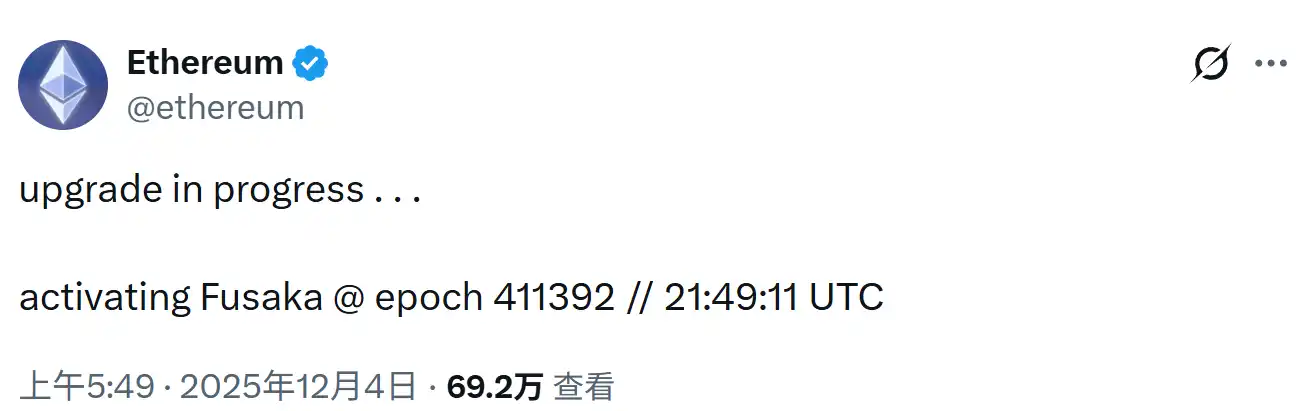
In this Fusaka upgrade, the focus was almost entirely on scaling: Blob capacity expanded by 8 times, combined with PeerDAS random sampling verification, making the cost narrative of the DA (Data Availability) track a thing of the past.

Indeed, cheaper L2s are a good thing, but for Ethereum's long-term ZK roadmap, EIP-7825 is the real game-changer because it sets a Gas limit for a single transaction on Ethereum (about 16.78 million Gas).

As we all know, Ethereum's block Gas Limit was increased to 60 million this year. But even as the upper limit continues to rise, theoretically, if they were willing to pay an extremely high Gas Price, someone could send a super-complex "Mega-Transaction" that directly occupies the entire block's 60 million Gas capacity, thereby clogging the entire block.

This was allowed before, but EIP-7825 introduces a new restriction: no single transaction can consume more than 16.78 million Gas, regardless of the block size.

So why limit the size of a single transaction? This change actually has no impact on ordinary user transfers, but for ZK Provers (proof generators), it is a matter of life and death, and it is also closely related to how ZK systems generate proofs.

To give a simple example, before EIP-7825, if a block contained a "Mega-Transaction" consuming 60 million Gas, the ZK Prover had to run this extremely complex transaction sequentially—it couldn't be split or parallelized. This is like a single-lane highway where a giant, extremely slow truck is in front, and all the cars behind (other transactions) have to wait for it to pass.

This would undoubtedly sentence "real-time proof" to death—because the time to generate the proof would be completely unpredictable, potentially taking dozens of minutes or even longer.

After EIP-7825, even if the block capacity expands to 100 million Gas in the future, since each transaction is forcibly limited to within 16.78 million Gas, each block is broken down into predictable, bounded, and parallelizable "small task units." This means that Ethereum's proof generation has changed from a tricky "logical puzzle" to a pure "money problem":

As long as enough parallel computing power is invested, we can process these split small tasks simultaneously in an extremely short time, thereby generating ZK proofs for huge blocks.

As Michael, co-founder and CEO of Brevis, said, EIP-7825 is the most underestimated upgrade on the future path of ZK and 100x scaling for Ethereum. It turns "real-time proof" from "theoretically impossible" to "engineerably schedulable." As long as we can solve the computing power problem through parallel computation, even a 200 million Gas block could achieve second-level proof. This is not only a breakthrough for ZK technology but also the physical foundation for Ethereum's Interoperability Layer (EIL) to achieve second-level cross-chain settlement.
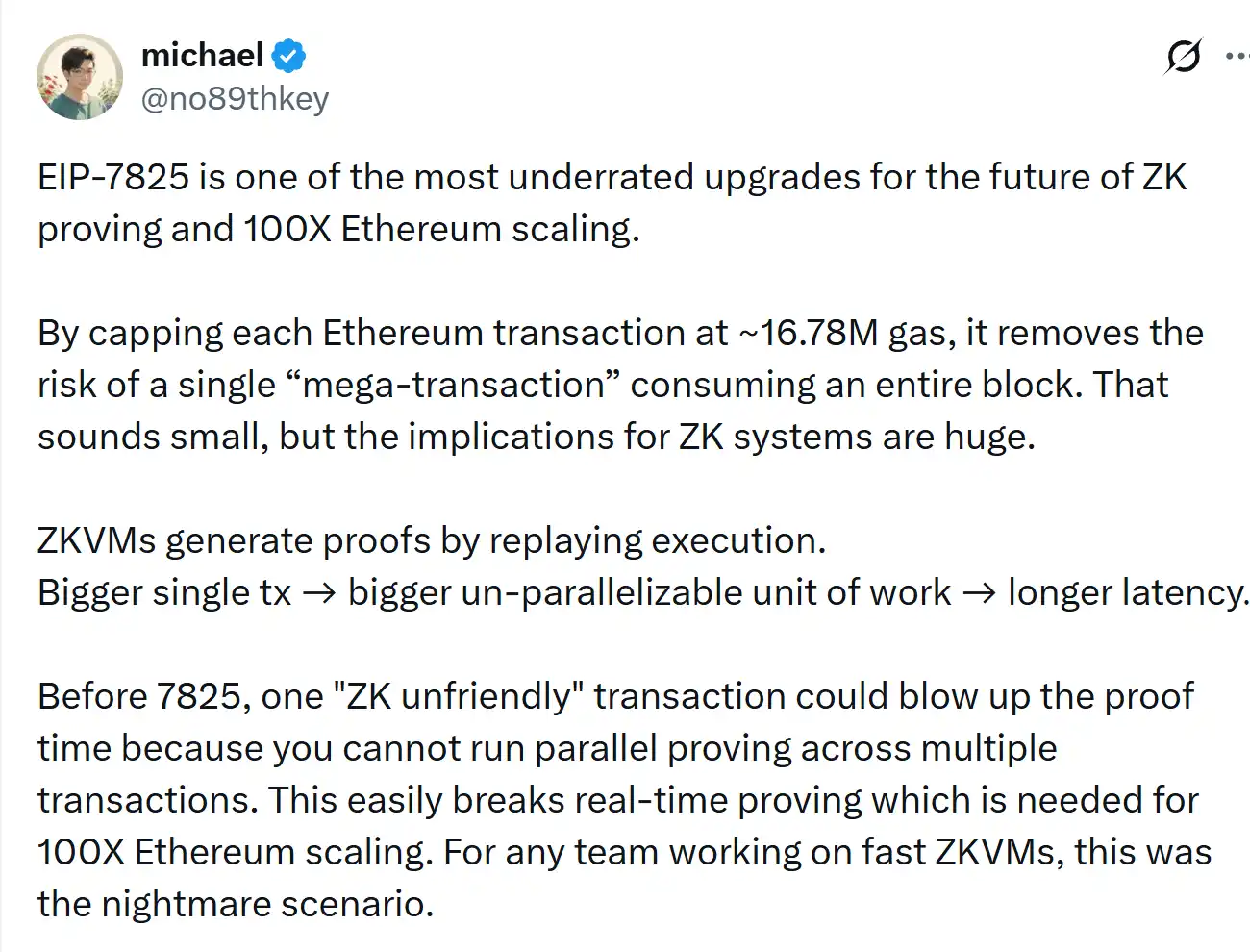
So this upgrade might not seem like the main event, but it is actually a huge breakthrough for the ZK roadmap and Ethereum's scaling future in 2026.

II. L1 zkEVM: The "Trust Anchor" for Ethereum Interoperability

However, although EIP-7825 paves the physical path (parallelizability) for real-time proof by limiting single transaction size, this is only one side of the coin. The other side is how the Ethereum mainnet itself utilizes this capability?

This involves the most hardcore narrative in Ethereum's roadmap—L1 zkEVM.

For a long time, zkEVM has been regarded as the "holy grail" for scaling Ethereum, not only because it can solve performance bottlenecks but also because it redefines the trust mechanism of blockchain. Its core idea is to enable the Ethereum mainnet to generate and verify ZK proofs.

In other words, in the future, after each Ethereum block is executed, it can output a verifiable mathematical proof, allowing other nodes (especially light nodes and L2s) to confirm the correctness of the result without repeating the calculation—if the ability to generate ZK proofs is directly written into the Ethereum protocol layer (L1), the proposer packs a block and generates a ZK proof, and validating nodes no longer need to rerun the transactions; they only need to verify this tiny mathematical proof.

What does this mean for interoperability?

In the context of Interop, the significance of L1 zkEVM far exceeds scaling itself. It can be said to be the "trust anchor" for all L2s. After all, if Ethereum L1 can generate proofs in real time, it means all L2s can read L1's final state in real time and trustlessly. This will bring about two qualitative changes:

  • Eliminate the Challenge Period: The confirmation time between chains will be compressed from "7 days (OP mechanism)" to "seconds (ZK mechanism)";
  • Decentralized Interconnection: Cross-chain will no longer require trust in third-party multi-signature bridges but will trust the mathematical truth of the Ethereum mainnet;

This is also the physical foundation we mentioned in the previous article for EIL (Interoperability Layer) to truly work—without real-time finality from L1, interoperability between L2s will never escape the shadow of "delay."

The goal is set (L1 zkEVM), and the physical limitation is removed (EIP-7825). So what about the specific implementation tools?

This leads to the subtle evolution happening in the ZK technology stack: from zkEVM to zkVM.

III. Fusaka & EIP-7825: The Interoperability Roadmap is Liberated

If EIP-7825 provides a "parallelizable hardware environment" for ZK by limiting single transaction size, then the evolution of the ZK technology stack is to find a "more efficient software architecture." This might sound like a tongue twister, but the difference is significant and represents two stages of ZK development.

The first stage is naturally zkEVM, which can be seen as the compatibility faction or the reformist faction.

The logic is to strive to imitate every instruction of the Ethereum EVM, allowing developers to deploy Solidity code directly, reducing migration costs and barriers.

In other words, the biggest advantage of zkEVM is its compatibility with existing Ethereum applications, greatly reducing the workload for Ethereum ecosystem developers. They can reuse most of the existing infrastructure and tools (including execution clients, block explorers, debugging tools, etc.).

However, precisely because of this, since the EVM was not designed with ZK-friendliness in mind, for the sake of compatibility, zkEVM's proof efficiency often has a ceiling, and proof times are much slower, burdened by historical baggage.

zkVM, on the other hand, belongs to the radical revolutionary faction, directly building a virtual machine that is extremely friendly to ZK proofs (such as based on RISC-V or WASM) to speed up proof time and achieve better execution speed and performance.

But it also loses compatibility with many EVM features and the ability to use existing tools (like low-level debuggers). However, a clear trend is that more and more L2 projects are shedding their baggage,极致 optimizing proof speed and cost, and exploring architectures based on zkVM.

So why is the Fusaka upgrade the unlocker?

After all, before EIP-7825, whether zkEVM or zkVM, once they encountered a Mega-Transaction on Ethereum, the proof generation time would skyrocket due to the inability to split the task.

Now, EIP-7825 forcibly breaks down transactions into predictable small units. With a parallelizable environment, an efficient architecture like zkVM can exert its maximum power. Even complex Ethereum blocks, when placed in a zkVM and combined with parallel computing power, can achieve real-time proof.

What does this mean for interoperability? The proliferation of zkVM combined with EIP-7825 means the cost of generating proofs will drop significantly. When the cost of generating a cross-chain proof is low enough to be negligible, and the speed is as fast as sending an email, traditional "cross-chain bridges" will completely disappear, replaced by underlying universal message protocols.

In Conclusion

As repeatedly mentioned in previous articles of the Interop series, the ultimate goal of Interop is not just asset "cross-chain," nor is it limited to the concept of "asset bridges" anymore. It is a comprehensive set of system-level capabilities, including cross-chain data communication, cross-chain logic execution, cross-chain user experience, cross-chain security, and consensus.

From this perspective, Interop can be understood as the universal language between future Ethereum ecosystem protocols. Its significance lies not only in transferring value but also in sharing logic. ZK's role in this is to guarantee execution correctness and support real-time state verification, making cross-domain calls "dare to do, able to do." It can even be said that without real-time ZK, there can hardly be truly usable Interop UX.

So when EIP-7825 was quietly activated in the Fusaka upgrade, and as L1 zkEVM gradually becomes a reality, we are getting closer to that ultimate goal: execution, settlement, and proof are completely abstracted in the background, and users are completely unaware of the chain's existence throughout the process.

This is the Interop endgame we all look forward to in the future.

Perguntas relacionadas

QWhat is the significance of EIP-7825 in the Fusaka upgrade for Ethereum's interoperability?

AEIP-7825 introduces a gas limit per transaction (approximately 16.78 million gas), which prevents a single complex 'mega-transaction' from blocking an entire Ethereum block. This allows for parallel processing of transactions, making it feasible to generate ZK proofs in real-time. This is a critical engineering enabler for Ethereum's ZK roadmap and interoperability, as it transforms proof generation from a logical challenge into a solvable computational problem, paving the way for near-instant cross-chain settlements.

QHow does L1 zkEVM serve as a 'trust anchor' for Ethereum interoperability?

AL1 zkEVM integrates the ability to generate and verify ZK proofs directly into the Ethereum protocol layer. This means every block produced on Ethereum L1 can be accompanied by a verifiable mathematical proof. For interoperability, this allows all L2s to read the final state of L1 in real-time without trust. It eliminates the need for long challenge periods (e.g., the 7-day wait in Optimistic Rollups) and enables decentralized cross-chain communication without relying on trusted multi-signature bridges, as chains can trust the mathematical truth of Ethereum's mainnet.

QWhat is the key difference between zkEVM and zkVM in the context of ZK technology evolution?

AzkEVM focuses on full compatibility with the Ethereum Virtual Machine (EVM), allowing developers to deploy existing Solidity code with minimal changes. However, this compatibility often results in slower proof generation due to EVM's design not being ZK-friendly. In contrast, zkVM is a more radical approach that builds a new virtual machine (e.g., based on RISC-V or WASM) optimized for ZK proof efficiency and execution speed. While zkVM sacrifices some EVM compatibility and existing tooling, it offers significantly faster proof generation and better performance, which is crucial for real-time interoperability.

QHow does the combination of EIP-7825 and zkVM architecture enhance Ethereum's interoperability capabilities?

AEIP-7825 ensures that Ethereum transactions are broken down into small, predictable units that can be processed in parallel. This eliminates the problem of 'mega-transactions' causing unpredictable proof generation times. When combined with the efficient architecture of zkVM, which is designed for speed and low cost, it becomes possible to generate ZK proofs for complex Ethereum blocks in real-time. This drastically reduces the cost and increases the speed of cross-chain proof generation, making traditional cross-chain bridges obsolete and enabling seamless,底层通用消息协议 for interoperability.

QWhat is the ultimate goal of Interop (interoperability) in the Ethereum ecosystem, as described in the article?

AThe ultimate goal of Interop is not just cross-chain asset transfers but a comprehensive system-level capability that includes cross-chain data communication, logic execution, user experience, security, and consensus. It aims to create a universal language for protocols within the Ethereum ecosystem, enabling not only value transfer but also logic sharing. ZK technology ensures execution correctness and real-time state verification, making cross-domain interactions feasible and user-friendly. The end vision is a fully abstracted backend where users are unaware of the underlying chains, experiencing seamless interoperability.

Leituras Relacionadas

GitHub Empire on the Brink of Collapse: Source Code Leak, 18-Year Veteran Leaves, Microsoft Loses 1.5 Billion Developers

GitHub is facing an unprecedented crisis, marked by a massive exodus of developers and severe operational failures. The tipping point came when Mitchell Hashimoto, creator of Ghostty and an 18-year GitHub user, publicly severed ties, citing persistent platform outages that made serious work impossible. This departure highlights a broader pattern of user frustration. The platform's instability has drawn complaints from major corporate clients like Citibank and Intel, forcing Microsoft to issue substantial service credits. A critical incident last month saw an accidentally triggered, unreleased feature cause widespread repository rollbacks, erasing recent code changes and pushing enterprises to migrate. Security has catastrophically breached. In May 2026, hackers infiltrated over 3,800 of GitHub's internal repositories via a poisoned VS Code extension installed by a developer, leading to the attempted sale of core source code for $50,000. This follows the discovery of a critical zero-day vulnerability in March that threatened access to millions of repositories. Internally, GitHub's autonomy has collapsed. After the resignation of CEO Thomas Dohmke in mid-2025, Microsoft eliminated the CEO role, folding GitHub into its CoreAI division under the unpopular leadership of Jay Parikh. This triggered a talent drain, with key executives and engineers leaving. A disruptive migration of GitHub's infrastructure to Azure servers, pushed by CTO Vladimir Fedorov, is blamed for the recurring outages. Competitively, GitHub Copilot is under "existential threat" from superior AI coding tools like Cursor (now owned by SpaceX) and Claude Code, which offer more advanced contextual coding and automation. Ironically, Microsoft's own engineers reportedly preferred Claude Code, forcing management to revoke licenses. Financially, GitHub is a loss leader. Despite Copilot surpassing 4.7 million paid users and $3 billion in annual revenue, the AI inference costs for free services massively outstrip subscription income, hurting Microsoft's cloud margins. The recent shift from a flat fee to a pay-as-you-go model for Copilot has further alienated developers. The core question for Microsoft is whether a centralized code repository remains essential in the AI agent era. The erosion of trust, developer culture, and platform reliability threatens the very ecosystem Microsoft spent decades building.

marsbitHá 1h

GitHub Empire on the Brink of Collapse: Source Code Leak, 18-Year Veteran Leaves, Microsoft Loses 1.5 Billion Developers

marsbitHá 1h

SEC Promotes Tokenized Stocks, Is the Traditional Finance Industry Starting to Worry?

The U.S. Securities and Exchange Commission (SEC) is preparing to formally release an "innovation exemption" framework this week. This framework would allow third parties to tokenize U.S. stocks like Apple and Tesla without approval from the listed companies. The move, rooted in a deregulatory vision proposed by pro-crypto commissioners earlier this year, could accelerate the migration of traditional stock markets to blockchain. This development poses a structural threat of "fragmentation" to traditional finance. Core concerns are liquidity fragmentation—where trading volume disperses across multiple blockchains and platforms, leading to price disparities and reduced market efficiency—and revenue fragmentation—where trading fees and intermediary income shift away from domestic exchanges to overseas or competing platforms. The report compares the traditional stock market to a monopolistic "supermarket." Tokenization enables countless "street stalls" to operate outside this system, threatening the exchange's dominance, diluting liquidity for large orders, and slicing into revenue streams. Evidence of this capital fragmentation is already emerging. On the same day the SEC signaled the framework, decentralized platform Hyperliquid saw its RWA (real-world asset) open interest hit a record $2.6 billion, driven by demand for 24/7 on-chain trading of traditional assets. Traditional institutions face a dilemma: either collaborate to build tokenization infrastructure proactively or lobby regulators to block innovation. Regulators must balance controlling the pace of innovation with preventing domestic revenue from being captured by offshore platforms. Key future battles will revolve around defining shareholder rights for tokenized assets and regulating platforms that have grown in regulatory gray areas. In the digital asset era, inaction risks the permanent loss of long-held fee monopolies and financial leadership as capital continues to disperse.

marsbitHá 1h

SEC Promotes Tokenized Stocks, Is the Traditional Finance Industry Starting to Worry?

marsbitHá 1h

A Comprehensive Analysis of On-Chain Pre-IPO: Why is the Pricing Power of SpaceX and OpenAI Moving On-Chain?

This podcast episode explores the rise of on-chain pre-IPO price discovery and trading, focusing on companies like SpaceX, OpenAI, and Anthropic. Key trends include the recent launch of a SpaceX pre-IPO perpetual contract on Hyperliquid, the secondary market trading of AI company shares, and a new partnership between Nasdaq Private Market and Polymarket. Dio Casares explains why AI companies like OpenAI and Anthropic actively deny the legitimacy of secondary trades. Primary reasons are to protect their primary funding rounds (as secondary trades don't provide cash to the company) and to avoid complex legal and administrative responsibilities associated with settling these transactions. He argues that on-chain **derivatives** (like perpetuals) are a more viable solution than **tokenized spot markets**, as they better navigate U.S. regulatory holding period requirements, provide effective hedging, and avoid antagonizing the companies themselves by competing with their primary raises. The discussion covers the risks and methods of gaining pre-IPO exposure, from direct investments and SPVs to riskier, layered structures that can lead to legal complications and settlement issues. Casares also maps the landscape of key players, differentiating between traditional secondary brokers (like Forge, Hiive, and Setter) and on-chain derivatives protocols (like Trade.xyz/Ventuals on Hyperliquid) and tokenization platforms (often on Solana). He positions Patagon as a facilitator for access to private market deals but clarifies it avoids on-chain tokenization to maintain good relations with portfolio companies. Looking ahead, the convergence of a historic IPO pipeline (with potential trillion-dollar valuations), the 24/7 nature of crypto markets, and the strategic use of pre-market perpetuals as a "loss leader" suggest continued growth and competition in the on-chain pre-IPO space.

marsbitHá 1h

A Comprehensive Analysis of On-Chain Pre-IPO: Why is the Pricing Power of SpaceX and OpenAI Moving On-Chain?

marsbitHá 1h

Token Packages Are Here, Are Telecom Operators in a Hurry?

Major Chinese telecom operators are launching token-based AI computing packages, sparking public debate and highlighting a strategic shift amid slowing traditional revenue growth. In May, Shanghai Telecom introduced token plans (e.g., 9.9 RMB for 10 million tokens), quickly followed by nationwide offerings from China Telecom, China Mobile, and China Unicom. While priced higher than major AI firms like DeepSeek, these packages allow users to access multiple AI models via API using their phone bills, similar to purchasing universal mobile data. The move reflects operators' anxiety as traditional voice, SMS, and data services stagnate. With revenue growth hitting multi-year lows in 2025, AI and computing power represent a critical new frontier. However, current C端 offerings, such as AI photo editing or virtual pets, are seen as non-essential and highlight operators' role as "pipes" or integrators rather than creators of compelling AI products. Beyond consumer packages, operators aim to become key infrastructure players in China’s national computing power network. They position themselves as the "power grid" delivering AI算力, leveraging their vast network of base stations to ensure low-latency, reliable coverage, especially for applications like autonomous driving. This infrastructure role, coupled with unified national调度, could make算力 a ubiquitous utility, driving new consumption scenarios even if mass adoption of token packages remains uncertain.

marsbitHá 1h

Token Packages Are Here, Are Telecom Operators in a Hurry?

marsbitHá 1h

Trading

Spot
Futuros

Artigos em Destaque

Como comprar HPP

Bem-vindo à HTX.com!Tornámos a compra de House Party Protocol (HPP) simples e conveniente.Segue o nosso guia passo a passo para iniciar a tua jornada no mundo das criptos.Passo 1: cria a tua conta HTXUtiliza o teu e-mail ou número de telefone para te inscreveres numa conta gratuita na HTX.Desfruta de um processo de inscrição sem complicações e desbloqueia todas as funcionalidades.Obter a minha contaPasso 2: vai para Comprar Cripto e escolhe o teu método de pagamentoCartão de crédito/débito: usa o teu visa ou mastercard para comprar House Party Protocol (HPP) instantaneamente.Saldo: usa os fundos da tua conta HTX para transacionar sem problemas.Terceiros: adicionamos métodos de pagamento populares, como Google Pay e Apple Pay, para aumentar a conveniência.P2P: transaciona diretamente com outros utilizadores na HTX.Mercado de balcão (OTC): oferecemos serviços personalizados e taxas de câmbio competitivas para os traders.Passo 3: armazena teu House Party Protocol (HPP)Depois de comprar o teu House Party Protocol (HPP), armazena-o na tua conta HTX.Alternativamente, podes enviá-lo para outro lugar através de transferência blockchain ou usá-lo para transacionar outras criptomoedas.Passo 4: transaciona House Party Protocol (HPP)Transaciona facilmente House Party Protocol (HPP) no mercado à vista da HTX.Acede simplesmente à tua conta, seleciona o teu par de trading, executa as tuas transações e monitoriza em tempo real.Oferecemos uma experiência de fácil utilização tanto para principiantes como para traders experientes.

182 Visualizações TotaisPublicado em {updateTime}Atualizado em 2026.04.29

Como comprar HPP

O que é GENIUS

I. Introdução ao Projeto1. O Que É Genius?Genius (GENIUS) é posicionado como o “terminal definitivo em cadeia”, uma plataforma de negociação descentralizada focada na privacidade e na velocidade. Ao integrar tecnologia de privacidade de topo, visa construir uma infraestrutura de negociação em privacidade de próxima geração em redes como a BNB Chain, permitindo que os utilizadores interajam em cadeia com uma experiência fluida comparável às trocas centralizadas.2. Como Funciona o Genius?A arquitetura técnica central do Genius está estruturada da seguinte forma:(1) Invisível na cadeia: Os utilizadores não precisam de lidar manualmente com aprovações em múltiplas etapas para operações cross-chain, embrulhamento de ativos ou gestão complexa de gás.(2) Negociação sem Assinatura: Através de integrações como a Turnkey, o Genius permite negociações instantâneas sem confirmações pop-up ou autorizações por transação.(3) Agregador de Agregadores: O Genius é alimentado por uma pilha de agregação de classe mundial integrada com mais de 150 DEXs, reivindicando uma eficiência de citação superior em comparação com produtos concorrentes.(4) Gestão de Contas: A plataforma adota uma arquitetura não custodial e utiliza o Turnkey e o Lit Protocol para gestão de chaves, permitindo que os utilizadores acedam às suas contas de forma segura através de chaves de acesso.3. Quem Criou o Genius?De acordo com os seus Termos de Serviço oficiais, o Genius foi desenvolvido pela Shuttle Labs, Inc. Com base na conta oficial do projeto no X, Ryan Myher é um dos principais colaboradores que impulsionam a iteração do produto, incluindo desenvolvimentos como a implementação do protocolo Ghost, bem como um maior envolvimento da comunidade.O fundador da Binance, CZ, juntou-se oficialmente ao projeto como conselheiro, com o objetivo de ajudar a equipa a construir uma experiência de negociação em cadeia mais rápida e que preserve a privacidade.Além disso, o projeto recebeu um forte apoio da YZi Labs, que investiu no Genius e trabalha ao lado da Genius Foundation, responsável pela manutenção do núcleo do Genius Bridge Protocol (GBP).4. Tokenomics do GeniusGENIUS é o token nativo do ecossistema Genius. Até ao momento, o projeto não lançou um documento completo de tokenomics.Com base nas últimas divulgações oficiais, o Genius incorpora um mecanismo deflacionário, e 4,6% do fornecimento total de tokens já foi queimado durante a fase inicial de lançamento.Sistema de Pontos Genius (GP):(1) Trade-to-Earn: A plataforma estabeleceu um pool de recompensas de 200 milhões de Pontos Genius, e os utilizadores ganham GP por cada negociação executada através do terminal.(2) Níveis e Distintivos: O Genius apresenta um sistema de distintivos baseado em progressão que varia de Smart a God, com níveis mais altos a desbloquear benefícios e vantagens adicionais.(3) Rendimento Nativo: Os utilizadores que detêm ativos designados como usdGG no painel podem ganhar rendimento nativo diretamente sem passar por staking complexo.(4) Incentivos de Referência: Os referenciadores podem ganhar reembolsos de taxas superiores a 45% pagos em USDC, juntamente com GP adicionais.5. Cronograma & Principais MarcosMarço de 2020: A conta oficial do projeto no X foi criada, marcando o início da sua fase de preparação inicial.13 de janeiro de 2026: O Genius anunciou um investimento de vários milhões de dólares da YZi Labs e simultaneamente confirmou CZ como conselheiro para acelerar a construção da sua infraestrutura de negociação em privacidade.18 de abril de 2026: O projeto anunciou que o protocolo de privacidade Ghost seria lançado em breve.29 de abril de 2026: O protocolo Ghost abriu oficialmente para os seus primeiros 50 testadores, marcando o início de uma nova era para a negociação em privacidade na BNB Chain. Ao mesmo tempo, a equipa confirmou que 4,6% dos tokens foram queimados.​II. Informação sobre o Token1) Informação BásicaNome do token: GENIUS (Genius)III. Links RelacionadosWebsite:https://www.tradegenius.com/homeExploradores:https://bscscan.com/address/0x1f12b85aac097e43aa1555b2881e98a51090e9a6Sociais:https://x.com/GeniusTerminalNota: A introdução ao projeto provém dos materiais publicados ou fornecidos pela equipa oficial do projeto, que é apenas para referência e não constitui aconselhamento de investimento. A HTX não se responsabiliza por quaisquer perdas diretas ou indiretas resultantes.

310 Visualizações TotaisPublicado em {updateTime}Atualizado em 2026.05.12

O que é GENIUS

Como comprar GENIUS

Bem-vindo à HTX.com!Tornámos a compra de Genius (GENIUS) simples e conveniente.Segue o nosso guia passo a passo para iniciar a tua jornada no mundo das criptos.Passo 1: cria a tua conta HTXUtiliza o teu e-mail ou número de telefone para te inscreveres numa conta gratuita na HTX.Desfruta de um processo de inscrição sem complicações e desbloqueia todas as funcionalidades.Obter a minha contaPasso 2: vai para Comprar Cripto e escolhe o teu método de pagamentoCartão de crédito/débito: usa o teu visa ou mastercard para comprar Genius (GENIUS) instantaneamente.Saldo: usa os fundos da tua conta HTX para transacionar sem problemas.Terceiros: adicionamos métodos de pagamento populares, como Google Pay e Apple Pay, para aumentar a conveniência.P2P: transaciona diretamente com outros utilizadores na HTX.Mercado de balcão (OTC): oferecemos serviços personalizados e taxas de câmbio competitivas para os traders.Passo 3: armazena teu Genius (GENIUS)Depois de comprar o teu Genius (GENIUS), armazena-o na tua conta HTX.Alternativamente, podes enviá-lo para outro lugar através de transferência blockchain ou usá-lo para transacionar outras criptomoedas.Passo 4: transaciona Genius (GENIUS)Transaciona facilmente Genius (GENIUS) no mercado à vista da HTX.Acede simplesmente à tua conta, seleciona o teu par de trading, executa as tuas transações e monitoriza em tempo real.Oferecemos uma experiência de fácil utilização tanto para principiantes como para traders experientes.

178 Visualizações TotaisPublicado em {updateTime}Atualizado em 2026.05.12

Como comprar GENIUS

Discussões

Bem-vindo à Comunidade HTX. Aqui, pode manter-se informado sobre os mais recentes desenvolvimentos da plataforma e obter acesso a análises profissionais de mercado. As opiniões dos utilizadores sobre o preço de A (A) são apresentadas abaixo.

活动图片