«100% риск без прибыли»: аналитик усомнился в рациональности хранения Tether

cryptonews.ruPublicado em 2025-09-26Última atualização em 2025-11-27

Крупнейший эмитент стейблкоинов Tether вновь оказался под пристальным вниманием экспертов. Сооснователь DeFi-студии Pink Brains под ником Ignas провел критический анализ структуры резервов компании.

Так, он усомнился в рациональности долгосрочного хранения стейблкоина. При этом его основная претензия касается дисбаланса рисков и отсутствия выгоды для конечных пользователей.

Зачем вы храните USDT?

Аналитик задался вопросом, почему инвесторы держат USDT вместо USDC.

По его мнению, кроме очевидных причин, таких как торговля на определенных рынках или возможность получить случайный более высокий доход по кредитованию, долгосрочное хранение не имеет смысла. Он считает, что стейблкоин-максимализм нерационален, так как ни USDT, ни USDC не передают доход своим держателям.

«В итоге пользователь принимает на себя 100% риска, но не получает никакой прибыли, кроме временного убежища от волатильности крипторынка. Более того, у держателей USDT нет доли в капитале компании Tether», — отметил он.

По теме: ЕЦБ оценил риски использования стейблкоинов в Европе как минимальные

Растущая доля высокорисковых активов

Новость о понижении рейтинга USDT до «слабого» от S&P вызвала бурные обсуждения, хотя, по мнению аналитика, сообществу не стоило занимать оборонительную позицию.

Он отметил, что Tether покупает биткоин (BTC), который составляет 5,5% от обеспечения. Это в свою очередь помогает росту цены самой первой криптовалюты. При этом Circle просто держит казначейские облигации США и эквиваленты наличных средств, согласно Ignas.
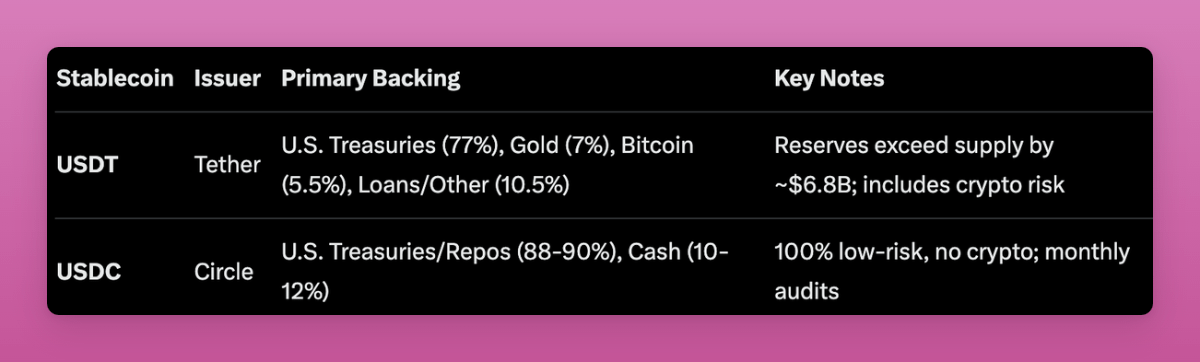
Стейблкоины
Обеспечение USDT и USDC. Источник: Ignas.
«Но если инвестор ищет чистый прокси-трейд, для этого есть Strategy, акции которой растут вместе с биткоином, тогда как USDT не дает никакого потенциала роста», — объяснил он.

Кроме биткоина, Tether также скупает золото, которое сейчас составляет 7% от обеспечения. Эксперт задается вопросом: зачем его покупать вместо большего количества биткоина, если компания не настроена «по-медвежьи» к первой криптовалюте?

«Сейчас около 23% обеспечения USDT — волатильные активы. S&P называет их “высокорисковыми”. Год назад этот показатель был всего 17%», — сказал он.

Ignas иронизирует, что при нынешней динамике Tether ничего не мешает за несколько лет поднять долю волатильных активов до 50%. Компания будет зарабатывать все больше и больше, а держатели USDT по-прежнему не получат от этого никакой выгоды.

По теме: S&P запустил индекс Digital Markets 50 для отслеживания криптовалют и блокчейн-компаний

Кредиты «на стороне»

Еще 10,5% обеспечения — это кредиты третьим аффилированным и неаффилированным организациям, продолжает Ignas. Это могут быть криптотрейдинговые фирмы, майнинговые и другие операции.

Аналитик напомнил, что в 2021 году Tether выдал 1 млрд USDT в кредит Celsius — обеспеченный биткоином — в рамках категории «обеспеченных займов» в резервах. Тогда такие займы составляли 8–10% от резервов стейблкоина.

«Tether не раскрывает личности заемщиков или условия кредитования по соображениям приватности. При этом аудитор только выборочно проверяет сделки, чтобы убедиться, что у займов есть обеспечение и что оно превышает сумму долга», — отметил он.

По теме: Metaplanet заняла еще $130 млн под залог биткоинов для новых покупок

Лучше USDC?

Пользователь под ником Maz напомнил, что проблемы есть и у других стейблкоинов. Так, он напомнил о случаях депега USDC и DAI.

Agnis в свою очередь ответил, что DAI был активом другого типа, и его профиль риска сейчас также высок. А отвязка USDC, по его мнению, также говори о том, что долгосрочное хранение «любого стейблкоина» не стоит сопутствующего риска.

Вместе с тем аналитик отмечает, что его слова — не FUD в отношении Tether, потому что потенциальный крах USDT вызвал бы массовый отток капитала из крипторынка и навредил бы в том числе и его собственному портфелю.

Он резюмировал, что не держит и не планирует держать USDT, но признает, что «Tether молодцы, так они «пампят его биткоин-запасы».

По теме: риски стейблкоинов — что может пойти не так и как защититься

Эта статья не содержит инвестиционных советов или рекомендаций. Каждое инвестиционное и торговое решение связано с риском, читатели должны самостоятельно проводить исследование перед принятием решений.


Leituras Relacionadas

Nearly a Hundred Players Rush into Embodied Data: With 4.47 Billion Yuan in Financing in One Year, Who Can Really Make Money by 'Selling Data'?

The domestic embodied AI data industry has attracted nearly 100 players, with 70 focused on data collection and 27 on data infrastructure. In the past year, 15 independent embodied data service providers raised approximately 4.47 billion yuan. Despite this growth, the sector remains early-stage, fragmented, and faces significant challenges. Data collection methods are diverse, categorized into four main routes: teleoperation of real robots, human demonstration without a robot (using motion capture, exoskeletons, etc.), simulation synthesis, and distillation from internet videos. Most companies (43%) adopt hybrid approaches, combining multiple routes, as no single method can meet all training needs. Teleoperation alone is pursued by 31% of players, often by state-owned platforms and robot companies, while newer firms favor asset-light, no-hardware human demonstration. Independent data service providers now form the largest player group (40%), indicating the emergence of a distinct industry segment rather than just a subsidiary function for robot makers. Two-thirds of all players are "embodied-native" startups, while one-third are companies that pivoted from fields like AI data annotation, which are more prevalent in the data infrastructure layer. Current annual industry capacity is estimated at 1.6-1.8 million hours plus 70-80 million data points, with a short-term goal to increase this 15-20 fold within 1-3 years. Data collection factories are spread across 20 provinces in China, concentrated in the Yangtze River Delta, Beijing-Tianjin-Hebei, and Pearl River Delta regions. Financially, the 4.47 billion yuan raised in the past year pales compared to the 43.8 billion yuan raised by the broader embodied intelligence sector in just the first half of 2026, highlighting that data remains a less "sexy" bet for investors. The 15 funded independent providers show clear stratification: a top tier led by a unicorn (Lightwheel Intelligence, 3.1 billion yuan), a middle tier of 11 firms raising tens to hundreds of millions, and an early-stage tier of 3 companies. Sixty-nine investment institutions have participated, but none have made concentrated bets, reflecting uncertainty about viable business models. Over half of these funded companies are less than a year old, most are at pre-A or A rounds, and profitability remains largely unproven. In summary, the embodied data industry has become an independent track creating jobs and local economic activity. However, it is still nascent, with unformed consensus, unsolved problems, and unproven business models. The coming 1-2 years will be a critical validation window to see if companies can build sustainable, profitable businesses purely by "selling data."

marsbitHá 2h

Nearly a Hundred Players Rush into Embodied Data: With 4.47 Billion Yuan in Financing in One Year, Who Can Really Make Money by 'Selling Data'?

marsbitHá 2h

Dialogue with Multicoin Partner: The Crypto Market Has Bottomed Out, Favoring Three Cryptocurrencies in This Cycle

In a recent interview, Multicoin Capital managing partner Tushar Jain shared his views on the crypto market. He believes the market has bottomed and is at an inflection point, citing that negative news no longer causes significant price declines and application adoption continues to grow. Jain remains highly bullish on Solana, viewing it as the correct architectural choice for internet capital markets, particularly for spot and tokenized security trading. He is also positive on Hyperliquid, noting its leadership in decentralized derivatives trading. His investment approach focuses on concentrating capital in top convictions rather than equal allocation. A distinct opportunity he highlights is Zcash (ZEC), which he sees as a return to the industry's cypherpunk ethos and a potential top-five asset by market cap. For assets like Zcash without cash flows, his valuation framework is based on relative market cap ranking. Regarding investment strategy, Jain employs a "three-part" entry method to avoid timing pitfalls and emphasizes long-term "active management" over "active trading." He outlines four sources of investment edge: informational, analytical, behavioral/psychological, and structural. On portfolio management, the fund uses Bitcoin as its "cash," selling assets into Bitcoin during market euphoria to reduce beta risk and using Bitcoin to buy dips. Sales occur only if a better opportunity arises, the investment thesis breaks, or valuations become excessively overheated. While respectful of Ethereum's resilience, he questions its unclear scaling roadmap. Finally, Jain reaffirms his commitment to the thesis that blockchains will form the foundational architecture for future capital markets.

marsbitHá 2h

Dialogue with Multicoin Partner: The Crypto Market Has Bottomed Out, Favoring Three Cryptocurrencies in This Cycle

marsbitHá 2h

Trading

Spot
活动图片