Best Presales Live News Today: Latest Updates on Early Crypto Projects with 10x Potential (November 21)

bitcoinistPublicado em 2025-11-21Última atualização em 2025-11-21

Resumo

Stay Ahead with the Latest Insights of Today's Best Presales News Check out our Live Best Presales Updates for November...

Trusted Editorial content, reviewed by leading industry experts and seasoned editors. Ad Disclosure

Stay Ahead with the Latest Insights of Today’s Best Presales News

Check out our Live Best Presales Updates for November 21, 2025!

Of all the crypto opportunities out there, presales are often the most promising and potentially the most profitable. These early-stage projects raise funds to launch community-driven meme coins, utility-heavy projects, and even degen shitcoins.

What defines crypto presales is the opportunity to join stage zero at the lowest possible price point. It can only go up from there, which it often does.

Pepe Unchained soared 550% post-presale, to name one presale. The potential is there, and if you’re looking for the latest crypto presale updates to get in early, you’ve come to the to right place.

Quick Picks for the Best Presales Today

We update this page regularly throughout the day with the latest insights on presales. Keep refreshing to stay ahead of the pack!

Disclaimer: No crypto investment comes without risk. Our content is for informational purposes, not financial advice. We may earn affiliate commissions at no extra cost to you.


Asia–US Bitcoin Split, Bitcoin Hyper ($HYPER) and Positioning for the Best Presales

November 21, 2025 • 10:00 UTC

US trading sessions have driven more than 20% of November’s $BTC drawdown, while Asian hours keep quietly buying the dip and cushioning price, creating a clear regional divergence in risk appetite.
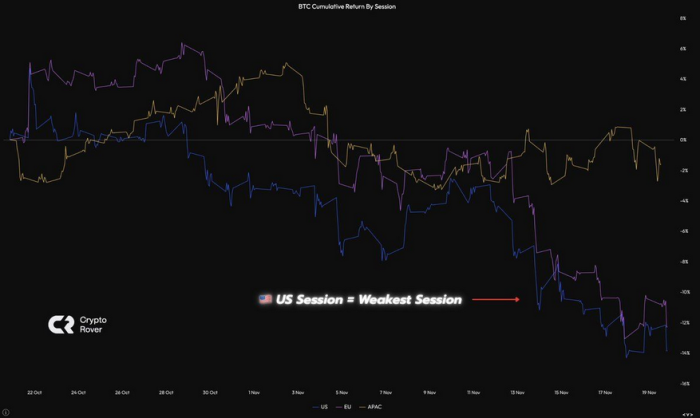
Bitcoin cumulative returns by trading session show US weakness.
Source: CryptoRover

At the same time, large institutional holders like Strategy, sitting on hundreds of thousands of coins, effectively cap how deep corrections can go and turn sharp sell-offs into extended accumulation zones for long-term players.

That mix of structural demand and short-term fear shifts the real asymmetry away from spot Bitcoin and toward Bitcoin-focused infrastructure that can scale usage.

Bitcoin Hyper ($HYPER) is building exactly in that lane. It’s a Layer-2 using Solana Virtual Machine tech to bridge $BTC into faster, smart-contract-enabled rails with its canonical bridge and multi-chain design.

With $28.22M already raised at a presale price of $0.013305, you get exposure to the ecosystem that benefits when those Asian buy-the-dip flows eventually demand more throughput, DeFi, and NFT rails around Bitcoin itself. 

Here’s how to buy $HYPER now.


Mid-Cycle Bitcoin Sellers, PEPENODE ($PEPENODE) and Rotating Into the Best Presales

November 21, 2025 • 10:00 UTC

VanEck’s latest on-chain report shows mid-cycle $BTC holders, whose coins last moved within five years, driving the current sell-off. Decade-plus whales keep their stacks untouched and futures positioning looks ‘washed out’ after open interest dropped roughly 20% in $BTC terms since October. 

That kind of cohort rotation usually marks a reset phase rather than a full structural breakdown. And this opens the door for you to redeploy risk from tired mid-cycle bags into new narratives with cleaner supply and community structures.

PEPENODE ($PEPENODE) leans into that shift with a ‘mine-to-earn’ memecoin model that swaps passive staking for gamified virtual mining.

You acquire Miner Nodes and Facilities, simulate hashrate and energy inside a dashboard, and earn tiered node rewards tracked by smart contracts, all without touching power-hungry hardware. 

With $2.17M already raised and the presale price at $0.0011592, you step into an early-stage ecosystem designed to reward long-term participants rather than jittery mid-cycle sellers exiting into weakness.

Join the PEPENODE presale now with our guide.


Authored by Ben Wallis, Bitcoinist — https://bitcoinist.com/best-presales-live-news-today-november-21-2025

Editorial Process for bitcoinist is centered on delivering thoroughly researched, accurate, and unbiased content. We uphold strict sourcing standards, and each page undergoes diligent review by our team of top technology experts and seasoned editors. This process ensures the integrity, relevance, and value of our content for our readers.

Ben is a freelance writer specializing in crypto developments (mainly altcoins) and the intricate ways global economics shape the digital asset space. His B.Ed. in Education provides a unique foundation for his writing, enabling him to distill complex crypto concepts and market shifts into clear, digestible insights. This skill is key to helping readers adapt and apply their understanding to the ever-evolving world of crypto investment. Passionate about making crypto accessible, Ben crafts content designed to educate a broad audience, from current market events to the essential foundational knowledge that underpins them. His goal is to empower readers through understanding. When he’s not immersed in crypto analysis and breaking down complex topics, Ben is an avid Pokémon fan and enjoys all things Disney.

Leituras Relacionadas

Upbit is Anxious: A Hasty Counterattack Aimed at Regaining Stablecoin Market Share

Title: Upbit's Rushed Counterattack to Reclaim Stablecoin Market Share Facing a dramatic shift in South Korea's stablecoin market, leading exchange Upbit launched a promotional campaign from July 26 to August 9, waiving the 0.05% trading fee for stablecoins paired with the Korean Won (KRW) and rapidly listing new stablecoins like RLUSD and USDG. This move is a direct response to its plummeting market share in this sector. Historically a duopoly with Bithumb, the market has been reshaped since October 2025 when Coinone permanently removed fees for USDC trading. By June 2026, Coinone led with 34.8% of stablecoin volume, followed by Bithumb (31.1%) and Upbit (30.1%). This contrasts sharply with the overall crypto market, where Upbit commands 60%. The data shows stablecoin demand is highly sensitive to fees, as users primarily buy them to transfer capital overseas for derivatives trading or forex arbitrage. South Korean exchanges have seen a net outflow of stablecoins for 18 consecutive months, totaling approximately 14.9 trillion KRW, underscoring their role as a cross-border capital conduit. Upbit's limited-time promotion initially boosted its daily stablecoin volume by 162%, but the surge was almost entirely in USDT (98.1% of volume). The newly listed stablecoins saw negligible, fleeting interest. Furthermore, the promotional effect quickly waned in the second week, with volume dropping 33% on weekdays. A concurrent weakening of the KRW also contributed to the trading spike, independent of the fee waiver. The analysis suggests that once the promotion ends, Upbit is unlikely to retain its temporary gains unless it matches Coinone's permanent zero-fee policy, forcing a choice between market share and fee revenue. Upbit's strategic push may be less about immediate profit and more about preparing for future regulatory shifts. With South Korea's *Digital Asset Basic Act* on the horizon, which will regulate KRW-backed stablecoins, and following Dunamu's (Upbit's parent) integration into Naver Financial to build a payment ecosystem, securing a dominant position in the dollar stablecoin distribution channel holds long-term strategic value. However, potential regulatory conflicts could prevent Upbit from listing a future Naver-issued KRW stablecoin, making the current fight for dollar stablecoin flow even more critical.

marsbitHá 1m

Upbit is Anxious: A Hasty Counterattack Aimed at Regaining Stablecoin Market Share

marsbitHá 1m

Michael Saylor Compares Bitcoin and Gold!

Michael Saylor, founder of MicroStrategy, argues that Bitcoin fundamentally changes how wealth is stored and transferred by transforming digital scarcity into economic value. He describes Bitcoin as the first digital monetary network, combining computers, digital networks, and cryptography. It digitizes monetary assets, allowing their supply to be controlled by public protocols rather than institutions, thus converting economic value into information transmissible over global networks. Comparing Bitcoin to gold, Saylor states that while increasing Bitcoin's supply is harder, its integration with software and transfer is easier. He highlights Bitcoin's proof-of-work mechanism, which ties it to the physical world by consuming real energy to secure the ledger, making past transactions immutable. This creates a shared security system involving miners, energy companies, and investors. Saylor suggests "digital monetary energy" is a more accurate term than "digital gold." He emphasizes that the Bitcoin network is an adaptive ecosystem of miners, nodes, developers, and users. Its core design is intentionally simple, focused on maintaining a secure ledger for scarce digital assets, with complex functionalities built in higher-layer applications. This architecture allows Bitcoin to serve as a foundation for transmitting value and fostering innovation in payments and financial services. Saylor notes Bitcoin's deeper impact lies in creating digital sovereignty, where private keys give individuals permissionless control over their economic power, with ownership verified mathematically, not by institutions. He concludes that while gold's physical scarcity makes it money, Bitcoin's digital scarcity does the same, characterizing Bitcoin as the monetary energy of the digital age.

cryptonews.ruHá 1h

Michael Saylor Compares Bitcoin and Gold!

cryptonews.ruHá 1h

Trading

Spot
活动图片