Великобритания рискует отстать от США и ЕС без стейблкоина GBP

cryptonews.ruPublicado em 2025-04-13Última atualização em 2025-11-14

По словам Марка Фэйрлесса, генерального директора группы банковской инфраструктуры и финтех-компании ClearBank, Соединенному Королевству необходимо регулировать и поощрять развитие стейблкоинов британского фунта, чтобы сохранить сектор финансовых услуг страны конкурентоспособным на мировом рынке.

«Стейблкоины — это логичное расширение для снижения трений в международных глобальных платежах», — сказал Фэйрлесс на Web Summit 2025 в Лиссабоне, Португалия.

Он заявил, что стейблкоины на основе фунта никогда не сравняются по рыночной капитализации с токенами, номинированными в долларах или евро, поскольку они не являются мировой резервной валютой.
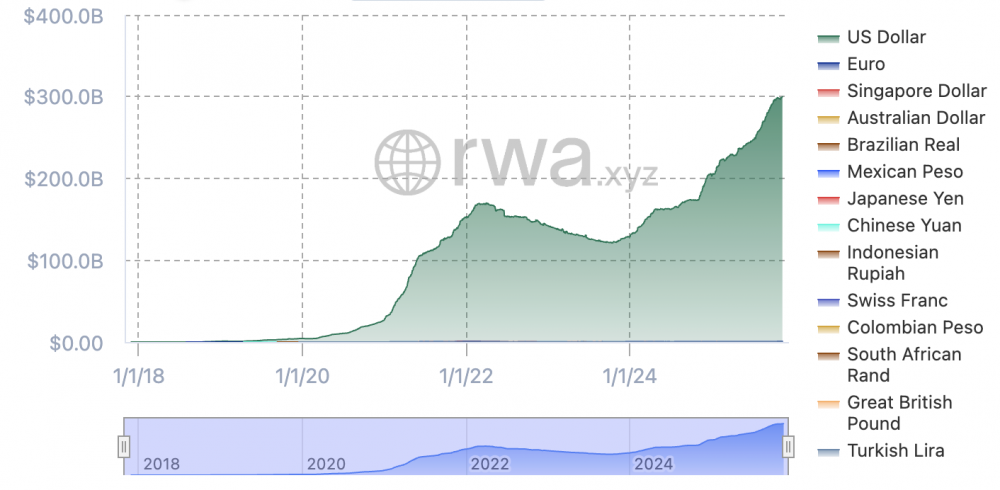
На долю стейблкоинов, номинированных в долларах, приходится около 299,4 млрд долларов из общей капитализации рынка стейблкоинов, составляющей почти 300 млрд долларов. Источник: RWA.XYZ.

Однако, по словам Фэйрлесса, Великобритании необходим стейблкоин на основе британского фунта, чтобы оставаться коммерчески конкурентоспособной в условиях перехода мира к ончейн-финансам и интернет-рынкам капитала.

«С точки зрения возможностей Великобритании, для осуществления международных платежей в режиме реального времени необходим стейблкоин GBP, и если у нас его не будет, мы рискуем отстать от других финансовых секторов. Рынок финансовых услуг в Великобритании является одним из самых сильных секторов экономики, поэтому стейблкоины — логичное направление для дальнейшего развития», — сказал он, добавив, что влияние стейблкоинов на банковский сектор и традиционные бизнес-модели еще предстоит оценить.

Стейблкоины стали геостратегически значимыми, поскольку правительства реагируют на растущее давление, вынуждающее их размещать свои фиатные валюты в блокчейне, чтобы оставаться конкурентоспособными со странами, которые интегрируют цифровые и блокчейн-решения в свою экономику.

Банк Англии обещает идти в ногу с США в вопросе стейблкоинов

Сара Бриден, заместитель управляющего Банка Англии, центрального банка Великобритании, заявила, что страна будет следовать требованиям США к регулированию стейблкоинов и тесно сотрудничать с международными партнерами для синхронизации усилий по регулированию.

Бриден также призвала к осторожному подходу и предостерегла от ослабления регулирования стейблкоинов до такой степени, когда этот класс активов начнет представлять системный риск для банковского сектора.

В понедельник Банк Англии опубликовал консультационный документ, в котором излагается предлагаемая система регулирования стейблкоинов в Великобритании.
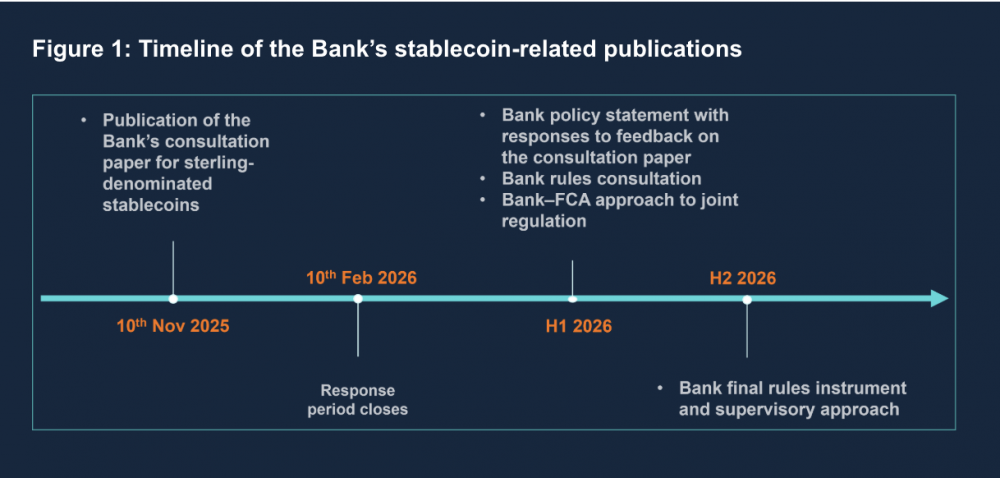
Хронология нормативно-правовой базы Банка Англии в отношении стейблкоинов. Источник: Банк Англии.

Предложение включает в себя потенциальные требования к резервированию, таксономию активов и правила управления рисками для эмитентов стейблкоинов и открыто для отзывов отрасли до февраля 2026 года, а окончательный вариант правил ожидается во второй половине года.


Leituras Relacionadas

Chip Stocks Lead U.S. Market Decline: Is AI Trading Being Hit by Both Interest Rates and Returns?

Chip stocks led a broad decline in US markets, with the Nasdaq dropping 2.2% and the S&P 500 falling 1.4%. This selloff reflects a dual challenge for the once-high-flying AI hardware trade: rising interest rate expectations and growing investor impatience for clear returns from massive AI capital expenditures. The pressure was most acute on hardware leaders. Nvidia fell about 4%, dipping below a $5 trillion market cap, while Micron plunged 13.2% ahead of its earnings report. Declines across memory, storage, AI, and mobile chips indicated a sector-wide retreat. The selloff spread globally, with South Korea's KOSPI index dropping nearly 10% as key suppliers SK Hynix and Samsung recorded double-digit losses. Investors appeared to be taking profits from the most crowded trades first. Macro headwinds intensified as market expectations shifted toward a more aggressive Federal Reserve. Forecasts for multiple rate hikes in 2026 pressured high-valuation tech stocks, which rely on long-term growth projections that become less attractive as discount rates rise. Concurrently, investors are scrutinizing the profit potential of the immense AI spending by cloud giants like Alphabet, Amazon, and Meta. While these expenditures drive demand for chips and hardware, the market is now questioning whether AI services will generate sufficient returns to justify the ongoing costs. This adjustment is not necessarily a bubble burst but a recalibration. AI demand fundamentals remain, but the narrative of endless growth can no longer fully offset concerns over higher interest rates and a longer path to profitability. Near-term direction may hinge on Micron's upcoming earnings guidance and incoming inflation data, which will influence both the AI demand outlook and the Fed's policy path. The market is transitioning from blindly buying growth to demanding clearer visibility on returns.

marsbitHá 1h

Chip Stocks Lead U.S. Market Decline: Is AI Trading Being Hit by Both Interest Rates and Returns?

marsbitHá 1h

OpenAI's New Paper: How to Train an AI that "Doesn't Deteriorate Under Pressure"?

OpenAI's new paper "Reinforcement Learning Towards Broadly and Persistently Beneficial Models" explores training AI to maintain safe, helpful, and honest behavior even under pressure, in unseen scenarios, or after being fine-tuned for harmful purposes. Moving beyond simple rule-based "don'ts," the research focuses on cultivating "beneficial traits" like honesty, risk-awareness, corrigibility, and transparency. It investigates if reinforcement learning (RL), often prone to "reward hacking" where models exploit loopholes, can instead be used to instill robust, generalized positive behaviors. Researchers created a multi-domain synthetic dialogue dataset covering areas like healthcare and law. They trained a model by replacing 5% of standard RL data with "beneficial trait" data. This model outperformed the baseline in 83% of 53 evaluations, showing average gains of 9.1% in alignment, safety, and helpfulness. Crucially, improvements generalized: a model trained only on healthcare "good behavior" data also performed better in 17 out of 19 non-healthcare alignment tests. The paper also tests "alignment persistence." When subjected to adversarial prompts or harmful fine-tuning, the beneficial trait model showed greater resilience, with smaller performance drops and less "spillover" of bad behavior to unrelated tasks. While not a complete solution, this work suggests a shift from post-hoc correction to proactively shaping robust, principled AI behavior, a critical step for deploying models in high-stakes, complex decision-making scenarios.

marsbitHá 1h

OpenAI's New Paper: How to Train an AI that "Doesn't Deteriorate Under Pressure"?

marsbitHá 1h

Semiconductor Stock Rebound: Is the Technical Correction Over or a Trend Reversal?

The core of recent semiconductor stock volatility is not about daily price swings, but rather the market questioning whether AI-driven semiconductor pricing has entered a new phase. Following a sharp sell-off in Korean stocks on June 23rd, led by Samsung and SK Hynix, a subsequent rebound is seen more as a technical positioning adjustment rather than a confirmed trend reversal. The key variable is HBM (High Bandwidth Memory), essential for AI chips. Its supply-demand imbalance granted memory makers significant pricing power. The current market focus is on whether this dynamic remains strong enough to justify elevated valuations. All eyes are on Micron's upcoming earnings report. The critical factor is not whether results meet already high expectations, but whether the company's guidance confirms that AI memory pricing power, order visibility, and future margins are still expanding. Micron's outlook will serve as a crucial test for the broader AI semiconductor chain, including Samsung, SK Hynix, and other infrastructure players. The recent bounce appears to be a pre-earnings positioning repair. For it to evolve into a sustained uptrend, concrete evidence is needed that the AI infrastructure expansion cycle's fundamentals—particularly for high-end memory—remain robust and can continue to surpass elevated market expectations. The risk is that strong demand alone may not be sufficient if future guidance hints at peaking momentum or increasing supply-side pressures.

marsbitHá 1h

Semiconductor Stock Rebound: Is the Technical Correction Over or a Trend Reversal?

marsbitHá 1h

Trading

Spot
Futuros
活动图片