Почему криптокомпании скупают реальное золото, а не биткоин

cryptonews.ruPublicado em 2025-04-12Última atualização em 2025-11-13

Мировой поток капитала меняется. На фоне роста регуляторного давления, периодических шоков ликвидности и усиливающейся конкуренции в криптоотрасли крупные компании все чаще делают ставку на физическое золото.

Наблюдения аналитиков The Kobeissi Letter показывают, что такой подход превращается в заметный тренд.

Биткоин против золота: во что выгоднее инвестировать в 2025 году

Tether и новый курс на физическое золото

По данным The Kobeissi Letter, в сентябре объем золотых резервов Tether достиг $12,9 миллиарда. Такой показатель соответствует 104 тоннам физического золота. Стоимость золотого портфеля удвоилась с начала года. Физические запасы выросли в два раза по сравнению со вторым кварталом 2024 года.
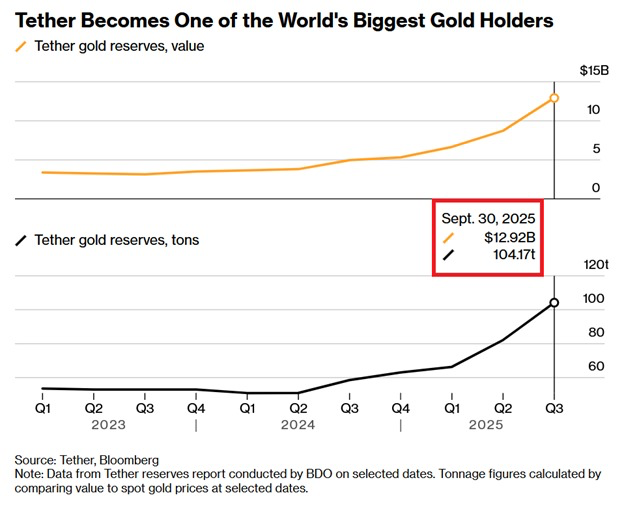
накопления tether в золоте
Как менялись накопления золота в резервах Tether. Источник: Bloomberg

Средний темп закупок превышает 1 тонну золота в неделю в 2025 году. Такой уровень превращает компанию в одного из крупных покупателей металла на глобальном рынке. Общий объем резервных активов Tether превысил $180 миллиардов. На золото приходится около 7%, и эта доля стала заметной частью структуры активов.

По последней публичной информации, Tether увеличила свои вложения в биткоин еще на 961 BTC. Такая покупка оценивается примерно в $97,34 миллиона. Общий объем биткоинов на балансе компании достиг примерно 87 000 BTC. При текущей цене биткоина в $102 766 такая позиция оценивается примерно в $8,94 миллиарда. Стоимость золотого портфеля остается выше и достигает $12,9 миллиарда. Получается, что физическое золото стало крупнейшим резервным активом компании.

Tether является эмитентом самого популярного стейблкоина в мире. Действия такой компании способны задавать ориентир для всей индустрии и формировать поведение других крупных игроков.

Почему криптокомпании делают ставку на золото

Золото помогает криптокомпаниям снизить риски и укрепить резервы. Металл сохраняет ликвидность в любых условиях и не зависит от резких колебаний криптовалют. Такой актив вписывается в практичный подход к управлению крупными балансами, особенно во времена общей финансовой нестабильности.

При этом внутри индустрии возникает заметная дилемма. Долгое время многие участники сообщества воспринимали биткоин как цифровой аналог золота и уверяли, что он способен заменить традиционные защитные активы. На этом строилась значительная часть идеологии рынка. Покупки физического металла крупнейшими криптокомпаниями выглядят для некоторых как отход от этих убеждений и шаг в сторону более консервативной финансовой модели.

Для самих компаний вопрос стоит иначе. Их задача — создавать устойчивую структуру активов и снижать зависимость от волатильности цифровых инструментов. Золото дает им возможность сбалансировать резервы за пределами крипторынка и подготовиться к любым рыночным сценариям. Такой подход стал элементом долгосрочной стратегии, где на первый план выходит надежность, а не идеология.

Макрообстановка усиливает интерес к золоту

Свежие данные подтверждают, что интерес к золоту остается высоким. 12 ноября фьючерсы на металл открылись на отметке $4 132,20 за унцию, поднявшись на 0,6% по сравнению с предыдущим днем. Цена удерживается выше $4 000 с начала недели. Движение следует за откатом от октябрьских максимумов выше $4 300, но общий рост остается уверенным.

Рынок находится под влиянием смешанных факторов. Продолжительный шатдаун правительства США усиливает интерес к защитным активам, тогда как сильный фондовый рынок поддерживает интерес к риску. Завершение шатдауна восстановит поток данных, необходимых для оценки перспектив ставок. Такие ожидания напрямую влияют на динамику золота. Более низкие ставки исторически поддерживают спрос на металл.

Напомним, ранее редакция BeInCrypto писала о том, что конец шатдауна в США вряд ли станет отправной точкой для нового бычьего ралли биткоина.

Leituras Relacionadas

If It's Not a Clear Yes, It's a No: A Nine-Year Retrospective by a VC Who Survived Four Cycles

**"Invest Only When Certain": A Nine-Year Retrospective from a VC Across Four Cycles** IOSG founder Jocy shares hard-earned lessons from nine years and over a hundred investments in Web3. The core challenge isn't identifying successful founders, but understanding why talented founders with solid ideas still fail. Through building a "failed founder database," IOSG identified six recurring failure patterns. **Founder Trait Red Flags:** 1. **Emotionally Unstable:** Founders who react defensively to criticism or publicly lash out under pressure (e.g., 80% drawdowns) often fail. Resilience is key. 2. **Lacking Hunger / Having a Fallback:** Founders with significant safety nets (family wealth, cushy fallback jobs) may lack the "do-or-die" commitment needed to survive crypto's brutal cycles. 3. **Unchecked Ego:** Includes "polished execution machines" who excel in known frameworks but struggle when paradigms shift, and "professor-types" who are technically brilliant but resistant to commercial feedback or coaching. **Project Structure Red Flags:** 4. **Token-First, Not Product-First:** Treating the token solely as a fundraising tool with no real utility or connection to product value is a major warning sign. The project should have value even if the token goes to zero. 5. **No Day-1 Exit Thesis:** Founders must have a clear, staged capital strategy from the start, understanding what each funding round needs to prove to unlock the next. "Exit before entry" is crucial. 6. **No Full-Cycle Experience:** Founders who haven't lived through a complete crypto bull/bear cycle (e.g., 2018, 2022) often underestimate their vulnerability. IOSG limits initial checks for such teams to $250k, sizing for risk. **The Positive Flipside: Desirable Founder Traits** The ideal candidate exhibits: obsessive problem-depth, being a second-time founder with a non-consensus vision, strong communication skills with *controlled* ego, relentless perseverance, and a global perspective with agency and taste (increasingly vital in the AI era). **Three Survival Tips for Founders:** 1. **Cash Flow Over Narrative:** Real revenue is what sustains projects, not vanity metrics. 2. **Tokens Are a Liability:** Avoid issuing a token unless absolutely necessary. The hidden costs (market making, liquidity, compliance) are immense, often a multi-million-dollar burden. 3. **Respect Liquidity:** Sell during peaks to build treasury, buy back to support the protocol during troughs. Be realistic about valuations and your ability to deliver for the next round. The final principle is simple yet paramount: **"If it's a borderline 'yes' or 'no,' don't invest."** In an industry that reinvents itself every few years, the discipline to consistently say "no" is the ultimate secret to longevity.

Foresight NewsHá 5m

If It's Not a Clear Yes, It's a No: A Nine-Year Retrospective by a VC Who Survived Four Cycles

Foresight NewsHá 5m

SemiAnalysis Deep Dive into CXMT: $50 Billion Revenue, An IPO Amidst a Supercycle

SemiAnalysis' in-depth report on ChangXin Memory Technologies (CXMT) details its rapid rise as China's largest upcoming semiconductor IPO. Founded in 2016 by Zhu Yiming, CXMT built its DRAM foundation on acquired patents and talent from the bankrupt German firm Qimonda. It achieved its first annual profit in 2025 after nearly a decade of significant capital support, primarily from patient Hefei municipal investors who fostered a local supply chain. The company is now capitalizing on a strong DRAM supercycle. Its revenue soared from ~$3.3B in 2024 to ~$8.6B in 2025, with Q1 2026 alone reaching ~$7.3B. SemiAnalysis projects full-year 2026 revenue could exceed $50B, driven by soaring ASPs rather than massive market share gains. While CXMT is closing the capacity gap with Micron, its product mix remains heavily focused on commodity DDR/LPDDR, which currently offers higher margins than its nascent HBM business. CXMT faces significant challenges in HBM, struggling with yield and stability for HBM3 8-Hi stacks while lagging behind the big three (Samsung, SK Hynix, Micron) in advanced nodes. However, strategic national priorities for AI self-sufficiency may push it to accelerate HBM capacity. Its complex IPO structure reveals heavy state-backed ownership and voting control over its fabs, with Alibaba appearing as both a key cloud customer and a minority shareholder. The IPO aims to raise ~$4.1B, primarily to strengthen its core DRAM manufacturing base.

marsbitHá 25m

SemiAnalysis Deep Dive into CXMT: $50 Billion Revenue, An IPO Amidst a Supercycle

marsbitHá 25m

From Corning to Ciena: The 10x Opportunity in the AI Optical Communication Chain

The transition from copper to optical communication in AI data centers is creating significant investment opportunities beyond just chipmakers. The entire photonics supply chain, from glass and fiber to connectors and test equipment, is critical. Corning, a key fiber supplier, has locked in multi-billion dollar, multi-year contracts with major cloud providers (Meta, Amazon, Google, Microsoft, OpenAI, NVIDIA), demonstrating pricing power and scale. Its profit growth is outpacing revenue growth. In the interconnect layer, Amphenol benefits from high growth in AI data centers, driven by strategic acquisitions and operational efficiency, while Credo Technology acts as a bridge between copper and optical solutions, though with high customer concentration risk. At the systems level, Ciena enables higher data capacity on existing fiber lines, with a strong backlog and cloud customer adoption. Further upstream, AXT is a bottleneck supplier of key indium phosphide wafers for lasers but faces geopolitical supply chain risks. VEO Solutions provides essential testing equipment for the entire photonics industry. A new pure-play photonics ETF (FOTO) offers a consolidated investment approach. The core thesis is that the physical limits of copper are driving an inevitable shift to optical technologies, with wealth flowing to essential, often overlooked, suppliers across the photonics value chain.

marsbitHá 37m

From Corning to Ciena: The 10x Opportunity in the AI Optical Communication Chain

marsbitHá 37m

Collector Crypt's DAU Is Only 800, Yet It's Already One of Crypto's Most Profitable Projects?

"Collector Crypt: A Highly Profitable Crypto Project with Only 800 Daily Active Users?" Collector Crypt (CARDS) is a crypto project tokenizing physical graded trading cards (primarily Pokémon) on Solana, achieving significant real-world profitability and growth. According to a Maelstrom Fund analysis, it generated approximately $53M in annualized profit in May, with a June run-rate nearing $109M, against a $550M FDV. Its core revenue driver is a digital pack-opening 'Gacha' system. The platform bulk-buys cards at a 5-15% discount. Users can open digital packs and choose to keep cards or sell them back to the platform at a 7-15% discount to market price. Most users sell back common cards, creating an efficient model: users get packs with a ~2% positive expected value, while Collector Crypt captures ~4.5% profit. The project aims to disrupt the inefficient $22.2B GMV (Q1 2026) eBay trading card market, which charges sellers 16-20% in total fees. Collector Crypt offers 2% fees, instant settlement, insured custody, and one-click trading. Beyond Gacha, future revenue streams include secondary market trading fees, infrastructure partnerships, and an eBay "snipe" tool. It holds ~$23M in card inventory and ~$10M in cash, and has already begun token buybacks. With a total supply of 2B tokens, effective circulation post-2027 unlocks is estimated at ~1.3B. Trading primarily on DEXs has so far limited large institutional entry. The project is expanding into sports cards and attracting Web2 users. Maelstrom Fund's price target is $4 by summer's end, positioning Collector Crypt at the forefront of migrating collectibles on-chain.

Foresight NewsHá 49m

Collector Crypt's DAU Is Only 800, Yet It's Already One of Crypto's Most Profitable Projects?

Foresight NewsHá 49m

Trading

Spot
Futuros
活动图片