Стоит ли сейчас закупаться USDT: прогноз курса доллара и перспективы рубля в 2025–2026 годах

cryptonews.ruPublicado em 2025-04-11Última atualização em 2025-11-12

Многих россиян сегодня беспокоят риски девальвации рубля. В условиях валютных ограничений один из немногих способов вложиться в иностранную валюту — покупка долларовых стейблкоинов, курс которых повторяет движения самого доллара.

Чтобы ответить на вопрос о том, стоит ли сейчас закупаться такими активами, редакция BeInCrypto попросила экспертов оценить устойчивость рубля, возможные риски его ослабления и дать прогноз по доллару до конца 2025 года, а также предположить, сколько будет стоить валюта в 2026-м.

Где купить USDT: 5 самых выгодных вариантов

Стабильность и краткосрочные факторы

Этой осенью курс доллара к рублю на сегодня остается стабильным: серьезных колебаний на рынке не наблюдается. По словам сооснователя NZT Rusfond Игоря Шимко, нынешний уровень можно считать сбалансированным, и до конца года заметных изменений ждать не стоит. Схожее мнение у аналитика ФГ «Финам» Александра Потавина, который отмечает, что ситуация на рынке выглядит устойчиво.

Сейчас баланс, поддерживающий курс рубля, обеспечивают несколько факторов:

  • высокая ключевая ставка, снижающая интерес к покупке иностранной валюты;
  • слабый отток капитала, поскольку привычные способы вывода средств ограничены;
  • рост расчетов в рублях и сокращение операций с иностранной валютой.

Игорь Шимко подчеркивает, что капиталы, которые могли уйти из страны, уже это сделали. При этом высокая ставка сдерживает импорт и уменьшает спрос на валюту внутри страны, что стабилизирует доллар в рублях.

Александр Потавин добавляет, что кратковременные колебания курса могут вызывать крупные сделки отдельных компаний — например, «Роснефти» или «Лукойла».

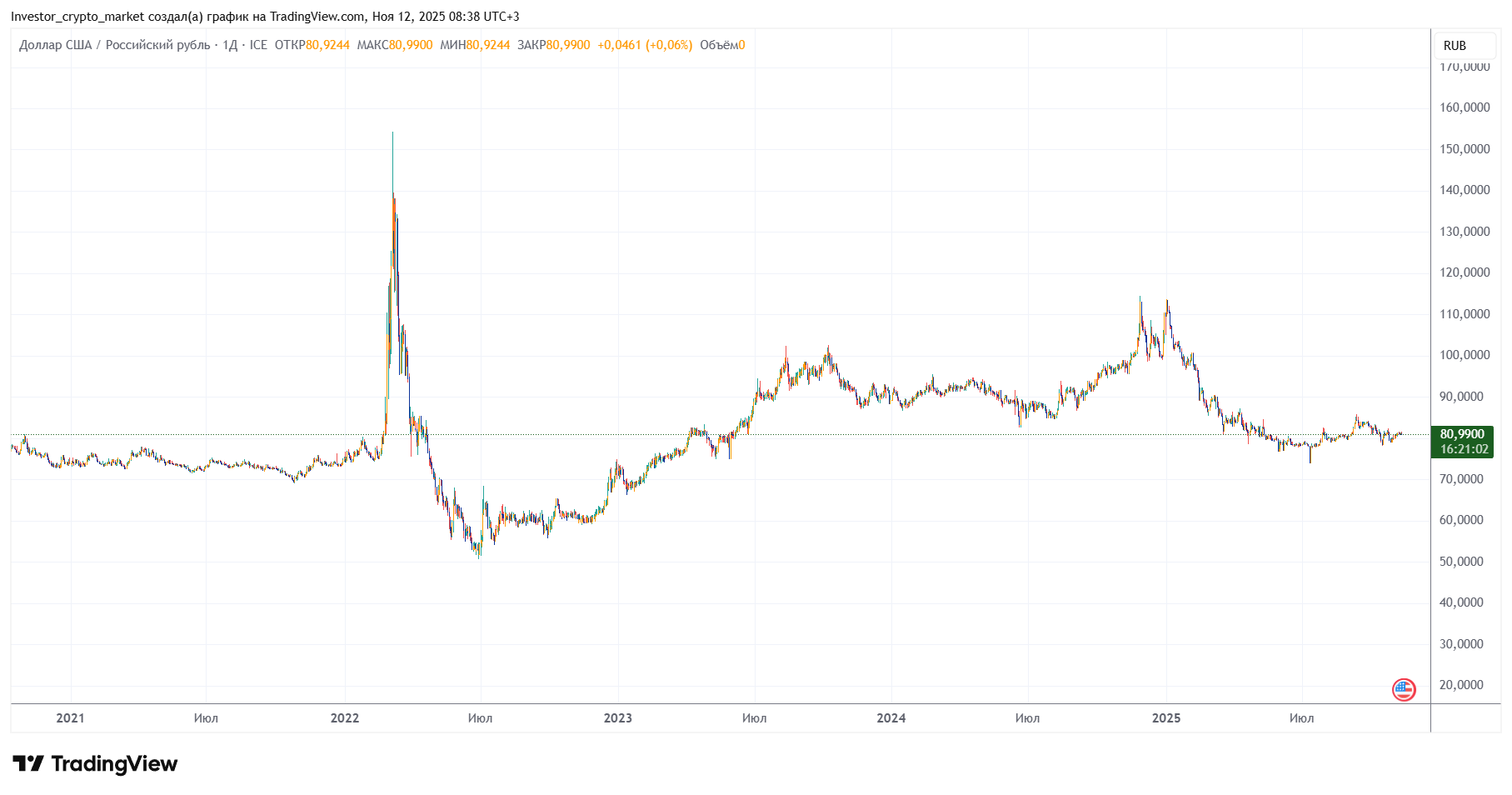
По словам эксперта по фондовому рынку «БКС Мир инвестиций» Михаила Зельцера, ноябрь традиционно неблагоприятен для рубля. Исторически в этом месяце доллар растет в более чем 70% случаев, и те, кто планирует купить доллары, стараются делать это заранее.
рубль к доллару
График рубля к доллару. Источник: TradingView

Долгосрочные тенденции: экспорт, импорт и сырьевые риски

В более длинной перспективе ситуация для рубля выглядит менее устойчивой. Игорь Шимко говорит, что приток валюты от экспортеров снижается, потому что мировые цены на основные товары остаются низкими. Это касается нефти, металлопроката, древесины и продукции горнодобывающей отрасли. Исключением остаются удобрения, но их доля в экспортных доходах невелика.

Главный аналитик Т-Инвестиций Софья Донец считает, что рубль постепенно теряет поддержку со стороны фундаментальных факторов. Ослабление курса могут вызвать три тенденции:

  1. восстановление импорта после длительной паузы в закупках;
  2. возможный рост процентных ставок со второго квартала следующего года;
  3. уменьшение продаж валюты со стороны Центрального банка в рамках операций с ФНБ.

По словам Софьи Донец, ЦБ уже сократил интервенции, и в следующем году объем таких операций может снизиться более чем вдвое — до примерно 30 миллиардов долларов. Это уменьшит предложение валюты на рынке.

Михаил Зельцер отмечает, что снижается профицит торгового баланса. За девять месяцев экспорт упал на 4,6%, а импорт — лишь на 1%. Это сокращает приток валюты в страну и ослабляет предложение долларов.

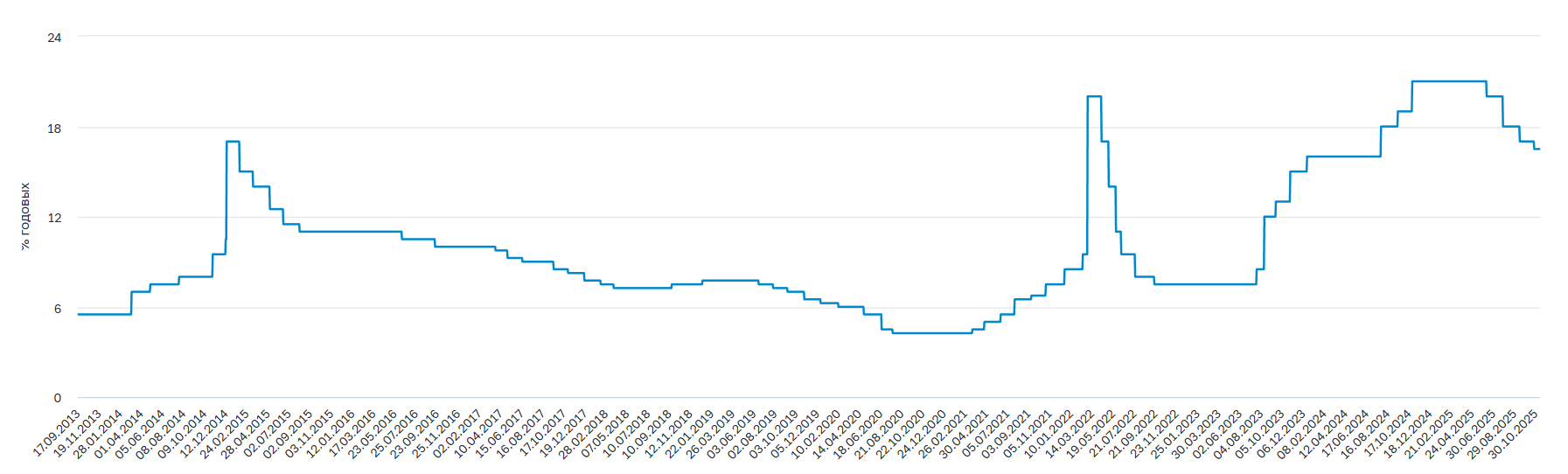
Он также ожидает, что на декабрьском заседании ЦБ может снизить ставку еще на 50 б.п., до 16% годовых. По его мнению, удешевление кредита усилит спрос на валюту со стороны импортеров.
ключевая ставка в России
Как менялась ключевая ставка ЦБ. Источник: Банк России

Прогнозы на 2025–2026 годы

Эксперты считают, что удержать нынешние уровни рублю будет непросто, хотя оценки масштабов ослабления различаются.

Михаил Зельцер прогнозирует, что доллар в ближайшие месяцы превысит 82 рубля, а к концу года закрепится выше 85.

Александр Потавин ожидает, что к концу 2025 года доллар достигнет диапазона 84–86 рублей, евро — 98–100 рублей, а юань — 11,85–11,95 рубля. Он допускает, что в 2026 году пара USD/RUB снова вернется к трехзначным значениям.

Софья Донец оценивает возможный диапазон шире — 86–92 рубля за доллар. Она считает, что рубль начнет ослабевать уже в ближайшие месяцы и этот процесс продолжится в 2026 году.

Игорь Шимко более сдержан в прогнозах. Он считает, что курс может остаться близким к текущему уровню, так как рынок уже приспособился к ограничениям, а баланс спроса и предложения стабилизировался.

Таким образом, говоря о том, сколько будет стоить доллар, эксперты сходятся во мнении, что в ближайшие месяцы сильных колебаний не будет, но к концу 2025 года американская валюта, вероятно, укрепится и продолжит рост в 2026-м.

Общие точки и расхождения

Эксперты сходятся во мнении о том, что до конца года курс рубля останется стабильным. Этому способствуют высокая ключевая ставка, слабый импорт, ограниченный отток капитала и рост расчетов в рублях.

Различия касаются сроков сохранения этой устойчивости. Игорь Шимко полагает, что баланс может продержаться и в следующем году. Многие эксперты считают, что устойчивость временная. Александр Потавин прогнозирует ослабление рубля в 2026 году, Софья Донец ожидает движение выше 90 уже в ближайшие месяцы, а Михаил Зельцер отмечает, что сезонные и денежные факторы уже сейчас работают против рубля.

Выводы

Пока рубль держится уверенно, но эта устойчивость во многом основана на высокой ставке и административных ограничениях. Снижение экспорта, рост импорта и сокращение валютных продаж ЦБ постепенно усиливают давление на курс.

К концу 2025 года доллар может стоить 84–90 рублей, а в 2026-м — еще дороже. Девальвация, по мнению экспертов, будет постепенной и контролируемой, без резких скачков. Однако общий прогноз курса доллара остается неизменным: рубль со временем ослабнет, а тем, кто планирует купить доллары, стоит учитывать возможный рост американской валюты.

Leituras Relacionadas

Mysterious "Ox Alpha" Large Model Goes Viral with Limited-Time Free Access

A mysterious anonymous AI model named "Ox Alpha," nicknamed "Cow is Coming" by Chinese netizens, has appeared on OpenRouter, sparking widespread speculation. The model offers a 1 million token context, supports text, image, and video inputs, can call tools, and is currently free. Its standout feature is strong coding ability. Initial tests on the DeepSWE benchmark, which evaluates real-world software engineering tasks, showed an 80% pass rate on a subset of tasks, reportedly nearing top-tier code models. However, follow-up tests yielded a 63% score, with variations attributed to different task sets and configurations. The model's true developer is a major topic of debate. The prevailing theory points to Zhipu AI's unreleased GLM-5.3 Flash or its multimodal variant. Evidence cited includes identical visual token consumption patterns with GLM-5V-Turbo for videos, a consistent offset in text token counts compared to GLM-5.3, and similar behavioral traits like refusing audio processing. Zhipu has a precedent of anonymous testing. Simultaneously, another anonymous model, "korrine," appeared on Code Arena, with guesses ranging from Moonshot's Kimi K3.1 to models from Qwen or MiMo, adding to the industry's guessing game. This trend of anonymous "undercover" testing allows for unbiased performance evaluation in platforms like Arena and provides real-world, high-pressure testing through tools like OpenRouter before official release. It also serves as an effective marketing tactic, prolonging discussion through suspense. If Ox Alpha is indeed a "Flash" model, its performance raises expectations for the full-scale version's potential.

marsbitHá 1h

Mysterious "Ox Alpha" Large Model Goes Viral with Limited-Time Free Access

marsbitHá 1h

Breaking News: DeepSeek Announces All-Day Off-Peak Pricing on Weekends, Making Weekend Work More Cost-Effective?

DeepSeek has announced a significant change to its API pricing model, effective August 23. The new policy removes peak/off-peak distinctions on weekends (Saturdays and Sundays), charging the lower off-peak rate for the entire two-day period. This adjustment has sparked mixed reactions within the developer and professional communities. For developers and businesses heavily reliant on DeepSeek's V4-Flash and V4-Pro APIs, this is welcome news. It allows them to schedule bulk processing tasks on weekends without the higher peak-hour costs, potentially halving their API bills for such workloads. Some users have celebrated the move for making weekend work more cost-effective. However, the announcement has also raised concerns among employees. There is apprehension that companies, particularly in cost-sensitive sectors like AI-powered short drama production, might reorganize work schedules to align with these new cost incentives. Instances are already emerging where teams schedule high-token tasks during cheaper nighttime hours or adjust staff shifts. This has led to worries about a potential shift towards weekend workdays and weekday time-off, prioritizing cost savings over traditional work-life balance. Debate has ensued regarding the practicality of such schedule changes, with questions about increased communication overhead and overall efficiency. Speculation about DeepSeek's motives for the change includes theories that peak pricing correlates with internal model training schedules, though others counter that training is largely automated. The new pricing structure is now in effect, prompting users to reconsider their task scheduling strategies.

marsbitHá 2h

Breaking News: DeepSeek Announces All-Day Off-Peak Pricing on Weekends, Making Weekend Work More Cost-Effective?

marsbitHá 2h

Just Now, The World's First Human vs. Robot Tennis Match Begins, Robot's Desperate Save Leaves Zheng Jie Astonished

Just now, the world's first human vs. robot tennis match began, featuring stunning robotic saves that left tennis star Zheng Jie in awe. This historic event, part of the second World Humanoid Robot Games and broadcast live globally by China Media Group, marked a pivotal moment in Chinese technological innovation and embodied artificial intelligence. The match featured both mixed human-robot doubles and a groundbreaking singles match between Zheng Jie and the "Galaxy Xingzai" humanoid robot developed by Galaxy General. The robot demonstrated impressive skills including serving, forehands, backhands, and strategic court movement, with serves exceeding 100 km/h. It exhibited remarkable adaptability, recovering from a fall to continue play and handling slices and spins. The doubles match highlighted its ability to coordinate dynamically with a human partner. The event's significance extends far beyond a novelty match. Tennis represents an ultimate pressure test for embodied AI, demanding real-time integration of perception, decision-making, full-body motion control, and live博弈 within fractions of a second—a stark contrast to the discrete, contemplative environment of board games like Go mastered by AlphaGo. It directly confronts Moravec's paradox, showcasing AI's move from digital cognition to physical execution. This capability is powered by Galaxy General's proprietary "Galaxy Star Brain" (AstraBrain) model. Its key innovation is a unified architecture that integrates high-level task understanding/tactical decision-making ("brain") and dynamic whole-body motion control ("cerebellum") into a single model, eliminating latency and information loss between separate modules. The model was trained using a two-step process via the "Galaxy Star Workshop" platform. First, it learned foundational movement priors from "imperfect" human motion data (both amateur and professional). Second, it underwent massive-scale evolution in a virtual tennis simulator where multiple AI agents played millions of games against each other. Through this adversarial training, skills like极限救球and recovery from falls emerged autonomously without explicit programming, before being transferred to the physical robot. This "AstraTennis" moment symbolizes a major leap: a decade after AlphaGo conquered the digital world, embodied AI from China has now demonstrated it can operate under the extreme, unpredictable physical pressures of real-world competition.

marsbitHá 2h

Just Now, The World's First Human vs. Robot Tennis Match Begins, Robot's Desperate Save Leaves Zheng Jie Astonished

marsbitHá 2h

The Biggest Dark Horse in AI Payments Might Be Coinbase Giving Agents a Wallet

In the AI payments race, while most focus on traditional giants like Visa or AI platforms like OpenAI, Coinbase has quietly emerged as a key player. Data from 2026 shows over 90% of on-chain Agent transactions occur on Coinbase's Base network, with 99% settled in USDC and over 97% using the x402 protocol. Coinbase's pivotal move was launching "Agentic Wallets" in February 2026—a dedicated wallet infrastructure giving AI Agents their own financial identity. Unlike Visa or Stripe, which connect Agents to existing payment rails, Coinbase provides Agents with autonomous wallets to hold assets (like stablecoins), initiate transfers, and execute transactions under predefined rules. This solves core issues for machine-to-machine payments: high credit card fees for micropayments, the need for constant human authorization, and unclear transaction attribution. Coinbase's strength lies in its closed-loop ecosystem: the Base blockchain (low-cost, high-throughput), the x402 payment protocol, Agentic Wallets, and native assets like USDC. This integrated stack, built through years of infrastructure investment, positioned Coinbase to capture early Agent payment demand as the AI economy surged. The key insight is that AI payment adoption may depend less on whose standard wins and more on whose usable infrastructure is ready first. While debates over protocols and payment rails continue, real Agent transactions are already flowing—primarily through Coinbase's ecosystem. It may not be the ultimate winner, but for now, it's the frontrunner by being prepared.

marsbitHá 3h

The Biggest Dark Horse in AI Payments Might Be Coinbase Giving Agents a Wallet

marsbitHá 3h

Trading

Spot
活动图片