Cardano Didn’t Fail On Scalability, Says Hoskinson — Leios Coming In 2026

bitcoinistPublicado em 2025-11-06Última atualização em 2025-11-06

Resumo

Charles Hoskinson used a Nov. 5 video address to rebut a renewed wave of criticism that Cardano has “failed on...

Trusted Editorial content, reviewed by leading industry experts and seasoned editors. Ad Disclosure

Charles Hoskinson used a Nov. 5 video address to rebut a renewed wave of criticism that Cardano has “failed on scalability,” centering his response on two pillars: Hydra, Cardano’s off-chain scaling stack, and Leios, a forthcoming Ouroboros upgrade that he says now has a complete design and a clear path to mainnet in 2026.

Hoskinson’s remarks were framed as a direct answer to a thread by Cyber Capital CEO Justin Bons alleging Cardano is capped at “23 transactions per second,” dismissing the impact of batching, fee markets, Hydra, and the Ouroboros Leios roadmap, and concluding that Input Output Global (IOG) has shifted focus to a new chain. “You’re entitled to an opinion, but you’re not entitled to your own facts,” Hoskinson said, calling the conclusion “blatantly wrong” and “pathetic” for ignoring public specifications and ongoing engineering work. He pushed back on claims that Leios had been abandoned: “There exists a CIP. We have the blueprint. We know how to do it.”

Cardano Has Not Failed On Scalability

Central to his argument is that Leios has moved from research to a fully specified implementation track. Hoskinson held up the CIP for Ouroboros Leios, emphasizing that the end-to-end design was completed only this year after “years of paper writing, prototyping, and simulation.”

In his telling, the protocol aims to thread the industry’s core dilemma of decentralization, security, and throughput without leaning on centralized shortcuts. “What do we care about in this industry? Do we care about decentralization or not?” he asked, warning that once systems optimize around cheap, high-throughput configurations with heavy hardware demands, “no one has any incentive to change the status quo.”

Hydra, he argued, is already live and delivering practical capacity gains that critics are “discounting.” As evidence, he cited the Glacier drop, saying “33.6 million accounts were loaded into that thing and we were able to operate no problem at all,” and that Hydra continues to “evolve and get more advanced.” While he did not present throughput figures beyond disputing the 23 TPS narrative, the thrust of his rebuttal was that Cardano’s scaling arc is cumulative: Hydra now, Leios next.

On Leios timelines, Hoskinson was unambiguous. “Yes, it will ship in 2026. No if, ands, or buts about it,” he said, adding that IOG has instituted “a 24/7 implementation, a follow-the-sun model to get Leios out in market faster.” He also previewed a dedicated Leios website “before the end of the month” to publish daily updates as the network “march[es] towards it,” and claimed “more than a dozen companies” are engaged in implementation work alongside multiple node clients. His message to the broader ecosystem was equally pointed: “In 2026, we’re going to find a path to get linear Leios on Cardano,” urging operators to “hold off on the adoption” of nodes that don’t support Leios so the feature can be activated network-wide.

Beyond scaling mechanics, the address veered into governance and industry structure. Hoskinson asserted Cardano targets “50% Byzantine resistance” while preserving decentralization, contending that no major chain—he named Bitcoin and Ethereum among others—has achieved at-scale decentralization without trade-offs. He linked scaling work to the project’s self-image as one of the few ecosystems “carrying on our backs the original dream of Satoshi,” warning that industry consolidation around ETFs, bank custody, and centralized stablecoins risks “put[ting] the chains on humanity for the rest of time.”

Marketing, Not The Technology

Hoskinson located Cardano’s bottleneck not in research or engineering but in go-to-market. “Our problem is not our technology… Our problem right now is marketing and adoption, deal making and partnerships,” he said, criticizing entities in the ecosystem that he claims received “hundreds and hundreds and hundreds of millions of ADA” or “over a billion” for adoption efforts that have been “pulling teeth.” He credited a new foundation-driven initiative—presented by critics as a “pivot” away from Cardano—as having already attracted listings, integrations, and a path to “tier one stables,” insisting such work ultimately routes back to Cardano usage.

The tone throughout was combative, reflecting frustration with narratives he sees as moving the goalposts. “Leios is going to ship. It’s a real thing. It exists. Look at CIP 164,” he said. “When we turn it on, they’ll move the goalpost and it will be something else.”

He portrayed the coming year as a campaign to close the engineering loop and reorient on adoption: “We have the technology. We have the ecosystem. We just have to invest heavily in [marketing and adoption]… and we will.” The message to skeptics was unvarnished—“You can’t discount Hydra… you can’t discount the progress made with Leios.”

At press time, ADA traded at $.05359
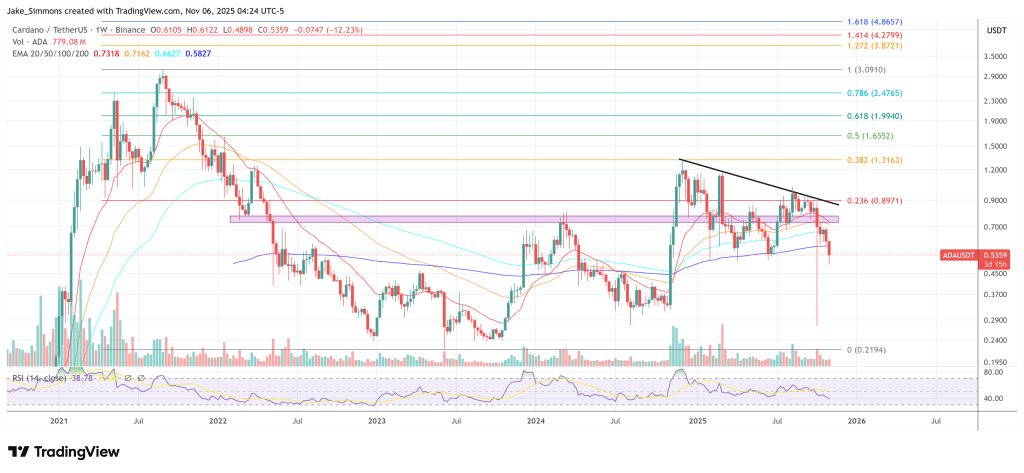
Cardano price
ADA falls below the 200-week EMA, 1-week chart | Source: ADAUSDT on TradingView.com
Featured image created with DALL.E, chart from TradingView.com
Editorial Process for bitcoinist is centered on delivering thoroughly researched, accurate, and unbiased content. We uphold strict sourcing standards, and each page undergoes diligent review by our team of top technology experts and seasoned editors. This process ensures the integrity, relevance, and value of our content for our readers.

Jake Simmons has been a Bitcoin enthusiast since 2016. Ever since he heard about Bitcoin, he has been studying the topic every day and trying to share his knowledge with others. His goal is to contribute to Bitcoin's financial revolution, which will replace the fiat money system. Besides BTC and crypto, Jake studied Business Informatics at a university. After graduation in 2017, he has been working in the blockchain and crypto sector. You can follow Jake on Twitter at @realJakeSimmons.

Criptomoedas em alta

Leituras Relacionadas

Analyst Who Predicted Bitcoin's Major Drop in October Now Predicts What Could Happen Next

Sean Farrell, head of digital asset strategy at Fundstrat, analyzes the current uncertain and volatile crypto market. He notes that while traditional tech stocks hit record highs, lagging crypto assets have created market apathy, which could be an early sign of a bottom forming. Farrell's base case suggests Bitcoin and the broader crypto market may experience one final sharp decline before initiating a sustained upward trend. It remains unclear if this drop will form a new deep low or test recent lows. He points out that global liquidity conditions and rising US 10-year Treasury yields continue to pressure liquidity-sensitive assets like cryptocurrencies in the short term. Farrell states that the tech sector's growth is driven by significant corporate profit increases, whereas the crypto market hasn't yet received the necessary monetary and fiscal liquidity. Although high US Treasury issuance and rising long-term bond yields are pressuring the market, he predicts a potential shift within the next 3-6 months. After risk appetite diminishes due to high interest rates, liquidity-boosting measures from regulators or central banks could trigger a new bull market. Additionally, Farrell believes that if a new governance proposal aimed at reducing inflation on the Solana network is adopted, it would lessen sell-side pressure and could act as a significant catalyst for the token's price.

cryptonews.ruHá 1h

Analyst Who Predicted Bitcoin's Major Drop in October Now Predicts What Could Happen Next

cryptonews.ruHá 1h

Bitcoin Breaches $64,000 Mark Again as Short Sellers Lose $57.4 Million in Liquidations

Bitcoin surged back above $64,000 on Monday, reversing a dip below $63,000 that had threatened to revisit mid-August lows. The rally coincided with an announcement from MicroStrategy stating it had neither bought nor sold any Bitcoin over the past week. After falling to a daily low near $62,653, Bitcoin sharply reversed course, climbing approximately $1,000 in six hours to reach a daily high above $64,375. By early afternoon EST, it was trading above $64,200, marking a nearly 2% daily gain and turning its weekly performance positive. The price movement triggered significant liquidations in the derivatives market, with leveraged short positions losing $57.4 million over 24 hours, contributing to total crypto market liquidations nearing $220 million. While MicroStrategy paused its Bitcoin purchases, it increased its cash reserves to $4.8 billion using part of the proceeds from a recent common stock sale. The funds were also used for share buybacks and preferred dividend payments. Analysts suggest this focus on balance sheet strength helps mitigate near-term liquidation pressure, especially as Bitcoin's price remains about 15% below MicroStrategy's average acquisition cost of $75,385. However, critics argue the capital allocation disproportionately benefits preferred shareholders (STRC) over common stockholders (MSTR) and sidelines the company's core growth strategy of aggressive Bitcoin accumulation. Bitcoin initially appeared to react positively to reports of a potential 60-day ceasefire extension between the U.S. and Iran, but the rally's momentum faded after Iranian officials denied the reports. Consequently, Bitcoin currently lacks a clear macroeconomic catalyst to sustain a decisive bullish breakout.

cryptonews.ruHá 1h

Bitcoin Breaches $64,000 Mark Again as Short Sellers Lose $57.4 Million in Liquidations

cryptonews.ruHá 1h

Trading

Spot

Artigos em Destaque

Como comprar T

Bem-vindo à HTX.com!Tornámos a compra de Threshold Network Token (T) simples e conveniente.Segue o nosso guia passo a passo para iniciar a tua jornada no mundo das criptos.Passo 1: cria a tua conta HTXUtiliza o teu e-mail ou número de telefone para te inscreveres numa conta gratuita na HTX.Desfruta de um processo de inscrição sem complicações e desbloqueia todas as funcionalidades.Obter a minha contaPasso 2: vai para Comprar Cripto e escolhe o teu método de pagamentoCartão de crédito/débito: usa o teu visa ou mastercard para comprar Threshold Network Token (T) instantaneamente.Saldo: usa os fundos da tua conta HTX para transacionar sem problemas.Terceiros: adicionamos métodos de pagamento populares, como Google Pay e Apple Pay, para aumentar a conveniência.P2P: transaciona diretamente com outros utilizadores na HTX.Mercado de balcão (OTC): oferecemos serviços personalizados e taxas de câmbio competitivas para os traders.Passo 3: armazena teu Threshold Network Token (T)Depois de comprar o teu Threshold Network Token (T), armazena-o na tua conta HTX.Alternativamente, podes enviá-lo para outro lugar através de transferência blockchain ou usá-lo para transacionar outras criptomoedas.Passo 4: transaciona Threshold Network Token (T)Transaciona facilmente Threshold Network Token (T) no mercado à vista da HTX.Acede simplesmente à tua conta, seleciona o teu par de trading, executa as tuas transações e monitoriza em tempo real.Oferecemos uma experiência de fácil utilização tanto para principiantes como para traders experientes.

687 Visualizações TotaisPublicado em {updateTime}Atualizado em 2026.06.02

Como comprar T

Discussões

Bem-vindo à Comunidade HTX. Aqui, pode manter-se informado sobre os mais recentes desenvolvimentos da plataforma e obter acesso a análises profissionais de mercado. As opiniões dos utilizadores sobre o preço de T (T) são apresentadas abaixo.

活动图片