Solana Foundation Exec Slams XRP Hype: ‘Show Me the Data’

bitcoinistPublicado em 2025-11-03Última atualização em 2025-11-03

Resumo

Solana Foundation executive Vibhu Norby ignited a fresh round of cross-ecosystem debate this weekend, challenging XRP supporters to ground their...

Trusted Editorial content, reviewed by leading industry experts and seasoned editors. Ad Disclosure

Solana Foundation executive Vibhu Norby ignited a fresh round of cross-ecosystem debate this weekend, challenging XRP supporters to ground their bullish narratives in verifiable network metrics rather than aspiration. In a series of posts on X, Norby said he “want[s] Ripple and XRP to succeed at an insane degree,” but argued that “the community does not argue with facts, even though the data is readily available.” He added: “as a longtime engineer and truth seeker, that bothers me.”

Norby Says XRP Growth Stalled

The core claim is that—measured by on-chain activity—the XRP Ledger’s growth has been “extremely mediocre” relative to faster-growing chains, most notably Solana. Citing XRPScan, he said the “active daily accounts shows no 3-year improvement, hovering around 25,000 daily active accounts,” while “this year, Solana is averaging over 2.5 million daily active accounts. That’s 100x.” Short of debating sentiment or distant roadmaps, he framed the discussion as empirical: “The fiction is very far ahead of the facts.”
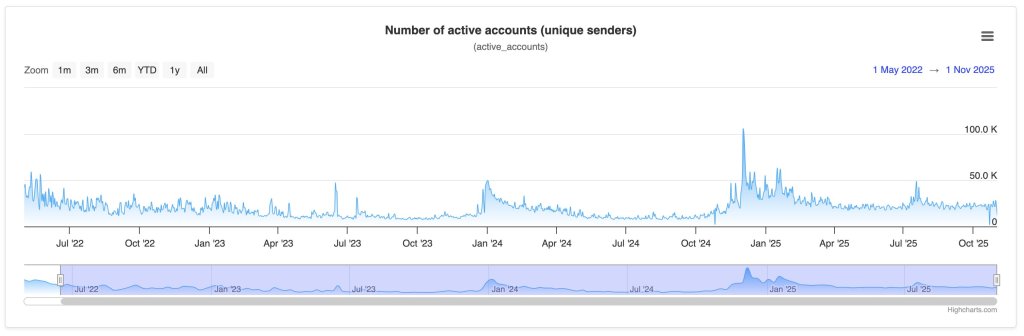
Number of active XRP Ledger accounts
Number of active accounts | Source: X @vibhu

The activity gap was a through-line in Norby’s posts. On throughput, he pointed to XRP’s roughly 1–1.5 million daily transactions and contrasted that with Solana’s order-of-magnitude higher traffic: “the total daily transactions, around 1.5 million per day, is outclassed by Solana which is handling about 100 million per day.”
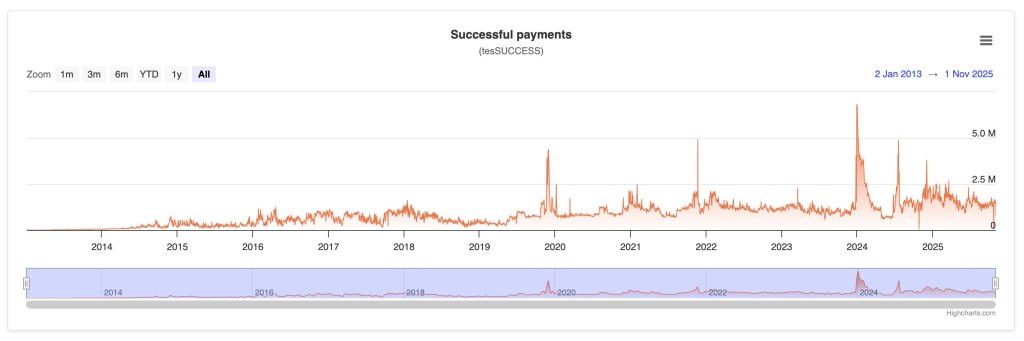
XRP successful payments
Successful payments | Source: X @vibhu

While exact daily figures vary with market conditions and data providers, independent dashboards corroborate the broad picture: XRP’s transactions typically sit in the low-single-digit millions per day, while Solana’s effective user-facing throughput has been documented near the ~1,000 TPS range with peaks far higher under stress; counting all transaction types, Solana’s raw transaction count regularly dwarfs legacy chains. “Currently, XRPL is handling about 17 TPS, according to XRPScan. Solana executes 1000 non-vote TPS on mainnet, and often more,” Norby said.

Norby also trained attention on value transfer rather than just message count. “XRP’s transfer volume today is about $50–60 billion per month. However, Solana’s October stablecoin transfer volume alone, which is a small subset of all network assets, was almost $2 trillion,” he wrote.

Anticipating the most common rejoinder—“oh it’s all fake, bots, etc.”—Norby argued that the Solana-side data excludes wash behavior in the stablecoin tallies he referenced and that fee structures are not a sufficient explanation for alleged bot asymmetry. “Given both XRPL and Solana have similarly low transaction fees, there’s no reason why Solana would uniquely attract bots that XRPL wouldn’t,” he wrote, adding that the on-chain payments edge in Solana remains “a huge measurable margin” even after obvious noise filters.

The exchange quickly broadened beyond raw counters to product-market fit. One defender asserted that “XRP isn’t for retail and memecoins. Financial institutions are heavily regulated and slow to adopt.” Norby rebutted that premise bluntly: “They haven’t been slow to adopt – lol. They’re just adopting stablecoins, not XRP.”

In a separate reply to a question about what’s driving Solana’s relative outperformance, Norby’s answer was a one-word thesis: “Technology.” He later summarized the posture of the XRP army he believes the data supports with a pointed quip: “Solana is a bridge currency.”

Norby also dismissed the idea that RippleNet’s progress should be conflated with on-chain traction: “One cannot have a view on RippleNet because it appears to be simply a private business. Therefore it’s hard to argue it has any bearing on XRP.”

That distinction echoes long-standing commentary that RippleNet, as an enterprise messaging and settlement network, can operate independently of XRP unless specific corridors use On-Demand Liquidity mechanisms. “Offchain connections are entirely commoditized,” Norby added, casting political or banking relationships as insufficient substitutes for measurable on-chain usage.

As the thread grew, community pushback coalesced around two counterclaims: that XRP’s design goal is institutional settlement rather than retail-heavy app ecosystems, and that a “HODL-heavy” holder base naturally depresses daily active address counts. Norby responded that Solana, too, is held by large numbers of passive investors—“Believe it or not, many people also just buy SOL and hold”—but “the difference is that people also actually use Solana.”

He concluded with a challenge: “Open offer to any community member or Ripple executive: let’s do a livestream debate right here on X. You bring facts, I bring facts. Facts are important. Let the internet decide who wins.” He also hosted a public X Space to continue the discussion.

None of the above makes Ripple’s endgame impossible. Norby repeatedly allows that “it is very possible that XRPL wins,” framing his argument as a present-tense snapshot rather than a terminal verdict. But his counsel to investors is unsparing: “If you hold XRP as an investment, you need to seriously consider how much longer it’s worth waiting around.”

At press time, XRP traded at $2.40.
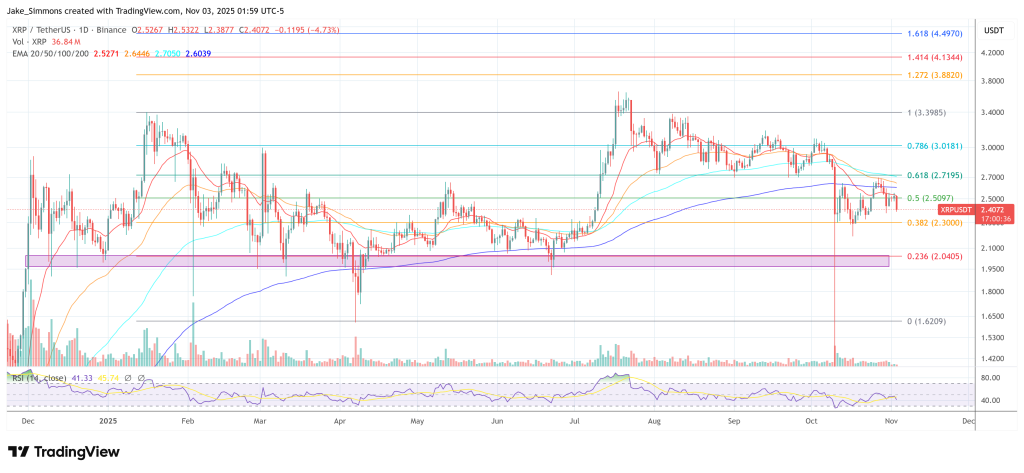
XRP price
XRP falls below the 0.5 Fib, 1-day chart | Source: XRPUSDT on TradingView.com
Featured image created with DALL.E, chart from TradingView.com
Editorial Process for bitcoinist is centered on delivering thoroughly researched, accurate, and unbiased content. We uphold strict sourcing standards, and each page undergoes diligent review by our team of top technology experts and seasoned editors. This process ensures the integrity, relevance, and value of our content for our readers.

Jake Simmons has been a Bitcoin enthusiast since 2016. Ever since he heard about Bitcoin, he has been studying the topic every day and trying to share his knowledge with others. His goal is to contribute to Bitcoin's financial revolution, which will replace the fiat money system. Besides BTC and crypto, Jake studied Business Informatics at a university. After graduation in 2017, he has been working in the blockchain and crypto sector. You can follow Jake on Twitter at @realJakeSimmons.

Leituras Relacionadas

DeepSeek Announces Permanent Price Cut, But Liang Wenfeng Is Not Trying to Be a "Cyber Bodhisattva"

DeepSeek has announced a permanent 75% discount on its V4-Pro API, significantly reducing its token prices. This move stands out as a major industry-wide price cut while competitors like Anthropic, OpenAI, and Google have been quietly raising theirs. The article contrasts this strategy with the broader trend of AI becoming more expensive, citing examples of companies like Microsoft and Uber struggling with high token costs as usage soars. While CEO Liang Wenfeng is hailed by some as a "Cyber Bodhisattva" for this普惠 approach, the article argues this is a strategic business choice, not mere altruism. DeepSeek's ability to maintain low prices is attributed to several structural advantages: lower-cost AI talent in China, the impending use of domestic昇腾 hardware for further cost reductions, and, most critically, access to China's cheaper and more abundant energy infrastructure, which drastically reduces the electricity costs dominating AI operations. The analysis suggests that for many commercial applications, a "good enough" model that is radically cheaper (e.g., 1% to 11% of GPT-5.5's cost) is more valuable than the absolute top-tier model. This allows for vastly more experimentation and iteration within a budget. Therefore, as AI generally becomes more expensive, DeepSeek's cost-competitiveness—rooted in China's energy and talent advantages—becomes its core strategic value and differentiator in the global market.

marsbitHá 8h

DeepSeek Announces Permanent Price Cut, But Liang Wenfeng Is Not Trying to Be a "Cyber Bodhisattva"

marsbitHá 8h

The Veil of Mythos Becomes Anthropic's Lever to Move Trillions

The article discusses Anthropic's reported upcoming $30 billion funding round, which would value the company at over $900 billion. It analyzes how the company has leveraged strategic narratives around its unreleased "Mythos" model, rather than just its publicly available products, to drive this massive valuation. Key points include Google's surprising $40 billion investment in a competitor, suggesting it is buying strategic positioning. Anthropic's "Glasswing" cybersecurity project and the unreleased Mythos model are portrayed not through direct proof, but through carefully crafted narratives of being "too powerful for public release," creating an aura of exclusive, high-level capability. This is bolstered by reports of the White House and NSA seeking access to Claude/Mythos despite previous security concerns, implying indispensable technology. Furthermore, Anthropic's reported rapid revenue growth—from a $1 billion annual run-rate in late 2024 to over $30 billion by April 2026, largely driven by enterprise API and Claude Code—provides a financial story for investors. The article concludes that Anthropic's core business model is effectively converting unverifiable technical potential, government interest, and future revenue projections into a compelling narrative that secures immense capital, using the actions of wealthy investors and powerful institutions as the ultimate validation of its worth.

marsbitHá 10h

The Veil of Mythos Becomes Anthropic's Lever to Move Trillions

marsbitHá 10h

Trading

Spot
Futuros

Artigos em Destaque

O que é XRP 2.0

XRP 2.0: Uma Nova Fronteira no Landscape das Criptomoedas Introdução ao XRP 2.0 No reino em constante evolução das criptomoedas, novos projetos surgem continuamente, lutando por atenção e adoção. Uma dessas iniciativas promissoras é o XRP 2.0, um novo projeto de criptomoeda concebido para aproveitar a tecnologia de blockchain avançada e as metodologias de criptografia robustas. Embora o nome tenha paralelos com o XRP da Ripple, é crucial notar que o XRP 2.0 opera de forma independente, focando em melhorar a segurança das transações, a privacidade e a escalabilidade. À medida que o panorama financeiro digital abraça cada vez mais soluções descentralizadas, o XRP 2.0 visa contribuir de forma significativa para a web3 e a expansão global dos projetos de criptomoedas. O que é o XRP 2.0? No seu núcleo, o XRP 2.0 é um projeto de criptomoeda que visa criar um ecossistema de moeda digital seguro e descentralizado. Sua tecnologia fundamental integra princípios de blockchain sofisticados com técnicas de criptografia de ponta. O objetivo abrangente do XRP 2.0 é estabelecer-se como uma plataforma confiável e eficiente que possibilita a execução rápida de transações, priorizando a proteção de privacidade aprimorada para os seus usuários. O projeto é promovido como uma solução para muitas limitações enfrentadas pelas criptomoedas existentes, propondo um sistema que pode lidar com um volume maior de transações com velocidade e privacidade melhoradas. Esta versatilidade posiciona o XRP 2.0 como um concorrente significativo em um mercado repleto de várias moedas digitais. Quem é o Criador do XRP 2.0? A identidade do criador por trás do XRP 2.0 foi identificada como 'Wilbur.' No entanto, detalhes abrangentes sobre Wilbur ou a sua entidade associada permanecem elusivos. O anonimato de muitos criadores de criptomoedas não é um fenômeno incomum na indústria, muitas vezes concebido para manter um grau de privacidade e segurança. Quem são os Investidores do XRP 2.0? Até agora, informações específicas relacionadas às fundações ou organizações de investimento que apoiam o XRP 2.0 não estão disponíveis publicamente. No setor das criptomoedas, o apoio de investidores reputados pode influenciar significativamente a credibilidade e o sucesso de um projeto, no entanto, a transparência em relação aos apoiantes financeiros do XRP 2.0 não foi estabelecida. Como Funciona o XRP 2.0? O XRP 2.0 destaca-se por empregar uma combinação de tecnologia blockchain e algoritmos de criptografia avançados que asseguram transações seguras e descentralizadas. Sua estrutura inovadora inclui características únicas projetadas para fomentar o envolvimento dos usuários e ampliar as funcionalidades além das transações convencionais de criptomoedas. Entre essas características, o XRP 2.0 incorpora capacidades potenciadas por IA, como funcionalidades de texto-para-imagem e texto-para-fala. Estas adições são projetadas para melhorar a experiência interativa dos usuários, promovendo uma maior aplicabilidade em vários setores. Ao unir avanços tecnológicos com um design centrado no utilizador, o XRP 2.0 pretende captar a atenção de uma diversa gama de indivíduos e empresas que procuram integrar soluções de criptomoedas em suas estruturas operacionais. Cronologia do XRP 2.0 Compreender o XRP 2.0 requer examinar os marcos que definiram sua jornada até agora: 23 de Julho de 2023: O XRP 2.0 é apresentado como um novo projeto de criptomoeda, visando revolucionar as capacidades de transação seguras e descentralizadas no domínio do blockchain. 8 de Setembro de 2023: O lançamento de outro projeto, XRP20, ocorre, marcando o surgimento de um token ERC-20 na blockchain Ethereum que permanece não relacionado ao XRP 2.0. 13 de Novembro de 2023: O XRP Ledger passa por uma atualização significativa com o lançamento da versão 2.0.0 do software do servidor rippled. É importante notar que este desenvolvimento está desconectado do projeto de criptomoeda XRP 2.0. Pontos-chave sobre o XRP 2.0 Para destilar a essência do XRP 2.0, vários fatores críticos emergem: Características Únicas: A inclusão de características como texto-para-imagem e texto-para-fala potenciadas por IA diversifica ainda mais as aplicações potenciais do XRP 2.0. Tecnologia Blockchain: A estrutura utiliza mecanismos de blockchain avançados e protocolos de criptografia, assegurando um ambiente seguro e descentralizado para transações. Escalabilidade e Privacidade: O XRP 2.0 prioriza proteção de privacidade aprimorada nos processos de transação e a escalabilidade necessária para acomodar uma base de utilizadores crescente. Sem Afiliação com a Ripple: Importante, apesar do seu nome, o XRP 2.0 não tem qualquer lealdade ou colaboração com o XRP da Ripple, distinguindo sua estrutura operacional e objetivos dentro do ecossistema das criptomoedas. Conclusão O XRP 2.0 representa uma empreitada ambiciosa no domínio das criptomoedas, visando oferecer uma combinação de segurança, privacidade e eficiência em transações digitais. Ao integrar tecnologias sofisticadas e características amigáveis ao utilizador, o projeto propõe-se a ampliar os horizontes do que as criptomoedas podem alcançar na economia digital atual. Embora o anonimato do seu criador e a falta de investidores divulgados possam levantar questões para alguns, o foco do XRP 2.0 em funcionalidades avançadas e descentralização aumenta seu apelo num mercado de criptomoedas cada vez mais congestionado. À medida que o panorama das criptomoedas continua a evoluir, o XRP 2.0 pode ainda emergir como um jogador crucial na expansão de soluções de blockchain seguras e escaláveis.

99 Visualizações TotaisPublicado em {updateTime}Atualizado em 2024.12.03

O que é XRP 2.0

Como comprar XRP

Bem-vindo à HTX.com!Tornámos a compra de XRP (XRP) simples e conveniente.Segue o nosso guia passo a passo para iniciar a tua jornada no mundo das criptos.Passo 1: cria a tua conta HTXUtiliza o teu e-mail ou número de telefone para te inscreveres numa conta gratuita na HTX.Desfruta de um processo de inscrição sem complicações e desbloqueia todas as funcionalidades.Obter a minha contaPasso 2: vai para Comprar Cripto e escolhe o teu método de pagamentoCartão de crédito/débito: usa o teu visa ou mastercard para comprar XRP (XRP) instantaneamente.Saldo: usa os fundos da tua conta HTX para transacionar sem problemas.Terceiros: adicionamos métodos de pagamento populares, como Google Pay e Apple Pay, para aumentar a conveniência.P2P: transaciona diretamente com outros utilizadores na HTX.Mercado de balcão (OTC): oferecemos serviços personalizados e taxas de câmbio competitivas para os traders.Passo 3: armazena teu XRP (XRP)Depois de comprar o teu XRP (XRP), armazena-o na tua conta HTX.Alternativamente, podes enviá-lo para outro lugar através de transferência blockchain ou usá-lo para transacionar outras criptomoedas.Passo 4: transaciona XRP (XRP)Transaciona facilmente XRP (XRP) no mercado à vista da HTX.Acede simplesmente à tua conta, seleciona o teu par de trading, executa as tuas transações e monitoriza em tempo real.Oferecemos uma experiência de fácil utilização tanto para principiantes como para traders experientes.

1.5k Visualizações TotaisPublicado em {updateTime}Atualizado em 2025.03.21

Como comprar XRP

Discussões

Bem-vindo à Comunidade HTX. Aqui, pode manter-se informado sobre os mais recentes desenvolvimentos da plataforma e obter acesso a análises profissionais de mercado. As opiniões dos utilizadores sobre o preço de XRP (XRP) são apresentadas abaixo.

活动图片