Румыния внесла в черный список Polymarket

cryptonews.ruPublicado em 2025-11-23Última atualização em 2025-11-23

Национальное управление Румынии по азартным играм (ONJN) внесло ведущую платформу предсказаний Polymarket в черный список, указав, что она работает без лицензии и вне государственного надзора.

Решение последовало за всплеском криптовалютных ставок во время президентских и местных выборов в стране. По данным регулятора, объем торгов на Polymarket превысил $600 млн.

Представители ONJN отметили, что деятельность платформы представляет собой «встречные пари» — когда пользователи делают ставки друг против друга на исход будущих событий. Независимо от использования блокчейна, такой формат «полностью подпадает» под законодательство об азартных играх.

Глава ведомства Влад-Кристиан Соаре подчеркнул, что «речь идет не о технологии, а о законе». По его словам, ставки — будь то в леях или криптовалюте — остаются азартной игрой и требуют лицензии.

«Азартная игра»

Регулятор указал на ряд нарушений, включая отсутствие фискальной отчетности, механизмов защиты игроков и процедур противодействия отмыванию средств (AML).

Несмотря на то что Polymarket называет себя платформой «торговли событиями», регулятор отметил обратное. Пользователи делают денежные ставки на неопределенные исходы, а площадка получает комиссию.

По мнению ONJN, такая модель полностью подпадает под определение азартных игр. Интернет-провайдерам Румынии предписано заблокировать доступ к сайту.
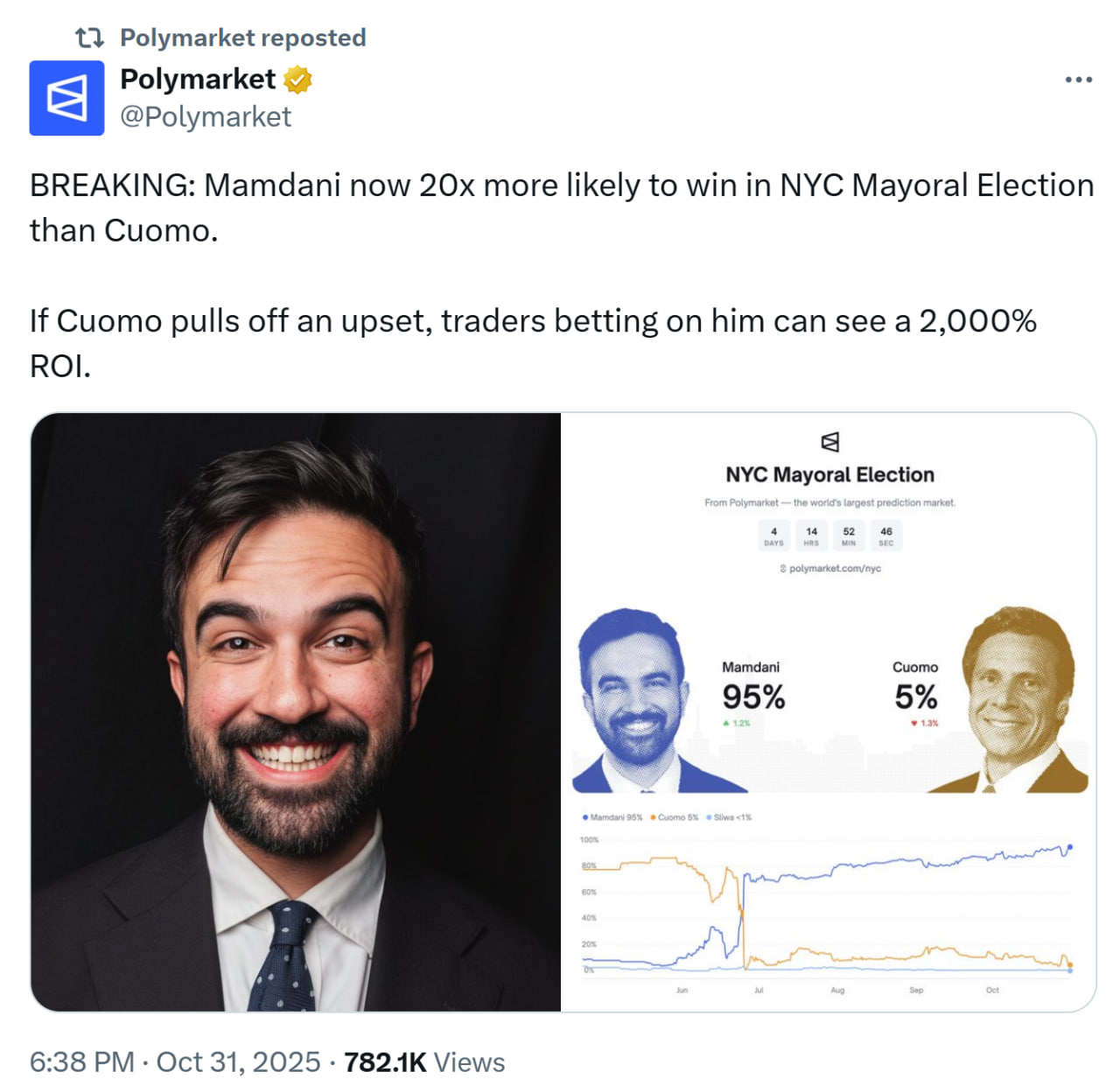
Пользователи Polymarket делают ставки на выборы мэра Нью-Йорка. Источник: X-аккаунт Polymarket.

Действия регулятора аналогичны мерам в других странах. В 2022 году Комиссия по торговле товарными фьючерсами США (CFTC) оштрафовала Polymarket за работу незарегистрированного деривативного рынка. Компании пришлось закрыть доступ для американских пользователей.

Подобные ограничения ввели регуляторы Бельгии, Франции, Польши, Сингапура и Таиланда. Несмотря на это, Polymarket продолжает расширяться: недавно компания получила $2 млрд инвестиций от Intercontinental Exchange — материнской структуры Нью-Йоркской фондовой биржи.

Polymarket готовится вернуться в США

По данным Bloomberg, Polymarket намерена в ближайшие недели возобновить работу в США, начав с спортивных рынков. Платформа рассчитывает частично открыть доступ американским пользователям до конца ноября.

Такое решение стало возможным после того, как CFTC направила письмо о неприменении мер к криптодеривативной бирже, приобретенной Polymarket. Это фактически открыло путь к возобновлению ее деятельности.


Leituras Relacionadas

Interview with Strategy CEO: Can STRC Recover After Selling Bitcoin?

Interview with Strategy CEO Phong Le on the recent sale of 32 Bitcoin and its impact. He clarifies the move was a small, strategic action to demonstrate liquidity to debt holders, test internal processes, and prove operational discipline—not a response to fears of a "death spiral" from DeFi protocols leveraging STRC (Strategy's preferred stock product), which he notes holds less than 10% of STRC. Le emphasizes Strategy’s long-term focus as the largest corporate Bitcoin holder, using the adage that markets are a "voting machine" short-term but a "weighing machine" long-term. Decision-making is data-driven, involving the board, complex modeling, and multiple stakeholder considerations, moving beyond a founder-centric model. He outlines various capital options but stresses the strategic importance of "doing nothing" as a valid choice, citing resilience built during the 2022 bear market. Le expresses unwavering belief in Bitcoin's foundational value for global sovereignty and its future role in an AI-driven economy with trillions of autonomous agents. Addressing STRC's current price below its $100 face value, Le explains recent pressure was due to using dollar reserves for bond buybacks. He expects STRC to return to par as reserves are replenished and its semi-monthly dividend payments begin, noting the product is heavily over-collateralized. Finally, Le confirms the company sold Bitcoin the week prior to May 31st, as disclosed in an 8-K filing, leaving prediction market interpretations to others. The overarching philosophy remains "Spread Bitcoin with love," embracing all methods of gaining Bitcoin exposure.

marsbitHá 6m

Interview with Strategy CEO: Can STRC Recover After Selling Bitcoin?

marsbitHá 6m

IOSG Founder: Ethereum Doesn't Need Another Leap of Technical Faith, It Needs a Musk-style Compromise

Jocy, founder of IOSG Ventures, argues that Ethereum does not need renewed technological faith but a "Musk-like compromise." The recent formation of ETHLabs—funded by major ETH holders like BitMine and Lubin—highlights a market-driven move to fill a gap left by the Ethereum Foundation (EF), signaling a loss of confidence in its decentralized, hands-off approach. The core critique contrasts Vitalik Buterin's (V) idealistic, technology-first vision with Elon Musk's pragmatic, business-driven execution. The author asserts Ethereum's current shortage is not another technical roadmap but a clear, real-world application narrative and a leader willing to engage directly with commercial realities—like Musk. Internal issues are emphasized, citing EF's management problems and talent drain. While the new decentralized model with independent nodes like ETHLabs addresses the single foundation's limitations, it risks fragmentation without cohesive direction. True cohesion, the author suggests, must come from a shared, compelling narrative around ETH's value, not just from aligned financial interests. Independence claims for new entities are seen as aspirational, needing years of transparency to build trust. The ultimate threat is not competitors like Solana, but the broader shift of attention and talent toward AI. Ethereum has a limited window—12 to 18 months—to recapture focus by delivering tangible, real-world applications. The conclusion urges V to shift from abstract ideals to grounded, pragmatic leadership. The time for this crucial pivot is running out.

marsbitHá 1h

IOSG Founder: Ethereum Doesn't Need Another Leap of Technical Faith, It Needs a Musk-style Compromise

marsbitHá 1h

Google Starts Selling TPUs, Big Tech Aims to Produce "Low-Cost Tokens" with AI Chips

Google has begun selling its proprietary TPU chips and AI computing hardware directly to third-party data centers and clients, marking a strategic shift. Previously only accessible via cloud rentals, TPUs are specialized processors designed for the matrix and tensor operations central to AI models. By combining thousands into supercomputing clusters managed by CPUs, Google achieves high-efficiency AI processing. This move enables Google’s Gemini AI to offer competitive token pricing, challenging rivals like OpenAI. It also signals a broader industry trend where AI compute is becoming a commoditized resource like electricity. While NVIDIA remains dominant with its CUDA ecosystem and high-performance GPUs, the focus is shifting from raw power to cost efficiency and system integration. Google’s approach mirrors NVIDIA’s by selling an entire ecosystem—hardware, software, and data center expertise—rather than just chips. This threatens NVIDIA’s grip on the mid-range inference market, where lower-cost, efficient solutions are increasingly demanded. Similarly, cloud providers like Huawei Cloud and Alibaba Cloud in China are developing their own AI chip ecosystems (e.g., Ascend, Zhenwu), packaging chips, clusters, and tools into full-stack solutions. They aim to reduce token costs and capture market share through integrated systems. In summary, the AI infrastructure race is evolving from a competition for the strongest chips to a contest for the most efficient and cost-effective systems. Google’s TPU sales highlight this transition, emphasizing that future success lies in delivering affordable, scalable AI compute as a foundational service.

marsbitHá 1h

Google Starts Selling TPUs, Big Tech Aims to Produce "Low-Cost Tokens" with AI Chips

marsbitHá 1h

Trading

Spot
Futuros
活动图片