加密早报:特朗普赦免赵长鹏,MegaETH 公布代币经济学

深潮Publicado em 2025-10-23Última atualização em 2025-10-24

美国国会两党就加密货币立法展开讨论,DeFi监管成焦点。

作者:深潮 TechFlow

昨日市场动态

特朗普赦免币安创始人赵长鹏

据华尔街日报报道,特朗普赦免币安创始人赵长鹏。

美国国会两党就加密货币立法展开讨论,DeFi监管成焦点

据Eleanor Terrett披露,美国国会山近日举行"加密货币闪电战"会议,两党分别与行业领袖进行圆桌讨论。白宫加密与AI沙皇David Sacks表示,通过市场结构立法是政府今年首要任务。

民主党会议上,参议员们承认加密货币为传统银行体系下受不公平对待的选民提供机会,但亚利桑那州参议员Gallego因DeFi提案泄露事件警告行业领袖"不要成为共和党的帮凶"。

共和党会议则重点讨论如何定义和监管DeFi,提出将监管重点放在中介机构而非协议上,并建议两党与行业代表共同逐行审查法案。

肯尼迪参议员比喻立法过程"如同海洛因成瘾者的起伏"。尽管两党均表达合作意愿,但下一步具体行动尚不明确。

美国总统特朗普政府正商谈入股量子计算公司

据华尔街日报,美国总统特朗普政府正商谈入股量子计算公司。

aPriori 宣布 APR 空投领取现已开放

据官方公告,Monad 生态流动性质押协议 aPriori 宣布 APR 空投领取现已开放。用户有 21 天的时间进行选择,提前领取较小份额,或等待 Monad 主网稍后解锁大部分份额。

MegaETH 公布代币经济学模型:总供应量 100 亿枚,公售占比 5%

MegaETH 发布代币分配详情。总供应量为 100 亿枚 MEGA 代币,其中

公开销售(Sonar)占 5%;

Sonar 奖励池占 2.5%;

生态系统保留代币总计 70.3%,包括:KPI 质押奖励 53.3%,团队和顾问 9.5%,基金会/生态储备 7.5%;

风险投资方分配 14.7%;

Echo 投资者 5%;

Fluffle 投资者 2.5%。

发行方 Superior Performance Limited 不直接保留公开销售的加密资产,所有 5 亿枚 MEGA 代币将分发给购买者。

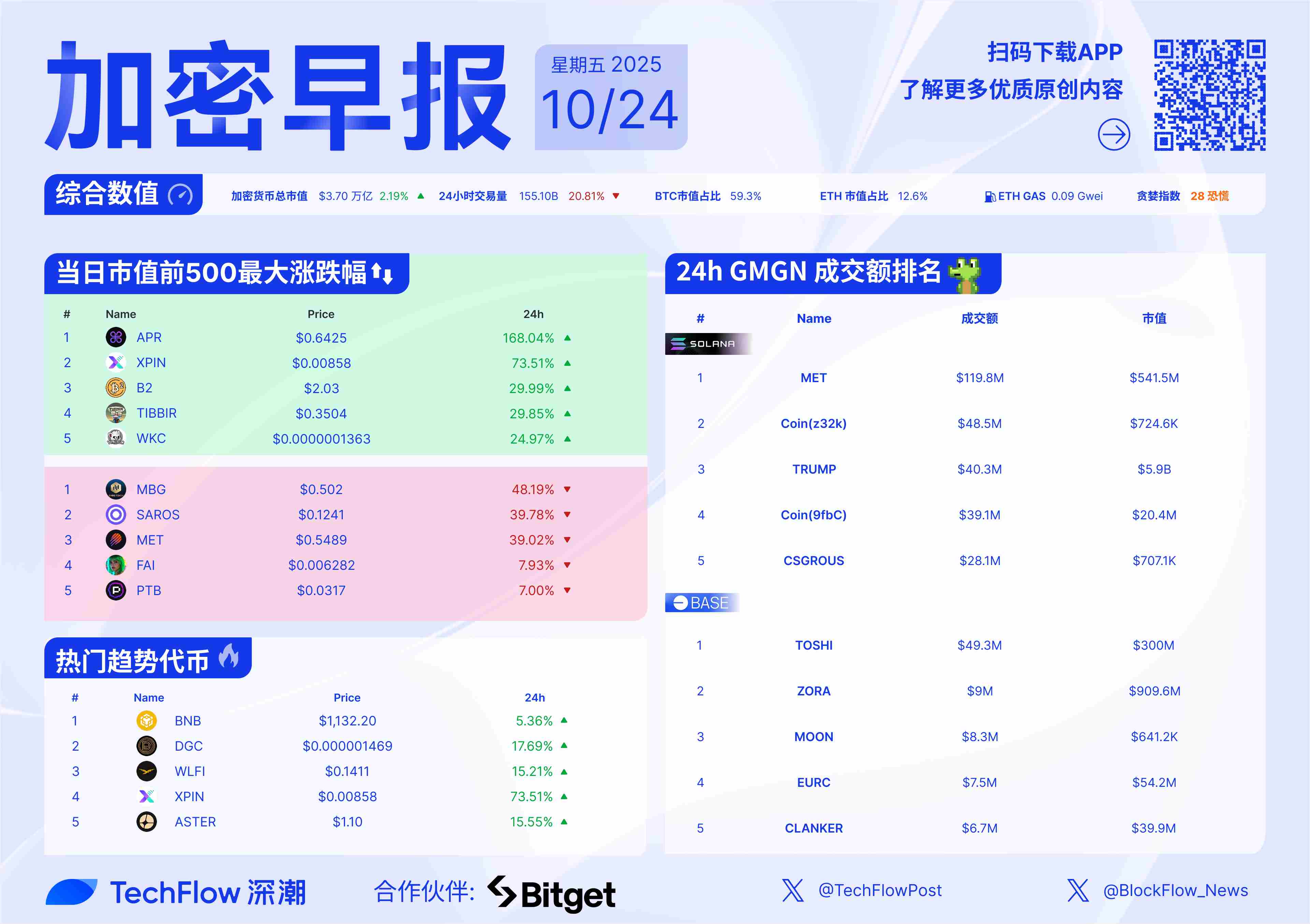
Bubblemaps:某单一实体领取价值 1000 万美元 MET 空投,或为年度最大空投领取

据 Bubblemaps 监测,某实体领取了价值 1000 万美元的 MET 代币空投。

具体而言,钱包地址 3vAauD 和 2zVx7U 分别领取了价值 700 万美元和 200 万美元的 MET 代币空投。链上数据显示,这两个钱包的 53 万美元的 RAY 代币和 1000 USDC 的转账记录显示两者存在关联性,表明可能由同一实体控制。

Bubblemaps 称,该笔空投领取金额或为今年迄今为止最大的单次空投领取记录。

DeFi协议Spark将1亿美元稳定币储备投入Superstate基金

据The Block报道,DeFi借贷协议Spark宣布将1亿美元稳定币储备分配至Superstate加密货币套利基金(USCC),此举被称为链上协议首次大规模"从政府证券中多元化"的尝试。该决策发生在美国国债收益率降至六个月低点之际。

Phoenix Labs首席执行官Sam MacPherson表示:"Superstate的USCC基金使Spark能够实现储备多元化,同时保持Spark一直优先考虑的安全性和合规性。"

Superstate基金通过比特币、以太坊、Solana和XRP的现货与期货市场交易产生收益,目前30天收益率达8.35%,明显高于传统国债收益。Spark此前主要通过BlackRock的BUIDL和Franklin Templeton的FOBXX等代币化国债产品获取收益。

BNB Chain 生态付费聊天平台 ReachMe 宣布停止运营

BNB Chain 生态付费聊天平台 ReachMe 宣布停止运营,所有服务已永久关闭。

此前 CZ 曾通过 ReachMe 接收私信,每条消息收费 1 BNB,后续将价格由 1 BNB 下调至 0.8 BNB。

《CS2》汰换系统重大调整引发部分饰品跌超70%

V社于10月23日更新《CS2》汰换系统,新增5个红色饰品可换取匕首、手套功能。此举导致市场剧烈波动,据CAQAQ网站数据,饰品指数从2800点跳水至1800点,日内下跌38.11%。匕首手套价格大幅下跌,如蝴蝶刀从近2万元跌至1万元左右,普跌60%至70%;同时,优质红色饰品价格暴涨,如"MP9-星使"从几十元涨至百余元。汰换所得饰品可交易但需等待7天冷却期。市场泡沫是否破裂仍有待观察。

Andreessen Horowitz拟募资100亿美元加码AI投资

据英国《金融时报》报道,风险投资巨头Andreessen Horowitz正在筹集100亿美元新资金,其中约60亿美元将用于投资人工智能初创企业,并增加其在已投资公司的持股比例。作为过去两年AI领域最活跃的投资者之一,该公司此举将进一步增强其在AI赛道的投资能力。

高盛维持黄金明年底达到4900美元的目标价预测

高盛维持黄金2026年底达到每盎司4900美元的目标价。高盛表示,由于市场对黄金作为战略投资组合多元化工具的兴趣日益增长,我们仍然认为到2026年底,金价突破4900美元预测目标的风险正在上升。我们相信,充满“粘性”且结构性的购买将持续下去。

行情动态
推荐阅读

当 Steam 遇上 Web3:9bit 如何让 30 亿玩家成为股东?

本文介绍了九城推出的9BIT平台如何通过将Web3的分配机制引入传统游戏平台模式,重新定义游戏价值分配规则。通过“消费即挖矿”的创新模式,9BIT为玩家提供了额外的经济激励,同时保持了传统游戏平台的使用体验。文章还详细分析了9BIT的收入模式、代币经济设计以及平台对社区和用户的激励机制。

AWS 云端危机,加密“中心化”现形记

本文探讨了AWS(亚马逊云服务)宕机对加密行业的影响,揭示了去中心化系统依赖中心化基础设施的矛盾现象。文章详细描述了宕机事件的后果,并分析了行业的系统性风险与潜在解决方案。

从币圈大赌场到超级个体时代

本文探讨了“超级个体”理念的形成、定义及其在AI和加密货币时代的意义,并提出了从币圈出发成为超级个体的五个阶段框架。作者分享了如何通过AI和Crypto工具实现个人主权、财务自由及成长的目标,并强调了超级个体的核心是自我驱动的生命系统。

一览近期可能影响 $HYPE 价格的催化剂

本文分析了去中心化永续合约交易所Hyperliquid及其原生代币$HYPE的动态发展。文章探讨了$HYPE的价格催化剂、代币解锁和供应动态、回购机制、生态系统扩展以及潜在的投资机会。Hyperliquid通过创新技术和强劲的收入表现,在去中心化金融领域占据主导地位,同时也面临代币解锁带来的供应压力。

Virtuals Robotics:我们为什么进入具身智能领域?

本文探讨了Virtuals Protocol在人工智能、区块链和机器人技术领域的创新与融合,重点介绍了其通过数据和资本基础设施推动具身智能发展的策略。

Leituras Relacionadas

OpenAI Post-Training Engineer Weng Jiayi Proposes a New Paradigm Hypothesis for Agentic AI

OpenAI engineer Weng Jiayi's "Heuristic Learning" experiments propose a new paradigm for Agentic AI, suggesting that intelligent agents can improve not just by training neural networks, but also by autonomously writing and refining code based on environmental feedback. In the experiment, a coding agent (powered by Codex) was tasked with developing and maintaining a programmatic strategy for the Atari game Breakout. Starting from a basic prompt, the agent iteratively wrote code, ran the game, analyzed logs and video replays to identify failures, and then modified the code. Through this engineering loop of "code-run-debug-update," it evolved a pure Python heuristic strategy that achieved a perfect score of 864 in Breakout and performed competitively with deep reinforcement learning (RL) algorithms in MuJoCo control tasks like Ant and HalfCheetah. This approach, termed Heuristic Learning (HL), contrasts with Deep RL. In HL, experience is captured in readable, modifiable code, tests, logs, and configurations—a software system—rather than being encoded solely into opaque neural network weights. This offers potential advantages in explainability, auditability for safety-critical applications, easier integration of regression tests to combat catastrophic forgetting, and more efficient sample use in early learning stages, as demonstrated in broader tests on 57 Atari games. However, the blog acknowledges clear limitations. Programmatic strategies struggle with tasks requiring long-horizon planning or complex perception (e.g., Montezuma's Revenge), areas where neural networks excel. The future vision is a hybrid architecture: specialized neural networks for fast perception (System 1), HL systems for rules, safety, and local recovery (also System 1), and LLM agents providing high-level feedback and learning from the HL system's data (System 2). The core proposition is that in the era of capable coding agents, a significant portion of an AI's learned experience could be maintained as an auditable, evolving software system.

marsbitHá 7m

OpenAI Post-Training Engineer Weng Jiayi Proposes a New Paradigm Hypothesis for Agentic AI

marsbitHá 7m

Your Claude Will Dream Tonight, Don't Disturb It

This article explores the recent phenomenon of AI companies increasingly using anthropomorphic language—like "thinking," "memory," "hallucination," and now "dreaming"—to describe machine learning processes. Focusing on Anthropic's newly announced "Dreaming" feature for its Claude Agent platform, the piece explains that this function is essentially an automated, offline batch processing of an agent's operational logs. It analyzes past task sessions to identify patterns, optimize future actions, and consolidate learnings into a persistent memory system, akin to a form of reinforcement learning and self-correction. The article draws parallels to similar features in other AI agent systems like Hermes Agent and OpenClaw, which also implement mechanisms for reviewing historical data, extracting reusable "skills," and strengthening long-term memory. It notes a key difference from human dreaming: these AI "dreams" still consume computational resources and user tokens. Further context is provided by discussing the technical challenges of managing AI "memory" or context, highlighting the computational expense of large context windows and innovations like Subquadratic's new model claiming drastically longer contexts. The core critique argues that this strategic use of human-centric vocabulary does more than market products; it subtly reshapes user perception. By framing algorithms with terms associated with consciousness, companies blur the line between tool and autonomous entity. This linguistic shift can influence user expectations, tolerance for errors, and even perceptions of responsibility when systems fail, potentially diverting scrutiny from the companies and engineers behind the technology. The article concludes by speculating that terms like "daydreaming" for predictive task simulation might be next, continuing this trend of embedding the idea of an "inner life" into computational processes.

marsbitHá 9m

Your Claude Will Dream Tonight, Don't Disturb It

marsbitHá 9m

Trading

Spot
Futuros
活动图片