Ethereum Will Impose Gas Limit In Fusaka Upgrade

bitcoinistPublicado em 2025-10-23Última atualização em 2025-10-23

Resumo

The Ethereum Foundation has confirmed that the upcoming Fusaka hard fork will introduce a protocol-level ceiling on how much gas...

Trusted Editorial content, reviewed by leading industry experts and seasoned editors. Ad Disclosure

The Ethereum Foundation has confirmed that the upcoming Fusaka hard fork will introduce a protocol-level ceiling on how much gas a single transaction may consume, formally codified as EIP-7825. The cap is set at 2²⁴ gas—16,777,216 units—marking the first time Ethereum enforces a per-transaction limit distinct from the block gas limit. The change is already active on Holesky and Sepolia and will go live on mainnet when Fusaka activates.

In a post published October 21, Toni Wahrstätter framed the rationale in direct terms: “Starting with the upcoming Fusaka hard fork, EIP-7825 introduces a per-transaction gas limit cap of 2²⁴ (≈ 16.78 million gas).” The Foundation’s note emphasizes that while the cap bounds individual transactions, it does not alter the block gas limit; instead, it is designed to mitigate denial-of-service vectors where a single oversized call monopolizes an entire block and to improve block packing predictability as the network prepares for parallel execution.

EIP-7825 draws a clean line between transaction-level complexity and system-level throughput. Previously, exceptionally large calls could approach the full block gas target (around 45 million at times), creating timing and scheduling pathologies for builders and validators.

The new ceiling obliges workloads that would exceed 16.78 million gas to be broken into smaller, sequenced calls. The Foundation’s guidance is careful to note that “for most users, nothing changes,” since the statistical distribution of real-world transactions already sits well below the threshold; the risk surface primarily concerns batch-heavy contracts, deployment scripts, and specialized routers.

What This Means For Ethereum And Users

From a roadmap perspective, the cap is explicitly positioned as groundwork for parallel execution. The blog post connects the change to anticipated efforts such as EIP-7928 in the “Glamsterdam” era, where predictable, bounded transactions are a prerequisite for meaningful concurrency in the execution layer. By ensuring that at least several independent transactions can be packed per block—even under pathological mempool conditions—the cap reduces worst-case contention and simplifies scheduler design for builders experimenting with parallelizable execution paths.

The specification itself is spare and mechanical. EIP-7825’s abstract states the intent “to 16,777,216 (2^24) gas” per transaction, improving resilience against certain DoS vectors and making transaction processing more predictable as block limits rise. That simplicity has been part of its appeal in core-dev channels: a small, well-scoped constraint that preserves forward compatibility with more ambitious scaling work.

Debate on how to encode and communicate the ceiling has been active for months, including discussions over naming and parameterization on Ethereum Magicians and during AllCoreDevs calls. One thread summarized the core guarantee being targeted by several contributors: aligning block targets to multiples of 2²⁴ so builders can always include at least n transactions if the mempool has n eligible ones—an argument for predictability rather than raw throughput.

Operationally, the Foundation says all major clients—Geth, Erigon, Reth, Nethermind, and Besu—have implemented the change in Fusaka-ready releases, reducing cross-client divergence risk at activation. The post also stresses that eth_call semantics are unaffected and that pre-signed transactions whose gas limits exceed 2²⁴ will need to be re-signed below the cap. The upgrade path for developers is straightforward: test against Holesky or Sepolia, re-tool batch operations that flirt with the limit, and adjust gas-estimation logic and alerts so they fail fast when constructions exceed the new ceiling.

The policy context is worth parsing. Ethereum’s history has favored minimal, general-purpose constraints, deferring complexity to higher layers. EIP-7825 fits that pattern: it does not opine on what contracts should do, only that they respect an upper bound that protects liveness and prepares the execution layer for a multi-threaded future.

It also sidesteps fee-market alterations and leaves blob-space economics and block targets to other EIPs and forks. As the Foundation put it, the cap “establishes a safer and more predictable foundation for higher throughput in future forks,” a line that sums up the trade-off succinctly.

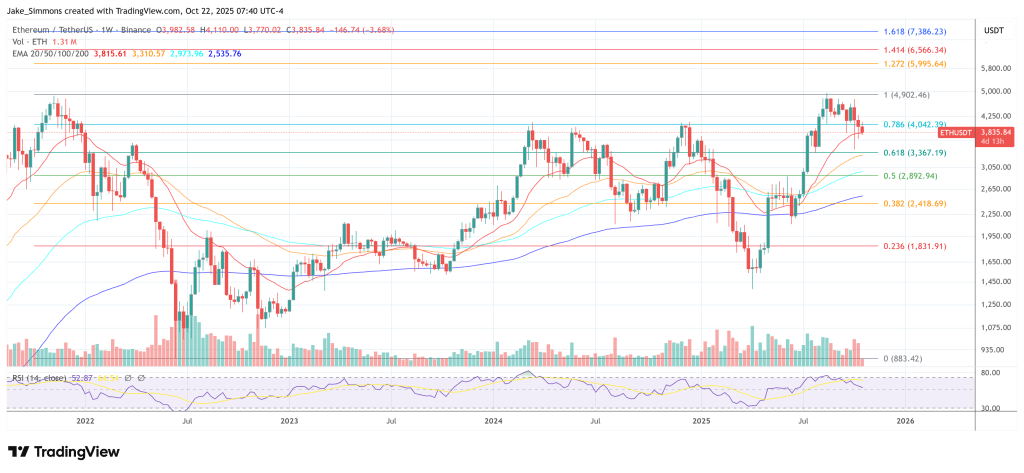
At press time, ETH traded at $3,835.
Ethereum price
ETH holds above the EMA20, 1-week chart | Source: ETHUSDT on TradingView.com
Featured image created with DALL.E, chart from TradingView.com
Editorial Process for bitcoinist is centered on delivering thoroughly researched, accurate, and unbiased content. We uphold strict sourcing standards, and each page undergoes diligent review by our team of top technology experts and seasoned editors. This process ensures the integrity, relevance, and value of our content for our readers.

Jake Simmons has been a Bitcoin enthusiast since 2016. Ever since he heard about Bitcoin, he has been studying the topic every day and trying to share his knowledge with others. His goal is to contribute to Bitcoin's financial revolution, which will replace the fiat money system. Besides BTC and crypto, Jake studied Business Informatics at a university. After graduation in 2017, he has been working in the blockchain and crypto sector. You can follow Jake on Twitter at @realJakeSimmons.

Criptomoedas em alta

Leituras Relacionadas

New Insider Trading in Prediction Market Exposed: It's Impossible to Lose When You Sit in That Position

PolyBeats reported on August 19 about a user who achieved a 120% return in just 89 seconds by betting that Russia would capture Konstantynivka on a prediction market platform, where the probability (and price) surged from 43% to 92%. This trade was notably the 14th in a series of perfect predictions related to the Russia-Ukraine war by this account, with a total profit of approximately $17,500. Eleven of these trades saw the probability jump to near 100% within five minutes of the purchase. The article suggests these consistent gains point to potential insider knowledge. The key is that these prediction markets on Polymarket settle based not on real-time battlefield events, but on whether the Institute for the Study of War (ISW) updates its official interactive map to show an area as controlled by Russia. Therefore, profiting reliably doesn't require military intelligence, but merely advance knowledge of when and where ISW will update its map. This mirrors a prior incident in November 2025, where an unauthorized, temporary edit to the ISW map regarding Myrnohrad allowed a trader to make over a 10,000% return before the edit was reversed. While ISW has since added safeguards like "pending review" statuses and duration requirements for map changes, the article argues the 14-trade winning streak indicates someone with access to the map update process—like an ISW staffer—could exploit the time gap between an internal decision and its public release, turning administrative knowledge into nearly guaranteed profits.

marsbitHá 3m

New Insider Trading in Prediction Market Exposed: It's Impossible to Lose When You Sit in That Position

marsbitHá 3m

Trading

Spot

Artigos em Destaque

Como comprar GAS

Bem-vindo à HTX.com!Tornámos a compra de GAS (GAS) simples e conveniente.Segue o nosso guia passo a passo para iniciar a tua jornada no mundo das criptos.Passo 1: cria a tua conta HTXUtiliza o teu e-mail ou número de telefone para te inscreveres numa conta gratuita na HTX.Desfruta de um processo de inscrição sem complicações e desbloqueia todas as funcionalidades.Obter a minha contaPasso 2: vai para Comprar Cripto e escolhe o teu método de pagamentoCartão de crédito/débito: usa o teu visa ou mastercard para comprar GAS (GAS) instantaneamente.Saldo: usa os fundos da tua conta HTX para transacionar sem problemas.Terceiros: adicionamos métodos de pagamento populares, como Google Pay e Apple Pay, para aumentar a conveniência.P2P: transaciona diretamente com outros utilizadores na HTX.Mercado de balcão (OTC): oferecemos serviços personalizados e taxas de câmbio competitivas para os traders.Passo 3: armazena teu GAS (GAS)Depois de comprar o teu GAS (GAS), armazena-o na tua conta HTX.Alternativamente, podes enviá-lo para outro lugar através de transferência blockchain ou usá-lo para transacionar outras criptomoedas.Passo 4: transaciona GAS (GAS)Transaciona facilmente GAS (GAS) no mercado à vista da HTX.Acede simplesmente à tua conta, seleciona o teu par de trading, executa as tuas transações e monitoriza em tempo real.Oferecemos uma experiência de fácil utilização tanto para principiantes como para traders experientes.

398 Visualizações TotaisPublicado em {updateTime}Atualizado em 2026.06.02

Como comprar GAS

Discussões

Bem-vindo à Comunidade HTX. Aqui, pode manter-se informado sobre os mais recentes desenvolvimentos da plataforma e obter acesso a análises profissionais de mercado. As opiniões dos utilizadores sobre o preço de GAS (GAS) são apresentadas abaixo.

活动图片