Большинство институциональных инвесторов прогнозируют рост биткоина

cryptonews.ruPublicado em 2025-04-19Última atualização em 2025-10-20

Согласно исследованию Coinbase, 67% институциональных инвесторов сохраняют оптимизм в отношении перспектив биткоина на ближайшие три-шесть месяцев. При этом почти половина респондентов считает, что рынок находится на поздней стадии бычьего ралли.

По данным Coinbase, около двух третей институциональных инвесторов позитивно оценивают перспективы биткоина в 2026 году.

«Большинство респондентов настроены оптимистично по отношению к биткоину», — написал Дэвид Дуонг, руководитель исследований Coinbase Institutional, в исследовательском отчете под названием «Преодоление неопределенности».

Coinbase провела опрос 124 институциональных инвесторов, который показал, что 67% из них позитивно оценивают перспективы биткоина на ближайшие три-шесть месяцев.

В отчете также отмечается значительное расхождение во мнениях относительно текущего этапа рыночного цикла. 45% институциональных инвесторов считают, что рынки находятся на поздней стадии бычьего ралли, по сравнению с всего 27% неинституциональных инвесторов.

Криптовалютные казначейские облигации скупают падение

«Глядя на соотношение спроса и предложения, трудно переоценить влияние компаний, занимающихся казначейскими облигациями цифровых активов, на рынки в этом году», — написал Дуонг.

Компания BitMine под руководством Тома Ли была среди тех, кто скупал активы на падении. Она приобрела более 379 тысяч ETH на сумму почти $1,5 млрд после обвала рынка, который опустил цену эфира ниже $4000.

Тем временем Майкл Сэйлор намекнул в воскресенье, что Strategy может купить больше биткоинов, опубликовав график, показывающий $69 млрд в активах BTC. Даже несмотря на откат акций, резервы криптовалюты DAT остаются нетронутыми, что свидетельствует о долгосрочной уверенности.
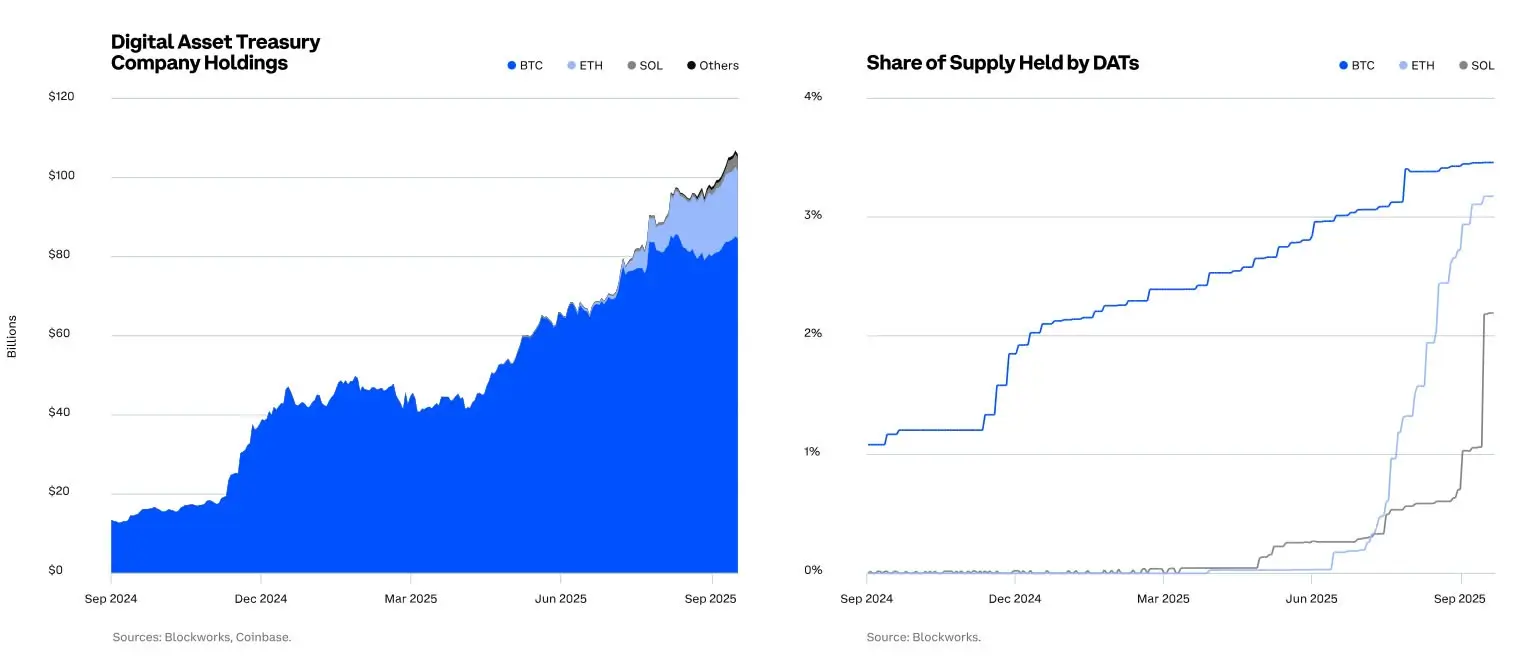

Объем криптовалюты DAT продолжает расти. Источник: Coinbase

Бычий рынок имеет потенциал для роста

Дуонг из Coinbase заявил, что бычий рынок криптовалют имеет потенциал для роста, но стал более осторожным после событий 10 октября.

«Мы по-прежнему наблюдаем устойчивую ликвидность, сильный макроэкономический фон и благоприятную динамику регулирования», — сказал он.

Coinbase также отметила благоприятные макроэкономические условия и условия ликвидности. Они включают два ожидаемых снижения ставок Федеральной резервной системы и крупные фонды денежного рынка, которые остаются в стороне, но могут стимулировать рынки в четвертом квартале.

«Дополнительное снижение ставок ФРС, а также усиление фискального и денежно-кредитного стимулирования в Китае могут побудить больше инвесторов выйти из игры».

Благоприятная ситуация для биткоина

Компания заявила, что текущая ситуация выглядит особенно благоприятной для биткоина, однако подход к инвестированию в альткоины у нее более осторожный.

На выходных криптовалютные рынки оставались стабильными: биткоин превысил $109 000, отыграв уровень поддержки, ставший сопротивлением, на $108 000, а эфир ненадолго поднялся выше $4000. Однако серьезных попыток восстановления пока не наблюдалось, поскольку настроения остаются осторожными.


Leituras Relacionadas

Rented Faith: How Much of the Bitcoin ETF Inflows Is Real Money?

"Rented Conviction: How Much of Bitcoin ETF Flows Is Real Money" The weekly inflows into Bitcoin ETFs are often interpreted as a gauge of institutional belief. However, a significant portion of this activity is driven by a hidden arbitrage trade, not directional conviction. The core mechanism is a cash-and-carry arbitrage: traders buy spot Bitcoin (often via ETFs) while simultaneously shorting CME futures to lock in the price difference, or "basis." This delta-neutral trade is essentially an interest rate play. In weekly data, about half the fluctuation in ETF flows can be explained by new short positions added by leveraged funds (hedge funds), with a correlation of 0.70. Bitcoin's price movement in a given week shows no statistical power in predicting these flows. While this arbitrage trade drives weekly *volatility*, it is not the main component of the cumulative *stock*. Of the total ~$55 billion in net ETF inflows, the current net arbitrage position is only about $1 billion. The remainder is steady, directional buying averaging ~$400 million per week, which constitutes the vast majority of the accumulated "mountain" over two years. Thus, ETF flow data overstates the *volatility* of conviction, not its *level*. This arbitrage trade has been unwinding for nearly two years. Leveraged fund short positions peaked at ~$14 billion in late 2024 and have since declined to ~$4.5 billion. When the basis compresses to unprofitable levels, ETF inflows and short positions retreat together. Recent outflows should not be mistaken for a loss of faith but rather the routine unwinding of this rate trade. For Ethereum ETFs, the pattern is weaker. Accounting for staking yield makes the basis often negative, so neither strong conviction buying nor robust arbitrage supports its flows. To interpret ETF flows correctly, monitor the CME basis versus T-bill rates and leveraged fund net shorts. They reveal how much of the next "demand" headline is real. The real, patient buy-and-hold demand is what constitutes the enduring bulk of ETF assets.

marsbitHá 47m

Rented Faith: How Much of the Bitcoin ETF Inflows Is Real Money?

marsbitHá 47m

Soaring Over Tenfold Within the Year: The Frenzy Over SK Hynix Leveraged Products

South China Morning Post The leveraged ETF tracking SK Hynix has surged over tenfold year-to-date, fueled by intense market speculation on the memory chip sector. By June 22, the value of the 'South Korea 2x Long SK Hynix ETF' listed in Hong Kong had skyrocketed by more than 1,061% since the start of the year, while its asset size exploded over twenty times from the end of last year. The rally is driven by AI-driven demand for high-bandwidth memory (HBM), with SK Hynix recently sampling its next-generation HBM4E product. However, industry professionals warn of significant risks. Leveraged ETFs magnify both gains and losses. During a recent market correction, while the underlying SK Hynix stock fell 19.1%, its double-leveraged ETF dropped nearly 38%. Korean regulators noted that such products could theoretically lose 60% in a single day. Additionally, these ETFs face risks like time decay in volatile markets, liquidity spirals during mass redemptions, and extreme price dislocations from market-making failures, as seen in early June when an ETF moved opposite to its underlying stock. The trading is predominantly driven by retail investors, with institutional capital largely absent due to the products' high volatility. Analysts caution that with the semiconductor sector at elevated valuations and facing geopolitical and supply chain uncertainties, leveraged ETFs pose a substantial threat of amplified losses for uninformed investors.

marsbitHá 1h

Soaring Over Tenfold Within the Year: The Frenzy Over SK Hynix Leveraged Products

marsbitHá 1h

18 Months, Over 50x Surge: KIOXIA's Epic Comeback

KIOXIA, a NAND flash memory giant, staged a dramatic comeback driven by AI demand. After a period of significant losses, a failed merger, and missed HBM opportunities, its 2024 IPO began modestly. However, fueled by explosive demand for AI data storage, its stock price skyrocketed over 50 times within 18 months, making it Japan's most valuable company, surpassing Toyota. Its Q1 FY2026 profit guidance soared 30-fold year-over-year, with 2026 NAND capacity already sold out. Key to its success is its 3D NAND technology, BiCS FLASH. As the inventor of NAND, KIOXIA advanced its technology through generations, reaching over 200 layers by 2023. Key innovations include CBA (CMOS directly Bonded to Array), which separately manufactures control circuits and memory arrays for better performance, and OPS (On Pitch Select Gate) to increase density. The company is now developing high-capacity packages like an 8TB solution stacking 32 dies. Looking beyond NAND, KIOXIA is exploring 3D DRAM with its OCTRAM technology, using oxide semiconductor transistors for ultra-low leakage to reduce power consumption. This fundamental research differs from HBM and represents a long-term bet to extend its 3D expertise from NAND into future DRAM architectures. KIOXIA's story highlights how technological assets and shifting market cycles can rapidly transform a company's fortunes. While questions remain about sustaining growth beyond the current AI boom, its resurgence demonstrates that in semiconductors, being down does not necessarily mean being out.

marsbitHá 1h

18 Months, Over 50x Surge: KIOXIA's Epic Comeback

marsbitHá 1h

Trading

Spot
Futuros
活动图片