Crypto Lawyer Warns Of ‘Massive’ Lobby To Pardon FTX Founder SBF

bitcoinistPublicado em 2025-10-15Última atualização em 2025-10-15

Resumo

Conservative activist Laura Loomer and crypto attorney John E. Deaton ignited a fresh wave of controversy around Sam Bankman-Fried’s legal...

Trusted Editorial content, reviewed by leading industry experts and seasoned editors. Ad Disclosure

Conservative activist Laura Loomer and crypto attorney John E. Deaton ignited a fresh wave of controversy around Sam Bankman-Fried’s legal fate, alleging a “massive and well funded” push to secure presidential clemency for the convicted FTX founder. Their claims arrive against the hard legal backdrop of Bankman-Fried’s 25-year federal sentence and an $11 billion forfeiture order—facts that sharply constrain the practical pathways for any pardon or commutation bid.

Lobby Efforts For Crypto’s Most Famous Felon

Loomer framed the matter as a sophisticated influence operation targeting “Trump world,” asserting that family members of Bankman-Fried are “actively working with a firm” to obtain a pardon. “There is a highly mobilized and well funded effort on the right to lobby Trump world to pardon Crypto scammer Sam Bankman Fried, who was the second largest donor to the Democrat Party after George Soros,” she wrote, adding that the push “needs to be exposed and shut down.”

She linked the surge in chatter to what she called an “inorganic” campaign by conservative influencers portraying Bankman-Fried as a victim after his reported stint in solitary confinement following a jailhouse interview with Tucker Carlson.

Deaton, a prominent crypto-side litigator and frequent critic of regulatory overreach, issued an unambiguous warning to the White House. “Let me be clear: any effort to pardon or commute the sentence of the Bernie Madoff of Crypto – SBF – should be squashed immediately,” he wrote, directing his message to “Mr President Donald Trump” and calling such a move “a slap in the face of justice and innocent investors.”

Deaton also urged renewed scrutiny of campaign-finance angles and of Bankman-Fried’s parents, while revisiting well-documented episodes in which Bankman-Fried leveraged political access during crypto’s last bull cycle. “In fact, Pam Bondi should re-open the case against him for violating campaign finance laws. His father Joe Bankman should be investigated as he helped SBF create the shell companies used to defraud people. Joe Bankman was the architect of Elizabeth Warren’s tax policies when she ran for president. He is no stranger to how to evade taxes,” Deaton wrote.

With regards to SBF#s mother, Deaton minced words either: “His mother Barbara Fried should also be investigated. She runs Mind The Gap – a political Super PAC – and helped her son with becoming the 2nd largest donor to the Democrat.” He concluded: “SBF’s parents participated in his criminal enterprise. They held luxury Bahamian property in their names worth tens of millions and received $10M in cash stolen from FTX customers. Because of their political connections they were never indicted.”

The legal record for SBF remains stark. On March 28, 2024, US District Judge Lewis A. Kaplan sentenced Bankman-Fried to 25 years in prison for orchestrating “multiple fraudulent schemes,” with the Southern District of New York securing an $11 billion forfeiture judgment—an enormous clawback that reflects what the court deemed to be the scale of customer, investor, and lender harms. The sentence followed a jury’s 2023 convictions on fraud and conspiracy counts tied to the wholesale misuse of FTX customer assets through Alameda Research.

Campaign-finance allegations have circulated around Bankman-Fried since 2022. In mid-2023, SDNY prosecutors dropped one campaign-finance charge on extradition grounds after the Bahamas—where Bankman-Fried was arrested—signaled it had not consented to extradition on that count. The federal fraud case then proceeded without that charge at trial, where jurors convicted across the remaining counts.

At press time, the total crypto market cap was at $3.8 trillion.
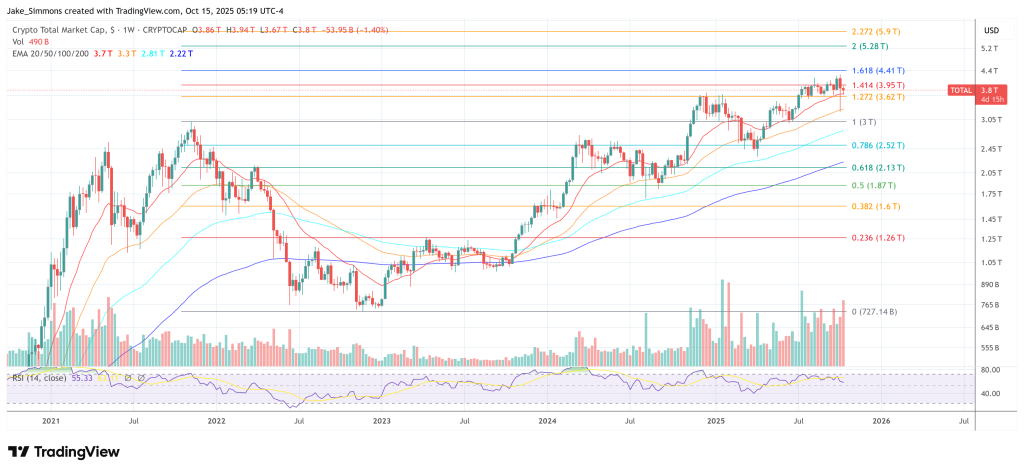
Total crypto market cap
Total crypto market cap, 1-week chart | Source: TOTAL on TradingView.com
Featured image created with DALL.E, chart from TradingView.com
Editorial Process for bitcoinist is centered on delivering thoroughly researched, accurate, and unbiased content. We uphold strict sourcing standards, and each page undergoes diligent review by our team of top technology experts and seasoned editors. This process ensures the integrity, relevance, and value of our content for our readers.

Jake Simmons has been a Bitcoin enthusiast since 2016. Ever since he heard about Bitcoin, he has been studying the topic every day and trying to share his knowledge with others. His goal is to contribute to Bitcoin's financial revolution, which will replace the fiat money system. Besides BTC and crypto, Jake studied Business Informatics at a university. After graduation in 2017, he has been working in the blockchain and crypto sector. You can follow Jake on Twitter at @realJakeSimmons.

Leituras Relacionadas

RWA Tokenization Enters the Next Phase: What is the Truly Time-Consuming Advantage to Build?

The article argues that as tokenization frameworks for Real-World Assets (RWA) mature, the ability to issue assets is becoming less of a competitive advantage. The focus is shifting to what happens *after* issuance: which RWA operations can build enduring trust, maintain stable operations, and remain integrated into the financial ecosystem over the long term. The piece introduces the concept of a **Reserve Layer**—infrastructure that connects tokenized assets to the necessary verification, liquidity, and operational systems for on-chain finance. For an asset to serve as a reliable reserve (e.g., short-term U.S. Treasuries, gold), it needs predictable value, standardized features, deep markets, and observable pricing. However, the true, hard-to-replicate advantage lies not just in the underlying asset but in the **operational track record** built over time. This includes consistent reserve management, independent audits, successful redemptions, maintained liquidity, and protocol integrations. Each successful operation adds evidence, creating a reinforcing cycle: more evidence builds stronger institutional confidence, leading to wider distribution, deeper liquidity, and more use cases as collateral. The article presents a framework combining two dimensions: an asset's suitability as a reserve and the issuer's operational capability. The most sustainable model combines **high-quality reserve assets with strong, long-term operational discipline**. A critical blind spot is an asset with high reserve suitability (like gold) issued by an entity with a limited operational track record; the quality of the infrastructure is separate from the quality of the asset itself. In conclusion, the next phase of RWA will be defined by participants who can pair appropriate reserve assets with the operational rigor to support them through market cycles, thereby transforming tokenized RWAs into durable financial infrastructure.

marsbitHá 3m

RWA Tokenization Enters the Next Phase: What is the Truly Time-Consuming Advantage to Build?

marsbitHá 3m

Claude Code Easily Compromised with Just a Fake Tool

Researchers have demonstrated a novel attack, dubbed ToolLeak, that can easily compromise AI coding assistants like Claude Code. The method exploits a "mode gap" by stealing the system prompts (instructions) not through direct chat queries, but by tricking the model into leaking them as parameters during tool calls. This extracted information is then used to craft a "two-channel prompt injection" attack. Attackers register a malicious tool with a description formatted to mimic legitimate instructions, prompting the AI agent to call it. The tool's return value then instructs the agent to execute a malicious command (e.g., `curl | bash`), achieving Remote Code Execution (RCE). In tests against six major AI programming tools (Cursor, Claude Code, Copilot, Windsurf, Cline, Trae) using older versions, all were fully compromised, with attack success rates reaching up to 1.0. Notably, Claude Code's secondary guard model (Haiku) was overridden by the main model (Sonnet), which had been manipulated by the injected instructions. Newer versions show improved defenses. Claude Code and Cursor implemented mitigations like "progressive tool description exposure," reducing RCE success to 0 and 0.3 respectively in some configurations. However, tools like Cline, Windsurf, and Trae paired with certain models remained fully vulnerable. The research underscores that architectural isolation is crucial for defense, as long as tool return values can ambiguously function as both data and executable instructions, the threat of tool hijacking persists. The paper "TIPExploit: Tool-Invocation Prompt Extraction and Exploitation in AI Coding Agents" has been accepted at ISSTA 2026.

marsbitHá 7m

Claude Code Easily Compromised with Just a Fake Tool

marsbitHá 7m

Bernstein Analysis: Samsung's HBM4 Accelerates Volume, Q3 Revenue May Overtake SK Hynix

South Korea’s July memory export data, serving as an early indicator for HBM business in Q3, shows overall HBM demand remains robust. While total exports to Taiwan and Malaysia declined 32% month-on-month from June’s peak—largely due to seasonality—they were still up 13% compared to April and rose 64% year-on-year. However, a divergence emerged between Samsung and SK Hynix. Samsung’s exports from Chungcheongnam-do (a proxy for its HBM shipments) surged, reaching $2.2 billion in July, up 122% from April. Based on regression analysis, Bernstein estimates Samsung’s Q3 HBM revenue could hit around $12 billion, roughly 30% above its prior forecast, driven by a rapid ramp in higher-value HBM4. The unit value of Samsung’s exports has doubled since April, signaling a shift toward HBM4, which carries a significantly higher price. In contrast, exports linked to SK Hynix from Chungcheongbuk-do and Icheon fell 28% month-on-month and 27% versus April. Bernstein’s base model suggests SK Hynix’s Q3 HBM revenue could drop to about $5.6 billion, though this could rebound to $12 billion if shipments concentrate later in the quarter as historically seen. The weakness may relate to potential delays in HBM4 shipments for Nvidia’s Rubin platform. Notably, HBM pricing is decoupling from general DRAM, with HBM4 mix driving average selling prices rather than broad-based hikes. Exports to Malaysia also surged, possibly linked to Intel’s EMIB packaging facilities, though the exact drivers remain unclear. While July data reinforces Samsung’s accelerating momentum in HBM4, it is insufficient to confirm a full-year market share reversal. Key factors to watch are Samsung’s August-September export performance, whether SK Hynix recovers lost ground, and upcoming 2027 HBM contract pricing negotiations.

marsbitHá 8m

Bernstein Analysis: Samsung's HBM4 Accelerates Volume, Q3 Revenue May Overtake SK Hynix

marsbitHá 8m

The New Rules of the AI Race: Nvidia Shifts from Chips to Energy Resources and Construction Sites

Nvidia is providing a $105 billion financial guarantee for the construction of OpenAI's data center campus in Ohio, signaling a strategic shift in the AI industry from competing on chips to battling for physical infrastructure and energy resources. The guarantee, detailed in an SEC filing, acts as insurance against tenant default rather than direct construction funding. OpenAI must repay any sums drawn. Nvidia will also invest $1.5 billion in SB Energy for the project's power component. The planned campus has a capacity of 4.25 GW, with OpenAI's current commitments to Nvidia reaching 12 GW. This move underscores that leading AI development now requires securing space, power, and financial backing for massive, long-term projects. Tech giants are taking on roles akin to developers and financial institutions. Concurrently, AI firms are diversifying suppliers: OpenAI and Anthropic have signed major deals with AMD for GPU deployments. Nvidia is also scaling its financial model through partnerships with investment firms to mobilize over $500 billion in external capital. The paradigm in AI is shifting from hardware supremacy to building comprehensive ecosystems. Future industry growth will depend on balancing innovation with real-world infrastructure capabilities, turning abstract computations into tangible industrial projects. An AI analysis notes the deal's resemblance to vendor financing schemes from the telecom bubble of the late 1990s and questions the long-term viability of gas-dependent energy infrastructure for AI, should market growth slow.

cryptonews.ruHá 17m

The New Rules of the AI Race: Nvidia Shifts from Chips to Energy Resources and Construction Sites

cryptonews.ruHá 17m

Trading

Spot
活动图片