The issuance framework for RWA (Real World Asset) tokenization is maturing.
From custody, issuance, and compliance to blockchain infrastructure, there are now corresponding service providers for each link in the chain. For teams with sufficient capital and professional capabilities, the speed to bring tokenized assets to market is faster than ever before.
This is an important milestone in the development of the RWA industry. At the same time, however, it is also changing the basis of competition.
As "issuance" itself gradually ceases to be a sufficiently high barrier, a more compelling question emerges: What happens after an asset is issued? Ten years from now, which RWA businesses will still enjoy market trust, remain integrated into the financial ecosystem, and maintain stable operations?
The answer may no longer depend solely on "what asset was issued," but also on whether the operational system built around these assets can withstand the continuous test of time and varying market conditions.
From RWA Issuance to Reserve Layer: What Kind of Assets Does On-Chain Finance Need?
The first phase of on-chain finance development largely solved the technical problem of how value can flow instantly and continuously on a global scale. Since then, the industry has also become increasingly sophisticated in building financial applications around existing assets. As on-chain finance evolves further, the asset base supporting these applications needs to expand accordingly.
Currently, this foundation is still largely built upon the US dollar and US dollar-denominated stablecoins. But as the market continues to grow, high-quality real-world assets can provide a more diverse and credible pool of reserve assets on this foundation.
This is also what Matrixdock (BIT's RWA platform) is building—the Reserve Layer: the infrastructure that connects these assets with the verification, liquidity, and operational systems required for their on-chain use.
However, once an asset is tokenized, it does not automatically qualify as a reserve asset.
A reserve asset needs to be able to undergo continuous verification, have reliable pricing, and possess the capacity for operation at scale. These conditions depend not only on the underlying asset itself but also on the operational infrastructure built around it.
Therefore, the construction of the Reserve Layer actually depends on two dimensions: whether the underlying asset itself is suitable as a reserve asset, and whether the issuer possesses the corresponding operational capabilities.
First is the asset itself. An asset can be of high value, yet not necessarily suitable as a reserve asset. Reserve assets need to have a high degree of value certainty: their prices should be independently observable, the assets themselves should have sufficiently standardized characteristics, and the underlying market needs to have sufficient depth to support reliable pricing and liquidity under scale conditions.
From this perspective, assets such as short-term US Treasuries, physical gold and silver, and money market instruments are well-positioned. They have mature markets, widely accepted standards, observable prices, and institutional-grade processes built around custody and settlement. These features make asset verification, liquidity management, and financial ecosystem integration more standardized and repeatable.
In contrast, the case of private credit is more complex. Private credit can possess standardized features such as Net Asset Value (NAV), contracted yields, and structured products. However, its underlying risk exposures remain heterogeneous, often requiring individual underwriting for each asset. Its value may need to be determined through valuation rather than directly observed from the market, and liquidity and credit performance can vary between different loans.
These characteristics make it more difficult for private credit to consistently establish the certainty required of a reserve asset.
And certainty at the asset level is merely the starting point. Once an asset enters the on-chain world in tokenized form, the issuer must continually demonstrate that the infrastructure built around this asset operates as intended.
The Truly Hard-to-Replicate Advantage of RWA: The Long-Term Record Accumulated Through Sustained Operations
Physical gold has served as a store of value for centuries, but a token representing gold on-chain still relies on an operational system that must function consistently over the long term.
Reserves need continuous management, custody security must be ensured, verification mechanisms must keep running, redemptions need to execute smoothly, liquidity must be maintained, and integrations with different ecosystems and protocols must remain reliable.
Many of these operational components are not inherently impossible to replicate. A well-funded competitor could establish many of these operational elements using third-party services.
What truly cannot be quickly replicated is the operational record accumulated from the long-term successful operation of these components as a complete system.
Years of stable reserve management, ongoing independent audits, successfully executed redemptions, market continuity, gradually established liquidity networks, protocol integrations, and the actual performance of the entire system under different market conditions can only be accumulated through sustained operation over time.
This is also an important characteristic brought by long-term operation: the operational work itself is repetitive, but the evidence generated by each operation accumulates continuously.
Each audit adds a new verification node; each successful redemption further proves the exit mechanism functions effectively; each period of continuous market operation accumulates new pricing and liquidity history; each new ecosystem integration further expands the asset's application capabilities within the broader financial system.
As this evidence accumulates, what it eventually forms is no longer a series of isolated operational events, but an increasingly complete operational record.
This can create a self-reinforcing operational cycle:
Sustained Operation → Evidence Accumulation → Stronger Operational Record → Provides More Substantial Support for Institutional Assessment → Broader Distribution → Deeper Liquidity → Stronger Collateral Utility → More Ecosystem Integrations → More Operational Evidence
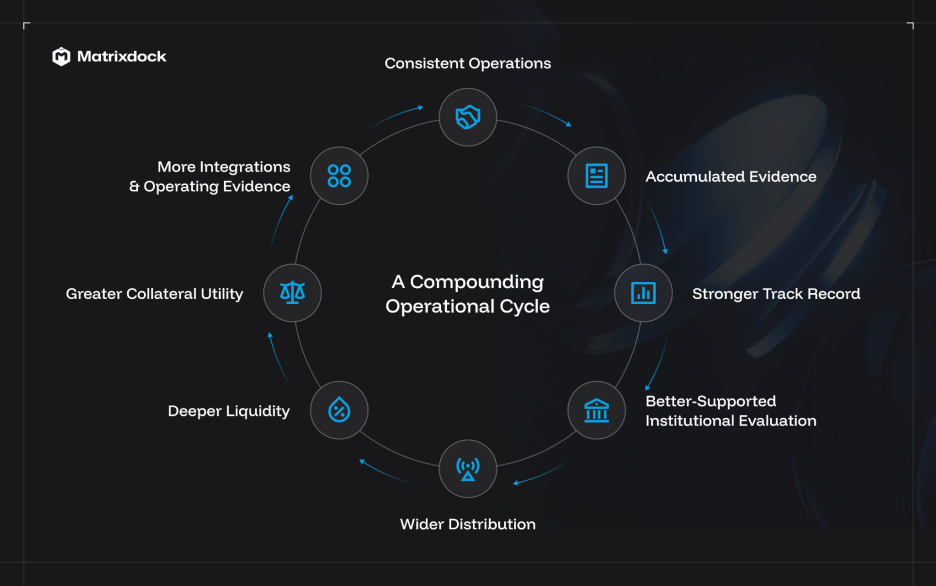
For institutions, a longer operational record means having access to more substantial historical evidence when conducting their own due diligence. Over time, this evidence can support assets in achieving broader distribution and deeper liquidity, which can further expand their utility as collateral and drive adoption into more financial applications.
Each new use case will further create new market and operational records, thereby reinforcing this cycle. Operations are repeated, evidence accumulates, and the advantage that truly takes time to build is thus formed.
Matrixdock's tokenized gold, XAUm, provides a real-world example.
Through consistently conducting biannual independent reserve audits, XAUm has established a continuous, consistent verification record. At the same time, in just the first half of 2026, XAUm added over 20 new ecosystem integrations.
Whether it's independent reserve audits or ecosystem integrations themselves, individually, they do not constitute a true advantage. The real advantage stems from the evidence accumulated through long-term, sustained, and scaled operations.
Reserve Assets and Operational Capability: Why Are Both Indispensable?
If we further deconstruct the long-term sustainability of RWA, we can identify two dimensions: on one side is the suitability of the underlying asset as a reserve asset, and on the other is the issuer's operational capability.
The combination of the two yields four possible outcomes.
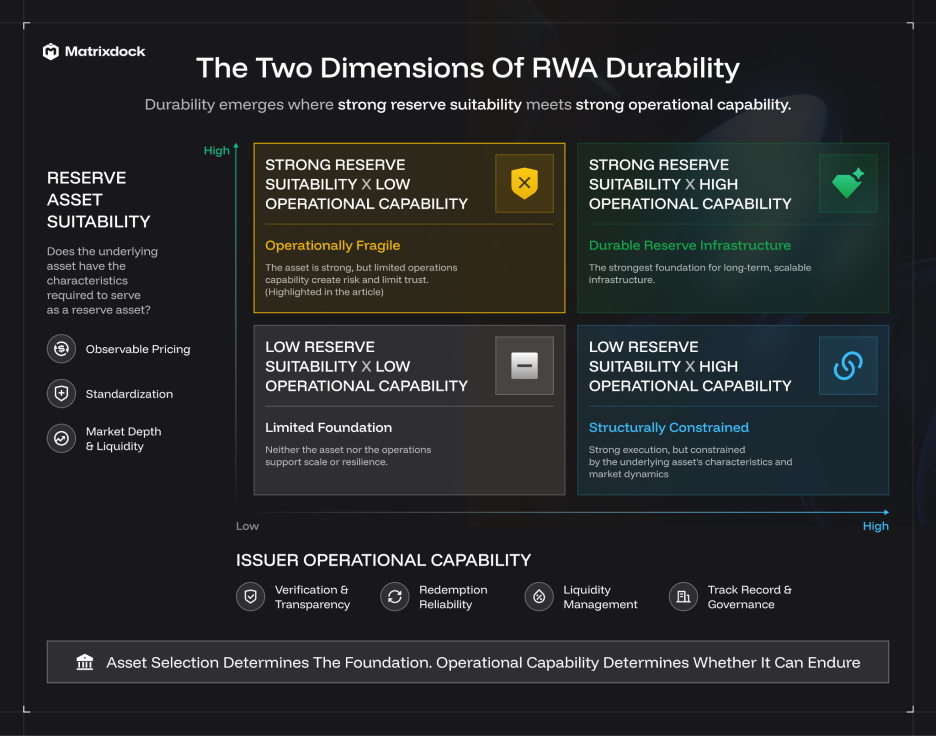
Low reserve asset suitability + low operational capability means the underlying asset itself lacks the characteristics of a reserve asset, while the issuer also lacks the operational capability to support its scaled operation.
Low reserve asset suitability + high operational capability will perform relatively better, but even excellent operational capability cannot fundamentally change the inherent characteristics of the underlying asset. Its development ceiling is ultimately constrained by the asset itself.
High reserve asset suitability + high operational capability builds the strongest foundation for long-term sustainable development. As operational evidence accumulates, market confidence strengthens, and institutional-grade applications expand, these two dimensions can reinforce each other and gradually form a sustainable long-term advantage.
The fourth combination—high reserve asset suitability + limited issuer operational record—is actually the most noteworthy, because it is the least obvious yet potentially carries the most significant implications.
Assets like gold and US Treasuries have mature markets, high institutional recognition, and a long history as financial assets. These characteristics can easily instill an initial sense of security in the market regarding their tokenized forms, even if the underlying issuer has not yet established an operational record matching that of the underlying asset.
But it is necessary to distinguish between two issues: the quality of the reserve asset itself and the quality of the infrastructure representing that asset are not the same thing.
The real differences often manifest in specific operational details: When audits become difficult to execute, can the established audit frequency be maintained? Has the redemption mechanism truly been tested at scale, rather than just assumed to function? Can insurance and vault custody arrangements be renewed as planned? When different jurisdictions adjust regulatory rules, can the compliance system keep pace?
In normal market environments, these differences may not be apparent. But when the market enters periods of extreme volatility, large-scale redemptions, liquidity stress, or operational disruptions—times when the infrastructure built around the asset is put to a more direct test—these differences become critical.
This is also why, as RWA issuance infrastructure matures, industry competition may become increasingly difficult to judge solely by "what was issued."
Tokenization creates the on-chain representation of the asset, asset quality builds the foundation, and sustained operation continuously accumulates evidence, eventually turning this foundation into genuine infrastructure.
A decade from now, the RWA businesses that will still have market trust, remain integrated into the financial ecosystem, and maintain operations are likely those that can combine reserve assets with long-term operational discipline and continue to support these assets through evolving market environments.
For Matrixdock, this is also the core logic of the Reserve Layer: through long-term, consistent execution, transforming high-quality real-world assets into infrastructure that serves on-chain finance.
Original Source:https://www.matrixdock.com/blog/market-insights/the-rwa-advantage-that-takes-time-to-build