加密ETF进入加速期,市场的下一步是什么?

比推Publicado em 2025-10-13Última atualização em 2025-10-13

作者:Tristero Research

编译:白话区块链

原文标题:告别漫长等待,加密ETF进入“高速公路”


2025年9月,美国加密市场风云突变。多年以来,推出一只新基金意味着要经历长达240天的监管炼狱。每一款产品都是与美国证券交易委员会(SEC)的一场定制化斗争。然后,仅凭一次投票,SEC就用一个秒表取代了旧的规则手册。

通过批准商品信托份额的通用上市标准,SEC为加密交易平台交易产品(ETPs)开辟了一条快车道。过去需要八个月时间的事情,现在只需两个月。其结果是:最后期限前的交通堵塞,从Solana到狗狗币的十几种另类TokenETF(山寨币ETF)都排在同一个狭窄的窗口期等待决策。

欢迎来到ETF之月。

游戏新规

在此之前,加密ETF需要进行“19b-4”规则变更——每一个都是一项定制化的请求。新系统对那些通过了明确、基于规则测试的资产,取消了这一步骤。这张“金票”——金融界的“TSA PreCheck”(机场快速安检通道)——是拥有至少六个月交易历史的、受美国商品期货交易委员会(CFTC)监管的期货市场。

这项测试创造了一个事实上的加密货币种姓制度:

第一梯队:比特币和以太坊,已经拥有了轰动市场的现货ETF。

第二梯队:像Solana、XRP和Cardano这样的资产,它们拥有期货市场,从而解锁了快车道。

第三梯队:其他所有币种,仍然困在慢车道上。

这是一个从“通过执法进行监管”到“通过基础设施进行监管”的转变。SEC不再辩论一个币种的效用,而是问:它是否在一个成熟、受监控的市场中交易?

十月日程表

新规催生了密集的十月日程:

10月10日:灰度信托转换(Solana, Litecoin)。

10月16日:现货Solana ETF决策(21Shares, Bitwise)。

10月18日–25日:XRP ETF预计获批,几乎可以肯定至少有一家会得到绿灯。

同样在排队中的还有:Cardano(灰度的GADA)、Dogecoin、Avalanche、Hedera。
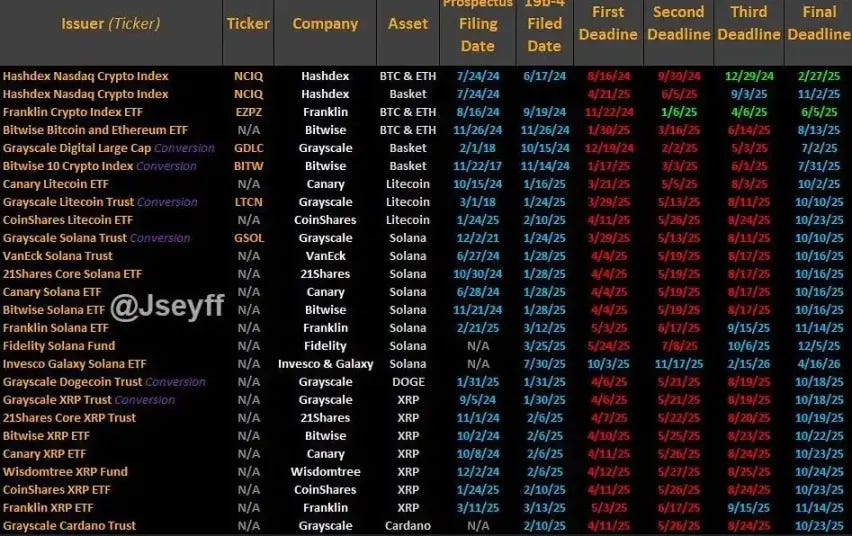
最大的文化信号是狗狗币(Dogecoin)。无论它是不是Meme币,DOGE都符合资格,因为它有一个受监管的期货市场。新的框架是中立的,它只关心数据。

这第一波浪潮也推动了下一个监管前沿:质押(staking)。几份Solana的申请文件提议,通过质押基金资产将收益传递给投资者。如果获得批准,ETF将从被动追踪工具演变为能产生收入的产品——一座连接华尔街金融产品与链上经济的直接桥梁。

资金流向

资金已经在流动,但并不均衡。机构参与者正在布局;散户交易者则在犹豫。

机构:芝加哥商品交易平台(CME)的XRP期货未平仓合约已超过10亿美元,这是大资金为新投资工具做准备的典型迹象。

散户:同期超过19亿美元的XRP清算,显示出小额交易者在波动中被反复收割。

结论是:早期的ETF浪潮将是现有机构敞口向更清晰、更便宜、受监管的金融产品中的一次迁移。这波另类TokenETP浪潮更多的是关于优化市场结构,而非释放新的需求。

全球竞赛

美国并非唯一一个开放加密市场的国家,这是一场全球竞赛。

欧洲:21Shares和CoinShares已在提供一篮子产品和另类TokenETP(瑞士自2018年起)。
香港:在结构上是创新者,允许“实物”申购和赎回(用实际的加密货币交易ETF份额)。美国最初禁止这种方式,但在2025年7月允许了比特币和以太坊的实物申赎,这标志着趋同。
美国:现在正利用其规模优势,但通过受监管的期货市场设置了准入门槛。

潜在风险

这种突然的扩张既带来了机遇,也带来了风险。

稀释 vs. 水涨船高

比特币ETF的推出是“水涨船高”的典范。但几十个另类TokenETF可能会分散资金流,大部分资本将集中在最便宜、品牌最大的产品上。较小的发行商有被边缘化的风险。

流动性压力

ETF的流动性最终依赖于其底层的现货市场。对于较小的另类Token,在市场下行期间的赎回潮可能会给做市商带来压力,导致ETF的交易价格偏离其资产净值。

大筛选

ETP资格正迅速成为合法性的标志。“蓝筹”币种因拥有期货市场将吸引机构资金;而其他数千种币种则被拒之门外。这加剧了可投资的主流币种与投机性的长尾资产之间的鸿沟。

结论:一个新纪元的开始

2025年10月是监管转向的直接结果,它将多年的产品开发压缩到了几周之内。

ETF之月是新发行机制的第一个证明。美国加密市场已经从比特币/以太坊时代,毕业进入一个更广阔、更复杂、更易于参与的生态系统。

闸门已经打开——而对资本、流动性和合法性的争夺才刚刚开始。


Twitter:https://twitter.com/BitpushNewsCN

比推 TG 交流群:https://t.me/BitPushCommunity

比推 TG 订阅: https://t.me/bitpush

说明: 比推所有文章只代表作者观点,不构成投资建议

Leituras Relacionadas

The World Cup is Approaching: Sports Entering the Era of 'Fragmented Finance'

With the approaching World Cup, sports are entering an era of "fragmented finance." This shift is exemplified by FIFA's new rule requiring debutant players to wear a special "World Cup debut patch." Post-tournament, these patches will be authenticated, cut, and embedded into collectible cards, potentially transforming into high-value assets. The global sports trading card market, valued at over $11.5 billion, represents a sophisticated alternative asset class with deep secondary markets and distinct bull/bear cycles. While football has a massive fanbase, its card market has historically lacked the liquidity and unified narrative of the NBA's system. The NBA's success stems from its centralized, star-driven storytelling—from draft nights to championships—which perfectly fuels financialization. The World Cup patch initiative is FIFA's attempt to create similar "financial raw material" for football. The NBA card market, evolving over 70 years, has matured into a financial ecosystem. After a 1990s crash due to overproduction, the industry rebounded by embracing scarcity: limited editions, autographs, game-worn memorabilia (patches), and serial numbering. Today, it features professional grading (e.g., PSA, BGS), auction platforms, live "break" streams, and dedicated marketplaces, mirroring aspects of cryptocurrency markets with their volatility, speculation, and community-driven trading. The core driver is narrative. A card's value is tied to a specific historic moment or player potential—like Stephen Curry's 1/1 card commemorating his Olympic game-winning shot selling for $518,500. This trade in "ownership of history" or "future greatness" parallels prediction markets, both monetizing collective emotion. Unlike many NFT projects that struggle to generate sustained narratives, sports are a perpetual emotion-generating machine. Leagues like the NBA and UFC constantly produce real-world drama—rivalries, comebacks, and triumphs—that fuels ongoing interest and investment. For younger audiences consuming sports via highlights and social media clips, trading cards become a direct financial instrument for engaging with these narratives. Thus, traditional sports leagues are leading the charge in assetization, leveraging their unique advantages: real events, global fan consensus, and endless storytelling. They are becoming platforms for issuing financial assets, turning fragments of history—a patch, a signature, a moment—into tradable commodities.

Odaily星球日报Há 36m

The World Cup is Approaching: Sports Entering the Era of 'Fragmented Finance'

Odaily星球日报Há 36m

Vitalik's Latest Long Read: In the AI Era, How Can Code Become More Secure?

Vitalik Buterin explores the role of formal verification as a critical tool for software security, especially in the AI era and for blockchain systems. He defines formal verification as using machine-checkable mathematical proofs to verify that code meets specified properties, moving beyond manual auditing. The article highlights that while AI can generate code and find vulnerabilities rapidly, it also makes formal verification more accessible by assisting in writing proofs. This is crucial for Ethereum's complex components like STARKs, ZK-EVMs, consensus algorithms, and high-performance EVM implementations, where bugs can lead to irreversible losses. Vitalik argues that formal verification enables a powerful "separation of concerns": AI can write highly optimized (e.g., assembly) code for efficiency, while a separate, human-readable specification defines correctness. A machine-checked proof then verifies their equivalence. This paradigm can create a more secure "trusted core" of software. However, he cautions that formal verification is not a panacea. "Proven correctness" depends on the accuracy of the specifications and proofs themselves, which can be wrong or incomplete. Risks include unverified code sections, hardware-level side-channel attacks, and overlooked assumptions. The true goal is not absolute proof but increased confidence through redundant expressions of intent—using code, tests, types, and formal proofs—and automatically checking their consistency. The article concludes that AI and formal verification are complementary: AI enables scale, while verification ensures accuracy. For critical systems, this combination offers a path toward stronger security in a future with powerful AI adversaries, helping to maintain the defensive advantage essential for a decentralized internet.

marsbitHá 1h

Vitalik's Latest Long Read: In the AI Era, How Can Code Become More Secure?

marsbitHá 1h

Trading

Spot
Futuros
活动图片