山寨季去哪了?加密股票市场告诉你

深潮Publicado em 2025-10-09Última atualização em 2025-10-10

真正的“山寨币季”正在加密股票市场上演。

作者:Alana Levin

编译:深潮TechFlow

关于本轮加密周期中是否会迎来“山寨币季”(Alt Season),人们提出了许多疑问。一些人将目光投向 2024 年 1 月或 2025 年,期待非比特币类加密资产(山寨币)大幅升值,甚至创下历史新高。

在过去的周期中,比特币价格的显著上涨通常会引发许多长尾加密资产的类似表现,甚至有时这些资产的涨幅会超过比特币。然而,在过去几年里,这种模式似乎并未重现。当前,比特币的市场占比已达到 58%,自 2022 年 11 月以来一直呈稳步上升趋势。

那么,这一周期是否会跳过“山寨币季”?抑或是“山寨币季”尚未到来?又或者……“山寨币季”其实已经在一个完全不同的市场中悄然上演,而我们却没有察觉?

我的直觉是最后一种情况。真正的“山寨币季”正在加密股票市场上演。

什么是“山寨币季”的典型特征?

  • 价格上涨吸引新资本→问题是,新资本从哪里来?

  • 价格上涨导致利润轮换→问题是,谁在获利以及利润被重新部署到哪里?

如今,确实有新资本希望进入加密领域,但这些资金更多来自机构投资者,而非散户。相比之下,散户往往是快速的早期采纳者,而机构投资者则更为谨慎,通常需要外部的合法性认证作为推动力。而这种合法性认证正在发生:2024年,美国证券交易委员会(SEC)批准了比特币和以太坊现货交易所交易基金(Spot ETFs);SEC主席阿特金(Atkin)最近宣布了“加密项目”(Project Crypto);纳斯达克首席执行官阿德娜·弗里德曼(Adena Friedman)也公开支持股权的代币化(Tokenization of Equities)。类似的例子不胜枚举。

机构投资者带着新鲜资本涌入,而我猜测,这些资本大多被导向了加密股票,而非加密资产。股票市场对机构来说更熟悉且更容易接触。机构投资者已经拥有完善的运营体系(包括托管、合规流程、交易商关系等),而直接购买加密资产则可能需要全新的能力建设。而且,购买股票属于他们的职责范围——而直接购买加密代币(尤其是长尾资产)可能超出了其职责范围。

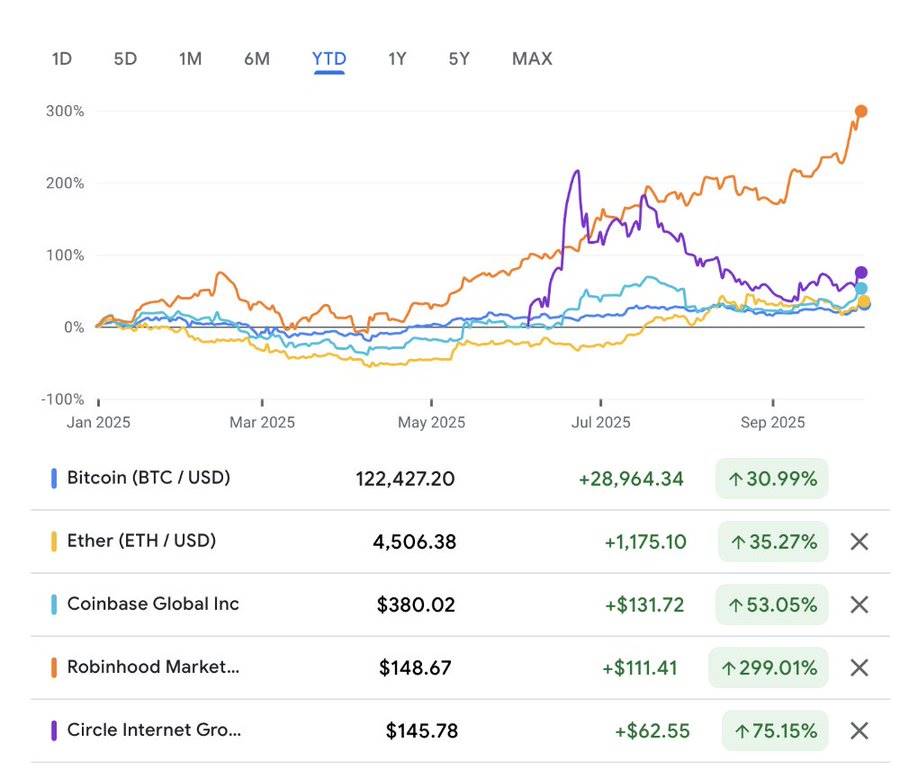
因此,机构正在将资金投入加密股票或与加密相关的股票中。例如:

  • Coinbase 年初至今上涨 53%;

  • Robinhood 上涨 299%;

  • Galaxy 上涨 100%;

  • Circle 自 6 月 IPO 以来上涨 368%(若以首个交易日收盘价计算,则上涨了 75%)。

相比之下,比特币上涨 31%,以太坊上涨 35%,Solana 上涨 21%。加密股票的表现显然更为抢眼。
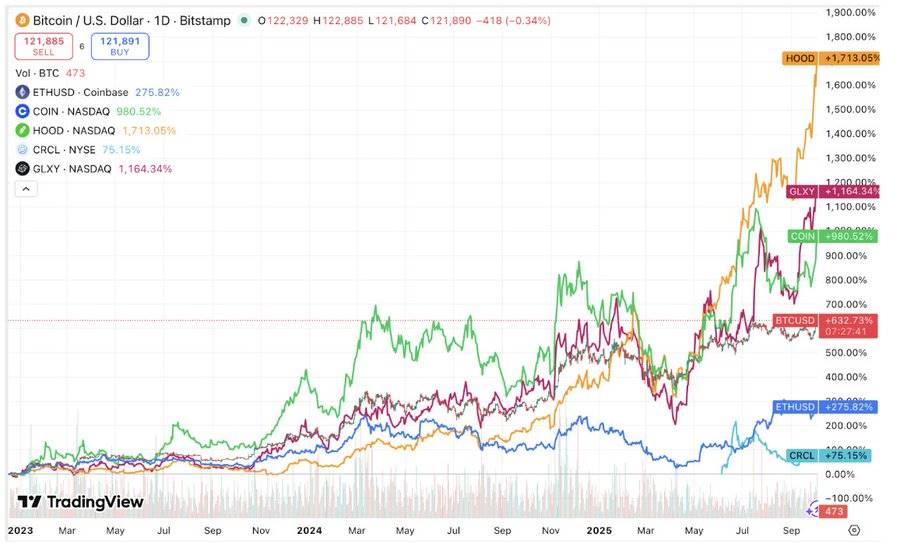
如果我们从比特币在 2022 年 12 月 17 日触底以来的表现来看,情况类似。
有理由相信这一趋势将继续。未来将有一系列加密股票 IPO 计划推出,更多处于后期阶段的公司可能在未来几年提交上市申请。

与典型的“山寨币季”一样,并非所有资产都会表现良好。我预计会有一定的资金轮动,例如交易者可能会从估值过高的资产(如 CRCL 当前的市销率为 26 倍)中获利了结,并将资金重新部署到其他资产中。

在加密市场中,我们经常看到不同的热点轮动,例如市场可能从DeFi资产转向游戏代币,再到AI相关代币。加密股票市场可能也会类似,一个“山寨币季”可能会看到资金从稳定币相关股票转向交易所股票,再到数字资产储备公司(或其他趋势)。

我认为,加密货币股票山寨币季最终可能看起来更像一个历史性的山寨币季,而不是加密原生市场中未来的任何山寨币季,原因有很多:

  • 资产集中度。目前只有少数几家股票提供加密货币投资。这与以往加密货币周期的情况类似,当时买家认为有吸引力的代币可能不足 100 种。值得注意的是,这与如今的加密货币原生市场截然不同——后者拥有数百万种代币,因此部署分布更加分散。

  • 杠杆利用。上一个周期中,许多加密原生的借贷平台相继倒闭,我们尚未看到它们的重建。然而,股票投资者可以使用杠杆,这意味着市场的繁荣可能更为显著(但崩盘也可能更加剧烈)。

我们或许会在未来迎来加密原生资产的“山寨币季”。但这需要时间,新的边际资本来源需要逐步建立起能够支持其投资加密资产的运营能力。

因此,就目前而言,这可能不是许多人期待的山寨币季——但无论如何,我们正处于山寨币季。

Leituras Relacionadas

When Hyperliquid Takes Away Solana's "Internet Capital Markets" Script

The article discusses how Solana's vision of becoming the "Internet Capital Markets" is being challenged, primarily by the rise of Hyperliquid. While Solana positioned itself as a high-performance blockchain for tokenizing all global assets, its native token SOL has significantly underperformed, and its core narrative faces pressure. Hyperliquid, initially a perpetual contracts platform, has evolved into a specialized Layer 1 financial network. Its focused, trading-optimized design is attracting users and capital, suggesting a vertical L1 may be better suited for a core capital market than a general-purpose chain like Solana. This external competition was compounded by an internal $200M+ exploit on Solana's key derivatives protocol, Drift, creating a strategic vacuum. In response, Solana founder Anatoly Yakovenko heavily promoted the Phoenix protocol as a decentralized, composable alternative. However, Phoenix's trading volume remains far behind leading platforms. Solana supporters also launched critiques against Hyperliquid's decentralization, citing its limited validators and closed-source code. Critics countered that Solana's own decentralization metrics have weakened, and the foundation's overt backing of Phoenix caused friction with other ecosystem builders. The piece concludes that Solana risks losing the "Internet Capital Markets" race if it cannot regain dominance in derivatives, potentially remaining a meme coin hub rather than achieving its grand ambition of hosting all global assets.

marsbitHá 1h

When Hyperliquid Takes Away Solana's "Internet Capital Markets" Script

marsbitHá 1h

Trump Signs Executive Order, Kraken, Coinbase and Others May Gain Access to Fed Payment Channels

President Trump has signed an executive order, "Incorporating Financial Technology Innovation into the Regulatory Framework," pressuring the Federal Reserve to reassess its rules on granting non-bank financial companies—including crypto and fintech firms—access to its payment systems, specifically master accounts that connect to the Fedwire settlement system. Currently, such accounts are primarily reserved for depository institutions. The order mandates a review to determine if broader access is permissible and to establish an application process. This move, supported by figures like Senator Cynthia Lummis, aims to reduce barriers to innovation and lower public payment costs by fostering fairer competition. It does not grant immediate access but could pave the way for companies like Kraken, Coinbase, Ripple, and Circle to reduce reliance on intermediary banks, lowering costs and speeding up settlements. A key precedent is the Kansas City Fed granting Kraken's parent company a restricted master account in March, offering limited payment services without interest or credit privileges. This model is seen as a potential template for allowing controlled access while mitigating systemic risk. Other firms like Anchorage, Paxos, and BitGo, which hold specialized banking charters, are also well-positioned to apply. The banking industry, represented by the American Bankers Association, opposes easing access, arguing any institution handling bank-like payments must meet the same stringent regulatory, consumer protection, and risk-management standards as traditional banks. Their core concerns include potential systemic risks, compliance gaps in areas like anti-money laundering, and the diversion of liquidity from the traditional banking system. The outcome of the Fed's review will be crucial in determining whether and how crypto and fintech firms can integrate more directly into the core U.S. financial infrastructure, balancing innovation with financial stability.

marsbitHá 1h

Trump Signs Executive Order, Kraken, Coinbase and Others May Gain Access to Fed Payment Channels

marsbitHá 1h

The First Large-Scale Strike in the AI Era Comes from the Factories That Build AI

The article describes a potential large-scale strike at Samsung Electronics, narrowly averted in May 2026 after a temporary agreement. The strike, planned by the company's union, would have been the first major labor action in the AI era targeting a core AI supply chain player. Samsung, alongside SK Hynix, produces roughly two-thirds of the world's memory chips, critical components for AI training and data centers like HBM. An 18-day strike could have disrupted global supply, affecting prices and production for tech companies and cloud providers. For South Korea, where semiconductors constitute about 35% of exports and Samsung represents a quarter of the stock market's value, such an action threatens national economic stability. The union's demands include a 7% base wage increase and, crucially, a clear, substantial profit-sharing model. They want 15% of annual operating profit as an employee bonus pool and the removal of the existing cap (about 50% of annual salary). This frustration is amplified by seeing rival SK Hynix successfully negotiate a deal granting employees 10% of operating profit as bonuses, with reports suggesting some workers could receive bonuses equivalent to hundreds of thousands of dollars. The conflict stems from deeper issues in South Korea's chaebol (conglomerate) system, where rapid national industrialization often prioritized corporate growth over labor rights. Samsung long maintained a "no union" policy until a 2020 apology from its leader. The article argues this strike highlights a fundamental tension in the AI age: as technology advances and corporate profits soar—often driven by AI—the workers who build the infrastructure are demanding a fair share and dignity, rejecting the notion that they are mere expendable components in a machine that "must not stop." The piece concludes that the true test of the AI era isn't just computational power, but whether the people who build the future can secure a stable and valued place within it.

marsbitHá 2h

The First Large-Scale Strike in the AI Era Comes from the Factories That Build AI

marsbitHá 2h

Ripple’s Fed Master Account Bid Gains Momentum After Trump Order

President Donald Trump has signed an executive order directing financial regulators and the Federal Reserve to review expanding fintech and crypto firms' access to core payment infrastructure. This order significantly advances the industry's push for direct Fed connectivity, a central issue for Ripple. The company has been seeking a Federal Reserve master account as part of its strategy for its RLUSD stablecoin, which would allow it to hold reserves directly with the central bank and access its payment rails. The order, titled "Integrating Financial Technology Innovation into Regulatory Frameworks," mandates a Fed review within 120 days on allowing access for entities like uninsured depository institutions and non-bank financial companies, including those in digital assets. This creates a formal policy timeline for resolving whether crypto payment firms must rely on traditional bank intermediaries. Ripple's application for a national bank charter and a master account is part of this broader landscape. The issue gained precedent when Kraken Financial received a limited-purpose master account, while Custodia Bank's application was denied after a legal battle. The Fed has also proposed a more restricted "payment account" option. Trump's order does not guarantee approval for Ripple but forces a high-level examination of the regulatory barriers, bringing the company's long-running effort to the forefront of Washington's financial policy agenda.

bitcoinistHá 2h

Ripple’s Fed Master Account Bid Gains Momentum After Trump Order

bitcoinistHá 2h

Trading

Spot
Futuros
活动图片




