Crypto Gamble Wipes Out 87% Of Smart Digital Group’s Market Value

bitcoinistPublicado em 2025-09-28Última atualização em 2025-09-28

Resumo

Smart Digital Group’s Nasdaq-listed shares collapsed after the company announced plans to build a cryptocurrency asset pool focused on Bitcoin...

Trusted Editorial content, reviewed by leading industry experts and seasoned editors. Ad Disclosure

Smart Digital Group’s Nasdaq-listed shares collapsed after the company announced plans to build a cryptocurrency asset pool focused on Bitcoin and Ethereum.

The selloff wiped out a huge chunk of market value in a single day, with the stock plunging roughly 87% on heavy volume.

Company Announcement And Missing Details

According to the firm’s press release, the plan was first disclosed in a filing that said the asset pool would emphasize “stability and transparency” and concentrate on major coins like Bitcoin and Ethereum.

The release also said more specifics — including the pool’s size and allocation — would be provided later, subject to regulatory and market conditions. Reports say that scarcity of concrete numbers left investors with little to judge.

Market Reaction And Price Moves

On the day of the announcement, Smart Digital Group’s share price fell from levels near the prior close to intraday lows reported at about $1.63 to $1.88.

The fall represented an 86–88% move in some reports, with many outlets using an 87% figure to sum up the drop.

The company had been a hot name earlier this year — one report shows a market cap around $364 million and a run that included a 123% jump over the prior six months — but Friday’s session erased most of that gain.

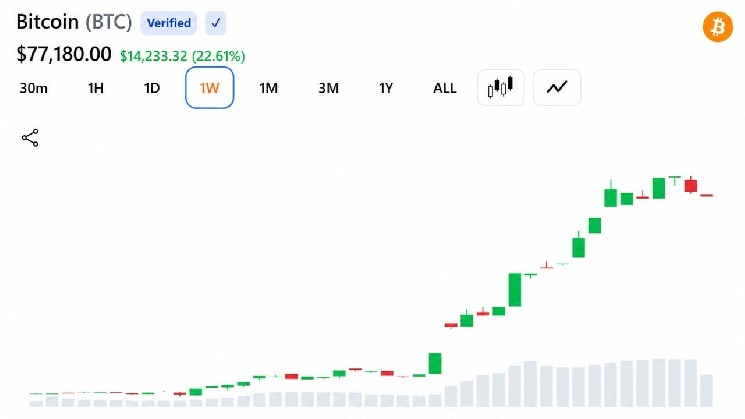
Total crypto market cap currently at $3.73 trillion. Chart: TradingView

Trading desk sources and market coverage point to two big drivers: panic selling by retail holders and sharp re-pricing by short sellers.

Price swings were extreme. Many investors said they had expected clearer rules about how corporate cash or balance-sheet assets would be used, and they did not get it.

Regulatory And Analyst Concerns

Based on reports, regulators have been watching trades tied to companies that announce crypto-treasury moves, and in this case the SEC and FINRA interest was mentioned in several stories.

Analysts and commentators said the lack of disclosure was a red flag, noting that companies that have publicly moved into crypto in the past sometimes saw gains — but only when management spelled out the guardrails and the source of funds.

Some market watchers cautioned that the fall may include an element of overshoot. When confidence evaporates fast, prices can move past what fundamentals alone would justify.

Other observers said the decision to shift part of a corporate balance sheet into volatile assets raises straightforward risks: accounting complexity, custody questions, and regulatory scrutiny.

Featured image from Financial Content, chart from TradingView

Editorial Process for bitcoinist is centered on delivering thoroughly researched, accurate, and unbiased content. We uphold strict sourcing standards, and each page undergoes diligent review by our team of top technology experts and seasoned editors. This process ensures the integrity, relevance, and value of our content for our readers.

Christian, a journalist and editor with leadership roles in Philippine and Canadian media, is fueled by his love for writing and cryptocurrency. Off-screen, he's a cook and cinephile who's constantly intrigued by the size of the universe.

Leituras Relacionadas

Will the STRC Issue Price Determined by ChatGPT Lead to a Death Spiral?

A "death spiral" concerns surround the "STRC" preferred shares from MicroStrategy, a financial instrument designed by CEO Michael Saylor with significant AI consultation to trade near a $100 face value. Since its July 2025 launch alongside a ~40% Bitcoin (BTC) decline, STRC has traded at a discount, hitting a low of $82.53 and pushing its effective dividend yield above 12.9%. The debate centers on whether STRC's structure—which relies on MicroStrategy issuing more shares to fund Bitcoin purchases and dividends—is sustainable or a "centralized Ponzi scheme," as economist Peter Schiff claims. Skepticism grew after Saylor revealed the product's design involved extensive AI dialogue to create a legally viable, monthly-dividend, price-stable preferred share—a novel concept. MicroStrategy's recent sale of 32 BTC to cover dividends, coupled with a sharp slowdown in its weekly Bitcoin buys (from billions to ~$100 million in June), has intensified fears. The "at-the-market" equity issuance, a key funding mechanism, is paused while STRC trades below par. This raises the "death spiral" risk: a lower STRC price triggers automatic dividend rate hikes, increasing cash obligations and potentially forcing more share sales or Bitcoin divestments. Bullish analysts like Jesse Myers argue the sell-off stems from leveraged positions unwinding, not fundamental failure, noting the company can cover dividends for decades if BTC appreciates modestly. The shift to semi-monthly dividends and the high yield at discounted prices may attract new buyers. Major AI models (ChatGPT, Grok, Claude) suggest a return to $100 is possible but conditional on restored market confidence, sustainable dividend coverage without asset sales, and a Bitcoin price recovery. The critical test arrives as new dividend rules take effect June 30, likely raising rates again with STRC below $95. The central question remains: Can MicroStrategy fulfill its obligations without selling Bitcoin, or will the mechanism accelerate its own decline?

marsbitHá 6m

Will the STRC Issue Price Determined by ChatGPT Lead to a Death Spiral?

marsbitHá 6m

Why Did NVIDIA's Bond Issue Go Unnoticed While SpaceX's Caused a Plunge?

The article analyzes the contrasting market reactions to recent bond issuances by SpaceX and NVIDIA. While NVIDIA's $25 billion bond offering was met with strong demand and seen as securing long-term capital for its already profitable AI business, SpaceX's move to raise at least $20 billion in bonds (primarily to refinance bridge loans) triggered a sell-off in its stock (SPCX). The key difference lies in the stage of cash flow validation for their respective core narratives. For NVIDIA, the AI boom is generating substantial, visible revenue and profits, making debt a tool to amplify a proven growth curve. For SpaceX, despite a strong cash position post-IPO and a revenue-generating business in Starlink, its valuation is heavily tied to future, capital-intensive projects like Starship, global satellite networks, and potential AI infrastructure. The bond issuance acted as a trigger, shifting market focus from SpaceX's long-term vision to the pressing question of whether Starlink's profits can fund these ambitious, unproven ventures before they generate their own returns. Thus, the market penalizes not the act of borrowing itself, but the perceived gap between high capital expenditure and the speed of cash flow realization. SpaceX's valuation recovery hinges on demonstrating that Starlink's profitability can outpace the burn rate of its futuristic projects or that those projects (like Starship achieving reliable, low-cost reusability) can soon transition from costly visions to commercial realities.

marsbitHá 11m

Why Did NVIDIA's Bond Issue Go Unnoticed While SpaceX's Caused a Plunge?

marsbitHá 11m

Will the STRC Issue Price Determined by ChatGPT Really Fall into a Death Spiral?

"Strategy's" (STRC) preferred share, a financial instrument designed by CEO Michael Saylor in consultation with AI to trade steadily at $100, faces mounting pressure. Since its July 2025 launch alongside a ~40% Bitcoin price drop, STRC has traded at a steep discount, hitting a low of $82.53. This discount pushes its effective dividend yield above 12.9%. The core debate revolves around whether STRC's structure is sustainable or a "centralized Ponzi scheme," as economist Peter Schiff claims. The mechanism relies on issuing new shares ("at-the-market" offerings) to fund Bitcoin purchases and dividend payments. However, the deep discount has paused these ATM offerings, slowing Bitcoin accumulation and forcing a minor sale of 32 BTC to cover obligations. Proponents, like The Smarter Web Company's Jesse Myers, argue the sell-off is a leveraged unwinding, not a fundamental failure. They note Strategy has ample resources to cover dividends for years if Bitcoin appreciates modestly. The deep discount also makes STRC attractive for yield-seeking buyers, as dividends are calculated on the $100 face value. The key test is whether Strategy can maintain dividends without sustained Bitcoin sales. A critical watchpoint is June 30th, when STRC switches to semi-monthly dividends. An automatic rule will likely raise the dividend rate further because the price remains below $95$, potentially creating a "death spiral": lower prices trigger higher yields, increasing the cash burden and forcing more dilution or asset sales. The question of whether this AI-designed "flywheel" is a stable instrument or a flawed accelerator will be answered by its price action and Strategy's funding choices in the coming months.

链捕手Há 11m

Will the STRC Issue Price Determined by ChatGPT Really Fall into a Death Spiral?

链捕手Há 11m

Ethereum's Next Stop Glamsterdam: The Core Upgrades You Must Know

The Glamsterdam upgrade, scheduled for late 2026, is a major Ethereum hard fork combining the Amsterdam execution layer and Glasgow consensus layer updates. Its primary goal is not simply increasing throughput but restructuring Ethereum's block production, validation, and resource pricing to enable future scaling. Key technical changes include **EIP-7732 (ePBS)**, which formally enshrines proposer-builder separation into the protocol. This decouples consensus and execution tasks, extending the execution payload propagation window to ~9 seconds. This provides more time for node verification, allowing for safer increases in block capacity (Gas limit) in the future. Another core component is **EIP-7928 (Block-Level Access Lists - BAL)**. It mandates a list of all state accessed within a block, moving this feature from an optional transaction-level (EIP-2930) to a mandatory block-level requirement. This explicit access list enables client optimizations like parallel disk reads and state root computations, paving the way for parallel execution. To manage long-term state growth, **EIP-8037** increases the cost of creating new state (e.g., accounts, storage slots), separating the pricing of permanent database bloat from temporary computation. This allows execution capacity to scale more aggressively without causing state size to explode proportionally. The planned upgrade bundle includes around 10 EIPs categorized into: 1) Core protocol restructuring (ePBS, BAL), 2) Resource pricing adjustments (state costs, calldata costs), and 3) EVM/developer improvements. Several other EIPs, including those potentially improving staker exit liquidity (EIP-8061, EIP-8080), are under consideration. The technical development coincides with significant personnel changes within the Ethereum Foundation's Protocol team. The Foundation's official communications frame this as part of a broader shift towards a "coalition of organizations" working on the Ethereum roadmap, citing new entities like ethlabs and the Ethereum Economic Zone. In summary, Glamsterdam represents a foundational re-engineering of Ethereum's block pipeline and economic model—focusing on ePBS, BAL, and multi-dimensional resource pricing—to prepare the network for sustainable, high-throughput scaling in the years ahead.

Foresight NewsHá 24m

Ethereum's Next Stop Glamsterdam: The Core Upgrades You Must Know

Foresight NewsHá 24m

The Ethereum Foundation Has Split?! An In-depth Look at Ethlabs' "Bright Future"

"Ethereum Foundation Splits? Understanding Ethlabs and Its 'Bright Future'" Former Ethereum Foundation members Ansgar Dietrichs, Barnabé Monnot, Caspar Schwarz-Schilling, Josh Rudolf, and Julian Ma have announced the launch of Ethlabs, an independent non-profit research and development lab. Announced on June 22nd, the initiative comes amidst discussions about the need for new organizational structures within the Ethereum ecosystem, a point highlighted by Bankless founder David Hoffman. Ethlabs' mission is to establish Ethereum as the foundational settlement layer for the global economy. The organization positions itself as a bridge connecting frontline developers, applications, and user needs with the core protocol. It aims to translate real-world demands into protocol improvements, industry standards, and deployable products. The founding team brings significant expertise: Dietrichs and Monnot are highly cited researchers in areas like Proposer-Builder Separation (PBS) and MEV, while Schwarz-Schilling, Rudolf, and Ma contribute backgrounds in economic modeling, consensus research, and applied cryptography. Initial supporters include BitMine, a major corporate ETH treasury; Sharplink, another treasury firm; and Consensys founder Joe Lubin in a personal capacity. Community backers include figures like Uniswap's Hayden Adams and Base's Jesse Pollak. The timing coincides with internal Ethereum Foundation discussions about "spinout" projects. While Ethlabs and the Foundation share research interests like MEV mitigation, Ethlabs frames its role not as a competitor but as part of a shift from a "single-core coordination model" to a "multi-R&D entity collaboration model." It views Ethereum as a public project belonging to all builders, with Ethlabs as one node in a broader governance network. Ultimately, Ethlabs represents an organizational evolution within the maturing Ethereum ecosystem. The key question is whether multiple research bodies can collaborate effectively to advance Ethereum as a competitive global settlement infrastructure.

Odaily星球日报Há 27m

The Ethereum Foundation Has Split?! An In-depth Look at Ethlabs' "Bright Future"

Odaily星球日报Há 27m

Trading

Spot
Futuros
活动图片