BlackRock Exec Pressed On XRP ETF: His Answer Raises More Questions

bitcoinistPublicado em 2025-09-27Última atualização em 2025-09-27

Resumo

BlackRock’s global head of digital assets, Robbie Mitchnick, was pressed on the prospect of a spot XRP exchange-traded fund during...

Trusted Editorial content, reviewed by leading industry experts and seasoned editors. Ad Disclosure

BlackRock’s global head of digital assets, Robbie Mitchnick, was pressed on the prospect of a spot XRP exchange-traded fund during an interview with Nate Geraci on the “Crypto Prime” podcast.

Will BlackRock Launch A Spot XRP ETF?

While he offered no product reveal, he did spell out precisely how BlackRock is thinking about what could come next after its blockbuster Bitcoin and Ether launches.

Geraci noted on air that he has “publicly predicted that BlackRock would file for a spot XRP ETF and a spot Solana ETF,” then asked how the firm evaluates “future product development around crypto-related ETFs.”

Mitchnick declined to speak to any specific tickers but was explicit about the decision framework: “There’s a lot of factors that go into that decision-making process obviously, but the biggest driver ultimately is our clients… What is the level of investor demand? What is the logic and investment thesis for investors and for our clients around these potential products? What problem are we solving for them?”

He added that BlackRock weighs “market cap, liquidity, [and] maturity,” along with “clarity of investment thesis and overall… portfolio considerations,” describing it as “a constant evaluation process,” not a single point in time.
The exchange came amid a wide-ranging discussion of how quickly BlackRock’s crypto business has scaled and how starkly the firm differentiates Bitcoin from Ether in client portfolios.

BlackRock Exec On Bitcoin Vs. Ethereum

Geraci highlighted the growth figures—“[IBIT] launched in early January 2024. It’s over $85 billion in assets… [ETHA] launched in July… around $16 billion”—and asked whether Ethereum’s trajectory matched expectations after Bitcoin’s record start.

Mitchnick pushed back on early narratives that Ether ETFs were a “bust” only because they were “being compared against the extraordinary record-setting numbers” of Bitcoin, pointing out that ETHA became “the third fastest ETF in history to reach $10 billion.”

Mitchnick drew a bright line between the two assets from a portfolio-construction perspective. Bitcoin, he said, functions for many allocators as “this sort of digital gold type instrument,” a “global scarce decentralized non-sovereign asset” with distinct risk and return drivers.

Ethereum is “a more nuanced, more technical discussion,” effectively “a bet around blockchain adoption and digital assets more broadly,” with competitive dynamics and questions about “value capture in the Ether token versus the activity level on the Ethereum blockchain.” As a result, Bitcoin has seen “much greater penetration” among institutional and wealth advisory channels, while Ether ownership remains “overwhelmingly” in the direct investor segment.

On the gating factors that could unlock the next wave of demand, Mitchnick said it is “still early days” for both institutions and wealth platforms in the United States. Many large firms allow execution-only access, but “the vast majority of advisers… still do not have the ability to make decisions on this on behalf of their clients.”

He described “various stages of approving this” across the wirehouses, including one firm “starting to put it in model portfolios,” and noted that BlackRock’s own model-portfolio team “early in 2025… put IBIT allocations into one of our model portfolios.” For institutions, he argued that further episodes of Bitcoin “decoupling from equities in a… distressed market environment” would be “critical” in cementing its role as a diversifier.

Asked about the SEC’s recent move to approve generic listing standards for commodity-based ETPs—the category that includes spot crypto ETFs—Mitchnick called it “a pragmatic step” that “streamlin[es] the process,” with clear, transparent standards that “support innovation.”

Taken together, Mitchnick’s comments sketched the contours of BlackRock’s next steps without tipping its hand. On an XRP ETF, he didn’t confirm or deny anything—but he gave a clear readout of the bar any new product must clear: credible client demand, a defensible investment thesis, sufficient market depth and maturity, and a well-defined role in diversified portfolios.

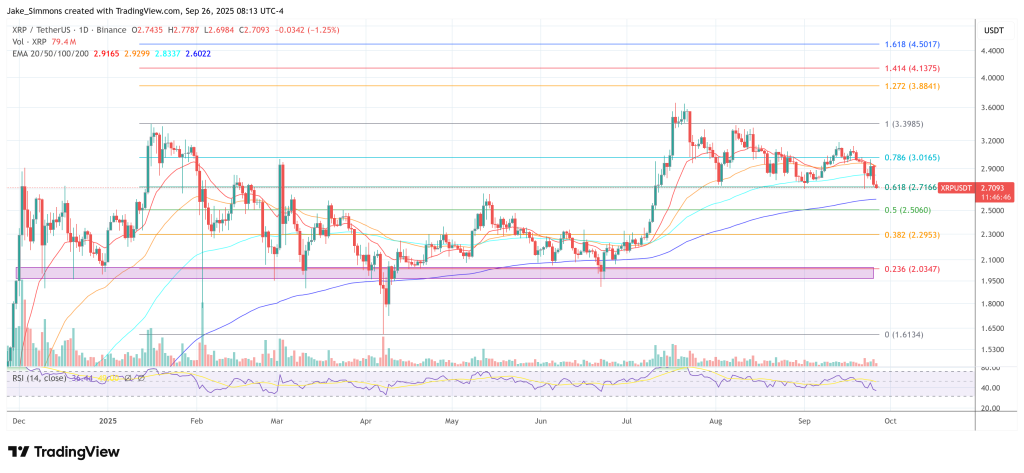
At press time, XRP traded at $2.71.
XRP price
XRP price, 1-day chart | Source: XRPUSDT on TradingView.com
Featured image from YouTube, chart from TradingView.com
Editorial Process for bitcoinist is centered on delivering thoroughly researched, accurate, and unbiased content. We uphold strict sourcing standards, and each page undergoes diligent review by our team of top technology experts and seasoned editors. This process ensures the integrity, relevance, and value of our content for our readers.

Jake Simmons has been a Bitcoin enthusiast since 2016. Ever since he heard about Bitcoin, he has been studying the topic every day and trying to share his knowledge with others. His goal is to contribute to Bitcoin's financial revolution, which will replace the fiat money system. Besides BTC and crypto, Jake studied Business Informatics at a university. After graduation in 2017, he has been working in the blockchain and crypto sector. You can follow Jake on Twitter at @realJakeSimmons.

Leituras Relacionadas

Musk Awaits $50 Trillion: Is There a Limit to the U.S. National Debt and What Comes Next?

Elon Musk reacted to a projection of US national debt reaching $50 trillion by 2030, labeling it a "precise timeline" with a laughing emoji. The debt has recently passed the $40 trillion mark. Skeptics note that specific debt thresholds have been breached before without immediate collapse. However, analysts warn the focus should shift from the nominal debt amount to its affordability. A key metric is when the average interest rate on the debt exceeds the economy's growth rate, a point the US Congressional Budget Office projects for 2031. Once this "debt spiral" begins, interest costs grow self-reinforcing. Currently, interest payments have already surpassed defense spending, exceeding $1 trillion annually. Ray Dalio warns a debt crisis could occur within "three years, plus or minus two," advising portfolio diversification into gold and some Bitcoin. Potential outcomes if debt becomes unmanageable include: 1) Financial repression and monetization (the "Japanese path" of controlled yields and inflation), seen as the most likely; 2) Severe austerity (the "Greek path" of spending cuts/tax hikes), considered politically unlikely; or 3) Technical default/restructuring, which would cause global financial shock. The most probable path is a hybrid of moderate financial repression and gradual inflation, leading not to a sudden crash but to long-term economic stagnation and a declining standard of living. By 2056, debt could reach 175% of GDP. Ultimately, the limit for US debt is not a fixed number but a function of market confidence in the dollar.

cryptonews.ruHá 1h

Musk Awaits $50 Trillion: Is There a Limit to the U.S. National Debt and What Comes Next?

cryptonews.ruHá 1h

Solana Developer Mert Mumtaz Highly Praises Altcoin!

In the world of cryptocurrencies and finance, where privacy is a major focus, significant developments are underway. Valor Group founder Dev and notable crypto ecosystem figure Mert Mumtaz participated in a program on The Rollup crypto broadcasting platform, discussing the latest developments for the Zcash (ZEC) network and its important future roadmap. The conversation covered network scalability, security updates, and measures taken against quantum threats. The recent Ironwood update implemented in the Zcash network is considered a crucial milestone for the project. During the event, Mert highlighted that internal security audits using 'red team' methods and AI identified a potential vulnerability in the Orchard pool that could have allowed the creation of counterfeit notes. Extensive work and formal verification proved the code mathematically perfect according to specifications. The seamless migration of funds from the Orchard pool to the new Ironwood pool has completely eliminated the risk of counterfeit coin creation in the network. Dev shared important technical details about Zcash's future vision, emphasizing that Valor Group's main goal is for Zcash to achieve transaction volumes comparable to credit cards. He stated they aim to process over 50,000 transactions per second with sub-second latency while maintaining the full proof-of-work mechanism. The main scaling bottleneck was identified not as the nodes themselves, but wallet scanning processes. A new wallet architecture and synchronization delay optimization are expected to resolve this issue. The upcoming Tachion update promises to provide complete protection for Zcash against quantum computing threats. This update will integrate recursive zero-knowledge proofs into the network. It is reported to reduce transaction sizes by more than five times, eliminate node data processing overhead, and address state growth issues. With Tachion, the network is claimed to achieve not just 'quantum-resilient' but a truly 'quantum-secure' privacy structure.

cryptonews.ruHá 1h

Solana Developer Mert Mumtaz Highly Praises Altcoin!

cryptonews.ruHá 1h

Trading

Spot
活动图片